Keto, low fat, intermittent fasting, paleo, carnivore, and calorie restriction all produce weight loss through the same underlying mechanism. Understanding what that mechanism is, and why adherence determines outcomes more than diet type, changes how the decision about which diet to follow is made.\
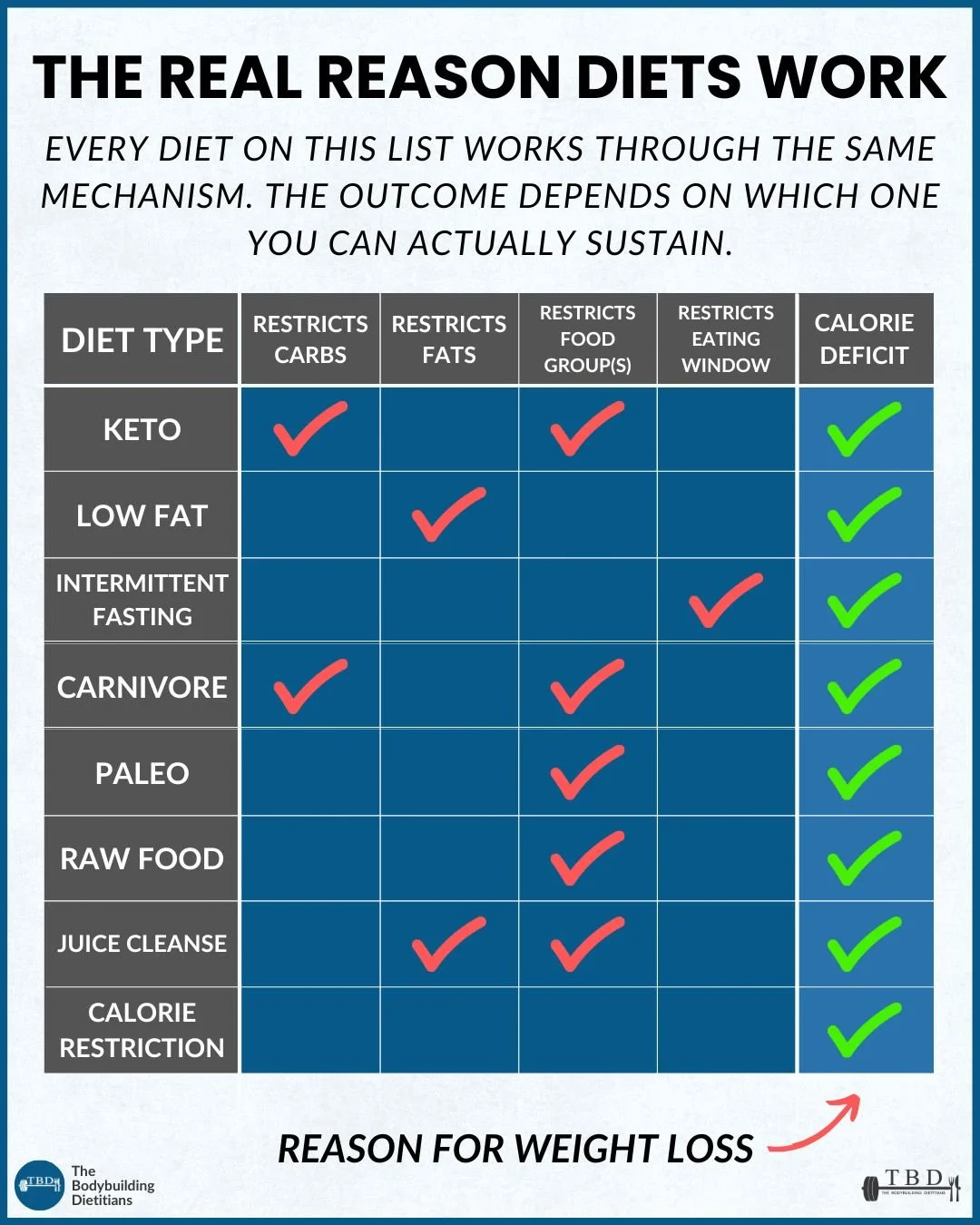
Every popular diet produces weight loss by creating a calorie deficit. The dietary rules that characterise each approach, whether that means restricting carbohydrates, limiting fat, eliminating food groups, or compressing the eating window, are different mechanisms for arriving at the same outcome. Keto restricts carbohydrates and food groups. Low fat restricts fat. Intermittent fasting restricts the eating window. Carnivore and paleo eliminate food groups. Juice cleanses restrict both fat and food groups. All of them, when followed, reduce total energy intake below expenditure. The diet that produces the best result for a given individual is the one that creates a sustainable calorie deficit within that person's food preferences, lifestyle, and long-term behavioural patterns.
The nutrition space produces a remarkable volume of disagreement about which diet is best, which macronutrient causes fat gain, and which approach is most supported by science. Much of that disagreement dissolves when the question is framed more precisely: best for what outcome, for whom, and over what time period?
For the specific outcome of weight loss, the answer to the mechanism question is not contested. Every popular diet, regardless of its rules, its ideology, or the specific foods it includes or excludes, produces weight loss through the same physiological mechanism: a calorie deficit. The dietary rules that define each approach are different vehicles for achieving that deficit. Understanding this changes how rationally someone can evaluate diet options, compare research on different approaches, and decide which structure is most likely to work for their specific situation.
This article is specifically about weight loss mechanisms. Diet choice matters considerably more when the lens shifts to overall health outcomes, specific nutrient needs, disease management, or ethical and personal considerations. Those are separate questions and are not the focus here.
What Is a Calorie Deficit and Why Does It Drive Weight Loss?
A calorie deficit exists when total energy intake falls below total energy expenditure over time. The body, requiring energy to sustain all physiological functions, draws on stored energy reserves to meet the shortfall. Because adipose tissue is the primary storage depot for surplus energy, a sustained calorie deficit results in the progressive mobilisation and oxidation of stored fat, producing the reduction in fat mass that weight loss reflects.
Energy balance is the overarching framework within which all dietary approaches to weight loss operate. Total energy expenditure is determined by basal metabolic rate, the thermic effect of food, and activity-related energy expenditure including structured exercise and NEAT. Total energy intake is determined by the amount of food consumed. When intake consistently falls below that expenditure across days and weeks, weight loss occurs. When intake exceeds it, weight gain occurs. The macronutrient composition of the diet influences hormone levels, satiety, training performance, and body composition within that framework, but it does not override the fundamental energy balance relationship.
The practical implication is that any dietary approach that reliably reduces total calorie intake below total expenditure will produce weight loss, regardless of which specific rules or restrictions it uses to achieve that reduction. The comparison table in the infographic makes this explicit: every diet listed, from keto to juice cleanse to calorie restriction, carries a green tick in the calorie deficit column, while the red ticks, indicating the specific restrictions each diet applies, differ across them.
How Do Different Diets Create a Calorie Deficit?
Each popular diet uses a different structural mechanism to reduce total energy intake.
Keto The ketogenic diet restricts carbohydrate intake to very low levels, typically below 20 to 50 grams per day, which eliminates or severely limits most grains, legumes, fruit, starchy vegetables, and many dairy products. This simultaneously restricts both a macronutrient and several entire food groups. The practical effect is a reduction in the range of foods that can be eaten, which tends to reduce total intake below what it would otherwise be. The metabolic state of ketosis, in which the body shifts to fat as its primary fuel source, is a consequence of very low carbohydrate availability rather than a driver of fat loss independent of energy balance.
Low fat Low-fat dietary approaches restrict dietary fat, which at 9 calories per gram is the most energy-dense macronutrient. Reducing fat intake reduces the caloric density of the diet, which allows a higher food volume to be consumed at the same calorie level and produces a calorie deficit when intake falls below expenditure. Low-fat dietary advice was dominant in nutritional guidelines for several decades and has been largely supplanted by more nuanced guidance, but the weight loss mechanism remains the same: lower fat intake, lower total calorie intake, calorie deficit.
Intermittent fasting Intermittent fasting restricts the hours during which food is consumed rather than the types of food consumed. By compressing the eating window, typically to eight hours in the case of the 16:8 protocol, the number of hours available for calorie intake is reduced. For most individuals, this structural reduction in the eating window produces a reduction in total daily calorie intake relative to an unrestricted eating pattern. The research comparing intermittent fasting to continuous calorie restriction with matched intake consistently shows comparable weight loss outcomes, which supports the conclusion that the eating window restriction is producing its effects through calorie reduction rather than through a unique metabolic mechanism.
Carnivore and paleo Both carnivore and paleo diets restrict food groups, eliminating processed foods, grains, legumes, and in the case of carnivore, all plant foods. By significantly narrowing the range of acceptable foods, these approaches reduce dietary variety, which tends to reduce total intake through a mechanism called sensory-specific satiety: a more monotonous diet produces a faster decline in appetite for the foods being eaten. The calorie deficit produced by food group elimination explains the weight loss observed in individuals following these approaches, rather than any unique metabolic effect of the specific foods included or excluded.
Raw food and juice cleanse Raw food diets restrict food to unprocessed, uncooked plant foods, and juice cleanses replace solid food with liquid calories derived from fruit and vegetable juices. Both approaches dramatically limit the range of foods available and, in the case of juice cleanses, reduce total calorie intake substantially, often to levels well below maintenance. The weight loss produced is a direct consequence of that caloric restriction, along with the loss of glycogen-bound water and gastrointestinal contents that accompanies any abrupt reduction in food volume.
Calorie restriction Direct calorie restriction, which involves tracking and managing total energy intake without imposing specific rules about macronutrient ratios or food groups, achieves the same calorie deficit through explicit management rather than structural restriction. It is the most mechanistically direct approach and the one that, in research comparing dietary interventions under controlled conditions, tends to perform as well as or better than alternatives when adherence is matched. Its limitation in practice is that the absence of structural rules means the burden of deficit creation falls more explicitly on conscious monitoring, which requires a skill set that not everyone finds accessible.
Why Does Adherence Determine Outcomes More Than Diet Type?
The research comparing dietary approaches is remarkably consistent on one point: when calorie intake is matched between groups, the differences in weight loss outcomes between diet types are small and often negligible. The differences that appear in real-world comparisons between diets are driven predominantly by differences in adherence rather than differences in mechanism.
A ketogenic diet followed consistently produces a calorie deficit and weight loss. The same diet followed intermittently, or abandoned after two months because carbohydrate restriction is incompatible with a person's food preferences and social eating patterns, produces less total weight loss than a moderate calorie deficit from a more flexible dietary approach that is sustained for six months. The structure of the diet matters less than whether the person can sustain it for long enough to accumulate meaningful fat loss.
This framing has a practical implication that is often underappreciated: the quality of a dietary approach is not primarily a property of the diet itself, but of the match between the diet's structure and the individual's food preferences, lifestyle, cooking habits, social context, and tolerance for dietary restraint. A highly restrictive diet that produces excellent adherence for a particular person is, for that person, a better dietary approach than a more evidence-friendly flexible diet that they consistently struggle to maintain. The theoretical best diet is the one they can actually follow.
The difficulty most dietary approaches create is real, and worth naming clearly. Eliminating food groups, avoiding entire macronutrients, or compressing the eating window are approaches that work until they do not. Adherence tends to be the limiting factor well before the goal is reached, not because the approach was physiologically ineffective, but because the restriction imposed was behaviorally unsustainable for that individual. Weight loss that cannot be maintained does not produce lasting body composition change, and the risk of cycling through restrictive approaches without sustaining any of them is that the net result over years is neither consistent progress nor a stable dietary pattern.
A randomised controlled trial by Gardner et al. comparing four popular dietary approaches found no significant difference in weight loss between low-carbohydrate and low-fat diets at twelve months when controlling for macronutrient differences, and concluded that dietary adherence was the primary determinant of outcomes across all groups studied.
Source: Gardner et al., 2007, JAMA.
What Is the Most Direct Approach to Creating a Calorie Deficit?
Understanding total energy requirements and managing intake to sit below them, without imposing macronutrient restrictions or food group eliminations beyond what is necessary, is the most structurally direct approach to creating a calorie deficit. It does not require eliminating carbohydrates to work, and it does not require fat restriction or a compressed eating window. The deficit is created through explicit management of total intake rather than through structural rules that achieve the deficit indirectly.
This approach is not inherently easier than the alternatives. Managing calorie intake directly requires tracking, some degree of nutritional literacy, and sustained conscious attention to food choices. For individuals who find that cognitively demanding or incompatible with their lifestyle, the structural simplicity of a rule-based approach, even a restrictive one, can produce better real-world adherence than the more flexible option. The approach that fits a person's actual life is preferable to the approach that is theoretically optimal on paper.
What direct calorie management does offer is that the difficulty is placed in the right location. The challenge of a sustainable fat loss phase should be the calorie deficit itself, the hunger, the patience, and the sustained adherence over time, rather than the arbitrary food group restrictions that are layered on top of it. Removing unnecessary restriction does not remove the difficulty of dieting, but it does mean the difficulty comes from the thing that actually drives fat loss rather than from rules that serve as an indirect proxy for it.
Structuring that approach around someone's actual food preferences, cooking habits, and lifestyle is a meaningful part of what fat loss coaching involves, and the reason why a generic diet plan applied without individual calibration tends to underperform relative to one that reflects how a person actually eats and lives. How that structure is built and adjusted across a fat loss phase is something we work through in detail with our coaching clients.
What Does This Mean for Comparing Popular Diets?
The mechanism-based view of how diets work changes how popular diet comparisons are interpreted. When a study reports that a ketogenic diet produces superior weight loss at six months compared to a low-fat diet, the relevant question is not whether carbohydrate restriction is metabolically superior to fat restriction, but whether the carbohydrate-restricted group maintained a larger calorie deficit across the study period. When the answer is yes, the finding reflects adherence or calorie differential rather than a unique metabolic effect of ketosis.
This does not mean all diets are identical in their broader effects. Dietary composition affects satiety, gut microbiome diversity, training performance, hormonal health, cardiovascular risk markers, and long-term disease risk in ways that calorie balance alone does not capture. A diet that produces a calorie deficit while also providing adequate protein, fibre, micronutrients, and food diversity is meaningfully different from one that produces the same calorie deficit through juice alone, even if the short-term weight loss outcome is similar.
The practical takeaway for someone choosing between dietary approaches is to ask a different set of questions than which diet is scientifically superior. The more useful questions are: which of these can I follow consistently for the duration required? Which fits my food preferences and lifestyle? Which allows me to meet protein and fibre targets adequately? And which is least likely to create the kind of restriction-reactivity cycle that produces short-term results followed by prolonged periods of unstructured eating? The answers to those questions, rather than the research ranking of diet types, are what determine real-world outcomes.
Practical Takeaways
Every popular diet, including keto, low fat, intermittent fasting, paleo, carnivore, and calorie restriction, produces weight loss through the same mechanism: a calorie deficit.
The dietary rules that characterise each approach, whether carbohydrate restriction, fat restriction, food group elimination, or a compressed eating window, are different vehicles for achieving the same outcome. They differ in structure, not in the fundamental mechanism through which fat loss occurs.
When calorie intake is matched between different dietary approaches in research, the differences in weight loss outcomes are small. The differences observed in real-world comparisons are driven primarily by differences in adherence.
The diet that produces the best outcome for a given individual is the one that creates a sustainable calorie deficit within their food preferences, lifestyle, and behavioural patterns, not the one that ranks highest in a theoretical comparison of diet types.
Most restrictive dietary approaches work until they stop working. Adherence tends to be the limiting factor well before the weight loss goal is reached, and weight loss that cannot be sustained does not produce lasting body composition change.
Direct calorie management, which involves understanding total energy requirements and managing intake below them without unnecessary restriction, is the most structurally direct approach. It places the difficulty in the right place: the calorie deficit itself rather than the arbitrary rules that produce it indirectly.
Diet choice matters considerably more for overall health, specific nutrient needs, and long-term disease risk than it does for the mechanism of weight loss specifically. These are separate questions that require separate analysis.
Frequently Asked Questions
Do all diets work by creating a calorie deficit?
Yes, in the context of weight loss. Every dietary approach that produces weight loss does so because it reduces total calorie intake below total energy expenditure over time. The specific rules of the diet, whether that means restricting carbohydrates, limiting fat, eliminating food groups, or compressing the eating window, are the structural mechanisms by which that deficit is created. The calorie deficit is the common and necessary condition; the dietary rules are the vehicle.
Is keto better than calorie counting for weight loss?
Research comparing keto to other dietary approaches generally shows that differences in weight loss outcomes between groups are explained by differences in calorie intake rather than by unique metabolic effects of ketosis. When calorie intake is matched, outcomes are broadly comparable. Keto may be easier for some individuals to follow because eliminating carbohydrates provides a clear and simple rule that reduces food choice decisions, which can support adherence. For others, the restriction of carbohydrates is incompatible with food preferences and social eating, reducing adherence compared to a more flexible approach. The better diet is the one a given person can actually sustain.
Does intermittent fasting work differently from regular calorie restriction?
Research comparing intermittent fasting to continuous calorie restriction with matched total intake consistently shows comparable weight loss outcomes between the two approaches. Intermittent fasting produces a calorie deficit by reducing the hours in which food can be consumed, which tends to reduce total daily intake for most individuals. It does not appear to produce a unique metabolic advantage beyond the calorie deficit it creates. For individuals who find it easier to skip meals at specific times than to consciously monitor total intake throughout the day, it may be a more adherent approach, which is the relevant practical distinction.
Can you lose weight on any diet as long as you are in a calorie deficit?
Yes. Any dietary approach that produces and sustains a calorie deficit will produce weight loss. The specific foods consumed within that deficit influence body composition outcomes, training performance, satiety, health markers, and nutritional adequacy, but they do not override the energy balance relationship. A diet that is nutritionally adequate, preserves lean mass through adequate protein, manages hunger through appropriate fibre and food volume, and fits the individual's lifestyle will produce better body composition outcomes than one that achieves the same calorie deficit through severe restriction with inadequate protein or food group elimination.
Why do people say carbs cause weight gain if that is not the full picture?
The observation that reducing carbohydrate intake tends to produce rapid early weight loss is real, but the mechanism is primarily water loss rather than accelerated fat loss. Glycogen is stored with approximately three to four grams of water per gram of glycogen, so reducing carbohydrate intake reduces glycogen stores and the water bound to them, producing a rapid and noticeable reduction in scale weight that is not representative of fat loss. This effect is reversible when carbohydrate intake is restored. The longer-term fat loss produced by low-carbohydrate diets reflects the calorie deficit those diets create rather than any unique effect of carbohydrate reduction on fat metabolism.
Is calorie restriction the healthiest way to lose weight?
Calorie restriction is the most mechanistically direct approach to creating a calorie deficit for weight loss, but the healthiest approach is one that creates that deficit within a dietary pattern that is nutritionally adequate, sustains training performance, supports gut health and microbiome diversity, manages hunger effectively, and is compatible with long-term adherence. The dietary composition within the calorie deficit matters considerably for overall health outcomes, even when it has a more modest effect on weight loss outcomes specifically. A calorie deficit achieved through adequate protein, fibre, and food diversity is preferable to the same deficit achieved through severe restriction or food group elimination.
Structuring a fat loss approach around your actual food preferences, training demands, and lifestyle, rather than applying a generic dietary framework, is what makes the difference between short-term results and sustained progress. If you want support building that structure, you can enquire about coaching or book a consultation to get started.