Four ways to achieve the same weekly deficit, structured around your lifestyle and training. The best approach is the one you can sustain consistently, not the one that looks most precise on paper.
A calorie deficit only works if it is maintained consistently over time, but how that deficit is distributed across the week is more flexible than most people realise. Four common approaches (consistent daily intake, higher weekend intake, variable intake, and training day bias) can all produce the same weekly energy balance while feeling very different to follow in practice. Choosing the structure that best fits your lifestyle, training schedule, and preferences is often what determines whether a fat loss phase feels manageable or becomes a source of daily friction.
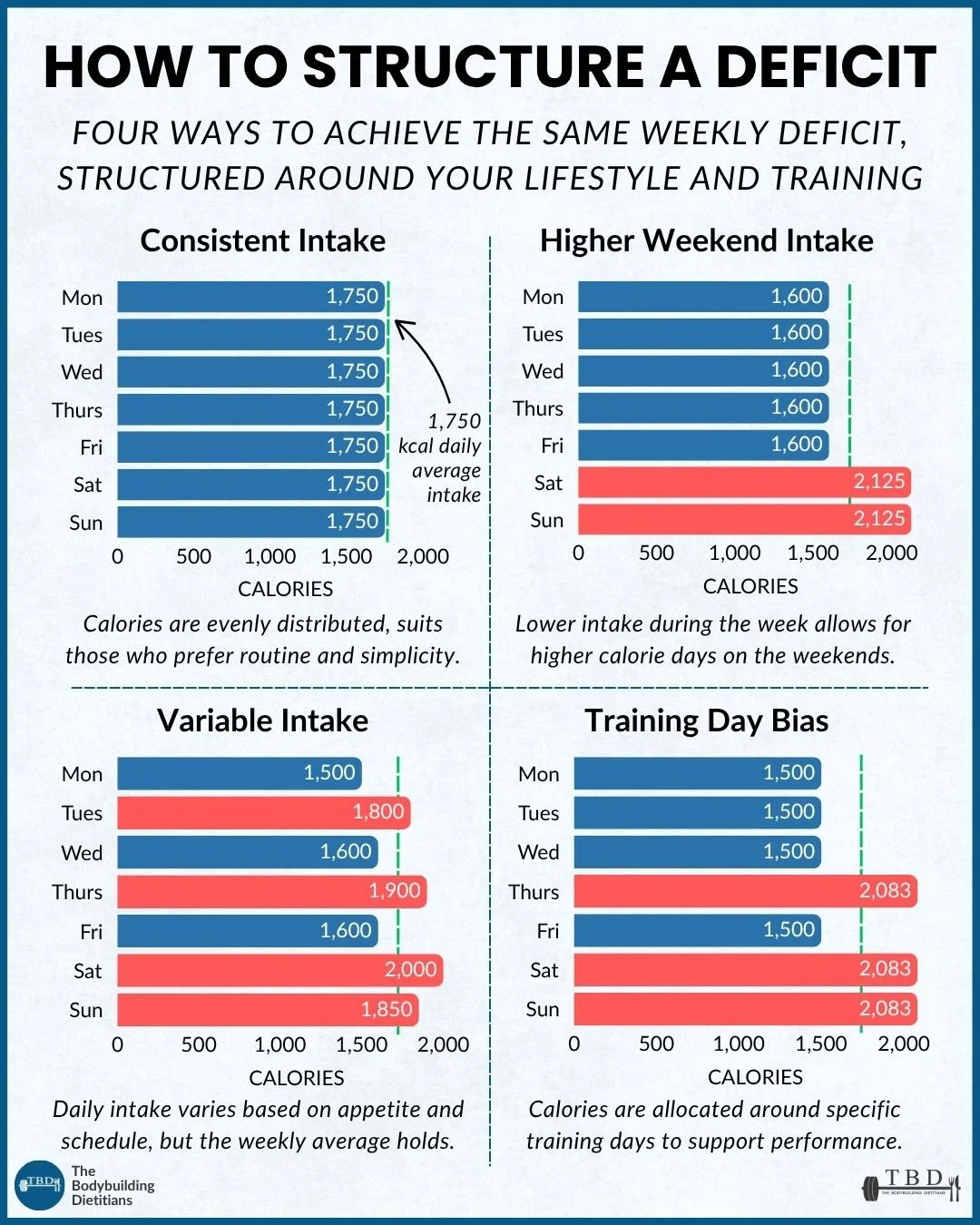
Four approaches to structuring a calorie deficit across the week, all producing the same weekly energy balance of 1,750 kilocalories per day on average. The best structure is the one that fits your lifestyle and training.
The best calorie deficit is the one you can actually stick to. This sounds simple, but it is the single most important principle in fat loss that people consistently underestimate. The physiology of energy balance is well understood: a sustained deficit leads to fat loss over time. What determines whether someone achieves that sustained deficit, however, is less about the numbers and more about how those numbers fit into the reality of their daily life.
A deficit only works if it is maintained consistently over weeks and months. How that deficit is distributed across any given week, however, is far more flexible than most people realise, and getting the structure right is often what separates a plan that feels manageable from one that creates friction at every turn.
The infographic above shows four approaches that all achieve the same weekly average of 1,750 kilocalories per day. The total weekly energy intake is identical in every case: 12,250 kilocalories. What changes is how those calories are allocated across the seven days, with each structure suited to a different lifestyle, training schedule, and set of personal preferences. The sections below explain how each one works, who it suits best, and how to decide which approach fits your situation.
A calorie deficit occurs when total energy intake falls below total energy expenditure over a given period, forcing the body to draw on stored energy (primarily body fat) to meet its remaining needs. The rate of fat loss is determined by the size and consistency of this deficit over time.
Why Does Weekly Energy Balance Matter More Than Daily?
The body does not reset its energy balance at midnight. Fat loss is driven by cumulative energy balance over days, weeks, and months rather than by what happens on any single day.
This is a genuinely important concept that changes how most people should think about structuring their nutrition during a fat loss phase. If your target is 1,750 kilocalories per day and you eat 1,500 on Monday and 2,000 on Tuesday, you have not "failed" on Tuesday. Your two-day average is still 1,750, and the weekly trajectory is exactly where it needs to be.
Energy balance refers to the relationship between energy intake (calories consumed) and energy expenditure (calories used through basal metabolic rate, the thermic effect of food, physical activity, and non-exercise activity thermogenesis). When intake is consistently below expenditure, the body is in a negative energy balance, which drives fat loss over time.
Understanding this principle is what unlocks the flexibility that makes a deficit sustainable. Rather than treating each day as a pass or fail, thinking in terms of weekly averages allows you to structure your intake around the realities of your life: social commitments, training schedules, fluctuations in appetite, and the natural variation in how each day unfolds. The four approaches covered below are all built on this principle, and they all work precisely because the weekly total is held consistent while the daily distribution is allowed to flex.
Research on energy balance and body composition change supports the view that cumulative energy balance over time, rather than precise daily intake, drives fat loss outcomes. Studies comparing continuous and intermittent energy restriction approaches have found comparable fat loss outcomes when total weekly energy deficits are matched, suggesting that the distribution of intake across the week is less important than the overall weekly balance.
Source: Byrne et al., 2018, International Journal of Obesity.
What Does a Consistent Daily Intake Look Like?
A consistent daily intake is the simplest structure: the same calorie target every day, with no variation between weekdays and weekends or between training and rest days.
In the example shown in the infographic, this means consuming 1,750 kilocalories every day of the week. The daily target and the weekly average are the same number, which makes the approach straightforward to plan, track, and follow.
This structure suits people who thrive on routine and simplicity. If you prefer eating the same meals each day, if your schedule is relatively consistent, and if you do not find rigid daily targets psychologically difficult, then a flat daily intake is an excellent starting point. It removes the need to think about which day gets more or fewer calories, which eliminates one layer of decision-making from the process.
The potential limitation is that it does not account for the natural variation in how most people actually live. Weekends often involve social meals, eating out, or a less structured routine. Training days may create more hunger or a greater need for fuel than rest days. For some people, holding a fixed number every day works well. For others, the rigidity creates friction on the days where life does not conform to the plan, which can lead to the kind of all-or-nothing thinking ("I went over today, so the day is ruined") that undermines long-term adherence.
If a consistent daily intake feels comfortable and sustainable, there is no reason to add complexity. Simplicity has real value, and many people achieve excellent results with this structure across an entire fat loss phase. The other three approaches exist for people who need the flexibility, not because they are inherently superior.
How Does a Higher Weekend Intake Work?
A higher weekend intake structure allocates fewer calories to weekdays and more to weekends, while maintaining the same weekly average.
In the example shown, this means consuming 1,600 kilocalories Monday to Friday and 2,125 kilocalories on Saturday and Sunday. The weekly total remains 12,250 kilocalories, identical to the consistent approach, but the distribution creates noticeably more room on the two days where social eating, dining out, and less structured routines are most likely to occur.
This is one of the most practically useful structures for people who find weekdays manageable but struggle to maintain the same level of control on weekends. It is also a genuinely honest approach, because it works with the reality of how most people eat rather than pretending that Saturday should look the same as Tuesday. The slight reduction during the week (150 kilocalories per day below the average in this example) is usually easy to absorb, and the payoff of an extra 375 kilocalories on each weekend day can make a meaningful difference to how a social meal or a more relaxed day feels within the plan.
In coaching settings, this structure tends to work particularly well for people who eat out regularly on weekends, have family meals that are harder to control precisely, or simply find that their appetite is higher on less structured days. The weekday consistency provides a stable baseline, and the weekend flexibility reduces the likelihood of significant overshoot on the days that are hardest to manage.
A common refinement is to adjust the weekday-to-weekend ratio depending on how social the upcoming week looks. If a particular weekend involves a dinner out or a social event, the weekday allocation can be reduced slightly further to create additional room. If the weekend is quiet, the distribution can shift back toward something closer to consistent. This kind of adaptive flexibility is part of what makes a deficit sustainable over 12 to 20 weeks rather than just two or three.
What Is Variable Intake and Who Does It Suit?
A variable intake approach allows daily calories to fluctuate throughout the week based on appetite, schedule, and circumstances, with the weekly average serving as the anchor.
In the example shown, daily intake ranges from 1,500 to 2,000 kilocalories across the week, with no fixed pattern to which days are higher or lower. The weekly total remains 12,250 kilocalories, but the daily numbers shift based on how each day actually unfolds rather than following a predetermined plan.
This structure suits people who have irregular schedules, variable appetites, or a preference for responding to how their body feels on any given day rather than adhering to a fixed target. It requires more nutritional awareness than the other approaches because the individual needs to maintain a running sense of where their weekly total sits in order to make informed decisions about the remaining days. Without that awareness, variable intake can easily drift into inconsistency rather than productive flexibility.
Adaptive thermogenesis refers to the body's tendency to reduce energy expenditure in response to sustained energy restriction, through mechanisms including reduced non-exercise activity, decreased thermic effect of food, and hormonal adjustments. While variable intake does not prevent adaptive thermogenesis, the flexibility it provides can support adherence during the phases when these adaptations make a fixed daily target feel increasingly difficult to sustain.
In practice, this approach tends to work best for people who have previously tracked their intake and developed a reliable sense of what different calorie levels look and feel like across a day. For someone new to structured nutrition, the lack of a fixed daily target can make it harder to stay on track. For someone with experience, the flexibility can make the deficit feel far less restrictive because no single day feels locked in.
A practical way to implement variable intake is to set a minimum daily floor (below which intake should not drop, to protect training performance and avoid excessive restriction on any single day) and a maximum daily ceiling, then allow intake to move freely within that range while monitoring the weekly average. For the example shown, a floor of 1,500 and a ceiling of 2,000, with a target weekly average of 1,750, provides enough structure to prevent significant overshoot or undershoot while preserving genuine daily flexibility.
How Does Training Day Bias Work?
A training day bias allocates more calories to training days and fewer to rest days, directing fuel toward the sessions where it has the greatest impact on performance and recovery.
In the example shown, rest days (four per week) are set at 1,500 kilocalories and training days (three per week) at 2,083 kilocalories. The weekly total remains 12,250 kilocalories, but the distribution means that training days receive significantly more fuel, primarily in the form of additional carbohydrate, to support session quality and post-training recovery.
Nutrient timing refers to the deliberate manipulation of when specific nutrients (particularly carbohydrate and protein) are consumed relative to training, with the goal of optimising performance, recovery, and body composition outcomes. While the overall daily and weekly intake is the primary driver of results, strategic allocation of carbohydrate around training can support training intensity and glycogen replenishment.
This structure is most relevant for athletes and serious lifters whose training quality is a high priority, particularly during a deficit where overall fuel availability is reduced. Higher-intensity resistance training and demanding sessions benefit from adequate carbohydrate availability, and directing a larger proportion of the day's calories (and carbohydrates specifically) toward these days can help preserve training performance that might otherwise decline as the deficit progresses.
Research on carbohydrate periodisation suggests that aligning higher carbohydrate intake with training days can support training intensity and glycogen replenishment without compromising fat loss outcomes, provided the overall weekly energy balance remains in a deficit. While the evidence for performance benefits of day-to-day calorie cycling is not as strong as for overall energy and macronutrient adequacy, practical observations in coaching settings consistently suggest that athletes report better session quality and recovery when training days are fuelled more generously.
Source: Impey et al., 2018, Sports Medicine.
The trade-off is that rest days feel more restricted. At 1,500 kilocalories in this example, rest days are 250 kilocalories below the weekly average, which may increase hunger or reduce dietary flexibility on those days. For people who are active on rest days (walking, recreational activities, household tasks), this lower intake can feel noticeable. The approach works best when the athlete genuinely values the performance benefit on training days enough to accept the tighter rest day allocation.
In coaching settings, a training day bias is often combined with elements of the higher weekend approach when training falls on weekends, or adjusted so that the most demanding sessions (such as a heavy lower body day) receive the highest calorie allocation while lighter sessions receive something closer to the average. This kind of fine-tuning is part of how our coaching individualises nutrition programming to match each athlete's training structure, schedule, and phase.
How Do You Choose the Right Structure for You?
The best structure is the one that fits your lifestyle well enough to sustain over the full duration of your fat loss phase, which typically spans 12 to 20 weeks or longer.
Choosing the right approach starts with an honest assessment of where your adherence tends to break down. If weekends are consistently the hardest days, a higher weekend intake structure directly addresses that. If your appetite varies significantly from day to day and you find fixed targets frustrating, a variable approach may feel more natural. If training performance is a priority and you are comfortable with tighter rest days, a training day bias allows you to fuel your sessions without increasing the weekly total. If none of these apply and you simply prefer simplicity, a consistent daily intake is the right starting point.
It is also worth recognising that these approaches are not mutually exclusive, and most people end up using elements of more than one across a fat loss phase. An athlete might begin with a consistent daily intake to establish the deficit, shift to a higher weekend structure as social commitments increase, and then move toward a training day bias during the final weeks of a prep when session quality becomes critical. The structure can and should evolve as the phase progresses and as the individual's needs change.
The principle that holds everything together is weekly consistency. Whichever structure you choose, the weekly average needs to remain within a range that produces the intended rate of fat loss. If the weekly total drifts consistently above the target, the deficit is not being maintained regardless of how elegant the daily distribution looks on paper. Conversely, if the weekly total is consistently on target, the specific daily distribution is doing its job even if individual days vary significantly.
What Happens When You Go Over on a Single Day?
A single day above your target does not erase the deficit. What matters is how you respond to it and whether the weekly average stays on track.
One of the most common psychological traps during a fat loss phase is treating a day where intake exceeds the target as a failure. This "all-or-nothing" thinking often leads to one of two responses: either abandoning the plan for the remainder of the day ("the day is already ruined, so I might as well eat freely") or over-restricting the following day to compensate. Neither response is productive, and both tend to create a pattern of inconsistency that undermines the overall deficit.
A more useful response is to simply note what happened, understand why (was it a social event, increased hunger, poor planning, or something else?), and return to the plan the following day. If the overshoot was significant, a small, distributed adjustment across the remaining days of the week (reducing intake by 100 to 200 kilocalories per day for two or three days, for example) can bring the weekly average back on target without creating the kind of sharp restriction that often triggers further overeating.
This is where the weekly average framework becomes particularly powerful. It provides a mechanism for absorbing the normal variation that occurs across any week of real life without interpreting that variation as failure. Over the course of a 16-week fat loss phase, the person who averages 1,750 kilocalories per week with daily variation between 1,500 and 2,100 will achieve virtually the same outcome as the person who hits 1,750 every single day. The difference is that the first person likely found the process considerably less stressful.
In coaching settings, helping athletes develop this kind of flexible, week-level perspective is one of the most impactful changes that can be made early in a fat loss phase. It shifts the relationship with the deficit from one of rigid daily compliance to one of adaptive weekly management, which is far more sustainable over the timeframes that meaningful fat loss requires.
Does the Rate of Fat Loss Change With Different Structures?
The rate of fat loss is determined by the weekly energy deficit, not by how calories are distributed across individual days, provided total weekly intake remains consistent.
This is worth stating clearly because there are persistent claims in fitness media that specific calorie distribution patterns (such as calorie cycling or training day bias) can enhance fat loss beyond what the overall deficit would predict. The evidence does not support this. When weekly energy intake and expenditure are matched, the distribution of calories across days does not meaningfully alter the rate of fat loss or the ratio of fat to lean mass lost.
What the distribution can influence is how the deficit feels, which in turn affects adherence, which in turn affects whether the deficit is actually maintained. This indirect pathway is the real mechanism through which choosing the right structure improves outcomes. A person who chooses a structure that fits their life sustains the deficit more consistently, experiences less psychological friction, and is less likely to abandon the plan or engage in compensatory overeating. Over 12 to 20 weeks, these behavioural advantages compound into meaningful differences in outcomes, not because the structure itself is metabolically superior, but because it is more adherable.
Non-exercise activity thermogenesis (NEAT) refers to the energy expended through all physical activity that is not structured exercise, including walking, fidgeting, household tasks, and occupational movement. NEAT can decrease significantly during prolonged energy restriction, partly as a physiological adaptation and partly as a behavioural response to reduced energy availability. Choosing a deficit structure that supports overall energy and mood may help attenuate NEAT reductions, though this relationship is not yet well quantified in research.
Practical Takeaways
A calorie deficit works through weekly energy balance, not daily perfection. The body does not reset at midnight, and weekly consistency matters far more than hitting the same number every day.
Four common structures (consistent daily intake, higher weekend intake, variable intake, and training day bias) can all produce the same weekly deficit while fitting very different lifestyles and schedules.
The best structure is the one you can sustain reliably over the full duration of your fat loss phase. Choose based on where your adherence typically breaks down, not based on which approach looks most optimal on paper.
A single day above target does not erase the deficit. Return to the plan the following day and, if needed, make small distributed adjustments across the remaining days to bring the weekly average back on track.
These structures are not mutually exclusive. Most people benefit from using elements of more than one approach across a fat loss phase as their needs, schedule, and training demands evolve.
The rate of fat loss is determined by the weekly deficit, not the daily distribution. Choosing the right structure improves outcomes indirectly by supporting adherence and reducing psychological friction.
Frequently Asked Questions
Do you have to eat the same calories every day to lose fat?
No. Fat loss is driven by cumulative energy balance over time, not by hitting an identical number each day. As long as the weekly average calorie intake creates a consistent deficit relative to expenditure, the specific daily distribution is flexible. Eating more on some days and less on others is a practical approach that can improve adherence and sustainability without affecting the rate of fat loss.
Should you eat more on training days during a deficit?
Eating more on training days can help support session quality and recovery by providing additional carbohydrate when it is most useful. This approach (training day bias) works by reducing intake on rest days to keep the weekly average in a deficit while directing more fuel toward the days that benefit from it. It is not necessary for everyone, but it tends to suit athletes who prioritise training performance and are comfortable with tighter rest days.
How many calories should you eat on a rest day?
Rest day calorie intake depends on the overall deficit structure being used. If following a consistent daily approach, rest day intake is the same as any other day. If using a training day bias, rest day intake is typically set below the weekly average (by 150 to 250 kilocalories, for example) to create room for higher intake on training days. The weekly total should remain consistent regardless of how individual days are allocated.
What should you do if you go over your calorie target?
A single day above target does not erase the weekly deficit. The most productive response is to return to the plan the following day without over-restricting. If the overshoot was significant, a small distributed reduction across two to three of the remaining days (100 to 200 kilocalories per day) can bring the weekly average back on track without creating the sharp restriction that often triggers further overeating.
Is calorie cycling better for fat loss?
Calorie cycling (varying daily intake across the week while maintaining a consistent weekly average) does not produce faster fat loss than a fixed daily intake when the weekly deficit is the same. Its value lies in improving adherence and flexibility rather than in any metabolic advantage. For people who find a fixed daily target difficult to sustain, calorie cycling provides a structured way to accommodate variation in appetite, social eating, and training demands without compromising the overall deficit.
How long should a fat loss phase last?
A structured fat loss phase typically spans 12 to 20 weeks, depending on the amount of fat to be lost and the rate at which it can be safely reduced while preserving lean mass. Longer, more moderate deficits (a rate of loss around 0.5 to 1.0 per cent of bodyweight per week) tend to produce better outcomes for muscle retention, performance maintenance, and psychological sustainability compared to shorter, more aggressive approaches. The phase length should also account for a planned transition back to maintenance or a slight surplus after the deficit concludes.
If you would like help designing a deficit structure around your lifestyle, training schedule, and goals, our team of qualified dietitians can build a plan that fits your context.