Tracking macros is a tool, not a requirement. A practical guide to deciding when macro tracking adds value, when it becomes counterproductive, and how to find the right approach for your goals, experience, and relationship with food.
Macro tracking is most valuable during time-sensitive physique goals such as fat loss phases or contest preparation, where precision improves outcomes and removes guesswork. It is also useful as a short-term learning tool for building nutritional awareness and identifying blind spots. However, it is not necessary for everyone, and for some people it can become counterproductive if it creates anxiety, disrupts their relationship with food, or shifts from a tool into a dependency. The goal for most people is to use tracking to build the skill of intuitive portion and macro estimation, then transition to a more flexible approach as confidence and experience develop.
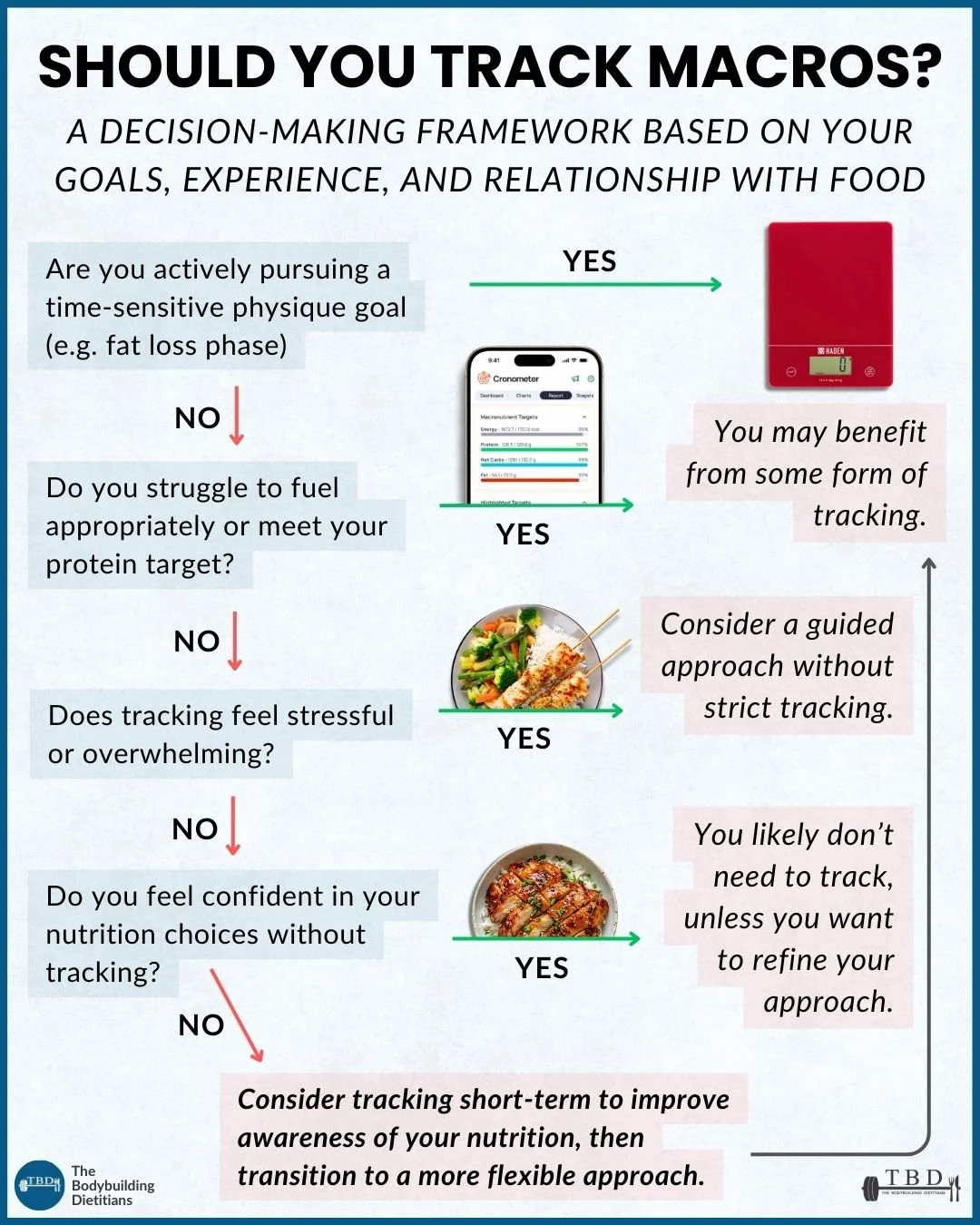
A practical decision-making framework for determining whether macro tracking suits your current goals, experience level, and relationship with food.
Tracking macros is not a requirement for achieving a strong physique outcome. It is a tool, and like any tool, its value depends on the context in which it is used.
A useful comparison is protein powder. You do not need a shake to hit your protein target, but it can make things easier and more consistent in certain situations. Macro tracking works in a similar way. It can improve precision, build awareness, and provide structure during phases where accuracy matters, but it is not something most people need to rely on indefinitely. The question is not whether tracking is good or bad in absolute terms, but whether it is the right tool for your current situation.
The flowchart above provides a practical framework for making that decision based on four key considerations: whether you have a time-sensitive physique goal, whether you are meeting your nutritional targets without tracking, whether tracking creates stress or psychological friction, and whether you have enough nutritional awareness to make confident decisions without it. The sections below expand on each of these and explore the broader question of how tracking fits into a long-term approach to nutrition.
When Is Macro Tracking Most Valuable?
Tracking tends to be most valuable during periods with a specific, time-sensitive goal where nutritional precision directly influences the outcome.
The clearest example is a structured fat loss phase. When the margin between an effective calorie deficit and an insufficient one can be as small as a few hundred kilocalories per day, the precision that tracking provides removes guesswork and ensures the plan is being executed as intended. Without some form of measurement, it is remarkably easy to underestimate intake (particularly from cooking oils, sauces, snacks, and incidental calories) or to overestimate protein consumption, both of which can stall progress without an obvious explanation.
Macronutrient tracking (commonly referred to as "tracking macros") involves measuring and recording the grams of protein, carbohydrate, and fat consumed each day, typically using a digital food diary or app such as Cronometer, MyFitnessPal, or MacroFactor. The purpose is to ensure that actual intake aligns with prescribed targets.
Contest preparation is another context where tracking adds clear value. The precision required during the later stages of prep, where small adjustments to carbohydrate, fat, or sodium intake can influence conditioning and stage presentation, makes some form of detailed tracking almost essential. For most competitive athletes, the question is not whether to track during prep but how to manage the transition away from tracking once the competition is over.
Tracking is also useful as a learning tool for anyone who is relatively new to structured nutrition. Even a short period of consistent tracking (four to eight weeks, for example) can reveal patterns and blind spots that are difficult to identify through estimation alone. Common discoveries include realising that protein intake was lower than assumed, that certain meals contribute far more fat than expected, or that total calorie intake on weekends is significantly higher than during the week. These insights are valuable precisely because they persist after the tracking stops.
This kind of structured nutritional education is one of the foundations of how our coaching works, using periods of tracking to build the awareness and skills that ultimately support more flexible, sustainable eating over time.
When Does Macro Tracking Become Counterproductive?
Tracking becomes counterproductive when it shifts from a tool that supports your goals into a source of anxiety, rigidity, or disordered behaviour around food.
This is an important distinction, and it is one that the fitness industry does not always handle well. For some people, macro tracking provides a sense of control and clarity that they find genuinely helpful. For others, the same process creates a relationship with food that is characterised by stress, guilt when targets are missed, and an inability to eat comfortably in situations where tracking is not possible.
The signs that tracking has moved from helpful to harmful vary between individuals, but some common patterns include: feeling anxious or distressed about eating a meal that has not been weighed and logged; avoiding social situations, restaurants, or travel because of the difficulty of tracking accurately; spending a disproportionate amount of time and mental energy planning, logging, and adjusting food intake; feeling guilty or like the day is "ruined" after exceeding a macro target; and an inability to eat intuitively even in situations where precision is not necessary or beneficial.
None of these responses are inevitable consequences of tracking. Many people track their intake for extended periods without any negative psychological effects. The point is that tracking is not psychologically neutral for everyone, and recognising when it has become a source of stress rather than a source of clarity is an important part of managing it well.
Research into the psychological effects of dietary self-monitoring has produced mixed findings. While tracking is consistently associated with improved dietary adherence and weight management outcomes in the short to medium term, some studies have identified associations between rigid dietary monitoring and increased eating-related anxiety, particularly in populations with pre-existing tendencies toward perfectionism or disordered eating. The balance of evidence supports tracking as an effective tool when used flexibly, with awareness of individual psychological responses.
Source: Linardon and Mitchell, 2017, Eating Behaviors.
For individuals who find that tracking creates more psychological cost than practical benefit, a guided approach without strict tracking is often the better path. This might involve following a structured meal plan with approximate portions, using hand-based portion estimation (a palm of protein, a cupped hand of carbohydrates, a thumb of fat), or simply working from a set of flexible guidelines with periodic check-ins rather than daily logging. The specific approach matters less than the principle: the method of managing nutrition should serve the person, not the other way around.
How Do You Know If You Need to Track?
The flowchart in the infographic provides a practical starting point, and the logic behind it is worth understanding in more detail.
Are you actively pursuing a time-sensitive physique goal? If you are in a structured fat loss phase, preparing for a competition, or working toward a specific body composition target within a defined timeframe, some form of tracking is likely to improve your outcomes. The more time-sensitive and specific the goal, the more valuable precision becomes. This does not necessarily mean weighing every gram of food. Even approximate tracking with a digital food diary can provide meaningful structure and accountability compared to no tracking at all.
Do you struggle to fuel appropriately or meet your protein target? If you are consistently falling short on protein, underestimating your calorie intake, or finding that your energy levels and training performance do not match what you expect from your diet, tracking can help identify where the gaps are. This is particularly common among people who eat well in general terms but have not yet developed the habit of structuring meals around specific macronutrient priorities. A period of tracking often resolves this quickly by making the invisible visible.
Does tracking feel stressful or overwhelming? If the process of logging food creates anxiety, takes up excessive mental energy, or negatively affects your relationship with food, then the tracking itself is the problem regardless of the nutritional benefits it might provide. In this situation, working with a coach or dietitian to develop a guided approach that provides structure without requiring daily logging is usually the more productive path.
Do you feel confident in your nutrition choices without tracking? If you have enough experience and nutritional awareness to structure your meals, hit your protein target within a reasonable range, and adjust your intake based on how your body is responding, then you likely do not need to track on an ongoing basis. You may still choose to track intermittently during specific phases (such as the early weeks of a cut) or to recalibrate periodically, but day-to-day tracking is probably no longer adding enough value to justify the time and mental energy it requires.
What Does the Transition Away From Tracking Look Like?
Most experienced athletes and coaches arrive at a middle ground over time, where periods of tracking have built enough awareness and skill to make confident nutritional decisions without logging every meal.
This transition does not happen overnight, and it rarely follows a clean, linear path. It tends to develop gradually through repeated cycles of tracking and not tracking, each of which reinforces the internal calibration that eventually makes strict tracking unnecessary for most day-to-day decisions.
The practical markers of this transition include: being able to estimate the protein content of a meal within a reasonable range without weighing it; knowing roughly how to structure a day's eating around training to support performance and recovery; being able to adjust intake up or down based on how the body is responding (energy levels, hunger, body composition trends) without needing precise data; and being comfortable eating in uncontrolled environments (restaurants, social events, travel) without significant anxiety about the accuracy of the meal.
Nutritional literacy refers to the practical understanding of how different foods contribute to macronutrient and micronutrient intake, and the ability to make informed food choices based on that understanding. It is distinct from nutritional knowledge (knowing facts about nutrition) in that it implies the capacity to apply that knowledge in real-world eating situations.
In coaching settings, a common approach is to use tracking as the primary tool during the phases that demand it (structured fat loss, contest prep, the initial weeks of a new nutrition plan) and then deliberately transition toward a more flexible approach during maintenance and improvement phases. This allows the athlete to benefit from precision when it matters most while developing the skills and confidence needed to manage their nutrition independently over the long term.
The goal is not to track forever. The goal is to use tracking to build the skill, and for the skill to eventually replace the tracking. Not everyone reaches that point at the same speed, and some phases will always benefit from more precision than others. The key is recognising that tracking exists on a spectrum rather than as a binary choice, and that you can move along that spectrum depending on your goals, experience, and how you are responding to the process both physically and psychologically.
Is Tracking Necessary for Building Muscle?
Tracking is not strictly necessary for building muscle, but it can accelerate progress by ensuring that protein intake and total energy availability are consistently adequate.
The two most important nutritional inputs for muscle growth are sufficient protein (generally 1.6 to 2.2 grams per kilogram of bodyweight per day for resistance-trained individuals) and a calorie intake that supports an energy surplus or at least avoids a chronic deficit. Both of these can be achieved without formal tracking, provided the individual has a reasonable understanding of what adequate protein and calorie intake look like in practice.
A meta-analysis of dietary protein supplementation and resistance training found that total daily protein intake was the primary dietary predictor of lean mass gains, with intakes above approximately 1.6 grams per kilogram per day offering diminishing additional benefit. The study did not find that the method of dietary monitoring (formal tracking versus estimation) independently predicted outcomes, suggesting that consistency of intake matters more than the precision of measurement.
Source: Morton et al., 2018, British Journal of Sports Medicine.
Where tracking can add value during a muscle gain phase is in ensuring that the energy surplus is controlled and intentional rather than excessive. A common pattern among lifters in an improvement season is to significantly overshoot calorie intake, which accelerates fat gain without proportionally accelerating muscle growth. Tracking, even loosely, can help maintain the surplus within a productive range (typically 200 to 500 kilocalories above maintenance) and prevent the accumulation of unnecessary body fat that will need to be dieted off later.
For athletes who have been through multiple improvement and fat loss cycles, the awareness developed through prior tracking periods often provides enough internal calibration to manage a surplus effectively without daily logging. For those in their first or second structured improvement season, tracking during at least the initial weeks can provide valuable data about where intake actually sits relative to the target.
What Are the Alternatives to Full Macro Tracking?
For people who do not need or want to track macros in detail, several alternative approaches can provide useful structure without the overhead of daily logging.
Protein-only tracking involves monitoring protein intake while allowing carbohydrate and fat to fall wherever they naturally land within overall calorie awareness. This is often the most practical compromise for people who want some nutritional structure without the full commitment of tracking all three macronutrients. Since protein is the macronutrient most commonly under-consumed and the one with the most direct impact on muscle retention and satiety, tracking it alone captures a disproportionate share of the benefit.
Hand-based portion estimation uses visual cues (a palm for protein, a cupped hand for carbohydrates, a thumb for fats, a fist for vegetables) to approximate portion sizes without weighing or logging. This approach is less precise than formal tracking but is practical, portable, and sustainable for long-term use. It works particularly well for people who have previously tracked and have a reasonable sense of what their portions look like in practice.
Structured meal plans with flexible substitutions provide a framework of meals with approximate macro compositions, allowing the individual to swap foods within categories (different protein sources, different carbohydrate sources) without needing to recalculate. This approach provides consistency and structure while reducing the cognitive load of daily decision-making and logging.
Periodic tracking involves using formal tracking intermittently rather than continuously. An athlete might track for the first two weeks of a new nutritional phase to calibrate their intake, then transition to estimation for the remainder, returning to tracking only if progress stalls or if a specific phase demands greater precision. This approach preserves the benefits of tracking as a diagnostic and calibration tool while minimising the ongoing time and mental energy it requires.
The best approach is the one that provides enough structure to support your goals while remaining sustainable and psychologically comfortable over the timeframe required. For most people, this means using different methods at different times rather than committing permanently to any single approach.
Practical Takeaways
Macro tracking is a tool, not a requirement. Its value depends on your current goals, experience, and relationship with food rather than being universally necessary or universally harmful.
Tracking is most valuable during time-sensitive physique goals (fat loss phases, contest preparation) and as a short-term learning tool for building nutritional awareness and identifying blind spots.
If tracking creates anxiety, disrupts your relationship with food, or has shifted from a tool into a dependency, stepping back to a guided or estimation-based approach is usually the more productive path.
The long-term goal of tracking is to build the nutritional literacy and internal calibration that eventually replace the need for daily logging. Tracking builds the skill, and the skill replaces the tracking.
Alternatives to full macro tracking include protein-only tracking, hand-based portion estimation, structured meal plans with flexible substitutions, and periodic tracking during specific phases.
Tracking exists on a spectrum rather than as a binary choice. Most experienced athletes move along this spectrum depending on the demands of their current phase and how they are responding both physically and psychologically.
Frequently Asked Questions
Do you need to track macros to lose fat?
Tracking macros is not strictly required for fat loss, but it can significantly improve the consistency and precision of a calorie deficit, particularly during structured fat loss phases with a defined timeline. The primary requirement for fat loss is a sustained energy deficit, which can be achieved through various methods including tracking, portion control, or structured meal plans. Tracking tends to be most valuable for people who have struggled to achieve consistent results through estimation alone.
Is macro tracking bad for your mental health?
Macro tracking is not inherently harmful to mental health, but it can become problematic for some individuals, particularly those with tendencies toward perfectionism, rigidity around food, or a history of disordered eating. The key indicators that tracking has become counterproductive include anxiety about untracked meals, guilt when targets are missed, and avoidance of social eating situations. If these patterns emerge, transitioning to a less rigid approach is usually advisable.
How long should you track macros for?
The optimal duration depends on the purpose. For learning and building nutritional awareness, four to eight weeks of consistent tracking is often sufficient to develop a working understanding of portion sizes and macro composition. For specific physique goals such as a fat loss phase or contest preparation, tracking for the duration of the phase is generally recommended. Most people benefit from moving between periods of tracking and not tracking rather than committing to it indefinitely.
Can you build muscle without tracking macros?
Building muscle does not require formal macro tracking, provided protein intake and total energy availability are consistently adequate. Many experienced lifters successfully gain muscle using estimation, structured meal plans, or protein-only tracking rather than logging all three macronutrients. The most important factor is the consistency of intake over time rather than the precision of daily measurement.
What is the best macro tracking app?
Several well-designed apps are available for macro tracking, including Cronometer, MyFitnessPal, and MacroFactor. Cronometer is often favoured in dietetic and coaching settings for its accuracy and use of verified nutritional databases. MacroFactor is popular among physique-focused individuals for its adaptive algorithm that adjusts targets based on intake and weight trends. The best app is ultimately the one that you find easiest to use consistently, as adherence to the tracking process matters more than the specific platform.
How accurate does macro tracking need to be?
Perfect accuracy is neither achievable nor necessary. Food composition databases, nutrition labels, and portion estimation all carry inherent margins of error, and the practical goal is to be consistently close to targets rather than exact. For most purposes, being within 5 to 10 per cent of your targets on a daily basis is sufficient to produce reliable outcomes. Consistency over time matters far more than precision on any single day.
If you would like help finding the right level of nutritional structure for your goals, whether that involves detailed tracking, a guided approach, or something in between, our team of qualified dietitians can help you build a plan that works.