A practical guide to the post-competition phase, covering how to restore energy availability, approach weight regain, choose between a recovery diet and a reverse diet, and rebuild training, cardio and flexibility around food.
Recovering from competition prep means deliberately restoring what months of dieting and stage-level leanness depleted, rather than moving straight into a surplus or clinging to prep conditioning. The priority is restoring energy availability, which usually involves a controlled weight regain of around 5 to 10% of stage weight over the first 4 to 8 weeks, increased food intake, and a shift in mindset from eating for weight loss to eating for recovery and performance. For most athletes coming off an aggressive prep, a recovery diet that returns intake toward maintenance relatively quickly suits this goal better than a slow, prolonged reverse diet, because restoring energy availability sooner supports hormonal and metabolic recovery. Training and cardio should both be scaled to support recovery first, with muscle growth deprioritised until the body has recovered, since hormonal status after prep does not provide a supportive environment for building. Rebuilding flexibility and confidence around food and social situations is as much a part of recovery as the physical side. These factors are connected, and the timing and size of each adjustment should reflect the individual athlete, their prep history and how recovery is progressing.
The work that goes into a competition prep is well understood, yet the phase that follows the show receives far less attention despite being just as consequential for an athlete's health and long-term progress. Months of dieting, high activity and stage-level leanness place significant physiological and psychological demands on the body, and the period after the show is where those demands are either resolved or allowed to linger. How an athlete handles this phase shapes their health, their next improvement season and the length and difficulty of their next prep.
Post-show recovery involves restoring energy availability, allowing an appropriate weight regain, adjusting training and cardio, and rebuilding flexibility around food and social situations. These factors are closely connected, and the right timing and size of each adjustment depend on the individual athlete, their prep history and how their recovery is progressing. This guide works through each one in turn.
Why Can the Post-Show Phase Be Harder Than Prep?
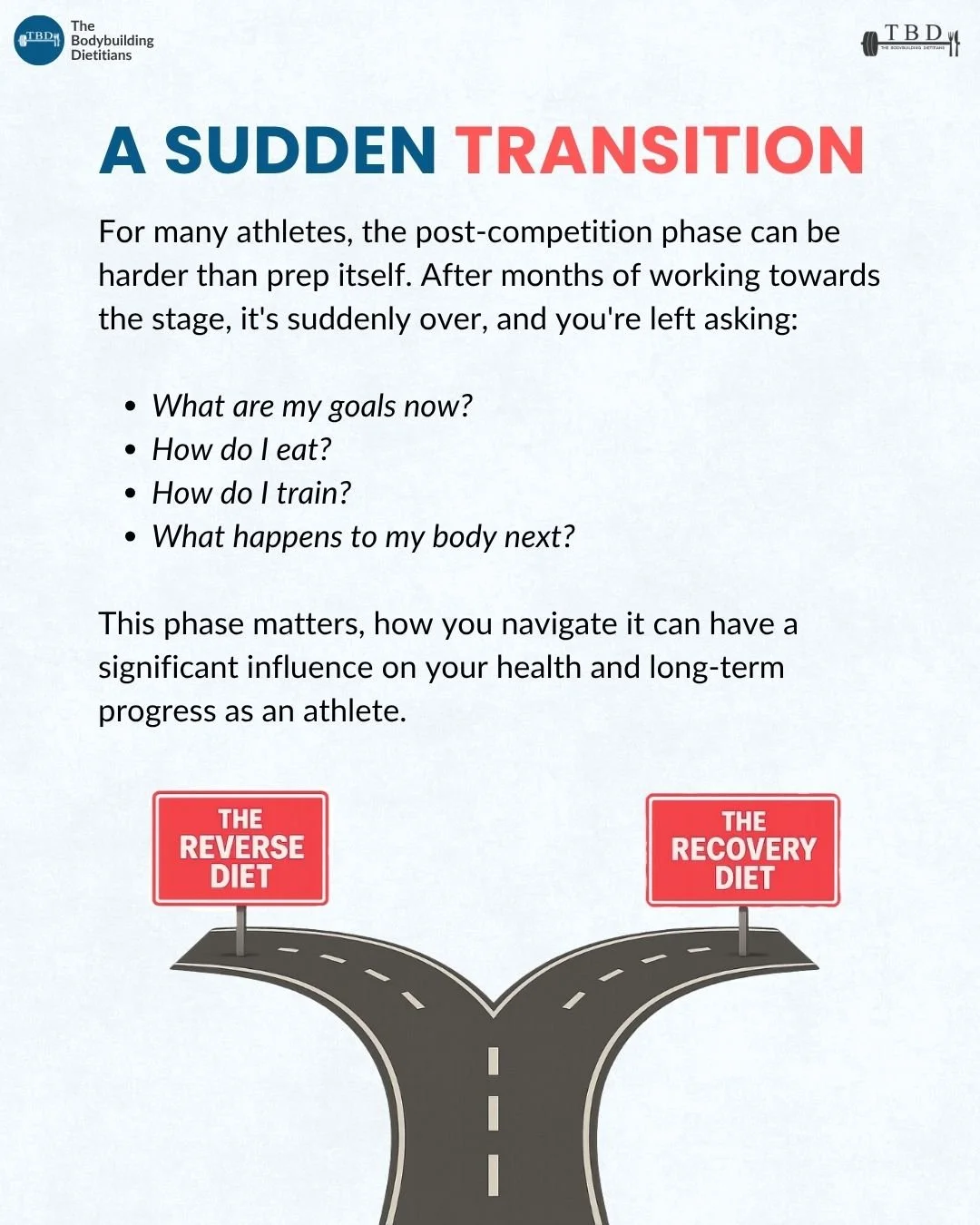
The post-show phase is often harder than prep because the structure, clarity and momentum of a prep disappear overnight, leaving an athlete without the goal that organised everything they were doing. After months of working towards a single date, the target is gone, and the questions that replace it are open-ended: what the goal is now, how to eat, how to train, and what happens to the body next.
Prep provides a clear framework, with every decision pointing towards the stage. Recovery offers no equivalent structure unless one is deliberately built, which is why many athletes find the weeks after a show more unsettling than the discipline of prep. The combination of suppressed physiology, a strained relationship with food, and the sudden absence of a goal creates a difficult transition. Treating recovery as its own phase, with its own plan, is what turns that transition from a drift into a managed process.
Recovery Diet or Reverse Diet: Which Approach Fits Post-Show?
The two common approaches to post-show nutrition are a recovery diet and a reverse diet, and the difference between them comes down to how quickly intake returns towards maintenance. The right choice depends on the athlete, but for most people coming off an aggressive prep, restoring energy availability sooner is the priority.
A recovery diet increases intake towards maintenance relatively quickly after the show, with the explicit goal of restoring energy availability and resolving the physiological cost of prep. A reverse diet increases intake in small weekly increments over a longer period, on the premise that a slow return limits fat regain. The appeal of the slow approach is understandable after months of dieting, but its central premise is weaker than often assumed, and a prolonged reverse diet keeps an athlete in a state of low energy availability for longer while the hormonal and metabolic consequences of prep remain unresolved. Energy availability is the dietary energy remaining after the energy cost of training, and low energy availability is linked to hormonal suppression, reduced metabolic rate and impaired recovery. Because restoring it is the central goal of this phase, the recovery-diet approach aligns with what the body needs after a show, which is why it has become the more commonly recommended path for most competitors. A more gradual increase still has a place for some athletes, particularly where appetite or gut comfort makes a rapid increase difficult, and the rate is best guided by how recovery is progressing rather than a fixed schedule.
How Much Weight Should You Expect to Regain?
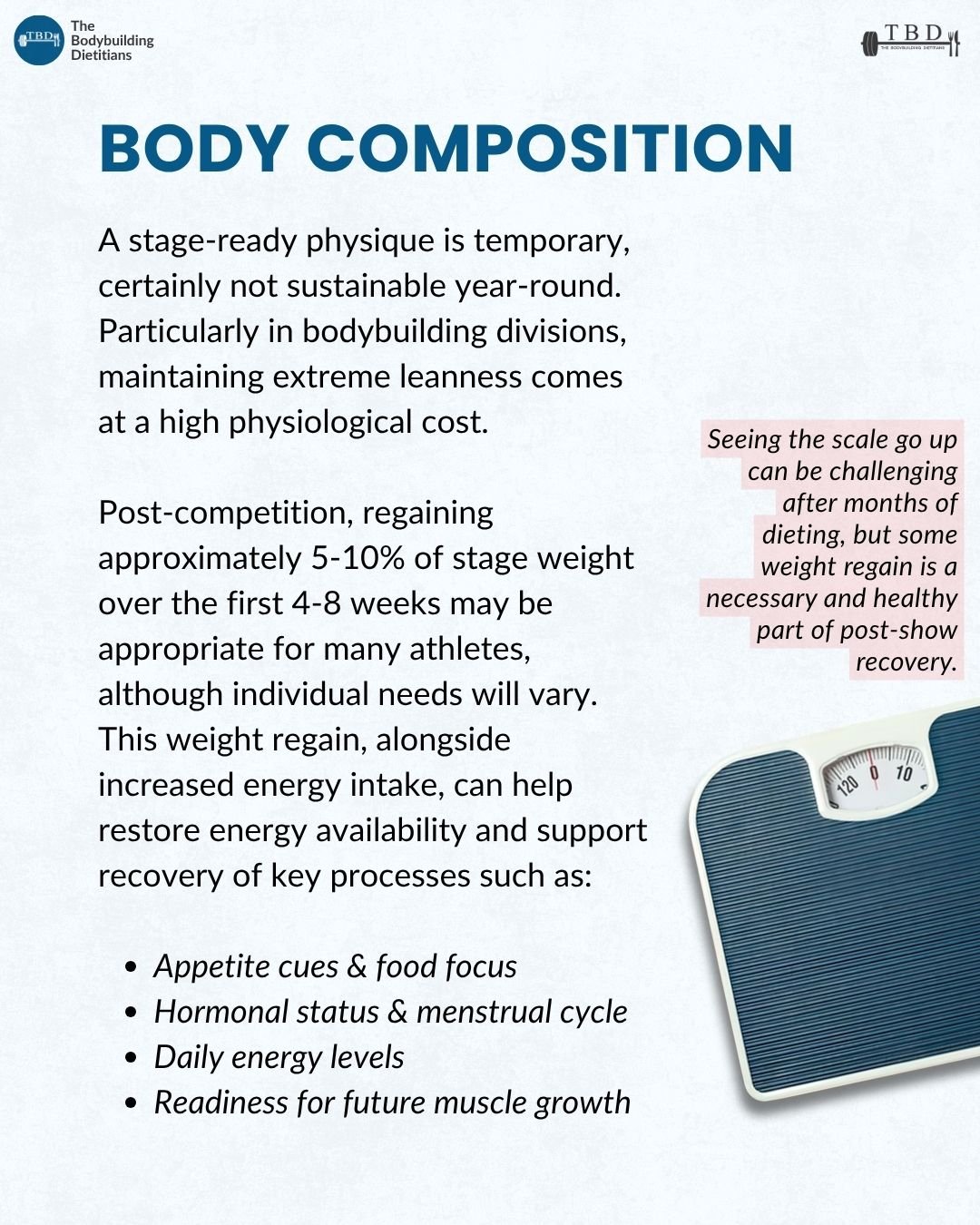
A controlled weight regain is a normal and healthy part of recovery, with around 5 to 10% of stage weight over the first 4 to 8 weeks being appropriate for many athletes, though individual needs vary. A stage-ready physique is temporary and not sustainable year-round, and in bodybuilding divisions especially, holding extreme leanness carries a high physiological cost that the regain begins to reverse.
This regain, alongside increased energy intake, helps restore energy availability and supports the recovery of several processes that suffer at stage-lean conditioning: appetite cues and food focus, hormonal status and the menstrual cycle, daily energy levels, and readiness for future muscle growth. The distinction worth holding onto is between a controlled, appropriate regain and an uncontrolled rebound. A deliberate 5 to 10% increase that restores essential reserves is the goal, whereas rapid and excessive fat regain in the first weeks post-show, usually driven by unplanned eating, is the outcome a structured plan is designed to avoid. Seeing the scale rise after months of dieting can be psychologically challenging, and recognising some regain as a necessary and healthy part of recovery is part of managing it well.
Dreading the post-show PHASE?
Watching the scale climb after months of dieting is one of the hardest parts of recovery, and it is where many athletes either panic and under-eat or swing the other way into an uncontrolled rebound. Structuring a controlled recovery that restores your health without losing the progress you made is the kind of thing our bodybuilding coaching handles directly, planned around your prep history and how you are responding.
How Should Nutrition Change After a Show?
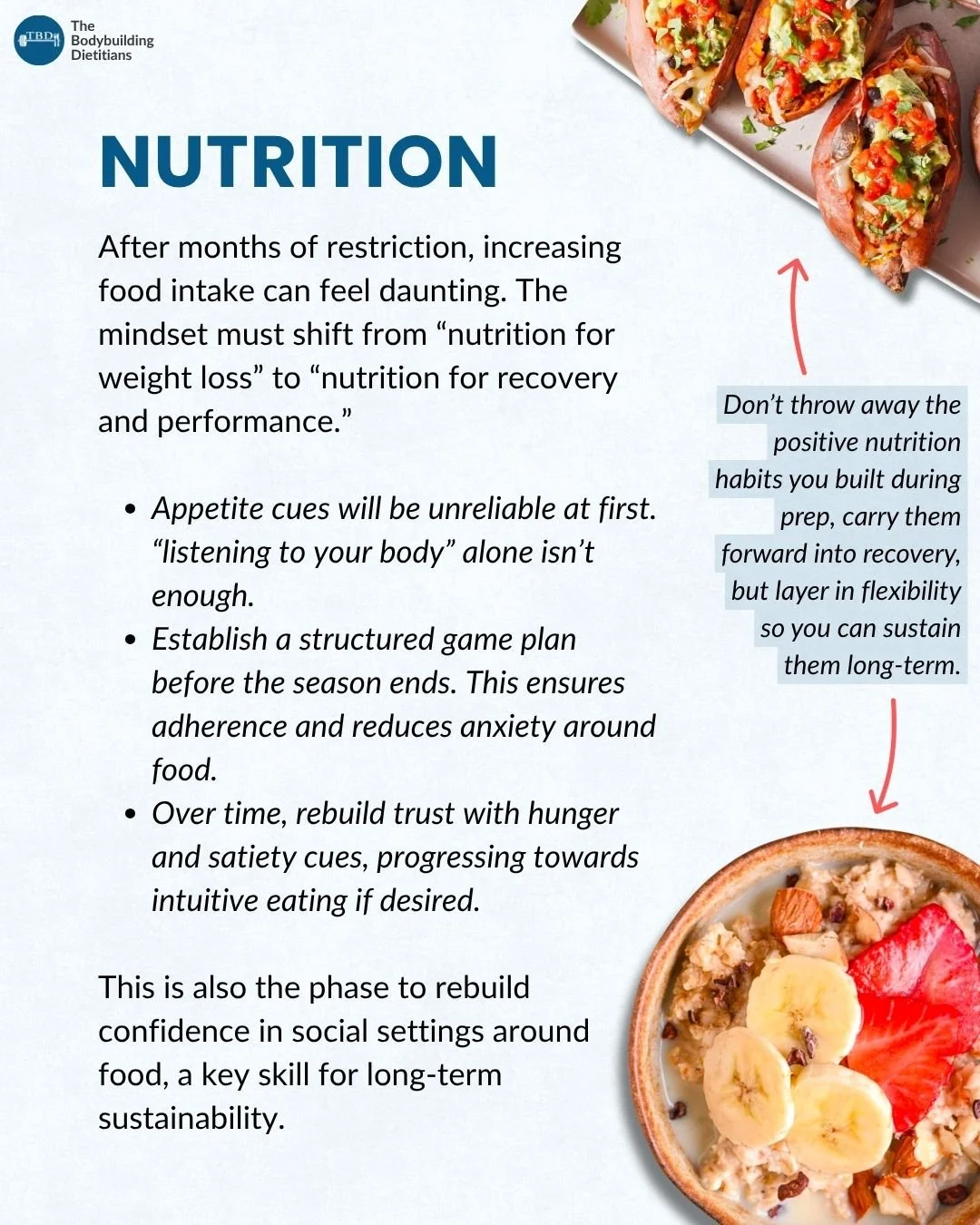
Nutrition after a show needs to shift from eating for weight loss to eating for recovery and performance, which can feel daunting after months of restriction. Increasing food intake deliberately is the goal, and it works best when it follows a plan rather than appetite alone.
Appetite cues tend to be unreliable in the early weeks of recovery, since the hormonal signals that regulate hunger and fullness are disrupted by prep, so advice to listen to your body alone is incomplete at this stage. Establishing a structured plan before the season ends supports adherence and reduces anxiety around food during a period when both are vulnerable. Over time, as physiology normalises, the aim is to rebuild trust with hunger and satiety cues and progress towards a more intuitive approach if that is the goal. The positive nutrition habits built during prep are worth carrying forward, with flexibility layered in so they remain sustainable long-term. This phase is also where confidence in social settings around food is rebuilt, which is a key skill for long-term sustainability.
How Should Training Adapt After a Show?
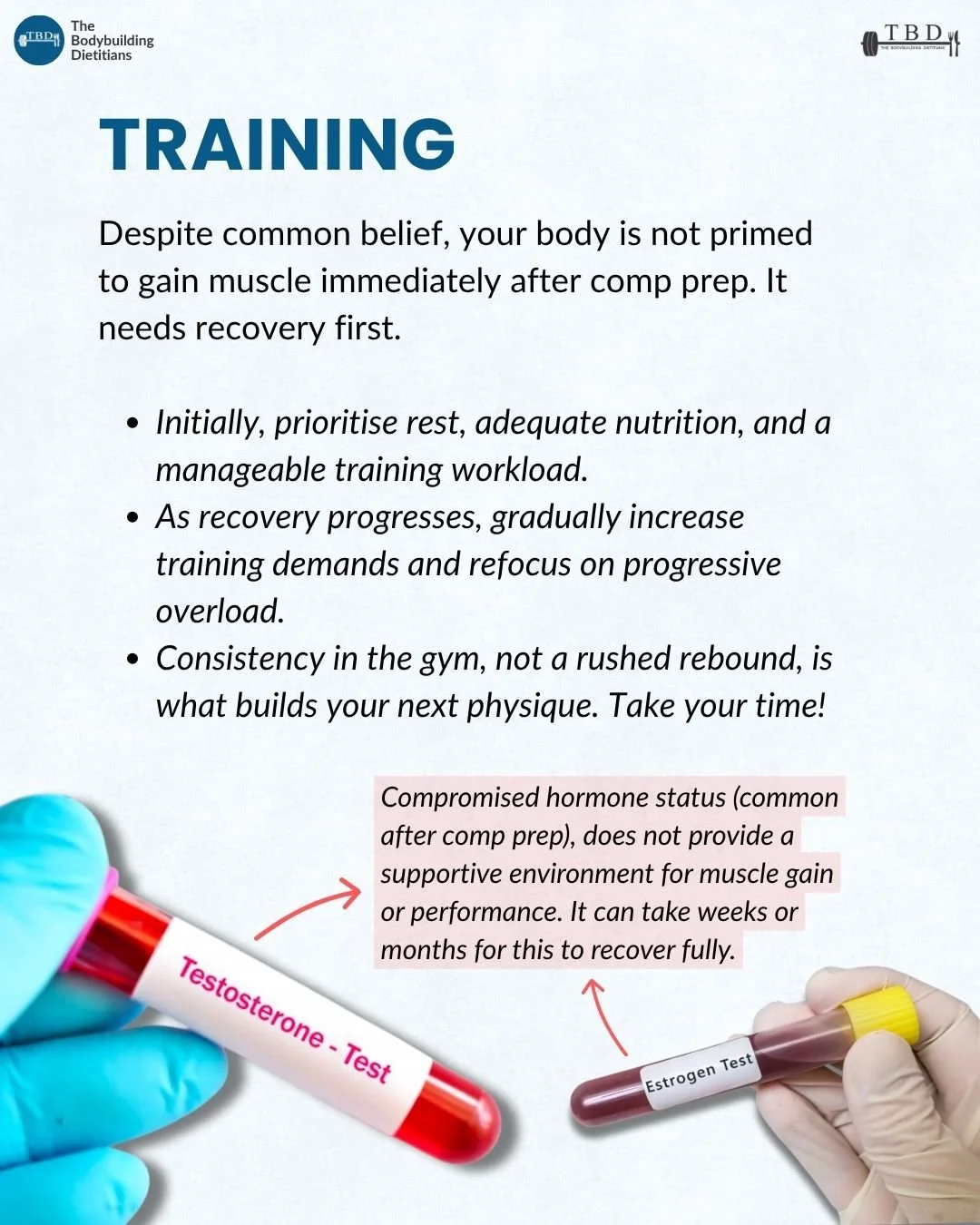
Training should support recovery first, because the body is not primed to build muscle immediately after prep and needs to recover before it can grow. A common assumption is that the post-prep period is an ideal window for rapid muscle gain, and the physiological reality is that the groundwork for growth has to be rebuilt before that window opens.
In the early weeks, the priority is rest, adequate nutrition and a manageable training workload, which allows the body to recover rather than adding further stress to a system already depleted. As recovery progresses, training demands can be increased gradually and the focus can return to progressive overload. Consistency in the gym over the following months is what builds the next physique, and a rushed rebound works against that by piling load onto a body that cannot yet support it.
Research on recovery following competitive bodybuilding preparation has documented persistent hormonal and metabolic disruptions for weeks to months after the show, including suppressed testosterone, elevated cortisol and reduced resting metabolic rate. These findings support a gradual, structured recovery before transitioning into a dedicated muscle gain phase. Source: Trexler, Smith-Ryan and Norton, 2014, Journal of the International Society of Sports Nutrition.
Compromised hormone status is common after prep and does not provide a supportive environment for muscle gain or performance, and it can take weeks or months to recover fully. Training in a way that respects that reality, rather than chasing growth before the body is ready, produces a better long-term outcome.
What Should Happen With Cardio After a Show?
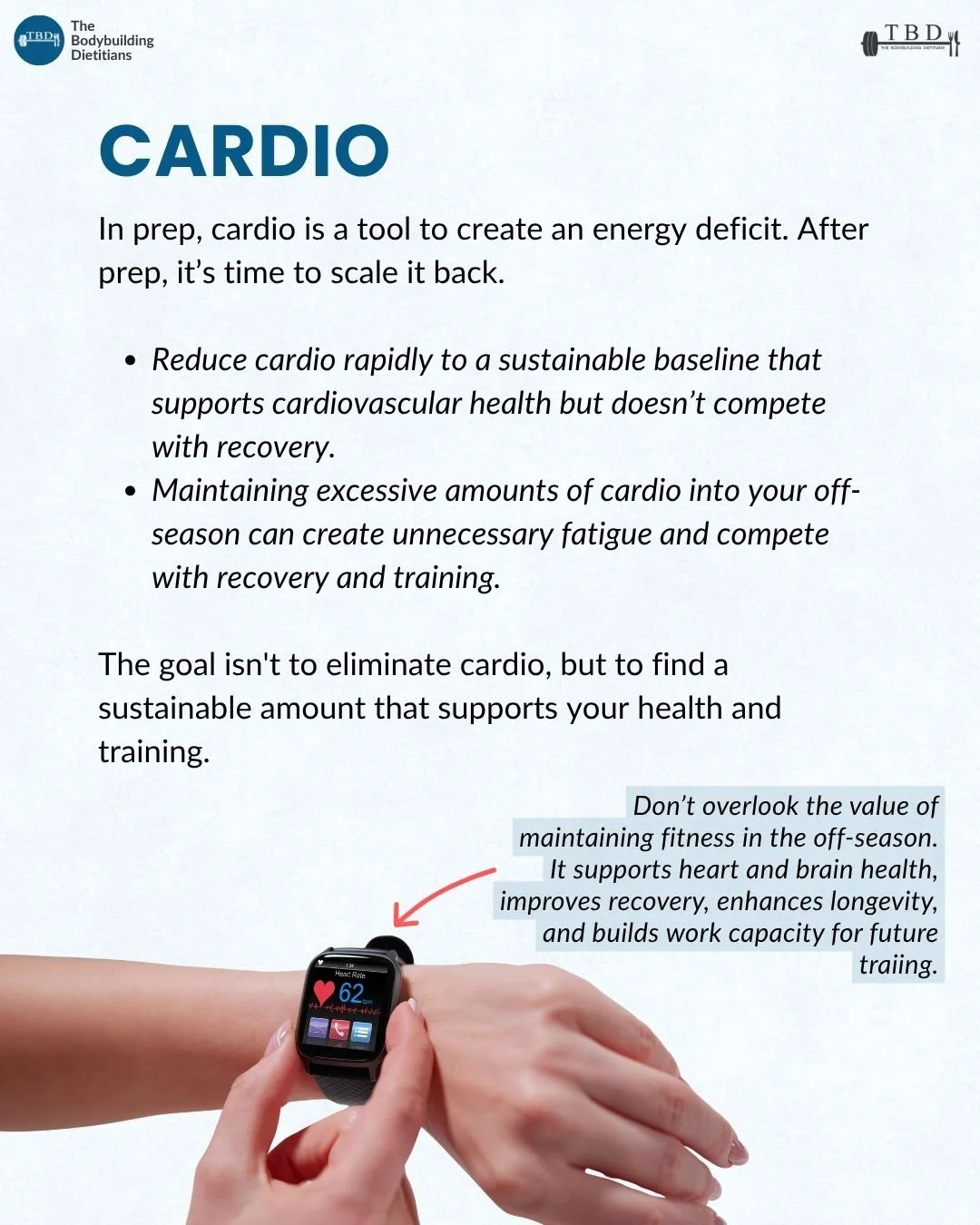
Cardio should be scaled back after a show, since its main role during prep was to help create an energy deficit that is no longer the goal. Reducing cardio relatively quickly to a sustainable baseline supports cardiovascular health without competing with recovery.
Carrying excessive cardio into the off-season creates unnecessary fatigue and competes with both recovery and training, which works against the priorities of this phase. The aim is a sustainable amount of cardio that supports health and training, rather than removing it entirely. Maintaining a baseline of fitness through the off-season has real value: it supports heart and brain health, improves recovery, contributes to longevity, and builds the work capacity that makes future training and the next prep more manageable. Finding that sustainable level is more useful than swinging between excessive cardio and none at all.
How Do You Rebuild Flexibility Around Food and Social Life?
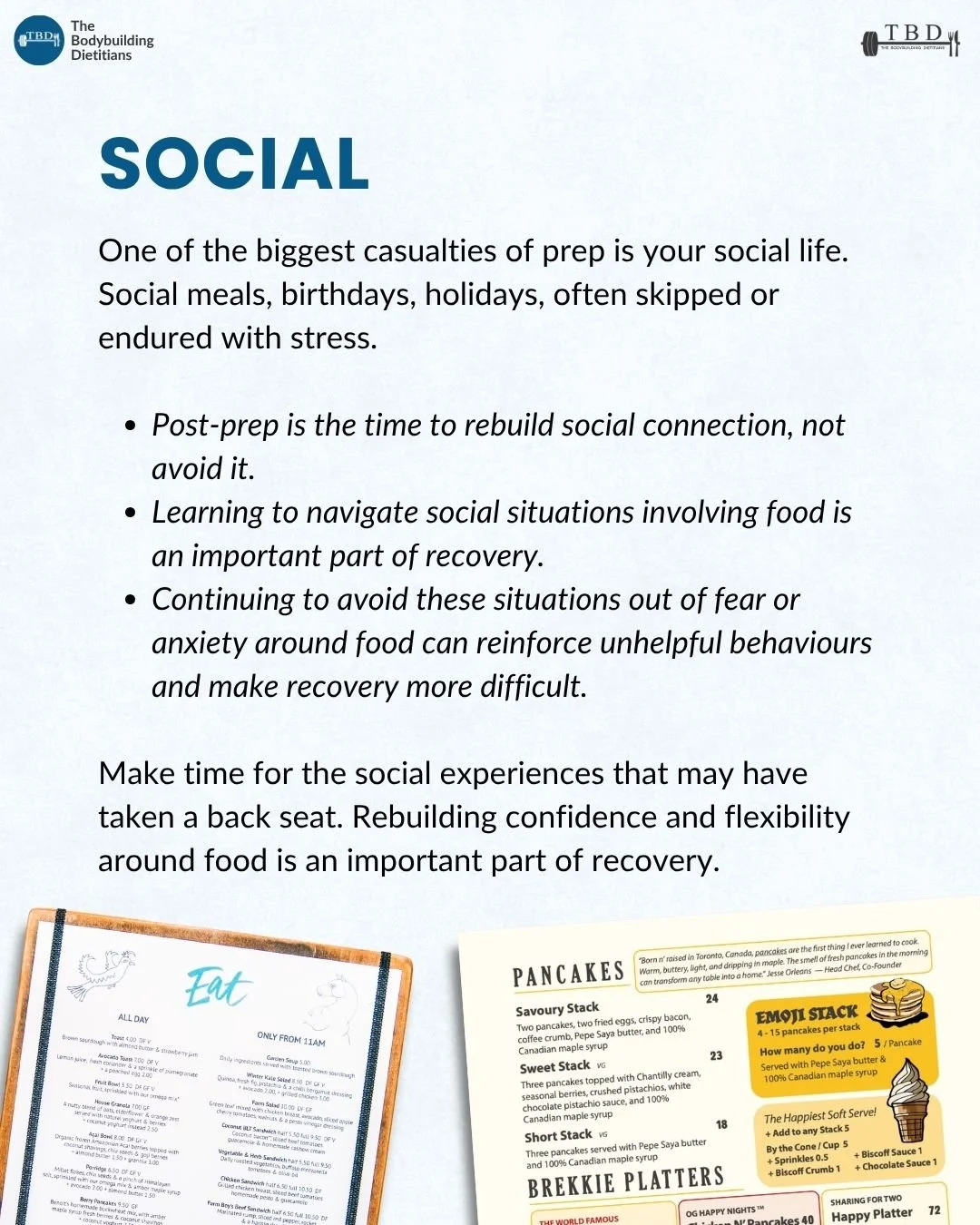
Rebuilding flexibility around food and social situations is a genuine part of recovery, not an afterthought to the physical side. One of the biggest casualties of prep is social life, with social meals, birthdays and holidays often skipped or endured with stress, and the period after a show is the time to rebuild that connection.
Learning to handle social situations involving food is an important recovery skill, and continuing to avoid them out of fear or anxiety around food can reinforce unhelpful patterns and make recovery harder. Making time for the social experiences that took a back seat during prep rebuilds confidence and flexibility around food, which supports long-term sustainability far more than a rigid approach carried indefinitely. The psychological side of recovery develops alongside the physical side, and an athlete who rebuilds a relaxed, flexible relationship with food and social eating is in a stronger position for their next phase than one who stays in a prep mindset long after the show is over.
Practical Takeaways
Treat post-show recovery as its own phase with its own plan, since the sudden loss of a prep's structure is what makes the transition difficult.
Prioritise restoring energy availability. For most athletes off an aggressive prep, a recovery diet that returns intake towards maintenance relatively quickly suits this better than a slow, prolonged reverse diet.
Expect a controlled weight regain of around 5 to 10% of stage weight over the first 4 to 8 weeks, which helps restore appetite regulation, hormonal status, energy and readiness to build. Distinguish this from an uncontrolled rebound.
Shift the nutrition mindset from weight loss to recovery and performance, use a structured plan while appetite cues are unreliable, and rebuild trust with hunger and fullness over time.
Support recovery before growth in the gym. Prioritise rest and a manageable workload first, then rebuild training demands gradually, since hormonal status takes weeks to months to normalise.
Scale cardio back to a sustainable baseline that supports health without competing with recovery, and rebuild flexibility and confidence around food and social situations.
Frequently Asked Questions
How long does it take to recover after a bodybuilding competition?
Recovery typically takes weeks to months rather than days, with the exact timeline depending on how long and severe the prep was and how the individual responds. Hormonal and metabolic disruptions from prep, including suppressed testosterone and reduced metabolic rate, can persist for weeks to months after the show. A structured recovery phase guided by improvements in energy, sleep, appetite and mood is more reliable than a fixed timeframe.
Should you do a reverse diet or a recovery diet after a show?
For most athletes coming off an aggressive prep, a recovery diet that returns intake towards maintenance relatively quickly is preferable, because restoring energy availability sooner supports hormonal and metabolic recovery. A slow, prolonged reverse diet keeps the body in low energy availability for longer, and its premise of limiting fat regain is weaker than often assumed. A more gradual increase can suit some athletes where appetite or digestion makes a rapid increase difficult.
How much weight should you regain after a bodybuilding show?
A controlled regain of around 5 to 10% of stage weight over the first 4 to 8 weeks is appropriate for many athletes, though individual needs vary. This regain helps restore energy availability and supports appetite regulation, hormonal status, energy levels and readiness for future muscle growth. The goal is a deliberate, controlled increase rather than an uncontrolled rebound driven by unplanned eating.
Can you build muscle right after comp prep?
The body is not primed to build muscle immediately after prep, because hormonal status is suppressed and energy availability is low, neither of which supports growth. The early weeks are better spent restoring health through rest, adequate nutrition and a manageable training load. Once recovery has progressed, training can refocus on progressive overload, and consistency over the following months is what builds the next physique.
Why is seeing the scale go up after a show normal?
A stage-ready physique is temporary and not sustainable year-round, so some weight regain is a necessary and healthy part of recovery rather than a setback. The regain, alongside increased food intake, restores energy availability and supports the recovery of hormones, appetite regulation and energy levels. Recognising this as expected makes the psychological side of watching the scale rise easier to manage.
Should you stop doing cardio after a competition?
Cardio should be scaled back rather than eliminated. Its role during prep was to help create an energy deficit, which is no longer the goal, so reducing it to a sustainable baseline frees up recovery capacity. Maintaining some cardio through the off-season supports cardiovascular and brain health, recovery, longevity and the work capacity that makes future training easier.
If you want personalised nutrition and training support through prep, recovery and beyond, our team can guide you through each phase in a way that protects your health and your long-term progress. Enquire about bodybuilding coaching or book a free discovery call to get started.