Some carbohydrate sources provide far more food and fibre per calorie than others, which is what makes them more filling. A look at how carb sources compare on volume and fibre per 100 calories, and how to use that when choosing carbs for fat loss and training.
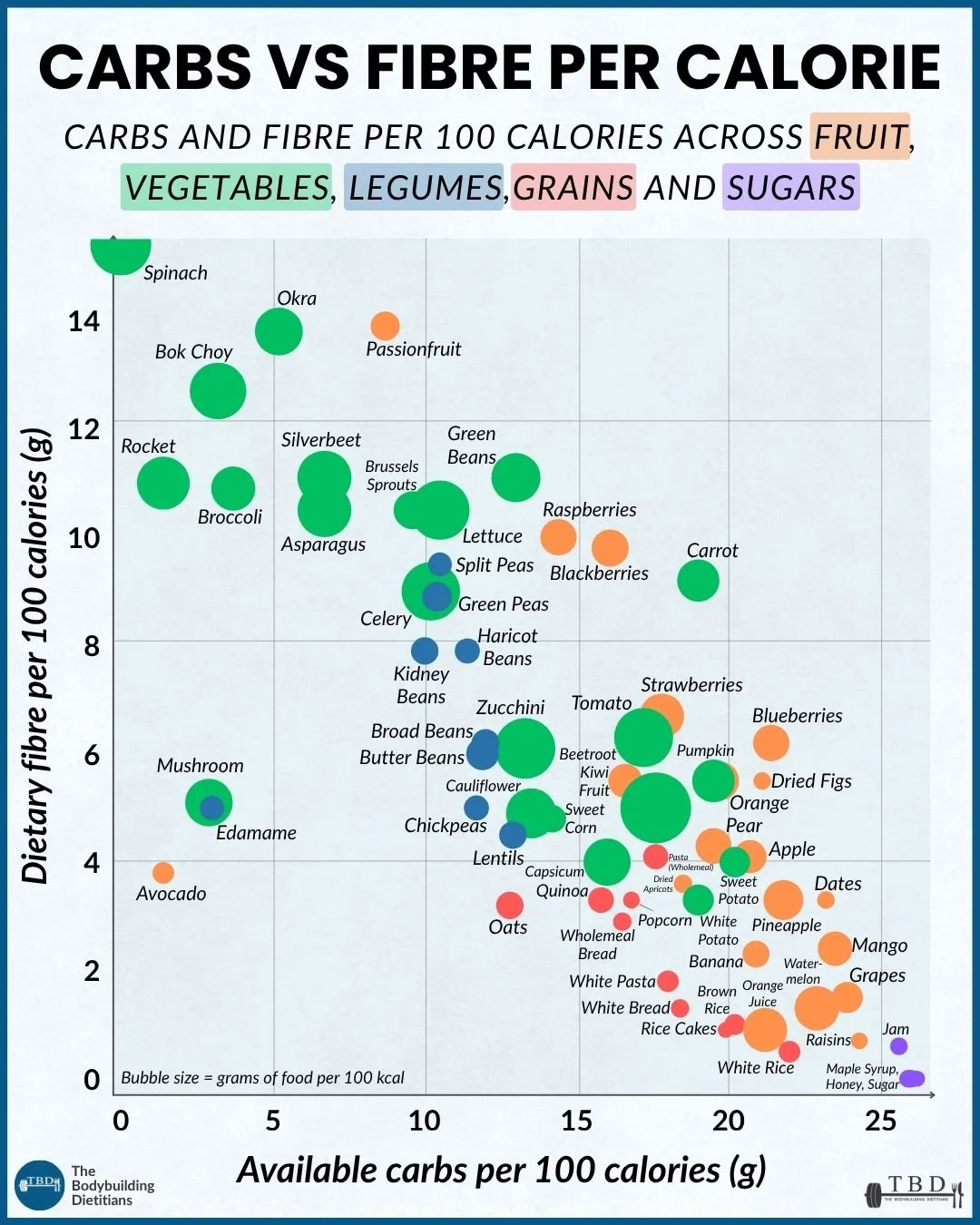
The most filling carbohydrate sources are those that provide the most food and fibre for the fewest calories, since food volume and fibre are two of the main drivers of fullness. Plotting available carbohydrate against fibre per 100 calories, with food volume shown by dot size, makes that pattern easy to read. Leafy vegetables, berries and other high-fibre, lower-carbohydrate-density foods sit towards the upper left, providing a large amount of food and fibre for few calories, which is what makes them the most filling carb sources during a fat loss phase. More carbohydrate-dense, lower-fibre options such as rice, grains and sugars sit towards the lower right, supplying most of their calories from digestible carbohydrate in a smaller amount of food, which makes them less filling but practical for meeting carbohydrate targets around training. Around 25 grams of available carbohydrate per 100 calories is close to the upper limit, since carbohydrate provides roughly 4 calories per gram, so foods near the far right draw nearly all their energy from digestible carbohydrate. The most useful carbohydrate source still depends on training demand, fibre needs, food volume, appetite and the phase you are in, rather than a single best option.
Carbohydrate sources are often treated as interchangeable once they fit a carbohydrate target, yet they vary considerably in how filling they are for the same calories. Some deliver a large amount of food and fibre per calorie, which keeps you fuller for longer, while others pack most of their energy into a small, easily eaten amount. Plotting available carbohydrate against fibre per 100 calories, with food volume shown by dot size, turns that variation into something you can read at a glance, and it shifts the question from how many carbohydrates to eat towards which carbohydrate sources suit the situation in front of you. This post works through what the chart shows and how to use it to choose carb sources for fat loss and around training.
What Does the Chart Show?
The chart maps each carbohydrate source by two numbers: its available carbohydrate on the horizontal axis and its fibre on the vertical axis, both per 100 calories, with the size of each dot showing how much food that 100 calories represents. Reading those three pieces together gives a fuller picture of a carb source than its carbohydrate content alone.
Available carbohydrate is the digestible carbohydrate that contributes energy, shown separately from fibre, which passes through largely without being absorbed for energy. Separating the two matters because total carbohydrate on a label combines both, and two foods with the same total carbohydrate can differ sharply once fibre is set aside. A food high on the vertical axis delivers a lot of fibre for its calories, a food far to the right delivers most of its calories as digestible carbohydrate, and the dot size tells you whether those calories arrive in a large or small amount of food. Energy density refers to the number of calories a food provides relative to its weight, so a large dot marks a low-energy-density food that fills more space per calorie.
One detail anchors the right-hand edge of the chart. Around 25 grams of available carbohydrate per 100 calories is close to the upper limit, because carbohydrate provides roughly 4 calories per gram, which means 25 grams of carbohydrate accounts for the full 100 calories. Foods sitting near the far right, such as honey, maple syrup and jam, are therefore supplying almost all of their energy as digestible carbohydrate with little else alongside it.
Why Do Carb Sources Vary So Much in Fibre Per Calorie?
Carbohydrate sources vary because the plant structures they come from differ in how much fibre, water and digestible starch or sugar they contain. The pattern on the chart follows those structural differences closely.
Leafy vegetables and many non-starchy vegetables sit high and to the left, combining high fibre with low available carbohydrate and large dot sizes, because they are mostly water and structural fibre with little digestible carbohydrate. Berries occupy a similar upper zone among fruit, offering more fibre per calorie than most other fruits. Legumes cluster through the middle, pairing a moderate amount of digestible carbohydrate with a meaningful fibre contribution, which is part of why they work well across a range of phases. Starchy staples such as rice, bread and potatoes sit lower and further right, where most of the calories come from digestible starch and fibre per calorie is lower. Sugars sit at the far lower right, almost pure digestible carbohydrate with negligible fibre. This is a read of carbohydrate structure rather than a ranking of food quality, since a food's position describes what it offers per calorie, not whether it belongs in the diet.
How Does Carbohydrate Density Help Around Training?
Carbohydrate-dense, lower-fibre sources are useful around training because they let you meet a carbohydrate target without a large volume of food sitting in the gut. When the goal is to fuel or recover from hard sessions, the digestibility and compactness of these foods becomes an advantage rather than a shortcoming.
Glycogen is the stored form of carbohydrate found primarily in muscle and liver tissue, and it is the main fuel for higher-intensity training. Topping up glycogen around a session often means consuming a fair amount of carbohydrate in a short window, and high-fibre, high-volume foods can make that uncomfortable when a large mass of food competes for space and digestive time. Foods towards the lower right of the chart, such as white rice, bananas or a simple carbohydrate drink, deliver the carbohydrate in a smaller, faster-digesting package, which is why they feature so commonly in pre and post-training meals. The lower fibre content that makes them less filling per calorie is the same quality that makes them practical when the priority is getting carbohydrate in without feeling weighed down.
How Do Fibre and Food Volume Help in a Fat Loss Phase?
High-fibre, lower-energy-density carbohydrate sources help during fat loss because they provide more food and more fullness for the same calories, which eases hunger when the calorie budget is tight. The foods in the upper-left of the chart are the ones doing this most effectively.
During a deficit, the practical challenge is managing appetite as food intake falls, and foods that occupy more space per calorie give the meal more physical volume without adding energy. Research on energy density consistently shows that lower-energy-density foods support greater fullness for fewer calories, which is the mechanism behind leaning on vegetables, berries and other high-volume options when dieting. Building meals around these sources lets you eat a satisfying amount of food while staying inside a reduced calorie target, and it is one of the more reliable ways to make a deficit feel manageable rather than relentless. The same foods that look inefficient as a carbohydrate source around training become the useful choice here, because volume and fibre are working for you rather than against you.
Why Is Fibre Only One Part of the Picture?
Fibre is one factor influencing digestion and fullness, and reading the chart as though fibre alone determines how a food behaves would overstate its role. Food form, starch structure, fat content, protein content and the rest of the meal all contribute to how a carbohydrate source is digested and how full it leaves you.
A whole food eaten in its intact form digests differently from the same food blended or juiced, even with identical fibre. The structure of the starch itself matters, since some starches resist digestion more than others. Fat and protein in the same meal slow gastric emptying and influence the overall response, so a carbohydrate source rarely acts in isolation. The chart is a useful starting point for thinking about carbohydrate selection, and it is most accurate when read as one input alongside the form of the food and the company it keeps on the plate. Treating it as the whole answer would miss the context that determines how a meal sits and performs.
How Should You Choose Carb Sources?
Choosing carbohydrate sources works best when you weigh training demand, fibre needs, food volume, appetite and the phase you are in together, rather than defaulting to the same few foods regardless of circumstance. The chart is a map of options, and the right selection moves around it as the situation changes.
Around heavy training, the lower-right foods earn their place by delivering carbohydrate efficiently. Through the rest of the day, and especially in a deficit, the upper-left foods help manage appetite and lift fibre intake. Across a building phase with a larger calorie budget, there is room to draw from both zones freely, with less pressure on volume and more scope to prioritise preference and performance. Someone training at high volume may lean further towards carbohydrate density regardless of phase, because the daily carbohydrate requirement is high. The skill is matching the carb source to the job it needs to do in that meal and that phase, which is a more useful habit than searching for a single best carbohydrate.
Choosing carbs on autopilot?
Most people pick the same carbohydrate sources out of habit, then wonder why hunger or training energy works against them in a given phase. Matching carb selection to your training, your appetite and the phase you are in is the kind of practical detail our coaching is built around, worked through for your situation rather than a generic food list.
Practical Takeaways
Plotting available carbohydrate against fibre per 100 calories shows how carb sources trade off digestible carbohydrate, fibre and food volume, which is more informative than carbohydrate content alone.
High-fibre, low-energy-density carb sources such as leafy vegetables and berries sit upper-left, providing large food volume and fullness per calorie, which suits appetite management during fat loss.
Carbohydrate-dense, lower-fibre sources such as rice, bread and sugars sit lower-right, delivering carbohydrate in a smaller amount of food, which suits meeting carbohydrate targets around training.
Around 25 grams of available carbohydrate per 100 calories is the practical ceiling, so foods at the far right draw almost all their energy from digestible carbohydrate.
Fibre is one factor in digestion and fullness. Food form, starch structure, fat, protein and the rest of the meal all contribute.
Match the carb source to training demand, fibre needs, food volume, appetite and phase rather than relying on a single best option.
Frequently Asked Questions
What is available carbohydrate?
Available carbohydrate is the digestible carbohydrate in a food that contributes energy, shown separately from fibre. Fibre is a carbohydrate too, but it passes through largely without being absorbed for energy, so separating the two gives a clearer picture of what a food provides. Two foods with the same total carbohydrate on the label can differ considerably in available carbohydrate once their fibre is accounted for.
Which carb sources have the most fibre per calorie?
Leafy vegetables, non-starchy vegetables and berries provide the most fibre per calorie, sitting high on the fibre axis while remaining low in available carbohydrate. Legumes offer a meaningful amount of fibre alongside moderate digestible carbohydrate. Starchy staples such as rice, bread and potatoes, and sugars such as honey and jam, provide the least fibre per calorie.
Are low-fibre carb sources like white rice a bad choice?
No. A food's position on the chart describes what it offers per calorie, not whether it belongs in the diet. Lower-fibre, carbohydrate-dense foods such as white rice are practical around training, where delivering carbohydrate in a small, easily digested amount of food is an advantage. The consideration is making sure fibre intake is met elsewhere in the day when these foods feature heavily.
Why do high-volume foods help during fat loss?
High-volume, low-energy-density foods provide more food and more fullness for the same calories, which helps manage appetite when the calorie budget is reduced. Research on energy density consistently shows that lower-energy-density foods support greater fullness for fewer calories. Building meals around vegetables and berries during a deficit lets you eat a satisfying amount of food while staying within a lower calorie target.
Is fibre the only thing that affects how filling a carb is?
No. Fibre is one factor, but food form, starch structure, fat content, protein content and the rest of the meal all influence digestion and fullness. A whole food digests differently from the same food blended or juiced, and fat or protein in the same meal slows digestion. The chart is best read as one useful input rather than the whole answer.
How do you choose the right carb source?
Weigh training demand, fibre needs, food volume, appetite and your current phase together. Carbohydrate-dense sources suit meals around training, higher-fibre and higher-volume sources suit the rest of the day and fat loss phases, and a building phase allows more freedom to draw from both. The aim is matching the carb source to the job it needs to do rather than relying on one option everywhere.
If you would like help selecting and structuring carbohydrate sources around your training, appetite and current phase, our team can build that into a plan made for your situation. Enquire about coaching or book a consultation to get started.