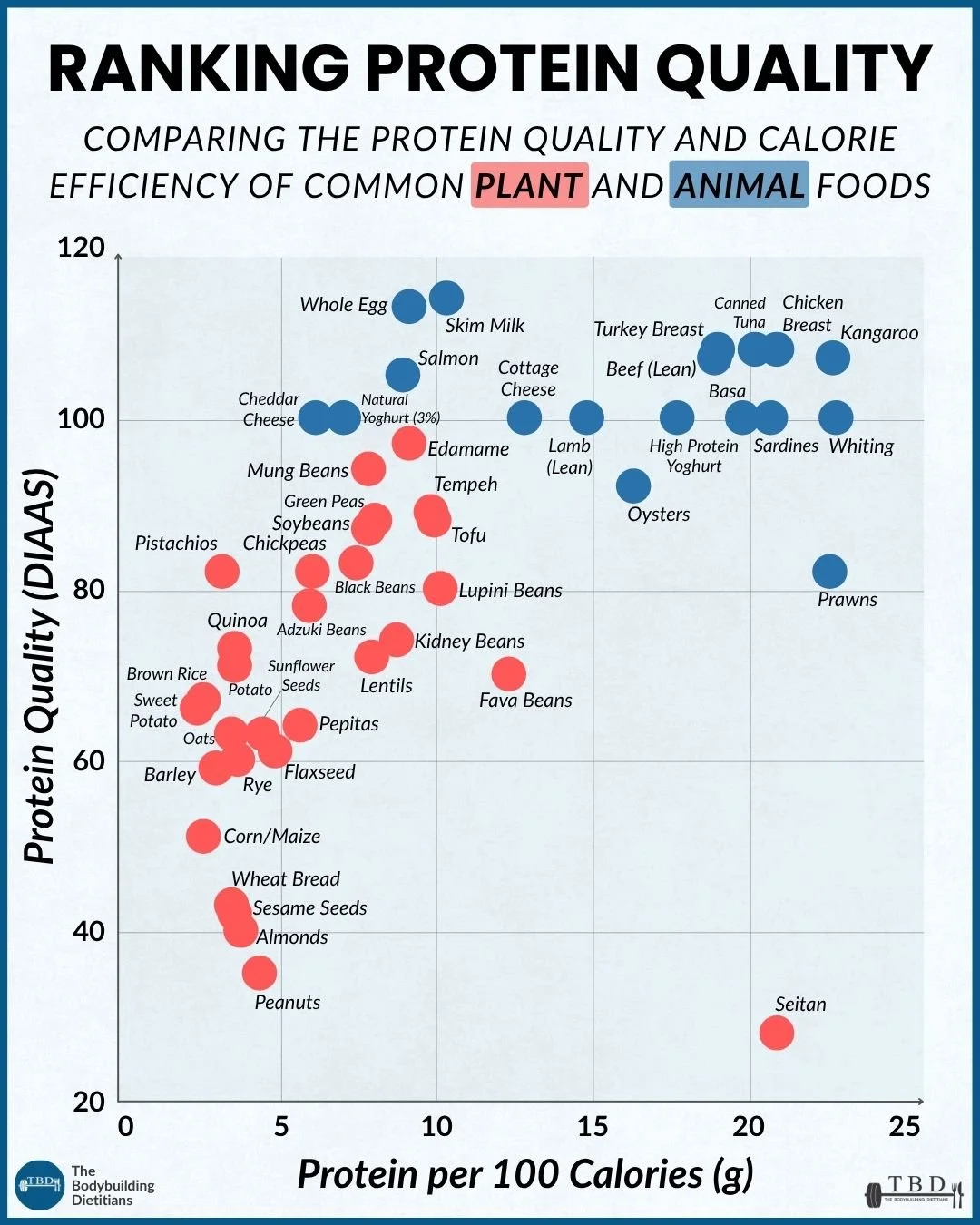
Common protein-containing foods plotted by DIAAS score (vertical) and protein per 100 calories (horizontal). Animal proteins cluster at the top of the DIAAS axis with mixed calorie efficiency. Plant proteins occupy the middle and lower DIAAS range with more variable protein per calorie.
Protein quality and protein content are two different things. DIAAS (Digestible Indispensable Amino Acid Score) is the current FAO-recommended measure of how well a protein source delivers the essential amino acids the body actually needs. This is a walk through what DIAAS is, which animal and plant foods score highest, why the plant proteins tend to score lower, and when protein quality actually matters for lifters.
DIAAS (Digestible Indispensable Amino Acid Score) is the current gold-standard measure of protein quality endorsed by the Food and Agriculture Organization. It accounts for both the amino acid composition of a protein and how well those amino acids are actually digested and absorbed in the small intestine. Animal proteins consistently score at the top of the DIAAS rankings: whole eggs (approximately 113), skim milk (approximately 114), and most lean meats (100 to 110) sit above the FAO's "excellent quality" threshold of 100. Dairy proteins including cheese, yoghurt, and cottage cheese also score at or above 100. Most plant proteins score meaningfully lower on DIAAS in their whole-food form: tempeh (approximately 88), soybeans (approximately 84), chickpeas (approximately 83), lentils (approximately 65), and grains like brown rice, oats, and wheat sit between 40 and 70. This does not mean plant proteins fail to contribute to muscle protein synthesis. It means that a diet built primarily on individual plant proteins requires either higher total protein intake, deliberate combining of complementary sources, or both to match the amino acid delivery of an animal-based diet. For lifters hitting daily protein targets from mixed sources, individual food DIAAS scores matter far less than the cumulative daily delivery across all sources combined.
Protein quality and protein content are two different things. A food can be high in total protein per 100 grams or per calorie while still delivering a lower-quality protein than another food with less total protein. The distinction matters because protein quality determines how effectively the amino acids in a food actually contribute to muscle protein synthesis, tissue repair, and other protein-dependent processes, not just how much protein appears on the nutrition label.
This article walks through the specific measure of protein quality that current sports nutrition science uses (DIAAS), how it compares animal and plant protein sources, why most plant proteins score lower, and when the quality difference actually matters for lifters hitting daily protein targets. The scatter plot in this article deliberately excludes highly concentrated products (whey protein, spirulina, TVP) because their protein density is high enough that including them would stretch the chart and make the whole-food comparisons harder to read.
The article is a companion to the broader food selection cluster. For food selection through the lens of combined protein and fibre density, our protein and fibre density article covers that specific angle. For cost-per-gram-of-protein comparisons, our protein sources ranked by calories and cost article covers the economic side. This article specifically fills the protein quality gap that those other articles explicitly do not address.
What Is DIAAS and Why Does It Matter?
DIAAS stands for Digestible Indispensable Amino Acid Score. It is the current gold-standard measure of protein quality endorsed by the Food and Agriculture Organization of the United Nations, having replaced the older Protein Digestibility Corrected Amino Acid Score (PDCAAS) as the recommended metric in 2013.
Two things determine a food's DIAAS score. First, the amino acid composition of the protein: does it contain all nine indispensable amino acids (the ones the body cannot synthesise and must obtain from food) in proportions that meet human requirements? Second, the digestibility of those amino acids at the ileum (the end of the small intestine, where amino acid absorption is measured): does the body actually absorb the amino acids the food contains, or do some of them pass through to the large intestine and get lost?
DIAAS is calculated by identifying the "limiting" indispensable amino acid in a food (the one present in the lowest amount relative to human requirements), then multiplying by the digestibility coefficient for that amino acid. A DIAAS score of 100 means the food delivers the limiting amino acid at the level required to meet human needs, once digestibility is accounted for. A score above 100 means the food delivers more than the required amount of the limiting amino acid. A score below 100 means the food is deficient in at least one indispensable amino acid relative to human requirements.
The FAO classification system based on DIAAS values sets three tiers: DIAAS above 100 is classified as "excellent quality" and permits a protein source claim, DIAAS between 75 and 99 is classified as "high quality" with a permitted protein content claim, and DIAAS below 75 does not qualify for a protein claim under the FAO framework. This classification reflects both the amino acid composition and the digestibility of the protein source, providing a more accurate assessment of protein quality than earlier metrics like PDCAAS which capped scores at 100 and used less accurate digestibility models. Source: Herreman et al., 2020, Food Science and Nutrition, 8(10):5379-5391; Muleya and Salter, 2021, Mendeley Data dataset compiling DIAAS values from 32 published references.
The practical value of DIAAS is that it captures information about protein quality that gram-total-protein measures miss. Two foods delivering the same 25 grams of protein can produce different acute muscle protein synthesis responses depending on their amino acid composition and digestibility, and DIAAS is the metric that captures this difference systematically.
Which Animal Proteins Score Highest on DIAAS?
Animal proteins consistently cluster at the top of the DIAAS rankings. Most whole-food animal proteins score between 100 and 115, placing them in the FAO's "excellent quality" category.
Dairy and eggs. Whole eggs (approximately 113 DIAAS) and skim milk (approximately 114 DIAAS) are among the highest-scoring foods on the entire chart. Cheddar cheese and natural yoghurt at 3 percent fat both sit at approximately 100 DIAAS. Cottage cheese and high-protein Greek yoghurt also score at or above 100.
Fish. Salmon (approximately 106 DIAAS), canned tuna (approximately 108), sardines (approximately 100), basa (approximately 100), and whiting (approximately 100) all sit in the excellent quality tier. Oysters (approximately 92) and prawns (approximately 82) sit slightly lower than the fin fish but still qualify as high-quality proteins.
Poultry and lean meats. Chicken breast (approximately 108 DIAAS), turkey breast (approximately 108), lean beef (approximately 103), lean lamb (approximately 100), and kangaroo (approximately 107) all cluster at the top of the animal protein group.
The specific reason animal proteins score consistently high is the combination of complete amino acid profiles (all nine indispensable amino acids present in proportions that meet human requirements) and high ileal digestibility (typically 90 to 98 percent of the amino acids are absorbed). This combination produces DIAAS scores that reflect both good composition and good absorption, which is why the animal proteins on the chart occupy a tight cluster in the upper region.
For lifters hitting daily protein targets primarily from animal sources, individual food DIAAS scores generally don't need close attention because most options in the category already score high enough that the daily protein delivery is more than adequate. The practical value of DIAAS for animal-protein-focused eaters is confirming that the food choices are supporting the goal rather than requiring optimisation across specific animal sources.
Which Plant Proteins Score Highest on DIAAS, and Why Do Most Score Lower?
Plant proteins occupy the middle and lower regions of the DIAAS chart, with meaningful variation across specific sources. The highest-scoring plant proteins can approach the low end of the animal protein range, while the lowest-scoring plant proteins sit substantially below.
Higher-scoring plant proteins. Edamame (approximately 96 DIAAS), tempeh (approximately 88), tofu (approximately 88), soybeans (approximately 84), and mung beans (approximately 93) are the plant proteins that sit closest to the animal protein cluster. Soy-based options in particular tend to score well because soy is one of the few plant proteins with a relatively complete amino acid profile, though the digestibility of soy is still lower than most animal proteins.
Mid-range plant proteins. Most common legumes sit in the 65 to 85 DIAAS range. Chickpeas (approximately 83), black beans (approximately 78), lupini beans (approximately 80), kidney beans (approximately 80), lentils (approximately 65), fava beans (approximately 70), and adzuki beans (approximately 72) fall into this range. Pistachios (approximately 82) sit surprisingly high among nuts and seeds due to a relatively balanced amino acid profile.
Lower-scoring plant proteins. Grains and most other nuts and seeds sit at the lower end. Brown rice (approximately 65), oats (approximately 63), quinoa (approximately 71), barley (approximately 60), rye (approximately 62), sweet potato (approximately 65), and potato (approximately 68) all sit in the 60 to 72 range. Wheat bread (approximately 44), sesame seeds (approximately 44), almonds (approximately 40), and peanuts (approximately 35) score in the lower quality tier. Seitan is a notable outlier, sitting at approximately 28 DIAAS despite being a very high-protein-per-calorie food, because it is a wheat-based protein missing key indispensable amino acids.
Several factors account for the lower DIAAS scores of most plant proteins. Amino acid composition tends to be less complete in individual plant proteins, with specific "limiting" amino acids (lysine in most grains, methionine in legumes, tryptophan and lysine in seitan) that drag the DIAAS score down. Ileal digestibility is typically lower for plant proteins (70 to 90 percent) than for animal proteins (90 to 98 percent), which further reduces the DIAAS score. Anti-nutritional compounds in raw plant foods (phytates, tannins, protease inhibitors) can reduce digestibility further, though cooking and processing typically reduce these effects.
One important caveat on plant protein DIAAS scores. The DIAAS framework has documented limitations when applied to plant-based dietary patterns specifically. These include a failure to fully account for the increased digestibility of heat-treated and processed plant foods, limited representation of commonly consumed plant foods within the scoring dataset, and a focus on individual isolated foods rather than the mixed plant protein sources that plant-focused eaters typically consume in combination. Recent reviews have called for careful interpretation of DIAAS values in plant-based contexts rather than treating them as definitive rankings of protein quality.
A comprehensive 2022 review of DIAAS limitations specifically in plant-based dietary contexts identified several methodological gaps, including inadequate recognition of the increased digestibility of commonly consumed heat-treated and processed plant-based foods, and a focus on individual isolated foods rather than the food matrix that plant-focused eaters actually consume. When investigating protein quality in a plant-based dietary context, the reviewers concluded that DIAAS should ideally be avoided as a standalone metric. Source: Sá et al., 2022, Current Nutrition Reports, 11(1):215-222.
The practical implication is that individual plant protein DIAAS scores can under-represent the quality of plant proteins as consumed in mixed dietary patterns. Combining complementary plant protein sources (say, legumes with grains, or soy with rice) produces mixed amino acid profiles that score meaningfully higher than either component alone, and this complementarity is one of the specific ways plant-focused eaters can achieve high total protein quality across the day.
How Does DIAAS Relate to Protein per Calorie?
The chart in this article plots DIAAS on the vertical axis and grams of protein per 100 calories on the horizontal axis. Looking at both together provides context that neither variable alone can deliver.
The upper-right quadrant (high DIAAS, high protein per calorie) contains the foods that deliver the most complete amino acid profile per unit of energy. Chicken breast, canned tuna, kangaroo, turkey breast, high-protein yoghurt, sardines, basa, whiting, and lean beef all sit here. For lifters in fat loss phases or with tight calorie budgets, these are the foods that deliver both quality and quantity efficiently.
The upper-left quadrant (high DIAAS, lower protein per calorie) contains foods like whole eggs, skim milk, cheddar cheese, natural yoghurt, and salmon. These are excellent quality proteins but come with more fat, carbohydrate, or both alongside the protein, which reduces protein per calorie. They're still valuable protein sources but require larger serving sizes or higher calorie budgets to hit protein targets.
The middle region (moderate DIAAS, moderate protein per calorie) contains most legumes and soy-based plant proteins. These foods contribute meaningfully to both protein totals and daily fibre and micronutrient intake, but individual servings deliver less complete amino acid profiles than the animal proteins.
The lower-left quadrant (lower DIAAS, lower protein per calorie) contains most grains, starchy vegetables, and lower-scoring nuts and seeds. These foods aren't primary protein sources in the DIAAS sense, but they can contribute usefully to daily protein totals when consumed in typical portions alongside higher-quality protein sources.
The lower-right quadrant (lower DIAAS, high protein per calorie) is essentially empty on this chart with the exception of seitan. Seitan's position highlights that protein per calorie alone doesn't guarantee protein quality: seitan is technically very protein-dense but the amino acid profile is poor enough that the DIAAS score sits at approximately 28. This is why seitan-focused plant-based lifters typically pair seitan with complementary protein sources rather than relying on it as a standalone protein.
Not Sure How to Apply Protein Quality to Your Own Rotation?
For lifters trying to balance protein quality, protein per calorie, cost, dietary preferences, and satiety considerations across their weekly food rotation, the specific application depends on individual context. Someone eating primarily animal proteins doesn't need to think about DIAAS much, because most of the animal options already score high. Someone with a mixed or plant-focused diet has more meaningful decisions to make around source combination, total protein intake, and specific product selection. Our team works with clients on the practical audit of protein sources within their broader nutrition plan, matched to their dietary preferences and physique goals rather than a generic protocol.
When Does DIAAS Actually Matter for Lifters?
The specific relevance of DIAAS depends on several context variables, and it matters more in some situations than others.
DIAAS matters most for plant-focused lifters. For lifters eating primarily plant proteins, DIAAS scores of individual sources genuinely shape the practical decisions around meeting total daily protein quality. Plant-focused lifters typically benefit from combining complementary protein sources at each meal (grains with legumes, soy with rice, mixed plant sources within a single dish), targeting the higher end of the daily protein range (2.0 to 2.4 grams per kilogram of bodyweight rather than 1.6 to 1.8), and prioritising the higher-scoring plant proteins (soy-based options, quinoa combined with legumes, tempeh) when protein quality is a specific concern.
DIAAS matters at the meal level for the acute MPS response. Per-meal protein doses need to deliver enough leucine (the primary trigger amino acid for muscle protein synthesis) to hit the leucine threshold that maximises the acute MPS response. Higher-DIAAS proteins deliver leucine more efficiently, meaning smaller doses can hit the threshold. Lower-DIAAS proteins require larger doses to deliver equivalent leucine, which is one of the reasons the per-meal protein threshold recommendation for plant-focused lifters sits slightly higher (approximately 0.4 to 0.5 grams per kilogram versus 0.3 to 0.4 grams per kilogram for animal-focused eating).
DIAAS matters less at the total daily intake level for mixed-diet lifters. For lifters eating a mixed diet with adequate total protein intake (1.6 to 2.2 grams per kilogram per day) from a rotation that includes both animal and plant sources, individual food DIAAS scores matter far less than the cumulative daily amino acid delivery. The mixed diet naturally captures both high-quality animal proteins and lower-quality plant proteins across the day, and the total amino acid profile ends up more than adequate for supporting muscle protein synthesis and other protein-dependent processes.
DIAAS matters less for lifters at higher daily protein intakes. The absolute amount of each indispensable amino acid delivered scales with total protein intake. A lifter eating 200 grams of protein daily from mixed sources will exceed the daily requirements for every indispensable amino acid regardless of the specific DIAAS scores of individual foods, because the absolute quantities are high enough that even lower-DIAAS sources contribute meaningfully.
DIAAS matters more in restricted calorie contexts. During fat loss phases when total protein intake may sit at the lower end of the range and food choices are more constrained, protein quality becomes more relevant because there's less margin for error. This is when the practical value of prioritising higher-DIAAS sources (animal proteins where possible, higher-quality plant options like soy and legume-grain combinations otherwise) is most pronounced.
Practical Takeaways
Protein quality and protein content are two different things. DIAAS (Digestible Indispensable Amino Acid Score) is the current gold-standard measure of protein quality endorsed by the FAO, replacing the older PDCAAS metric.
Animal proteins consistently score at the top of DIAAS rankings, with most whole-food animal sources sitting between 100 and 115 (the FAO's "excellent quality" tier). Whole eggs, skim milk, chicken breast, turkey breast, kangaroo, lean beef, and fish all sit in this cluster.
Plant proteins occupy the middle and lower DIAAS regions, with soy-based options (edamame, tempeh, tofu, soybeans) scoring highest among individual plant sources. Grains, most nuts and seeds, and wheat-based proteins like seitan score meaningfully lower.
The lower scores for individual plant proteins reflect less complete amino acid profiles, lower ileal digestibility, and (in raw foods) anti-nutritional compounds. Combining complementary plant protein sources produces higher effective quality than any individual plant source alone.
DIAAS matters most for plant-focused lifters, at the meal-level MPS response, and in restricted-calorie contexts. It matters less for mixed-diet lifters at adequate total daily protein intake, where individual food DIAAS scores are averaged out by the cumulative daily delivery.
Chart interpretation requires context. The scatter plot excludes concentrated protein products (whey, spirulina, TVP) because their extreme protein density would stretch the chart and make whole-food comparisons harder to interpret. This is one lens among several for comparing protein sources, and fibre, micronutrients, satiety, cost, dietary pattern, and total protein intake all remain relevant when deciding which sources make sense for an individual.
Frequently Asked Questions
What is DIAAS?
DIAAS stands for Digestible Indispensable Amino Acid Score. It is the current gold-standard measure of protein quality endorsed by the Food and Agriculture Organization of the United Nations, replacing the older PDCAAS metric in 2013. DIAAS accounts for both the amino acid composition of a protein source and the digestibility of those amino acids at the ileum. A score above 100 is classified as "excellent quality," between 75 and 99 as "high quality," and below 75 does not qualify for a protein claim under the FAO framework.
Which foods have the highest DIAAS scores?
Animal proteins consistently score at the top. Whole eggs (approximately 113 DIAAS), skim milk (approximately 114), chicken breast, turkey breast, canned tuna, kangaroo, and lean beef (all approximately 100 to 108), along with dairy products including cheddar cheese, cottage cheese, natural yoghurt, and high-protein Greek yoghurt (all around 100), sit at the top of the ranking. Among plant proteins, edamame (approximately 96), mung beans (approximately 93), tempeh (approximately 88), tofu (approximately 88), and soybeans (approximately 84) are the highest-scoring options.
Do plant proteins fail to build muscle?
No. Individual plant proteins score lower on DIAAS than most animal proteins, but this does not mean plant proteins fail to build muscle. Plant-focused lifters can hit daily protein quality targets by consuming higher total protein intake (2.0 to 2.4 grams per kilogram of bodyweight versus 1.6 to 1.8 for animal-focused eaters), combining complementary plant sources (grains with legumes, soy with rice), and prioritising the higher-scoring plant proteins. Research and practical evidence both support that plant-based diets can support meaningful muscle gain and physique progress when structured deliberately.
Why do most plant proteins score lower on DIAAS?
Several factors contribute. First, individual plant proteins tend to have less complete amino acid profiles, with specific limiting amino acids (typically lysine in grains and methionine in legumes) that reduce the DIAAS score. Second, ileal digestibility is typically lower for plant proteins (70 to 90 percent) than animal proteins (90 to 98 percent). Third, some raw plant foods contain anti-nutritional compounds (phytates, tannins) that reduce absorption, though cooking and processing typically reduce these effects meaningfully. Combining complementary plant proteins produces higher effective quality than any individual source alone.
Does DIAAS matter if I eat a mixed diet with adequate protein?
Less than it might seem. For lifters eating a mixed diet with adequate total protein intake (1.6 to 2.2 grams per kilogram per day) from a rotation that includes both animal and plant sources, individual food DIAAS scores matter far less than the cumulative daily amino acid delivery. The mixed diet naturally captures both high-quality and lower-quality proteins across the day, and total delivery ends up more than adequate. DIAAS matters most for plant-focused lifters, at the meal-level MPS response threshold, and in restricted-calorie contexts where total protein intake is constrained.
Should I only eat foods with high DIAAS scores?
No. DIAAS is one lens for comparing protein sources, not a ranking of what a lifter should eat. Fibre content, micronutrients, satiety, cost, dietary preferences, cultural food patterns, and total protein intake across the day all remain relevant when deciding which protein sources make sense for an individual. Lower-DIAAS foods like legumes and whole grains contribute meaningfully to daily protein totals alongside providing fibre and micronutrients that higher-DIAAS animal proteins don't deliver. Building a diet around DIAAS-optimal foods alone would sacrifice dietary variety and micronutrient breadth without producing meaningful improvements in muscle-building outcomes.
If you want help auditing your current protein sources against quality, quantity, cost, and dietary preferences, and building a rotation that supports both your physique goals and your food preferences, our team can build a plan matched to your specific situation. You can enquire about coaching or book a consultation with our team.