Progress slowing rarely reflects a lack of effort. Most experienced lifters are already doing a lot of the obvious things well, and when the physique stops moving forward, the limiting variable is usually somewhere more basic than the details getting most of the attention. This is a diagnostic framework covering the seven specific patterns that most commonly hold experienced physique athletes back, and how to identify which one is currently limiting your progress.
When experienced lifters find their physique progress slowing despite consistent training and dieting effort, the limiting variable is usually one of seven common patterns rather than a lack of effort in general. The seven patterns are: prioritising macro tracking over food quality and micronutrient intake, ignoring signs of mental health strain or burnout, program hopping (switching training programs before mastering the current one), chasing instant gratification (rushing timelines that muscle gain and fat loss actually require), overlooking recovery (particularly sleep and stress management), majoring in the minors (fine-tuning supplements and rep tempos while the fundamentals are compromised), and prioritising supplements before nutrition (relying on supplements to compensate for gaps in the diet). Identifying which of these patterns currently limits your progress matters more than adding new variables to optimise. Progress usually comes from fixing the currently limiting pattern rather than layering additional refinements onto variables that aren't the actual bottleneck.

The reason a physique stops improving is rarely a lack of effort. Most experienced lifters are already doing a lot of the obvious things well. They're training hard, following a reasonable program, hitting their nutrition targets, and paying attention to the details. When progress slows, the instinct is often to add more, even though the actual limiter is usually somewhere more basic.
This article walks through the seven specific patterns that most commonly hold physique progress back in experienced lifters. Recovery is a common one, since training demand can gradually outpace sleep, stress management, and overall recovery capacity, and that eventually shows up in performance and adaptation. Time is another, since meaningful off-season progress takes longer than most lifters instinctively want to commit to, and trying to compress that process usually creates more problems than it solves. There's also the psychological side of sustaining this work for years, which carries its own load and matters more than most physique athletes account for.
At a higher level, progress is usually less about finding something new and more about identifying what is currently limiting the process and fixing that first. This article is designed to function as a diagnostic audit rather than a prescription. For each pattern, the article covers what it looks like in practice and how to identify whether it's currently affecting your own progress. For a related positive-framed look at what actually drives muscle gain in order of priority, our article on the four priorities that build muscle covers the hierarchy that these patterns most commonly compromise.
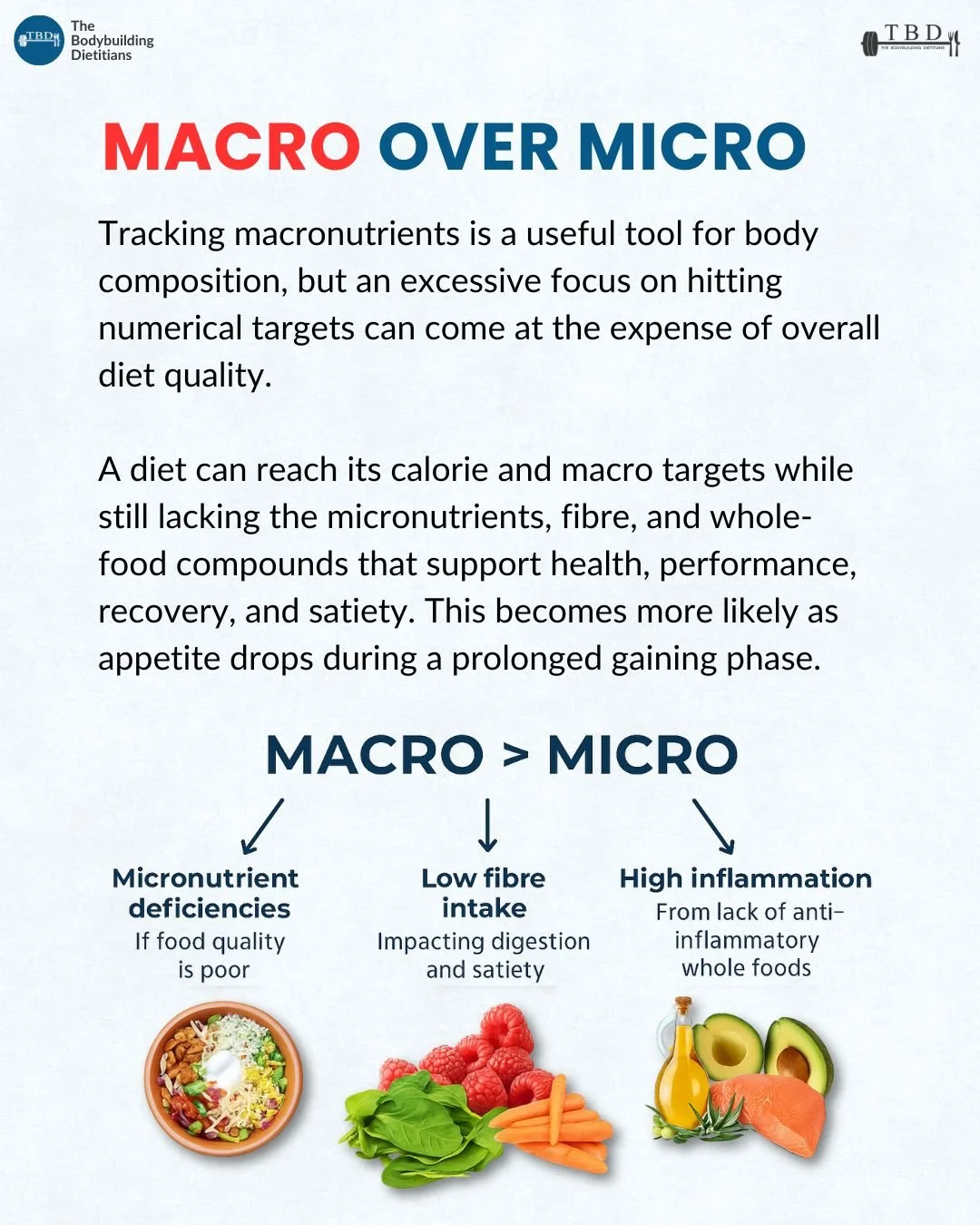
Pattern 1: Macro Over Micro
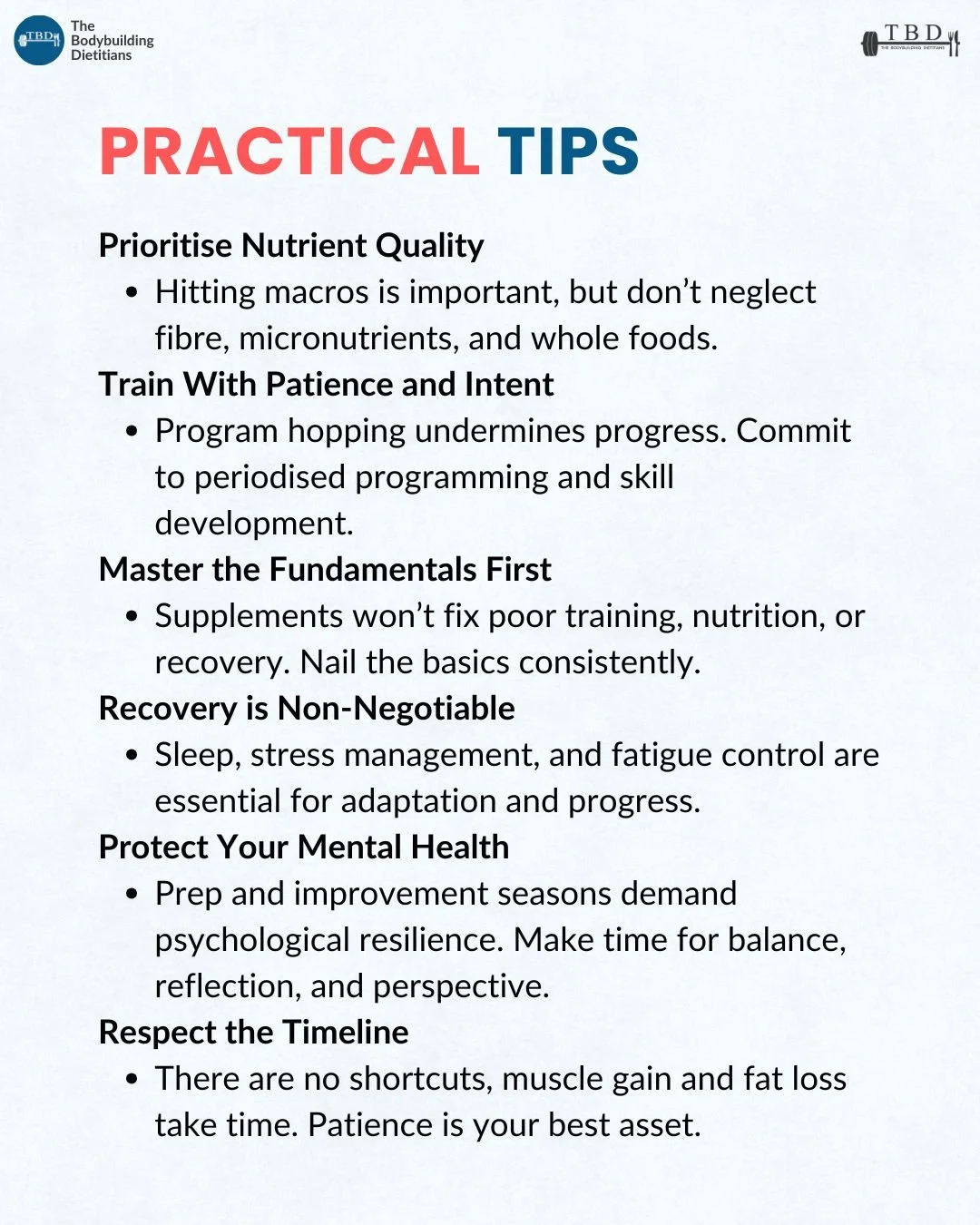
Tracking macronutrients is a useful tool for body composition management, but an excessive focus on hitting numerical targets can come at the expense of overall diet quality. A diet can reach its calorie and macro targets while still lacking the micronutrients, fibre, and whole-food compounds that support health, performance, recovery, and satiety.
This pattern becomes more likely as appetite drops during prolonged gaining phases (where lifters lean on calorie-dense, macro-friendly foods to hit higher targets) or as decision fatigue sets in during extended cuts (where the same 6 to 8 macro-friendly foods get rotated indefinitely). The result is a diet that looks structurally correct on paper but delivers systematically less of the micronutrient and phytonutrient variety that supports long-term progress.
The specific signs that macro-over-micro thinking is affecting progress include: fibre intake sitting consistently below 25 to 30 grams per day despite normal calorie levels, a food rotation of fewer than 10 to 12 distinct foods repeated most weeks, minimal vegetable intake outside of a single serving alongside dinner, and reliance on ultra-processed macro-fortified products (protein bars, protein-fortified snacks) making up a substantial share of the daily protein target.
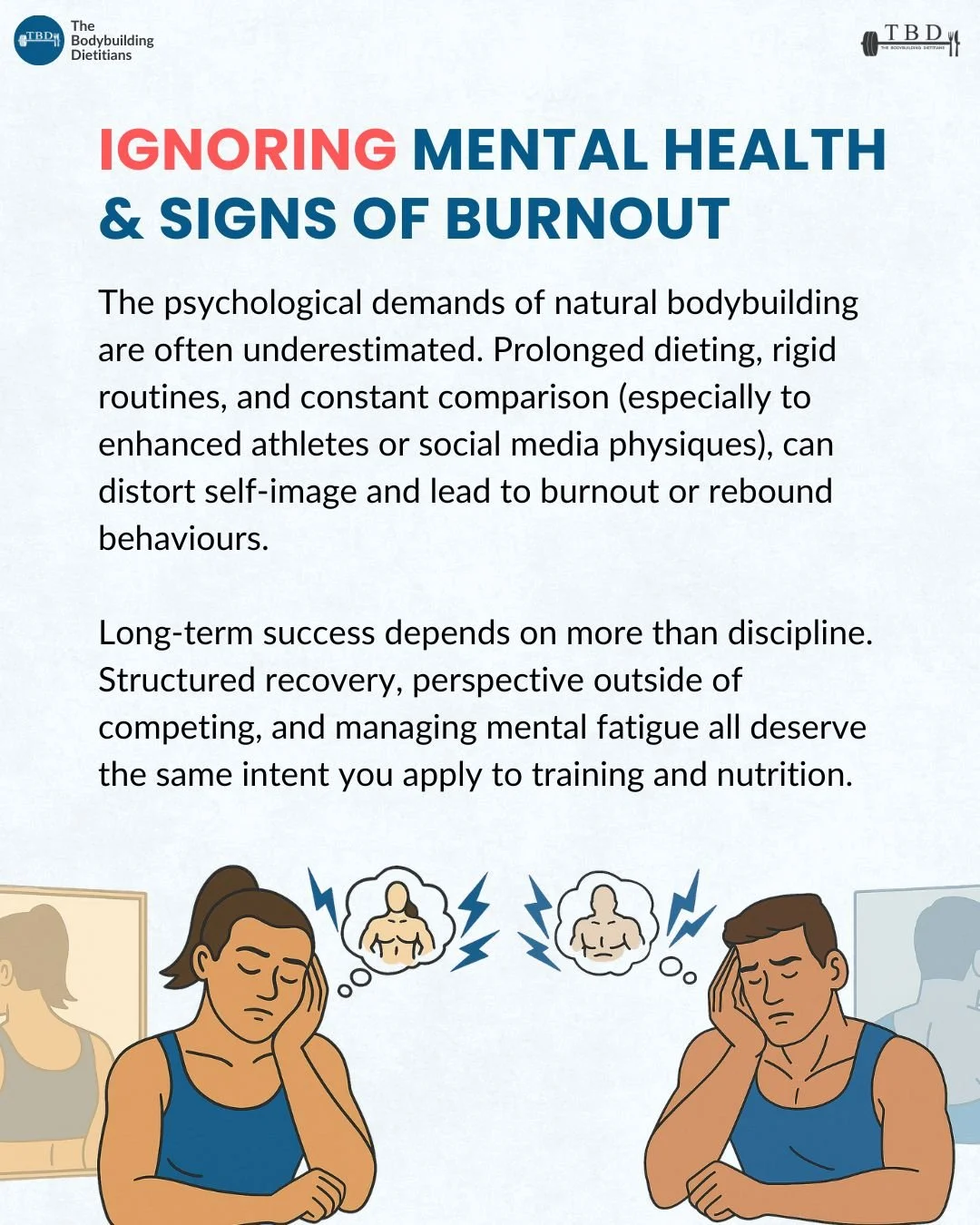
Pattern 2: Ignoring Mental Health and Signs of Burnout
The psychological demands of natural bodybuilding are often underestimated. Prolonged dieting, rigid routines, restricted social eating, and constant comparison (especially to enhanced athletes or heavily filtered social media physiques) can distort self-image, drive perfectionist patterns, and lead to burnout or rebound behaviours that end careers or lead to extended breaks from training.
Long-term success depends on more than discipline. Structured recovery, perspective outside of competing, and managing mental fatigue all deserve the same intent applied to training and nutrition. The lifters who sustain competitive careers over decades tend to have deliberately built in the psychological infrastructure that supports sustained effort, rather than assuming that discipline alone will carry them through.
Specific signs of accumulating mental health strain in physique athletes include: persistent thoughts about food beyond the practical needs of daily eating, difficulty enjoying social occasions that involve food, sustained mood decline that tracks with dieting phases, difficulty transitioning out of prep back into normal eating, elevated anxiety around body composition changes, and comparison behaviours that consistently produce negative emotional states. Any one of these in isolation is normal in the context of prep. Multiple appearing simultaneously, or any single one becoming persistent, warrants attention beyond the training and nutrition variables.
The specific interventions that support psychological sustainability in physique athletes include: structured off-season phases that deliberately reduce nutrition rigidity and food focus, limiting exposure to social media content that drives comparison patterns, maintaining relationships and interests outside of the sport, working with a coach or practitioner who can flag patterns the lifter may not see themselves, and taking meaningful breaks from competitive prep between shows rather than running back-to-back preps that don't allow psychological recovery.
This is a genuine limiter on long-term progress in the sport, and one that tends to be discussed less than the training and nutrition variables despite affecting career longevity as much as either. For readers thinking about the sustainability of the lifestyle beyond any single prep, our article on bodybuilding and balance covers the 90/10 framing that supports sustained effort without producing the specific patterns that lead to burnout.
If any of the specific signs above resonate strongly with your current situation, working with a qualified mental health practitioner alongside your training and nutrition support is worthwhile. Physique-focused environments don't always make this obvious, but the professionals with expertise in disordered eating, body image, and athletic burnout can meaningfully shift outcomes for lifters who are experiencing these patterns.
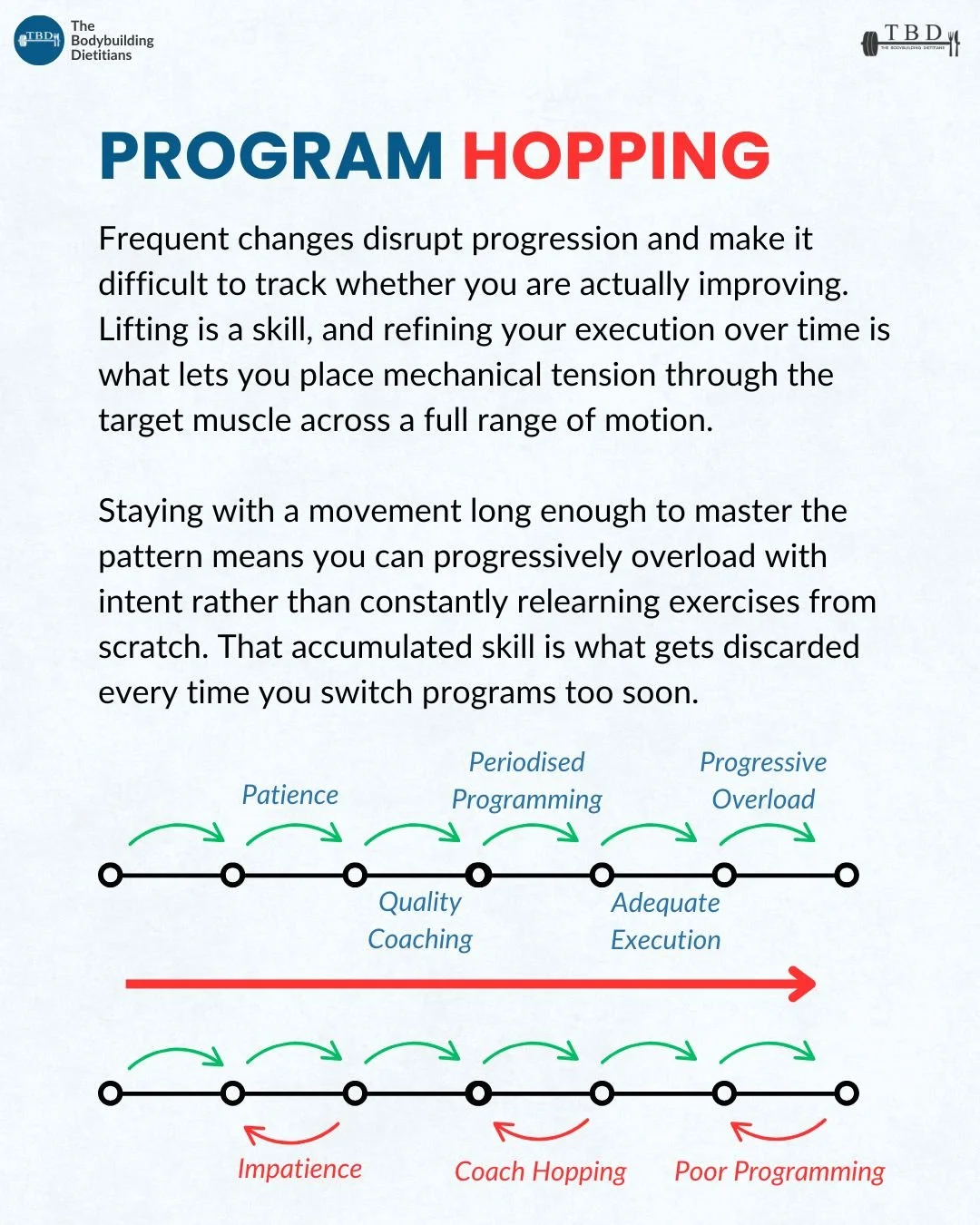
Pattern 3: Program Hopping
Frequent changes to training programs disrupt progression and make it difficult to track whether the current approach is actually working. Lifting is a skill, and refining execution over time is what lets a lifter place mechanical tension through the target muscle across a full range of motion. That accumulated skill is discarded every time programs are switched too soon.
Staying with a movement long enough to master the pattern means progressive overload happens with intent rather than as a constant relearning process. The lifters who make sustained progress across years tend to commit to programs for months rather than weeks, and to specific exercise selections for longer than that.
The specific signs of program hopping affecting progress include: switching training programs every 4 to 8 weeks based on new information rather than results, chasing every new training methodology that appears on social media, changing coaches or program sources multiple times per year, exercises rotating in and out of the program before the lifter has developed technical mastery, and difficulty answering the question "am I stronger than I was three months ago" for specific lifts because the exercises have changed.
The correction is to commit to a specific program for a meaningful duration (typically 8 to 16 weeks depending on the training block structure), assess whether progression is happening on the specific lifts in the program, and only make changes based on actual results rather than the appeal of a novel approach. Programs that produce progression over 12 weeks should generally be continued rather than replaced.
Pattern 4: Chasing Instant Gratification
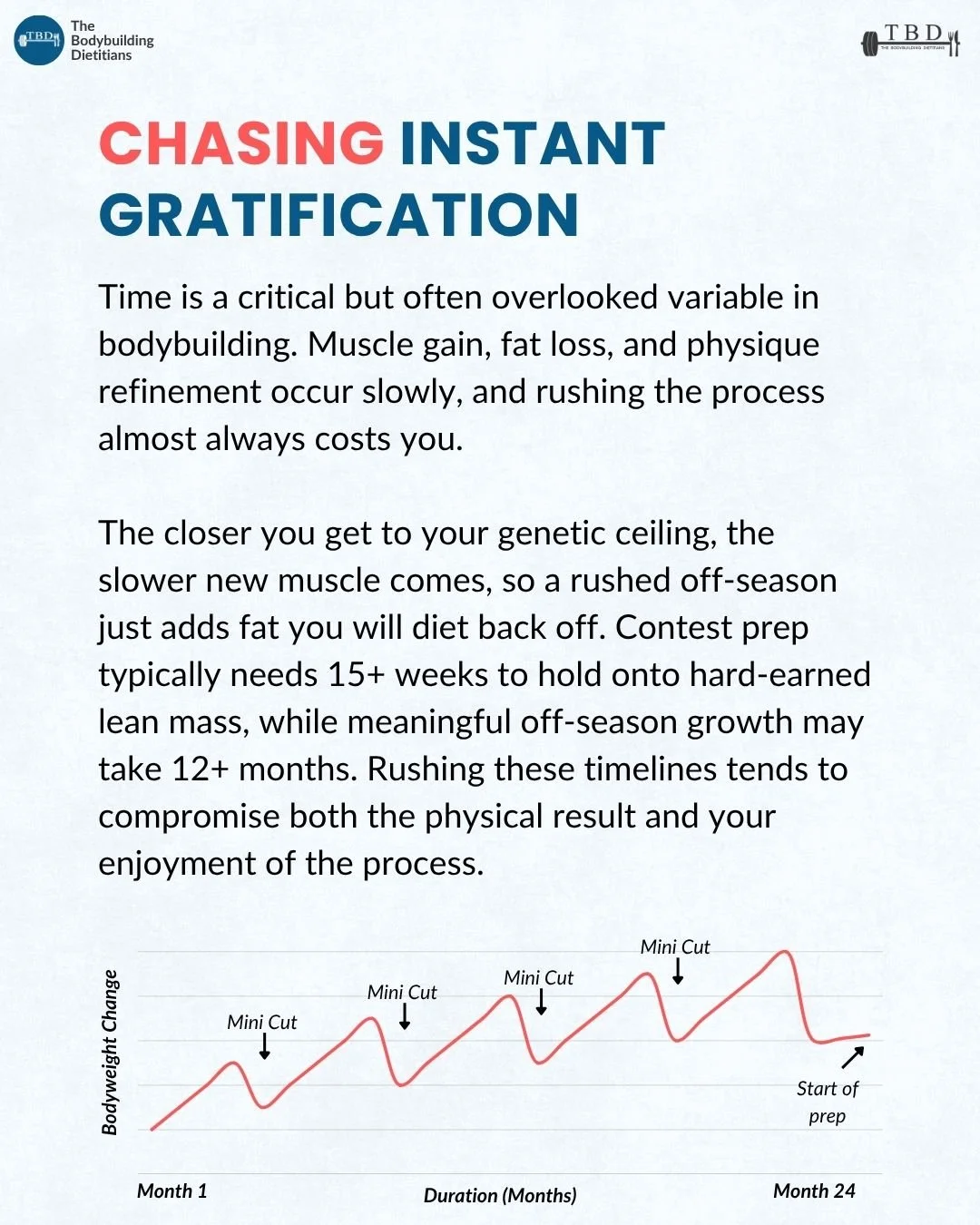
Time is a critical but often overlooked variable in bodybuilding. Muscle gain, fat loss, and physique refinement occur slowly, and rushing the process almost always costs progress rather than accelerating it.
The specific pattern is: running short gaining phases (4 to 8 weeks) followed by mini-cuts to reverse the fat gain, then another short gaining phase, then another mini-cut. The lifter feels like they're being productive because each phase is deliberately structured, but the cumulative effect is that the total time spent in an actual sustained surplus is too short for meaningful muscle accrual to occur. Twelve months of this pattern typically produces less muscle gain than a single 20 to 30 week sustained gaining phase would have produced in the same period.
The closer a lifter gets to their genetic ceiling, the slower new muscle comes, so a rushed off-season just adds fat that will need to be dieted back off without producing the muscle gain that would have justified the fat gain. Contest prep typically needs 15 or more weeks to hold onto hard-earned lean mass, while meaningful off-season growth may take 12 or more months in advanced lifters. Rushing these timelines tends to compromise both the physical result and the psychological enjoyment of the process.
The specific correction depends on where the lifter sits. For lifters in the pattern of short gaining phases followed by mini-cuts, committing to a single sustained gaining phase of at least 20 to 30 weeks (with the fat gain understood as expected and acceptable) tends to produce more meaningful muscle accrual than a year of shorter cycles. For lifters approaching prep, allowing 15 to 20 weeks rather than 8 to 12 tends to preserve substantially more muscle mass at the same target condition.
Pattern 5: Overlooking Recovery
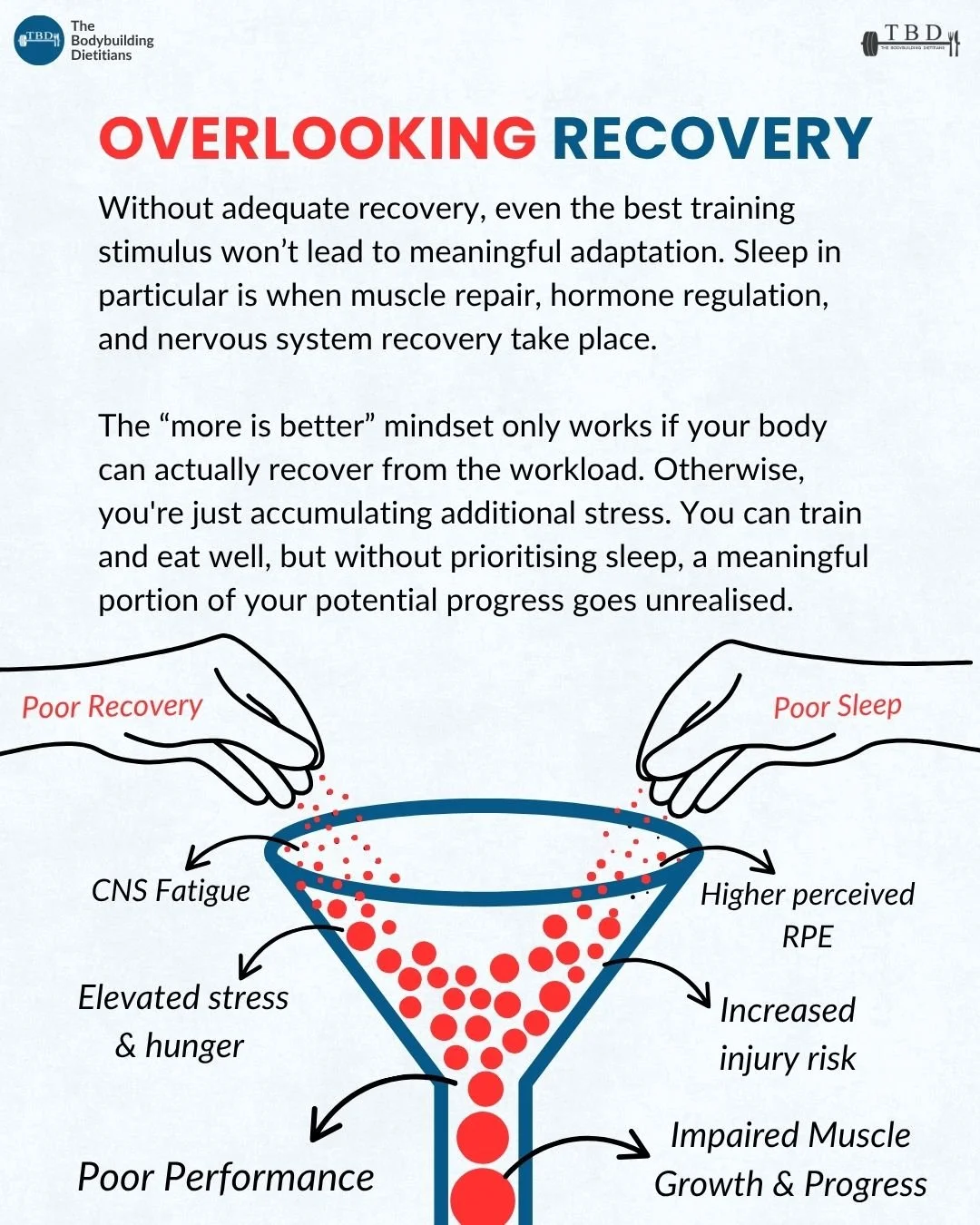
Without adequate recovery, even the best training stimulus won't lead to meaningful adaptation. Sleep in particular is when muscle repair, hormone regulation, and nervous system recovery take place. The "more is better" mindset only works if the body can actually recover from the workload; otherwise the training just accumulates additional stress without producing the adaptation it's designed to drive.
Specific signs that recovery is currently limiting progress include: sleep consistently below 6.5 to 7 hours per night for extended periods, elevated resting heart rate compared to baseline, worsening rather than improving training performance over consecutive weeks, persistent muscle soreness that doesn't resolve between sessions, elevated hunger disproportionate to calorie intake, and reduced motivation for training that doesn't reflect the normal fluctuations of a hard training block.
The correction depends on which specific recovery variable is compromised. For chronic sleep restriction, extending sleep by 30 to 60 minutes per night for a few weeks tends to produce noticeable improvements in training performance and recovery. For accumulated fatigue from sustained high volume, a deload week at 40 to 50 percent of normal volume typically resolves the fatigue and allows subsequent training to progress again. For stress-driven recovery limitation, addressing the underlying life circumstances (workload, sleep environment, relationships) matters more than training-side adjustments.
For a more detailed look at how sleep specifically affects body composition and training outcomes, our article on sleep and body composition covers the mechanisms and practical strategies.
Pattern 6: Majoring in the Minors
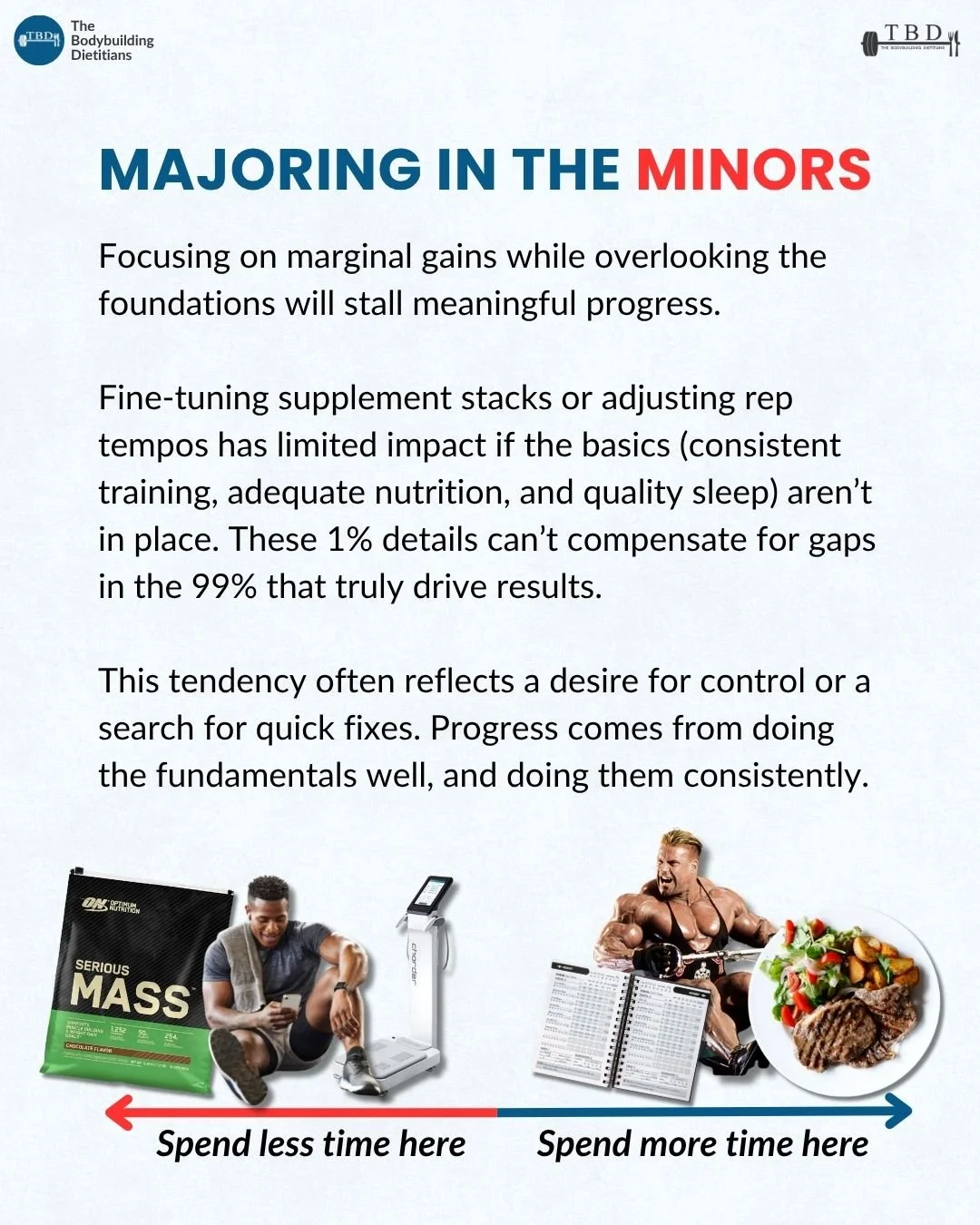
Focusing on marginal gains while overlooking the foundations will stall meaningful progress. Fine-tuning supplement stacks or adjusting rep tempos has limited impact if the basics of consistent training, adequate nutrition, and quality sleep aren't in place. These 1 percent details can't compensate for gaps in the 99 percent that truly drive results.
This pattern often reflects a desire for control or a search for quick fixes. Optimising specific details is easier and more emotionally satisfying than addressing the fundamentals, because the details are small enough to control precisely while the fundamentals require sustained behaviour change. Lifters spending significant attention on the details often report feeling productive without producing the outcomes the attention would have driven if directed at the fundamentals instead.
The specific correction is a deliberate audit of where attention is currently going versus where the actual limiting variable sits. If the answer is that attention is going to supplements, timing details, and specific exercise selections while sleep is short, training progression has stalled, or calorie intake isn't matched to the phase, the correction is to redirect attention to the fundamentals until they're actually in place. Progress comes from doing the fundamentals well and doing them consistently, and the 1 percent details only start to matter once the 99 percent is genuinely dialled in.
Pattern 7: Supplements Before Nutrition
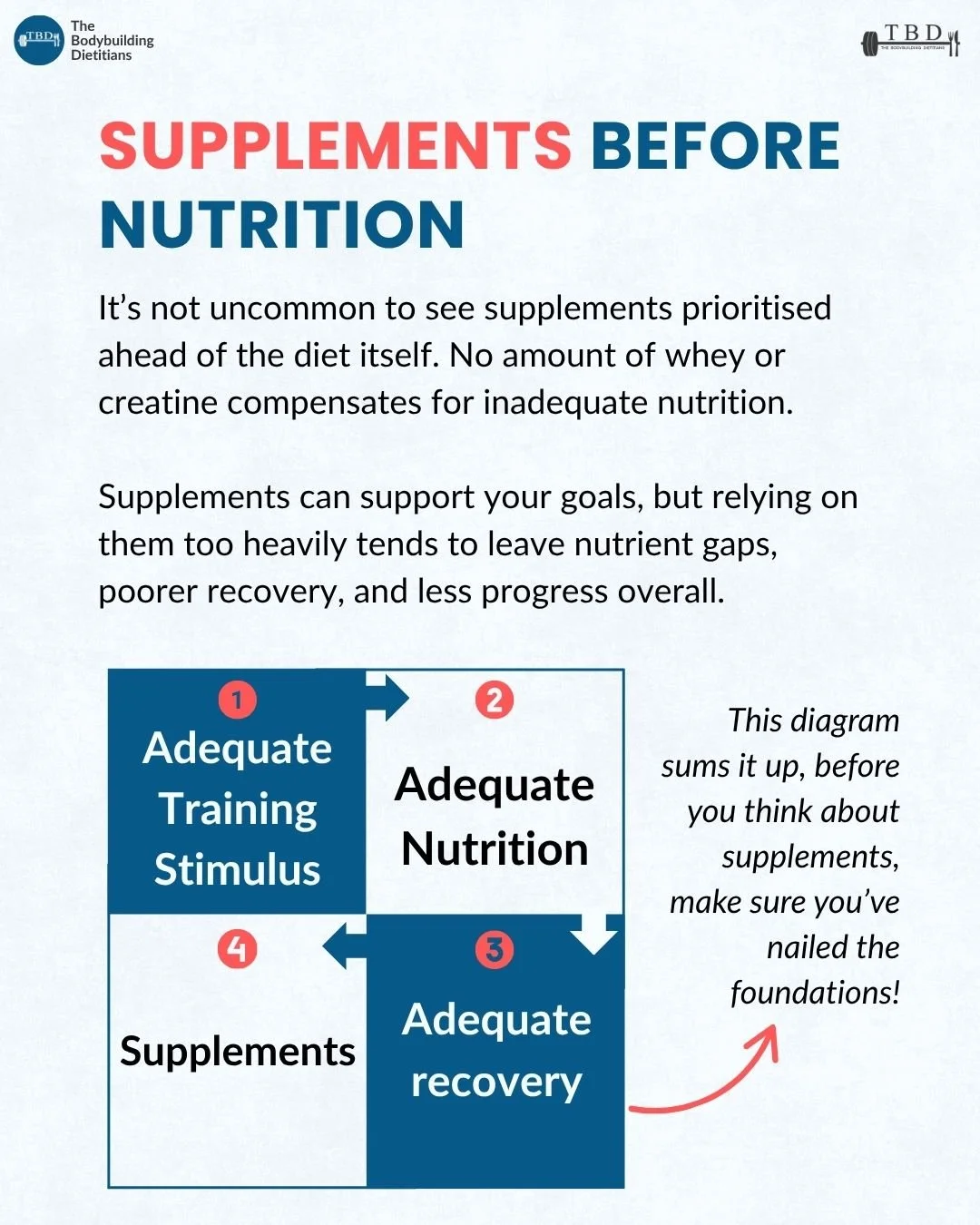
It's not uncommon to see supplements prioritised ahead of the diet itself. No amount of whey protein or creatine compensates for inadequate nutrition. Supplements can support goals when the underlying diet is well-structured, but relying on them too heavily tends to leave nutrient gaps, poorer recovery, and less progress overall.
The specific version of this pattern that shows up most commonly involves lifters using protein powder to hit protein targets while whole-food protein intake sits meaningfully below what it could be, or relying on pre-workout products to sustain training intensity while sleep and food intake sit compromised, or building a supplement stack of 6 to 10 products while the diet is missing basic dietary variety across vegetables, fruit, whole grains, and legumes.
The correction is to structure supplements as additions to a well-composed diet rather than as substitutes for what the diet should provide. Protein powder is useful when total daily protein target requires supplementation to reach, not as a primary source when whole-food alternatives are available. Pre-workout products can support acute training performance but don't compensate for undernutrition. Multivitamins and other nutrient-adjacent supplements are worth including when specific gaps warrant them, not as a general insurance policy against a low-quality diet.
Not Sure Which Pattern Is Actually Limiting Your Progress?
The seven patterns above rarely appear in isolation. Most experienced lifters whose progress has slowed have at least two or three of them operating simultaneously, and identifying which one is the current bottleneck requires honest assessment across training, nutrition, recovery, and psychological variables together. Our team works with clients on this specifically, matched to their individual context rather than assuming the same pattern is limiting for everyone.
How to Audit Yourself Against These Patterns
The seven patterns above are diagnostic categories rather than strict definitions. Most experienced lifters have at least one or two operating in some form, and the practical work is identifying which one is currently the largest limiter on progress.
Start with the fundamentals. Before assessing any of the specific patterns, honestly answer three questions. Is training progressing on the specific lifts you're doing (weight or reps increasing across weeks or months, not just from session to session)? Is calorie intake actually matched to the phase you're in (a sustained surplus for gaining, a sustained deficit for fat loss, or maintenance)? Is sleep consistently at 7 or more hours per night? If any of these three answers is no, that gap is almost certainly your current limiter regardless of which other patterns are also present.
Assess the specific patterns in order of impact. If the fundamentals are in place, work through the patterns in the order they appear in this article. Macro-over-micro thinking tends to be a slower-building limiter that shows up over months. Mental health strain shows up as sustained mood changes and rigidity. Program hopping shows up as difficulty answering "am I stronger than three months ago." Instant gratification shows up as multiple short gaining or cutting cycles that produce little net progress. Recovery gaps show up as declining training performance and elevated hunger. Majoring in minors and supplements-before-nutrition tend to co-occur and show up as disproportionate attention to details relative to fundamentals.
Address one pattern at a time rather than all seven simultaneously. Attempting to fix multiple patterns at once tends to produce partial improvements across all of them rather than meaningful change in any single one. Identifying the largest current limiter and addressing it specifically over 8 to 12 weeks typically produces more meaningful progress than an attempted overhaul across all seven areas.
Give the correction time to produce results. Fixing a recovery gap produces measurable performance improvements within 2 to 4 weeks. Fixing a nutrition gap produces measurable body composition changes over 4 to 12 weeks. Fixing a training progression issue produces measurable strength gains over 6 to 16 weeks depending on the specific issue. Attempting to reassess whether the correction is working within a week or two typically leads to premature abandonment of an intervention that would have produced results with time.
Practical Takeaways
Progress slowing in experienced lifters rarely reflects a lack of effort. The limiting variable is usually one of seven specific patterns that hold physique progress back, and identifying which pattern currently applies matters more than adding new variables to optimise.
The seven patterns are: macro-over-micro thinking (nutrient quality suffers while macros hit), ignoring mental health and burnout signs, program hopping (switching training too frequently), chasing instant gratification (rushing timelines that muscle gain and fat loss actually require), overlooking recovery (particularly sleep), majoring in the minors (fine-tuning details while fundamentals sit compromised), and supplements before nutrition (relying on supplements to compensate for gaps in the diet).
Two of the seven patterns are particularly under-discussed relative to their impact: mental health strain and instant gratification. Both are limiters that develop over months and years rather than showing up acutely, which makes them easy to overlook until they've meaningfully compromised progress or career longevity.
Before assessing any specific pattern, verify the three fundamentals: training is progressing on specific lifts, calorie intake matches the phase, and sleep is consistently at 7 or more hours. If any of these is compromised, that gap is almost certainly the current limiter regardless of which other patterns are also present.
Address one pattern at a time rather than attempting to fix all seven simultaneously. Give the correction 4 to 12 weeks to produce measurable results before reassessing whether the intervention is working.
Progress usually comes from identifying and fixing the currently limiting pattern rather than layering additional refinements onto variables that aren't the actual bottleneck. The lifters who make sustained progress over years tend to be honest about which variable is currently limiting them and address it directly.
Frequently Asked Questions
Why has my physique progress stalled despite consistent training?
The most common cause in experienced lifters is one of seven specific patterns rather than a lack of effort in general. These include macro-over-micro thinking, ignoring signs of mental health strain, program hopping, chasing instant gratification through rushed timelines, overlooking recovery, majoring in the minors, and prioritising supplements over nutrition. Identifying which one is currently limiting your progress requires an honest audit of training, nutrition, recovery, and psychological variables together. Fixing the currently limiting pattern tends to produce more progress than adding new variables to optimise.
How do I know if I'm program hopping?
Common signs include switching training programs every 4 to 8 weeks based on new information rather than actual results, changing coaches or program sources multiple times per year, difficulty answering "am I stronger than I was three months ago" for specific lifts because the exercises have changed, and chasing new training methodologies that appear on social media before evaluating whether the current program is producing progression. The correction is to commit to a specific program for 8 to 16 weeks minimum and only change based on actual results rather than novelty.
How long should a gaining phase last?
Meaningful off-season growth may take 12 or more months in advanced lifters, and productive gaining phases typically run for a minimum of 20 to 30 weeks at a single stretch. The specific pattern of running short 4 to 8 week gaining phases followed by mini-cuts prevents sustained time in a surplus and typically produces less muscle gain than a single 20 to 30 week sustained phase would have produced in the same period. Contest prep typically needs 15 or more weeks to hold onto hard-earned lean mass.
What are the signs of burnout in bodybuilders?
Specific signs include persistent thoughts about food beyond the practical needs of daily eating, difficulty enjoying social occasions involving food, sustained mood decline that tracks with dieting phases, difficulty transitioning out of prep back into normal eating, elevated anxiety around body composition changes, and comparison behaviours that consistently produce negative emotional states. Any one of these in isolation is normal in the context of prep, but multiple appearing simultaneously or any single one becoming persistent warrants attention. Working with a qualified mental health practitioner alongside training and nutrition support is worthwhile when these patterns are present.
How important is sleep for muscle gain?
Sleep is one of the largest recovery variables for lifters and often the most under-optimised. Chronic sleep restriction under 6.5 to 7 hours per night impairs muscle protein synthesis, reduces training performance, elevates perceived exertion, and disrupts the hormonal environment that supports muscle growth. For most trained lifters, aiming for 7 to 9 hours per night produces measurable improvements in training and recovery within 2 to 4 weeks of consistent implementation.
Can supplements make up for poor nutrition?
No. Supplements sit at the bottom of the muscle gain priority hierarchy for a reason. They can support well-structured training and nutrition modestly but cannot compensate for gaps in either. Whey protein doesn't fix inadequate whole-food protein intake, creatine doesn't fix insufficient training progression, and pre-workout products don't fix undernutrition or poor sleep. The correct approach is to structure supplements as additions to a well-composed diet rather than as substitutes for what the diet should provide.
If you want help identifying which of these seven patterns is currently limiting your progress and building a plan that addresses the actual bottleneck rather than continuing to refine variables that aren't the limiting factor, our team can build a plan matched to your specific situation. You can enquire about coaching or book a consultation with our team.