Macro tracking is an approximation, not a precise measurement. Understanding the sources of unavoidable error, how they stack up, and how much precision your goal actually requires changes how usefully and sustainably tracking is applied.
Macro tracking is inherently imprecise because multiple independent sources of error accumulate simultaneously. Food labels are legally permitted to be up to 20 percent away from their stated values in many countries. The macronutrient content of whole foods varies with ripeness, animal feed, soil quality, and cut. Cooking changes the weight and water content of foods, altering macronutrient concentration per gram if the same database entry is used for both raw and cooked weights. Nutrition databases are built on population averages rather than the specific item being eaten. These errors stack together, meaning even meticulous tracking produces an approximation rather than an exact figure. The appropriate response is to match tracking precision to the goal, maintain a consistent method so error is stable rather than random, and use the direction of progress as the primary feedback signal rather than the absolute accuracy of the numbers.
Macro tracking is one of the most practically useful tools available for managing food intake around body composition and performance goals. It is also, by design, an approximation. The numbers that appear in a tracking app represent estimates derived from databases, labels, and measurement conventions that each carry their own margin of error, and those errors accumulate independently, meaning the gap between what the app shows and what is actually being eaten is larger and more systematic than most people tracking to the gram assume.
Understanding this does not undermine the value of tracking. It changes how tracking is applied: what level of precision is worth pursuing, what method decisions actually matter, and when the consistency of the approach is more useful than the accuracy of the numbers.
How Far Off Can Food Labels Be?
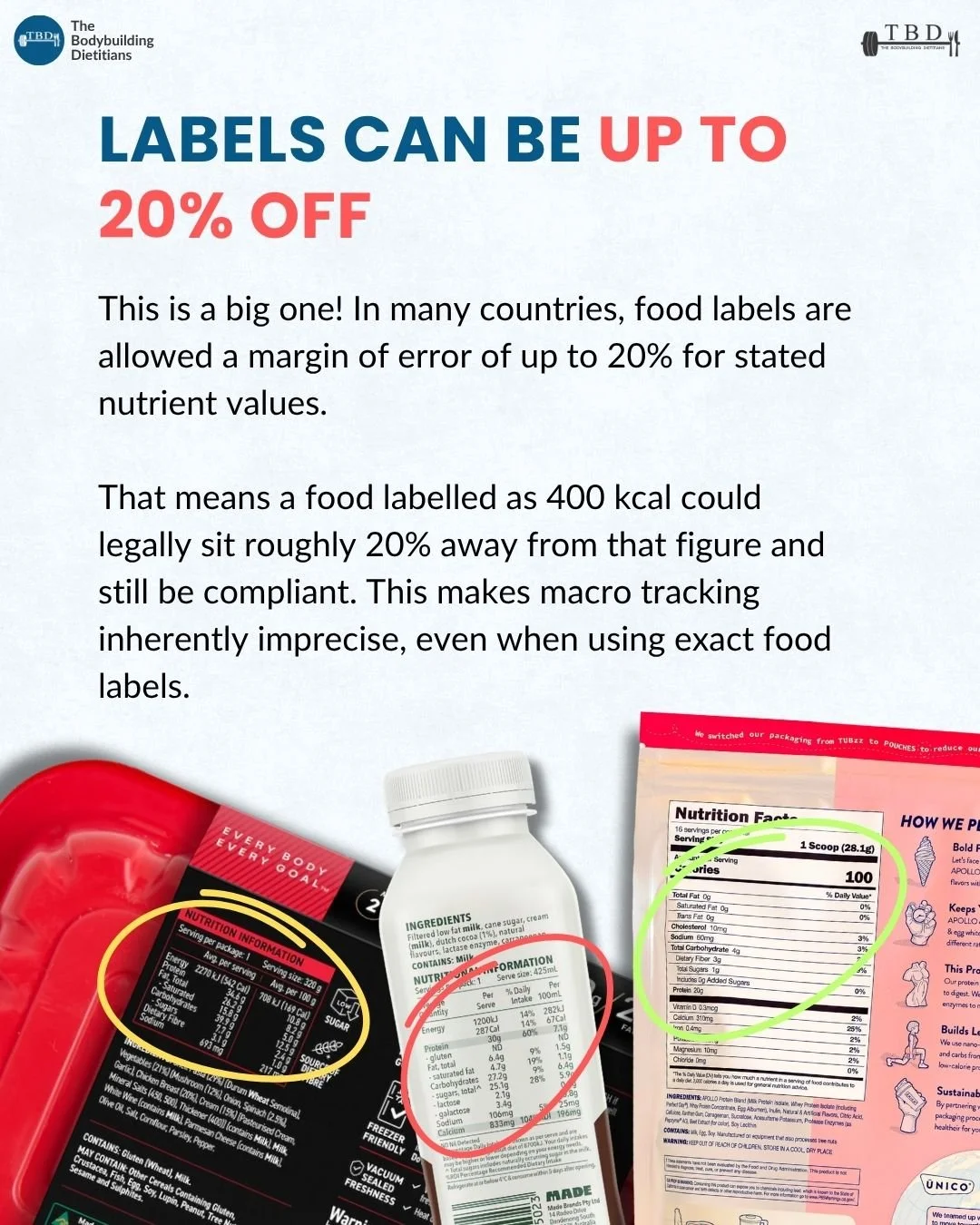
Food labels are the most familiar data source in macro tracking, and they carry a margin of error that most people tracking are not aware of. In many countries, including Australia, the regulatory tolerance for nutrient values on food labels allows stated values to sit approximately 20 percent away from the actual nutrient content and remain compliant. A food labelled at 400 calories could legally contain anywhere from around 320 to 480 calories and still meet labelling requirements.
This is not a flaw in any specific product. It reflects the practical reality that the exact nutrient content of a manufactured food varies across batches, production runs, and ingredient lots, and that label values are derived from analysis of representative samples rather than continuous real-time measurement of every unit produced.
The practical implication is that even when a food is logged from its own product label, the figure entered may be 10 to 20 percent away from the actual energy and macronutrient content of that specific unit on that day. For a food contributing 400 calories to a daily total, that represents an absolute error of up to 80 calories from a single product. Across a full day of eating, multiple such errors accumulate in the same direction or different directions, producing a total estimated intake that may differ from actual intake by several hundred calories even in a well-tracked day.
The label margin is the largest single source of systematic error in macro tracking and also the one least within the tracker's control. Knowing it exists is more useful than trying to compensate for it, because the compensation itself would require accurate data that is not available at the point of logging.
Why Does the Nutrient Content of the Same Food Vary?
Nutrition databases are built on population averages derived from analyses of multiple samples of each food. The figure for chicken breast in a food database reflects an average across many samples, and the specific chicken breast being eaten may differ meaningfully from that average depending on the bird's breed, feed, age, farming conditions, and how the meat was handled after processing.
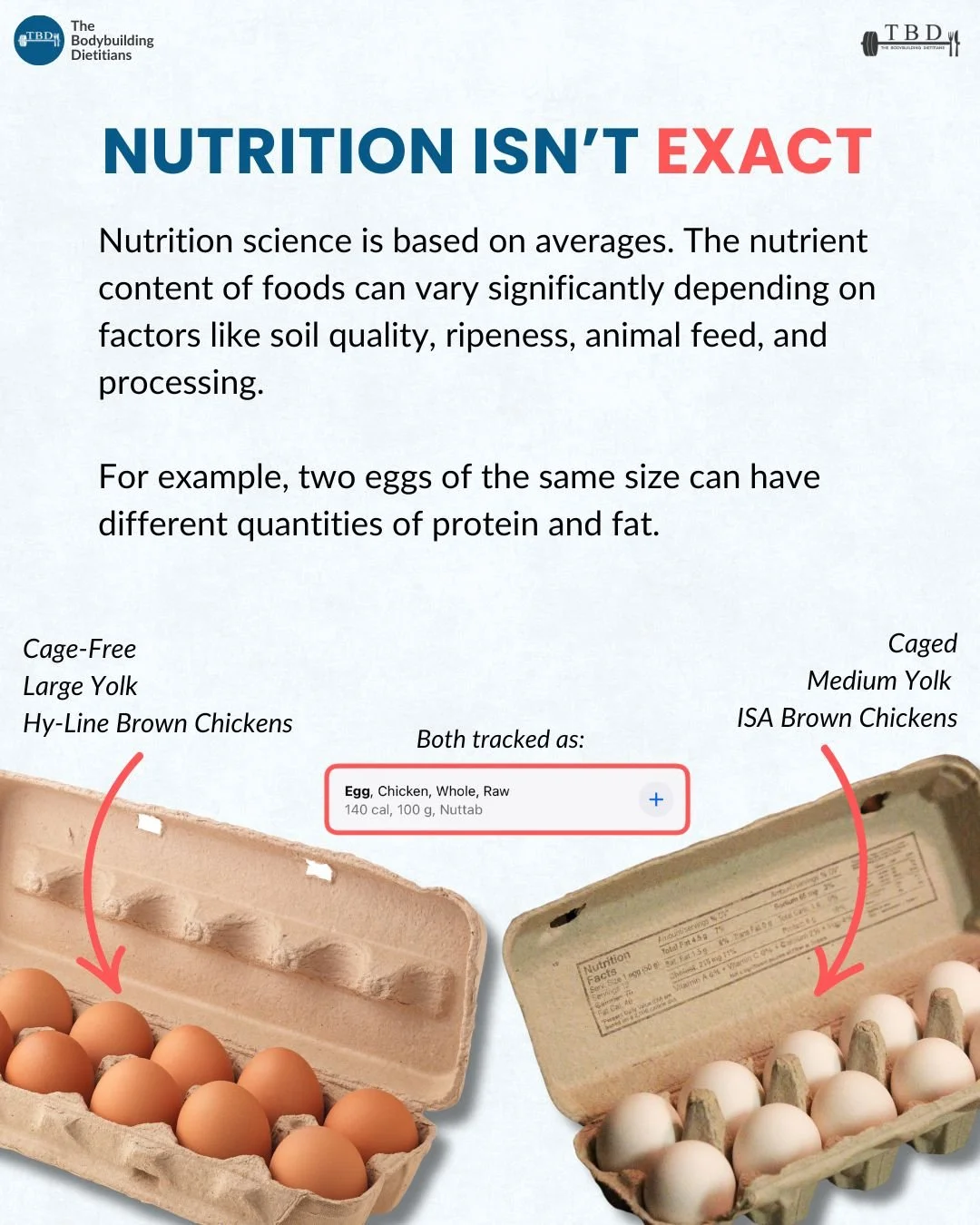
The same applies across all whole foods. The protein content of an egg varies with the breed of chicken that laid it, the size of the yolk relative to the white, and the conditions in which the bird was raised. Two eggs of identical visual size from different production systems, tracked under the same generic database entry, may deliver meaningfully different amounts of protein and fat. Both are tracked identically. Neither is tracked exactly correctly.
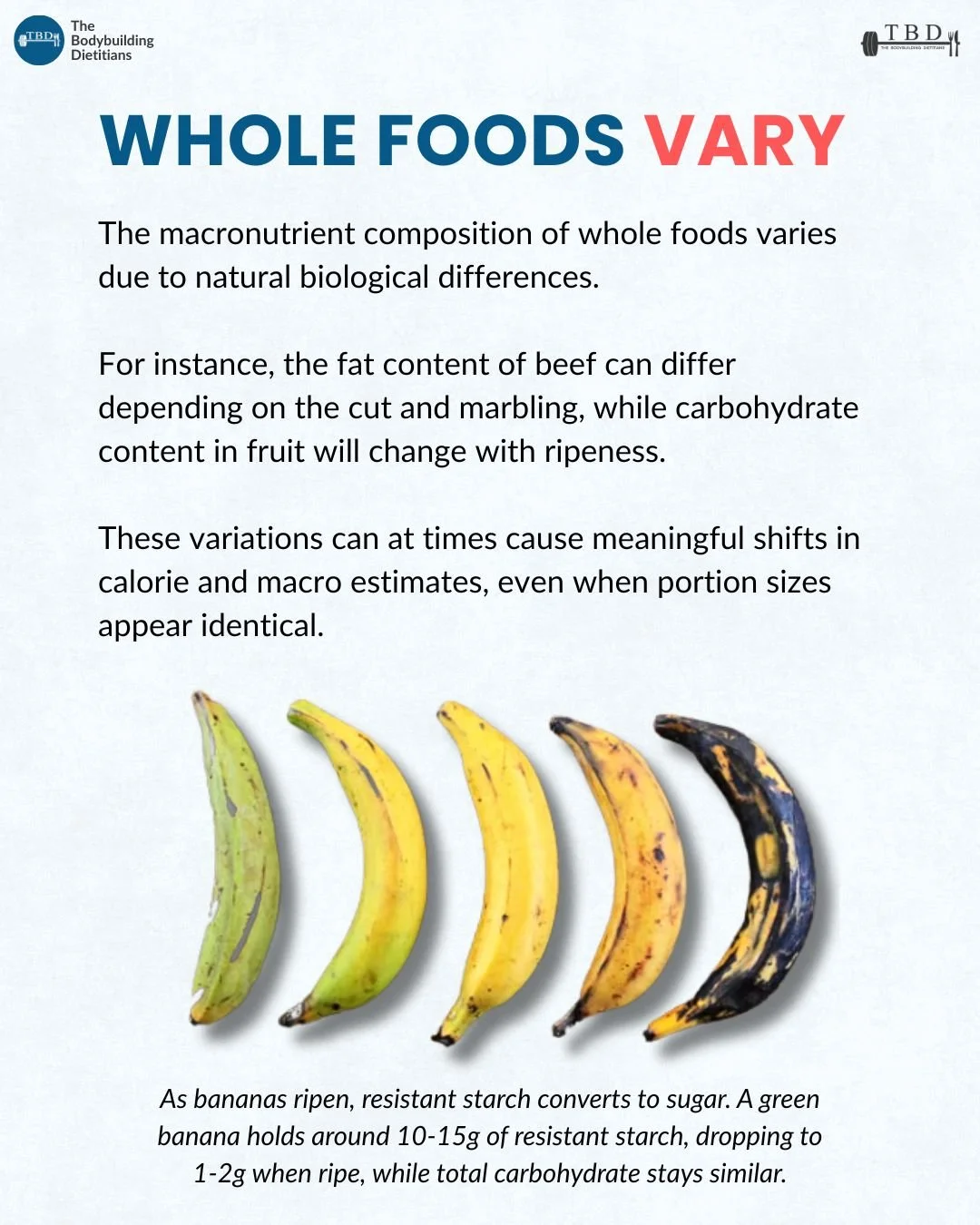
For fruit, ripeness is one of the more significant sources of nutrient variation. As a banana ripens, resistant starch is progressively converted to free sugar. A green banana holds approximately 10 to 15 grams of resistant starch, which falls to around 1 to 2 grams in a fully ripe banana. Total carbohydrate stays broadly similar, but the type changes considerably. A food database entry for banana reflects an average that may not represent either the underripe or the fully ripe version being eaten, and the metabolic handling of the resistant starch versus the free sugar version differs in ways that a single database value cannot capture.
For beef, fat content varies substantially with cut and marbling. A database entry for lean ground beef reflects a different fat and calorie content from a marbled ribeye, and even within the same cut, the fat content varies between individual portions depending on the specific piece. The database entry used is an approximation for the specific cut, and the specific cut is itself variable.
These variations are not errors in the database. They are an accurate reflection of biological variability in natural foods, and they cannot be resolved by more careful logging because the specific nutrient content of the specific item being eaten is genuinely unknown at the point of consumption.
How Does Cooking Change the Macro Content Per Gram?
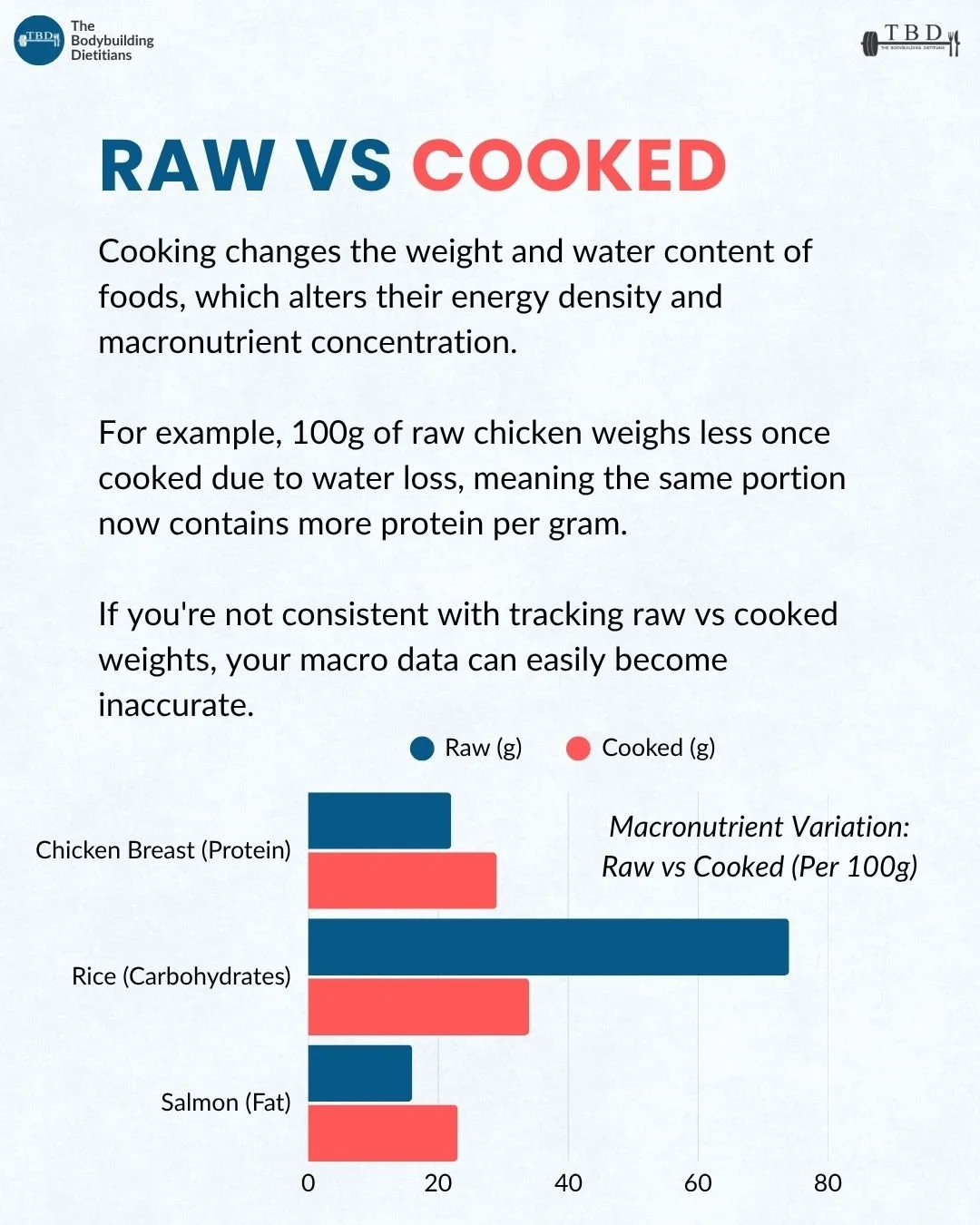
Cooking changes the weight and water content of most foods, which alters the macronutrient concentration per gram of cooked food without changing the total macronutrient content of the original raw portion. This creates a tracking inconsistency that is one of the most common practical sources of error in food logging.
When 100 grams of raw chicken breast is cooked, it loses water through evaporation and loses some fat if rendered, ending up lighter than the raw portion. The protein content stays essentially the same in absolute terms, but per gram of the cooked product, protein concentration is now higher than the raw database value reflects. If the cooked weight is entered using a raw chicken breast database entry, the calculation overstates what was actually eaten relative to the cooked weight logged.
Conversely, when 100 grams of dry rice is cooked, it absorbs water and becomes significantly heavier, perhaps two and a half to three times its dry weight. The total carbohydrate content stays the same in absolute terms, but per gram of cooked rice, carbohydrate concentration is much lower than the raw or dry database value. If the cooked weight is entered using a dry rice database entry, the carbohydrate total is dramatically overstated.
Salmon provides a third pattern: cooking renders and redistributes fat, modifying the fat-per-gram figure depending on whether fat is retained in the pan or absorbed back into the flesh. The bar chart in the carousel illustrates these three patterns clearly: rice carbohydrate drops from approximately 78 grams per 100 grams raw to approximately 28 grams per 100 grams cooked; chicken breast protein increases from approximately 22 grams raw to approximately 31 grams cooked per 100 grams; and salmon fat changes depending on cooking method.
The practical resolution is to be consistent: either track all foods raw and use raw database entries, or track all foods cooked and use cooked database entries, but do not mix the two. The ratio of raw to cooked weight for commonly eaten foods can be used as a conversion factor when necessary. The specific method is less important than applying it consistently, because consistency converts a potentially large and variable error into a stable systematic offset that still accurately reflects the direction and relative magnitude of dietary changes.
How Do Crowd-Sourced Database Errors Add to the Problem?
Food tracking apps rely heavily on user-generated databases, where individual entries are created and submitted by users rather than verified against laboratory analysis. The quality of these entries varies considerably: some are accurate, sourced directly from product labels or verified databases; others contain errors introduced by incorrect serving size units, transcription mistakes, or entries that have been attributed to the wrong product.
When an app returns multiple results for the same food, the entries can show meaningfully different calorie and macro values. Selecting the wrong one, or selecting a crowd-sourced entry with a data error, introduces an additional and entirely avoidable source of inaccuracy.
The practical mitigation is to prioritise verified or barcode-scanned entries when they are available, and to cross-reference unfamiliar entries against the product label before logging. This does not eliminate the underlying label tolerance issue, but it removes the avoidable layer of crowd-sourced error on top of it.
For anyone committed to the most accurate tracking available, using a database with verified, laboratory-tested entries, such as the Australian Food Composition Database, as the reference for common whole foods provides a more reliable foundation than app-generated averages.
How Much Tracking Precision Does Your Goal Actually Require?
The most useful question in macro tracking is not how accurate is it possible to be, but how accurate does your specific goal require you to be. The answer to that question varies considerably between individuals and contexts, and calibrating tracking effort to match the actual requirement is more productive than pursuing maximum precision uniformly.
For someone tracking to support general health, a healthy body weight, or a flexible and sustainable approach to eating, a high degree of precision is neither necessary nor worth the cognitive effort. The goal tolerates a wide margin, and the benefit of tracking lies in building awareness of approximate intake patterns rather than hitting specific numbers. Logging consistently and honestly at a level of detail that reflects typical food choices provides useful directional feedback without requiring gram-level accuracy.
For someone managing an active fat loss phase or muscle gain phase with specific macro targets, tighter tracking becomes more relevant because the goal operates within a narrower margin. Here, the method decisions that reduce systematic error, consistent raw versus cooked weight tracking, verified food entries, a stable food selection that minimises variability, matter more. The goal is not to eliminate all error but to make the error stable and consistent, so that the tracking data reliably reflects what is changing rather than introducing noise.
For someone in the final weeks of a contest prep, where the margin between on-stage condition and off-stage is narrow and time is fixed, precision matters most. Here, every source of error that can be reduced without creating an unsustainable burden is worth addressing, and the gap between a tracked figure and actual intake is worth minimising through consistent method, verified entries, and stable food selection.
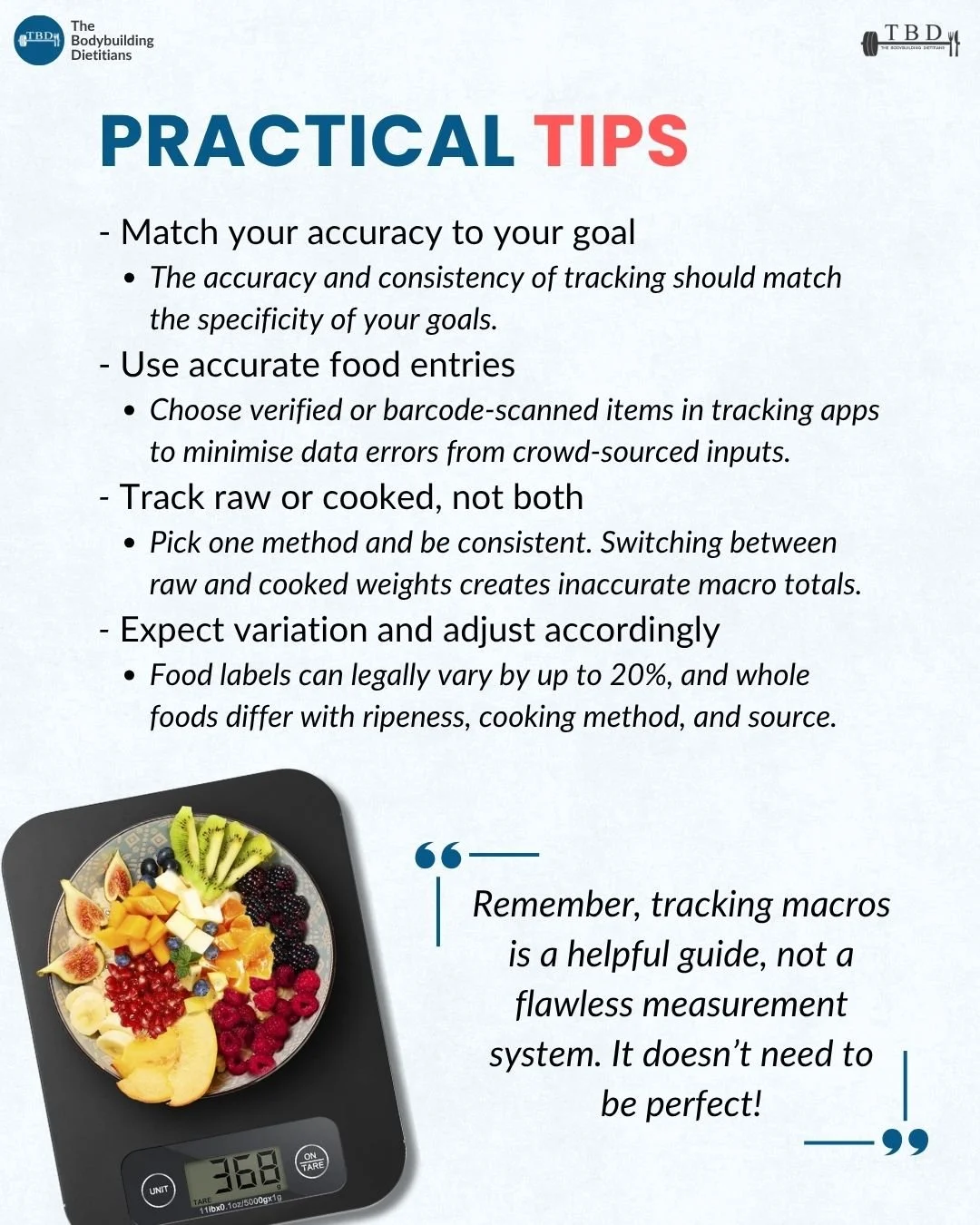
Tracking macros is a helpful guide, not a flawless measurement system. The numbers do not need to be perfect for tracking to be useful. What makes tracking productive is the consistency and honesty of the method, the stability of whatever error exists, and the use of progress monitoring across weeks rather than daily absolute figures as the primary feedback signal. How that approach is calibrated to the specific goal is part of what we work through with our coaching clients from the outset of any new phase.
What Practical Steps Reduce Tracking Error Most Effectively?
Given the unavoidable error sources described above, the most productive tracking improvements are those that reduce the variable and controllable components of error rather than trying to eliminate errors that cannot be controlled.
Choosing verified or barcode-scanned database entries over user-submitted crowd-sourced ones removes an avoidable layer of inaccuracy. The label on the product is still subject to the 20 percent regulatory tolerance, but it is a more reliable starting point than a crowd-sourced entry that may have been entered incorrectly.
Tracking raw or cooked consistently, rather than switching between the two or using a method that does not match the database entry, is the single most impactful method decision for eliminating the large errors that the raw-versus-cooked discrepancy can introduce. Picking one convention and applying it to all foods across all meals makes the error stable rather than variable.
Building a stable core food selection, the foods that appear consistently across most meals each week, and using the same verified entry for each each time, reduces variability in the database error component and makes week-to-week comparisons more reliable. This does not require a rigid or repetitive diet. It means the commonly eaten foods are tracked from consistently reliable entries rather than different entries each time.
Expecting a margin of error and adjusting the tracking process based on progress rather than absolute numbers is the most important conceptual shift. If scale weight is trending in the right direction across several weeks, the method is working regardless of whether the numbers are precisely accurate. If weight is not moving as expected, the first step is to consider whether total intake may be higher than tracked due to the error sources above, rather than immediately cutting calories further.
Practical Takeaways
Food labels in many countries are legally permitted to be up to 20 percent away from their stated nutrient values and remain compliant. A food labelled at 400 calories could legally contain anywhere from around 320 to 480 calories.
The nutrient content of whole foods varies with ripeness, animal feed, farming conditions, and biological variability between individual units. Two identical-looking eggs from different production systems may contain different amounts of protein and fat.
Cooking changes the water content and therefore the macronutrient concentration per gram of food. Raw chicken breast is not the same per gram as cooked chicken breast, and tracking one weight with the other's database entry introduces significant error. Consistency in method, tracking raw or cooked but not both, is the practical resolution.
Crowd-sourced food database entries vary in accuracy. Using verified or barcode-scanned entries, and cross-referencing against product labels, reduces the avoidable component of database error.
These error sources stack independently, meaning even careful tracking in an app produces an estimate with a meaningful and unavoidable margin of variation rather than an exact figure.
The appropriate level of precision matches the goal. General health and body weight maintenance tolerates loose tracking. Active fat loss and muscle gain phases benefit from tighter method consistency. Late-stage contest prep warrants the highest available precision.
Consistency of method matters more than absolute accuracy. A stable systematic error still accurately reflects the direction and relative magnitude of dietary changes, which is what makes tracking useful for managing progress.
Frequently Asked Questions
How accurate is macro tracking with an app like MyFitnessPal?
Macro tracking apps provide useful approximations rather than precise measurements. Errors accumulate from multiple sources simultaneously: food label tolerances of up to 20 percent, natural variation in whole food nutrient content, inconsistent raw versus cooked weight tracking, and crowd-sourced database entries of variable quality. A well-tracked day using consistent methods and verified entries may still differ from actual intake by several hundred calories. The value of tracking lies in consistent relative measurement over time rather than absolute accuracy at any single meal.
Does cooking meat affect how many macros it contains?
Cooking does not change the total macronutrient content of a food, but it changes the weight and water content, which means the macronutrient concentration per gram changes. Raw chicken breast contains less protein per gram than cooked chicken breast because water loss during cooking concentrates the protein. If you track a cooked weight of chicken using a raw database entry, you will underestimate protein and calories significantly. The solution is to track consistently using either raw or cooked weights matched to the corresponding database entry.
Why do two foods with the same database entry have different nutrition?
Food database entries are built from averages across multiple samples, and the specific item being eaten may differ from that average due to breed, feed, growing conditions, ripeness, or processing. Two eggs tracked under the same generic database entry can have meaningfully different protein and fat content depending on the hen breed and yolk size. This is unavoidable, and the appropriate response is to use the best available entry and accept that a degree of variation is inherent to whole food tracking.
How much does ripeness affect the macros in fruit?
Ripeness can affect the type of carbohydrate in fruit without substantially changing total carbohydrate content. In bananas, resistant starch progressively converts to free sugar as ripeness increases: a green banana contains approximately 10 to 15 grams of resistant starch while a fully ripe banana contains only 1 to 2 grams, with the remainder converted to sugars. Total carbohydrate per gram stays broadly similar, but the glycaemic and digestive properties differ. Most food database entries use a single value that reflects an average ripeness point and does not distinguish between these states.
Should I track macros in grams to decimal places for accuracy?
No. Given that food labels can be up to 20 percent off and whole food variation can produce meaningful differences between items tracked identically, the practical accuracy ceiling for macro tracking is considerably lower than gram-level precision. Tracking to the nearest five grams is indistinguishable from tracking to the nearest gram once the label and database errors are considered. The effort of decimal precision does not produce a corresponding improvement in accuracy. Consistency of method across days and weeks provides more useful information than attempts at precision that the underlying data cannot support.
How do I know if my tracking is accurate enough?
If your tracked data is trending in the direction your goal requires, your tracking is accurate enough for your purpose. The test is not whether the absolute numbers are correct but whether the method is stable enough to detect meaningful changes in intake relative to expenditure. If your weight is not moving as expected despite consistent tracking, the first step is to assess whether the error sources above may be producing a systematic underestimate of actual intake, before concluding that your maintenance calories are higher than expected.
Knowing how precisely to track for a given goal, and when more precision stops being worth the effort, is part of what we work through in one-on-one coaching. If you want support building a tracking approach that is both accurate enough and sustainable for your specific context, you can enquire about coaching or book a consultation to get started.