Losing fat and preserving muscle through a deficit are two separate problems that require four distinct skills to manage simultaneously: energy balance, protein intake, dietary adherence, and progress tracking. Getting all four working together is what determines whether a fat loss phase produces the intended outcome.
Losing fat while preserving muscle requires a sustained calorie deficit of approximately 300 to 500 calories below total daily energy expenditure, targeting a rate of bodyweight loss of 0.5 to 1 percent per week. Protein intake at a minimum of 1.8 grams per kilogram of bodyweight, distributed across 3 to 5 meals, preserves lean mass and supports satiety during the deficit. Dietary adherence over the full duration of the phase, supported by meals built around protein and fibre, advance meal preparation, and planned diet breaks when needed, determines whether the approach is actually completed. Progress tracking across scale weight rolling averages, training performance, and progress photos provides the data needed to make informed adjustments rather than reactive ones. These four skills work together rather than independently, and the most common points of failure involve one being in place without the others.
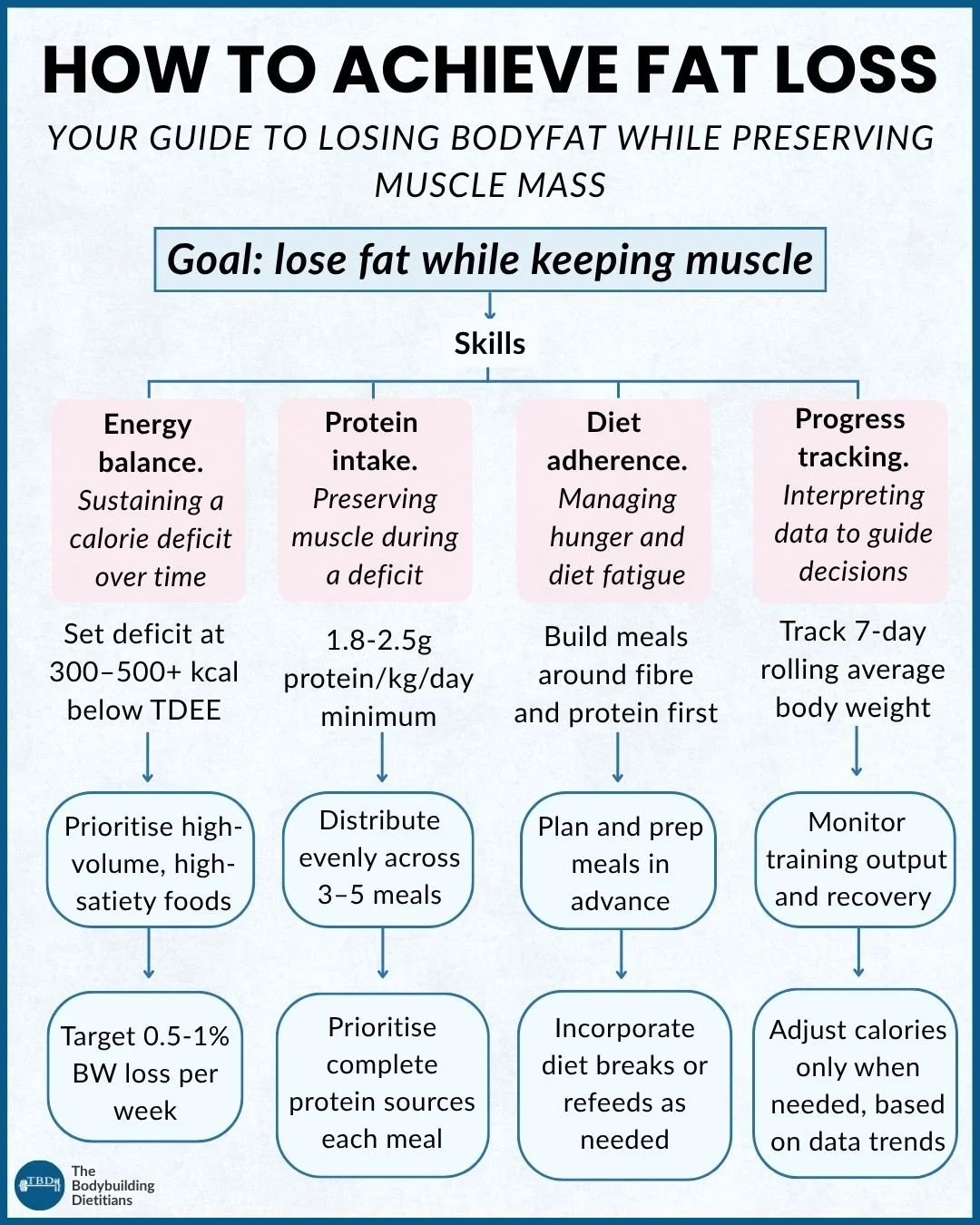
Losing fat and keeping muscle are not the same goal, even though they are pursued through the same general process. A calorie deficit will produce fat loss. Whether muscle is preserved through that process depends on how the deficit is structured, what is eaten within it, how sustainable the approach is across the full duration, and how accurately progress is interpreted and acted upon.
These four dimensions of a fat loss phase are often discussed in isolation: set a deficit, hit your protein, stay adherent, track your weight. The practical challenge is that they interact with each other in ways that mean weakness in one makes the others harder to execute. A deficit that is too aggressive undermines protein utilisation and adherence simultaneously. Inadequate protein increases hunger and makes adherence more effortful. Poor adherence invalidates progress tracking. The framework below covers each skill with its practical targets and explains how they connect.
How Should the Calorie Deficit Be Set and Managed?
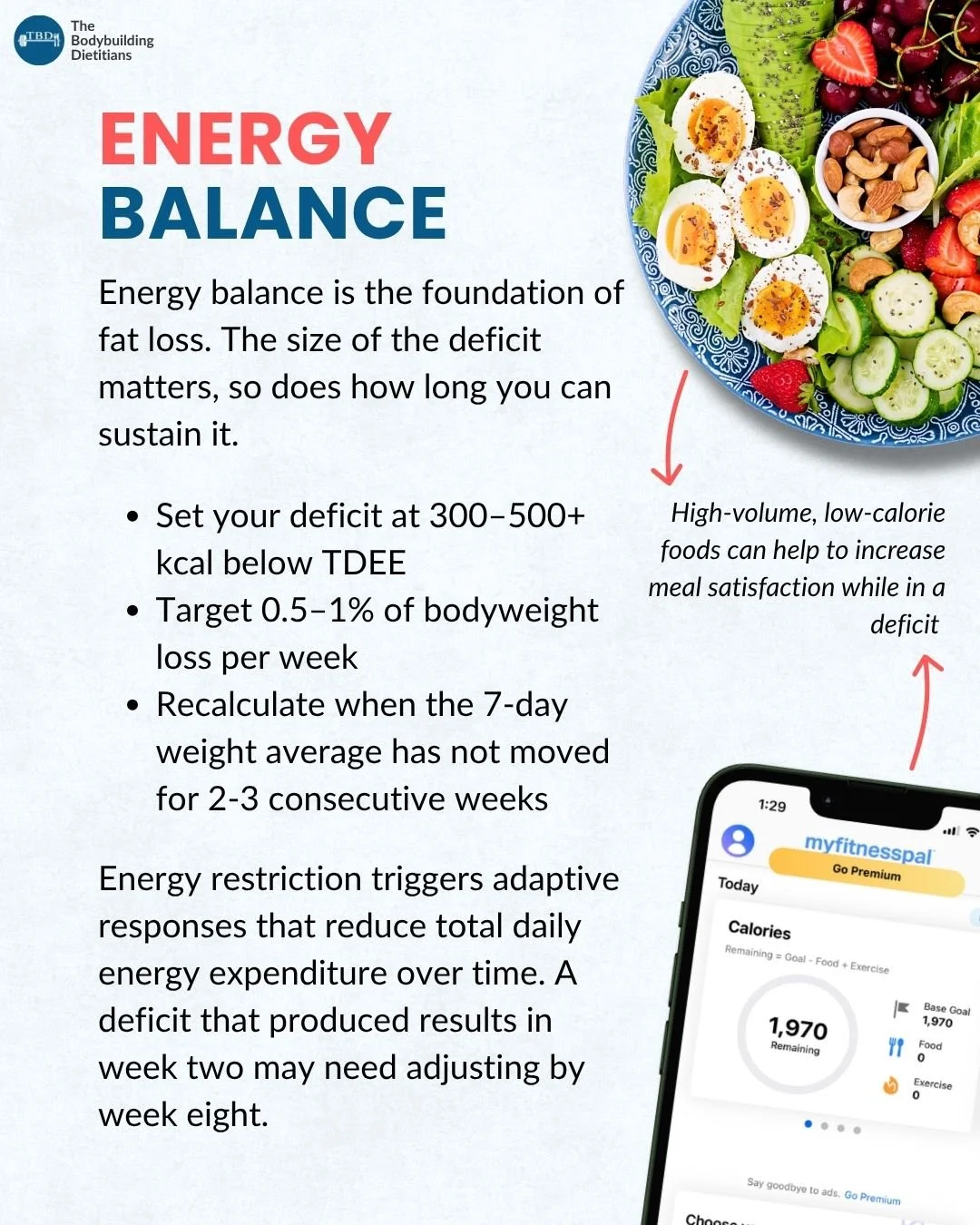
Energy balance is the foundation of fat loss. A calorie deficit is a necessary condition: without it, fat loss does not occur regardless of what is eaten or how training is structured. The size of that deficit and the ability to sustain it over time are the two variables that determine how much fat is lost and how well muscle is preserved in the process.
A starting deficit of approximately 300 to 500 calories below total daily energy expenditure is a practical range that balances the rate of fat loss with the physiological and psychological sustainability of the process. The goal is a rate of bodyweight loss of approximately 0.5 to 1 percent of bodyweight per week. This rate is worth contextualising: a 60-kilogram individual targeting 0.5 percent loss per week is working with a very different calorie figure from a 100-kilogram individual targeting the same rate. The percentage is the useful anchor, not the absolute calorie number.
Energy restriction triggers adaptive responses that progressively reduce total daily energy expenditure over the course of a diet. This is adaptive thermogenesis: the body responds to sustained restriction by reducing metabolic rate through reductions in thyroid hormone activity, spontaneous physical activity, and the energy cost of movement. The practical consequence is that a deficit that produced results in the early weeks of a phase produces a progressively smaller deficit as weeks pass, and the scale slows or stalls without any change in behaviour.
Recalibrating the deficit based on objective data rather than subjective impression is what keeps the phase productive. A practical trigger point is two to three consecutive weeks during which the 7-day rolling average of bodyweight has not moved. At that point, the maintenance calorie level has likely shifted, and a modest reduction in intake, an increase in daily movement, or a structured diet break to allow partial metabolic recovery are the appropriate responses.
High-volume, high-satiety foods serve a specific function within this framework: they allow a given calorie budget to occupy more stomach volume, produce a stronger satiety signal, and extend the period of post-meal fullness. This makes the experience of the deficit more manageable without changing the calorie target itself.
Why Is Protein Intake Especially Important During a Fat Loss Phase?
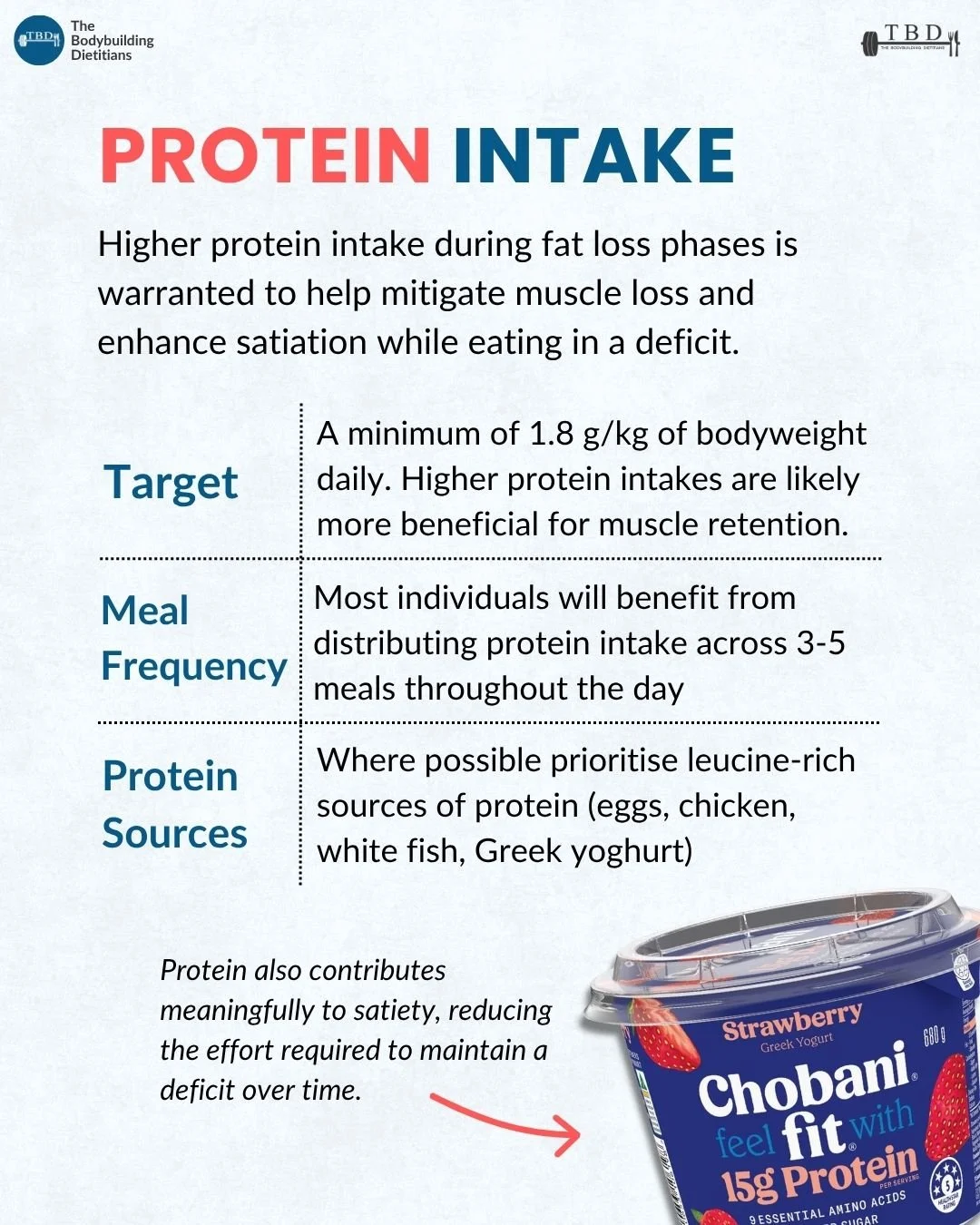
Protein requirements increase during a calorie deficit, for several reasons that operate simultaneously. The body's tendency to use amino acids for energy accelerates when total energy is restricted and glycogen availability is reduced. Muscle protein synthesis, the process through which dietary protein stimulates the repair and construction of muscle tissue, requires adequate amino acid availability to proceed at a rate that keeps pace with muscle protein breakdown. And the satiety value of protein, which is the highest of any macronutrient per calorie, reduces the hunger and dietary effort that the deficit itself creates.
A minimum of 1.8 grams of protein per kilogram of bodyweight per day is a reasonable floor for preserving lean mass during a fat loss phase. Higher intakes in the range of 2.0 to 2.5 grams per kilogram are likely more beneficial for muscle retention, particularly for leaner individuals in more aggressive deficits where the margin between fat and muscle as fuel sources is smaller. The leaner the starting point and the steeper the deficit, the more important the upper end of this protein range becomes.
Leucine is the amino acid that acts as the primary signal for muscle protein synthesis. Prioritising protein sources that are rich in leucine, including eggs, chicken, white fish, and Greek yoghurt, supports the anabolic signalling that preserves lean mass during restriction. This does not mean other protein sources are without value, but where food selection flexibility exists, leaning toward leucine-rich complete protein sources at each meal covers the practical basis effectively.
Distributing protein intake across 3 to 5 meals rather than concentrating it in one or two large servings allows muscle protein synthesis to be stimulated repeatedly across the day, which is more effective for lean mass preservation than an equivalent total dose delivered infrequently. Each meal should contain a meaningful protein contribution, typically somewhere around 30 to 50 grams depending on total daily target and meal frequency, rather than one or two meals carrying the bulk of the day's intake.
What Are the Most Effective Strategies for Maintaining Dietary Adherence?
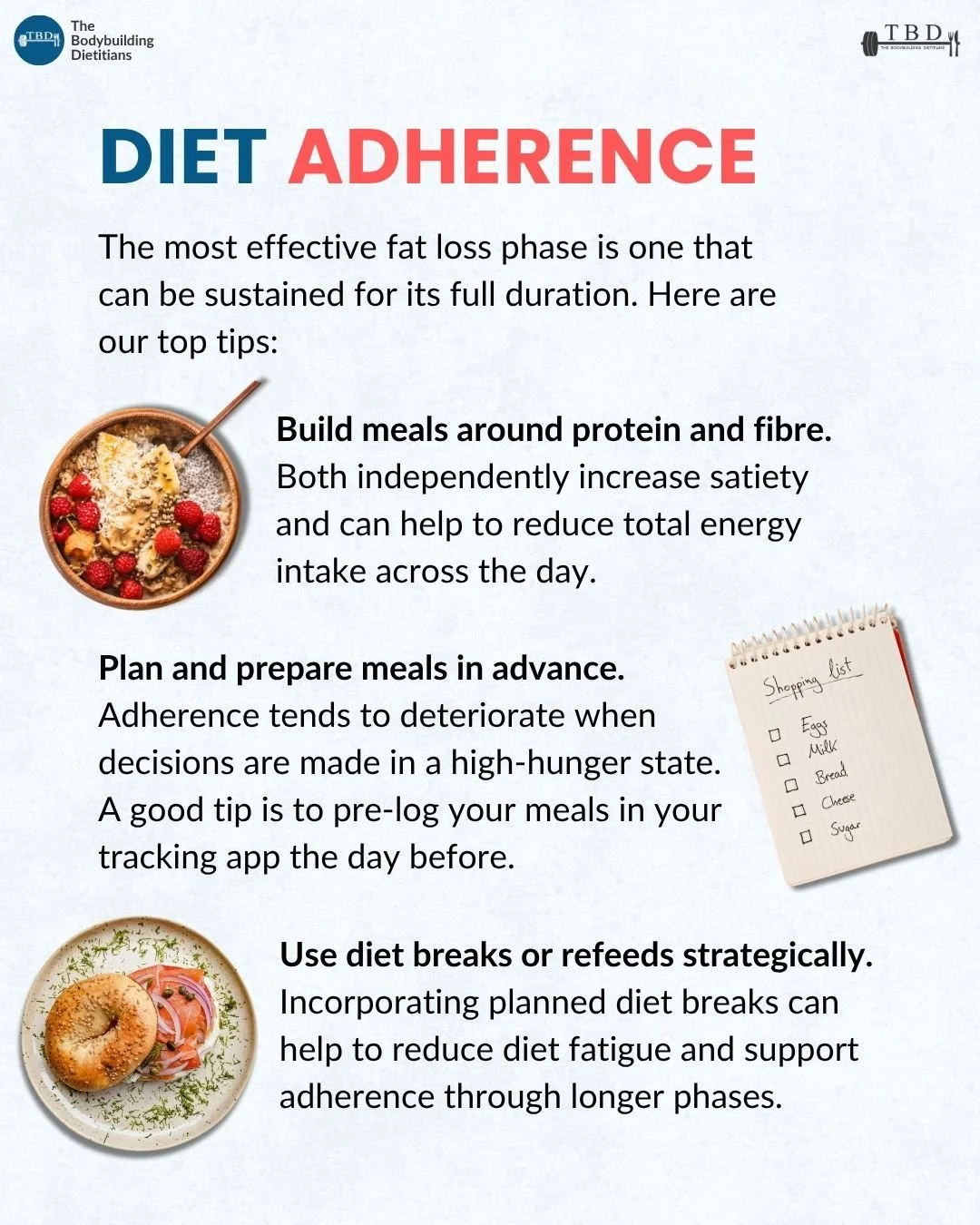
The most effective fat loss phase is one that is sustained for its full intended duration. A theoretical perfect diet that is abandoned at week six produces worse outcomes than an imperfect diet completed across sixteen weeks. Adherence over time is more consequential than precision at any given meal.
Several structural strategies reliably support adherence, and they operate through different mechanisms.
Building meals around protein and fibre first is the nutritional foundation of adherence management. Protein and fibre independently increase satiety through distinct pathways: protein through gut hormones including GLP-1 and peptide YY, fibre through the physical stretch of gastric contents and slowing of gastric emptying. The combination at each meal produces a satiety effect that extends across the period between meals and reduces the moment-to-moment experience of hunger that makes dietary adherence effortful. A meal built around a lean protein source and a large volume of vegetables or legumes is considerably easier to stop eating at a reasonable portion than one built around processed, palatable foods with minimal fibre or protein.
Planning and preparing meals in advance removes food decisions from the high-hunger state in which dietary adherence most often breaks down. Food decisions made when genuinely hungry, with highly palatable options available and cognitive resources depleted, tend toward higher-calorie choices than the same decisions made calmly in a well-fed state. Pre-logging meals in a tracking app the day before is a practical extension of this principle: it commits the decision ahead of time rather than leaving it to be made in real time under less favourable conditions.
Planned diet breaks and refeeds address the physiological and psychological accumulation that makes longer phases harder over time. A structured diet break of approximately one to two weeks at maintenance calories partially restores the hormonal environment that sustained restriction disrupts and provides meaningful psychological respite from the demands of continuous dietary management. For phases longer than ten to twelve weeks, incorporating planned breaks is not an interruption to the diet but a structural feature that makes the full duration achievable.
How Should Progress Be Tracked During a Fat Loss Phase?
Progress tracking provides the data that allows the deficit to be maintained at the right level for the full duration of the phase. Without adequate tracking, adjustments are made reactively to subjective impressions that may not reflect what is actually happening physiologically, which leads to unnecessary changes when the diet is working and delayed responses when it is not.
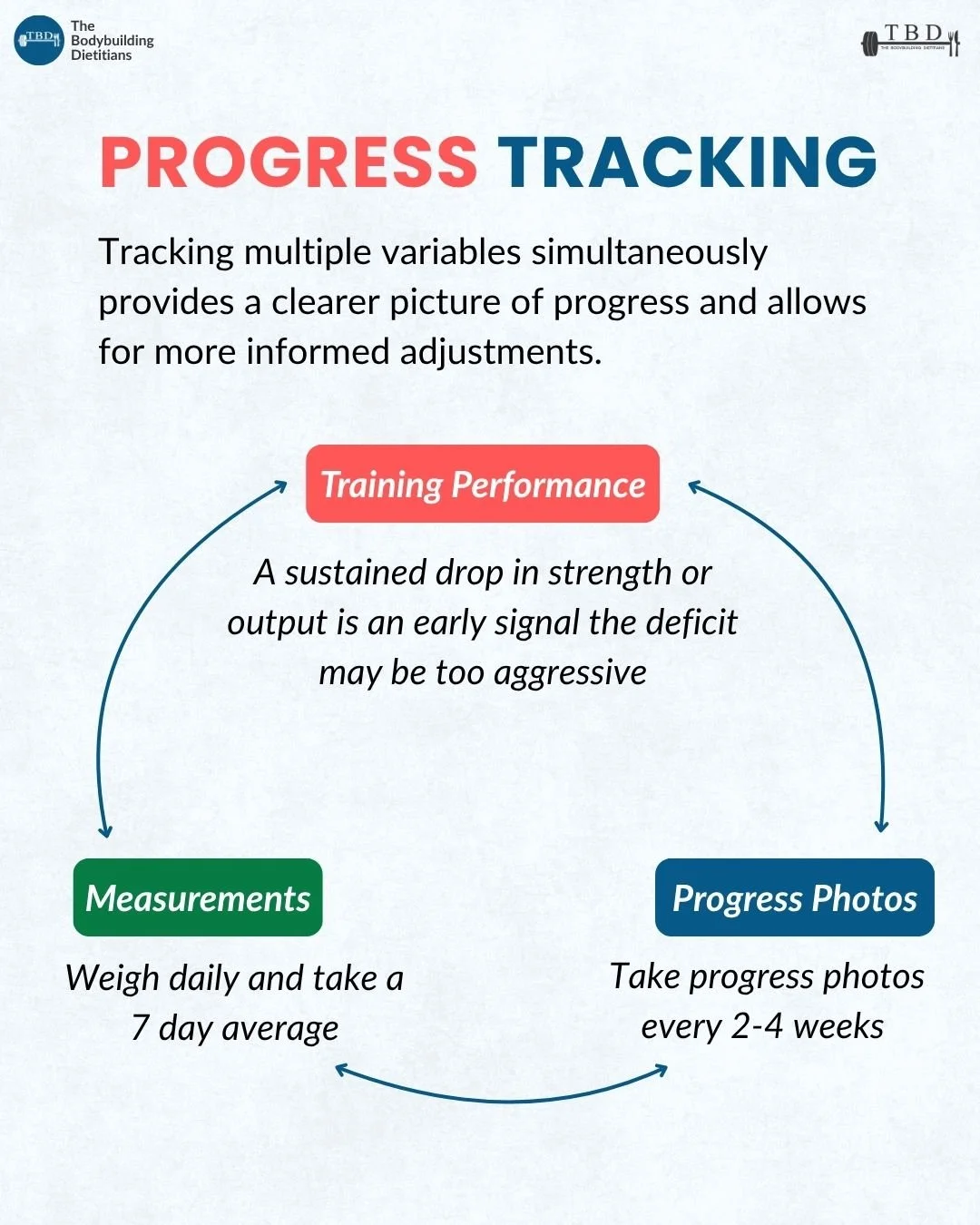
The core tracking framework involves three complementary variables.
Scale weight tracked as a 7-day rolling average is the primary progress signal. Daily bodyweight fluctuates by 0.5 to 2 kilograms or more depending on hydration, glycogen, food mass, and hormonal variation, which makes individual weigh-ins unreliable as decision-making inputs. The 7-day average smooths this noise and reveals the underlying trend. Weighing daily at the same time under the same conditions and calculating the average across each week, then comparing weekly averages, provides a reliable indicator of whether the deficit is producing fat loss at the expected rate.
Training performance is one of the most practically important progress signals and is often underused relative to scale weight. A sustained drop in strength or training output that is not attributable to a specific short-term cause is an early and sensitive indicator that the deficit has become too aggressive or that nutritional status is insufficient. Performance declines precede visible muscle loss, which makes it a more actionable early warning signal than scale weight or body composition alone. Monitoring training performance alongside dietary adherence allows the deficit to be calibrated before muscle loss becomes a problem rather than after.
Progress photos taken every two to four weeks in consistent lighting and conditions provide visual reference points that the subjective experience of looking in the mirror daily cannot. The difference between photos taken at the start and end of an eight-week phase is often more informative and more encouraging than any week-to-week comparison, and it provides evidence of body composition change that scale weight cannot capture when fat loss and muscle gain offset each other.
The decision to adjust calories should be based on data trends rather than individual days or weeks. A single slow week does not warrant a calorie reduction. Two to three consecutive weeks without scale movement, combined with consistent dietary adherence and stable training performance, provides sufficient signal. A single week of strong progress does not warrant loosening the approach. The principle is to make the minimum necessary adjustment when the data genuinely calls for it, rather than constant tinkering that prevents the approach from running long enough to assess whether it is working.
Understanding this tracking framework and applying it to individual circumstances is part of how we structure fat loss phases with our coaching clients, where the goal is to make adjustments when the data supports them and hold steady when it does not.
Practical Takeaways
A calorie deficit of 300 to 500 calories below total daily energy expenditure, targeting 0.5 to 1 percent of bodyweight loss per week, is a practical starting range. The percentage matters more than the absolute figure because it scales with bodyweight.
Protein intake at a minimum of 1.8 grams per kilogram of bodyweight per day, distributed across 3 to 5 meals, preserves lean mass and supports satiety during a deficit. Leaner individuals and steeper deficits warrant the higher end of the range.
Prioritising leucine-rich complete protein sources including eggs, chicken, white fish, and Greek yoghurt supports the anabolic signalling that protects lean tissue during restriction.
Building meals around protein and fibre first makes the dietary deficit more manageable by extending satiety between meals and reducing the moment-to-moment experience of hunger.
Planning and preparing meals in advance, and pre-logging them the day before, removes food decisions from high-hunger states where adherence most often deteriorates.
Planned diet breaks of one to two weeks at maintenance calories reduce diet fatigue accumulation and support adherence through longer phases. They are a structural feature of well-managed longer phases, not an interruption.
Track scale weight as a 7-day rolling average rather than individual daily weigh-ins. Adjust calorie intake only when the average has not moved for two to three consecutive weeks despite consistent adherence.
Monitor training performance as a parallel progress signal. A sustained drop in strength or output is an early indicator the deficit is too aggressive and warrants attention before visible muscle loss occurs.
Frequently Asked Questions
How many calories below maintenance should I eat to lose fat?
A starting deficit of 300 to 500 calories below total daily energy expenditure is a practical range that balances fat loss rate with sustainability and muscle retention. The target rate of loss is 0.5 to 1 percent of bodyweight per week, and the calorie deficit should be set to achieve that rate rather than using an absolute calorie figure. As bodyweight falls and metabolic rate adapts, the deficit will narrow over time and may need recalibrating based on progress data.
How much protein do I need to keep muscle while losing fat?
A minimum of 1.8 grams of protein per kilogram of bodyweight per day is a practical floor for muscle retention during a calorie deficit. Higher intakes in the range of 2.0 to 2.5 grams per kilogram are likely more beneficial, particularly for leaner individuals and those in more aggressive deficits where the physiological pressure on lean mass is greater. Distributing that intake across 3 to 5 meals and prioritising leucine-rich sources covers both the total intake and distribution requirements effectively.
How long should a fat loss phase last?
Fat loss phase duration depends on the amount of fat to be lost, the rate of loss, and the capacity to sustain the deficit productively. Most effective fat loss phases run for 10 to 20 weeks, with structured diet breaks incorporated for phases beyond 12 weeks. A phase that is too short forces an aggressive rate of loss that compromises muscle retention. A phase without planned breaks tends to accumulate diet fatigue to a point where adherence deteriorates before the goal is reached.
Why has my weight stopped moving even though I am still in a deficit?
A stalled scale during consistent dietary adherence most commonly reflects caloric adaptation: as bodyweight falls, total daily energy expenditure falls through adaptive thermogenesis and NEAT reduction, narrowing the deficit without any change in behaviour. The appropriate response is to recalibrate the approach: a modest reduction in intake, an increase in daily movement, or a structured diet break followed by a recalibrated deficit. Two to three consecutive weeks of no movement in the 7-day rolling average despite consistent adherence is the trigger for reassessment.
Should I reduce calories immediately if progress has stalled?
No, not on the basis of a single week or even two weeks of slower progress. Adjustments should be based on data trends rather than reactive responses to individual weeks. Bodyweight fluctuates from day to day for reasons unrelated to fat loss, and a week of slower scale movement may reflect water retention, glycogen loading, or normal biological variation rather than an insufficient deficit. The 7-day rolling average across two to three consecutive weeks of no movement with confirmed adherence provides sufficient signal to act.
How do progress photos help track fat loss?
Progress photos taken every two to four weeks in consistent lighting, at the same time of day, and in the same conditions provide visual reference points that scale weight cannot capture. Body composition can improve meaningfully while scale weight changes slowly or not at all, because fat loss and muscle gain can offset each other in total mass. Photos taken several months apart often show more visible change than any individual week-to-week comparison, and they serve as objective evidence of progress that the subjective daily experience of looking in the mirror frequently misrepresents.
Setting these variables for an individual, then deciding when to adjust calories, when to call a diet break, and when to end the phase as the body responds, is what our one-on-one coaching involves for fat loss. If you want support building and managing a fat loss phase with that level of individual calibration, you can enquire about coaching or book a consultation to get started.