A visual comparison of 38 common foods based on the calories, cost, and weight required to obtain 10 grams of dietary fibre, with practical interpretation for physique-focused nutrition.
The most calorie-efficient and cost-effective sources of dietary fibre include canned legumes (such as chickpeas, black beans, lentils, and pinto beans), psyllium husk, bran cereal, oat bran, and flaxmeal, all of which deliver 10 grams of fibre for relatively few calories and at low cost. Many foods commonly perceived as high in fibre, including tomatoes, bananas, cauliflower, and most fresh fruit, require a surprisingly large volume or caloric investment to contribute meaningfully to daily fibre intake. Understanding these trade-offs makes it easier to build a diet that meets fibre targets without consuming excessive calories or spending unnecessarily.
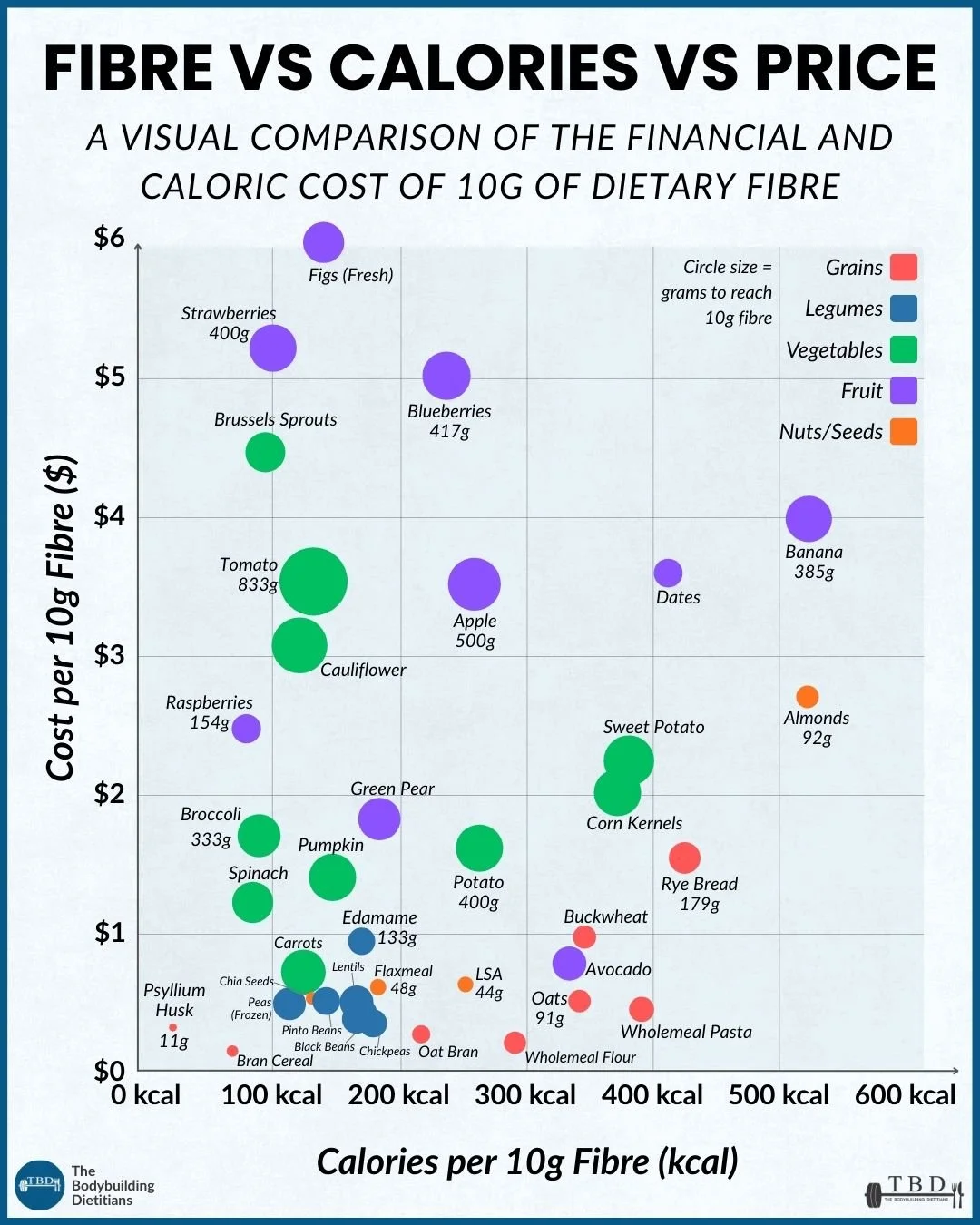
A practical comparison of how much it costs, in both calories and dollars, to get 10 grams of fibre from 38 commonly purchased foods. Position closer to the bottom-left corner indicates a more efficient fibre source.
Want the complete list?
Our free Fibre Guide ranks over 80 foods by fibre-per-calorie, so you can hit your target without overshooting your calories. You’ll also receive occasional nutrition and training insights from our dietitians, with the option to unsubscribe at any time.

LET’S TALK ABOUT FIBRE
Fibre is one of those nutrients that most people know they should be eating enough of, but relatively few give strategic thought to where it actually comes from. The general advice to "eat more fibre" is sound, but it does not account for the practical reality that different foods deliver fibre at vastly different caloric and financial costs. For anyone managing a calorie budget, whether during a fat loss phase, contest prep, or simply trying to maintain a specific body composition, these differences matter.
The bubble chart above compares 38 commonly purchased foods across three variables simultaneously. The x-axis shows the calories required to obtain 10 grams of dietary fibre. The y-axis shows the financial cost of that same 10 grams of fibre in Australian dollars. The size of each circle represents the weight of food you would need to consume to reach the 10-gram threshold. Foods positioned further to the left deliver fibre with fewer calories. Foods positioned lower on the chart do it more cheaply. Smaller circles mean less physical volume on your plate.
This kind of comparison is useful because it moves beyond the simple question of "does this food contain fibre?" and into the more practical question of "how much do I actually need to eat, and at what cost, to get a meaningful amount?" The answers can be surprising, and they often challenge assumptions about which foods are genuinely fibre-dense versus which foods simply have a reputation for being high in fibre.
Dietary fibre refers to the non-digestible carbohydrate components of plant foods that pass through the upper gastrointestinal tract largely intact and are either fermented by bacteria in the colon or excreted. Fibre plays essential roles in digestive health, blood sugar regulation, satiety, and the maintenance of a diverse gut microbiome.
Which Foods Deliver the Most Fibre for the Fewest Calories?
Psyllium husk, bran cereal, oat bran, and canned legumes are the most calorie-efficient fibre sources on this chart, delivering 10 grams of fibre for fewer than 200 kilocalories in most cases.
The bottom-left corner of the chart is where the most efficient fibre sources cluster, and a few patterns emerge clearly.
Psyllium husk stands out as an extreme outlier in the best possible way. It delivers 10 grams of fibre from just 11 grams of product and essentially negligible calories, making it one of the most concentrated fibre sources available. It is not a whole food in the traditional sense, but it serves a practical purpose for anyone who needs to increase fibre intake without adding meaningful calories or food volume to their diet. This is particularly relevant during lower-calorie phases where fibre targets can become difficult to meet from food alone.
Bran cereal sits in a similar position, providing a large amount of fibre relative to its caloric cost. A small serve added to a meal or eaten as a snack can contribute meaningfully to daily fibre intake without a significant caloric investment.
Canned legumes, including chickpeas, black beans, pinto beans, lentils, and peas, form a tight cluster in the bottom-left region of the chart. They are consistently among the cheapest and most calorie-efficient ways to increase fibre intake, and they offer the added benefit of contributing plant-based protein, resistant starch, and a range of micronutrients alongside their fibre content. For physique-focused individuals, legumes are often underutilised despite being one of the most practical fibre sources available.
Legume consumption has been consistently associated with improved markers of metabolic health, including better blood sugar regulation and reduced LDL cholesterol, partly attributed to their high content of soluble fibre and resistant starch. A meta-analysis of randomised controlled trials found that dietary pulse intake (beans, lentils, chickpeas, and peas) significantly reduced LDL cholesterol compared to control diets.
Source: Ha et al., 2014, Canadian Medical Association Journal.
Oat bran, flaxmeal, chia seeds, and LSA (linseed, sunflower seed, and almond mix) also perform well on both axes, delivering fibre efficiently in terms of both calories and cost. These are particularly useful as additions to existing meals rather than standalone foods. Sprinkling a tablespoon of flaxmeal or chia seeds onto oats, yoghurt, or a smoothie is a low-effort way to boost fibre intake without changing the structure of the meal.
Oats deserve a mention as well. While they sit further to the right on the caloric axis than the legumes and concentrated fibre sources (at approximately 300 to 400 kilocalories per 10 grams of fibre), they remain one of the most versatile, affordable, and palatable fibre sources in most people's diets. Their position on the chart reflects the fact that oats are a meaningful source of both carbohydrate and fibre rather than a concentrated fibre source, which is an important distinction.
Which Foods Are Less Fibre-Dense Than People Expect?
Several foods commonly associated with high fibre content, including tomatoes, bananas, cauliflower, and many fresh fruits, require a surprisingly large volume or caloric investment to deliver a meaningful amount of fibre.
This is one of the more practically useful insights from the chart. Many people assume that eating vegetables and fruit automatically provides adequate fibre, and while these foods are nutritionally valuable for many reasons, fibre density is not always one of their primary strengths.
Tomato is perhaps the most striking example. To obtain 10 grams of fibre from tomatoes, you would need to consume approximately 833 grams, which is a substantial volume of food. This does not mean tomatoes are a poor food choice. They provide lycopene, vitamin C, potassium, and water content that all contribute value to the diet. It simply means that relying on tomatoes as a primary fibre source would require eating an impractical quantity of them.
Banana requires roughly 385 grams (approximately three to four medium bananas) and around 450 kilocalories to deliver 10 grams of fibre. Again, bananas are a useful and convenient food, but their fibre contribution is relatively modest per serve compared to their caloric cost.
Cauliflower, brussels sprouts, and broccoli all require several hundred grams of food to reach the 10-gram fibre threshold. These vegetables are valuable in the diet for other reasons (low energy density, micronutrient content, and food volume for satiety), but they are best understood as complementary fibre contributors rather than primary ones.
Fresh fruit as a category tends to sit in the upper portion of the chart, meaning it delivers fibre at a relatively high caloric and financial cost. Berries (particularly raspberries) perform better than most other fruits, which is consistent with their higher fibre density per serve, but even they require more calories and cost per gram of fibre than legumes or concentrated fibre sources.
Energy density refers to the number of calories a food provides relative to its weight or volume. Foods with low energy density (such as most vegetables and fruits) provide fewer calories per gram, which makes them valuable for satiety and food volume during fat loss, even when their fibre density is not particularly high.
The practical implication is that fibre intake should not be left to chance or assumed to be adequate simply because the diet includes vegetables and fruit. For most physique-focused individuals, meeting a target of 25 to 30 grams of fibre per day reliably requires the deliberate inclusion of at least some fibre-dense foods from the bottom-left region of the chart, particularly legumes, whole grains, or concentrated sources like psyllium husk or bran.
How Do Grains and Whole Grain Products Compare?
Whole grain products, including wholemeal pasta, wholemeal flour, rye bread, buckwheat, and oats, provide fibre alongside a meaningful carbohydrate contribution, making them practical choices for people who need both.
The grains on the chart tend to sit in the mid-right region, reflecting the fact that they are more calorie-dense than vegetables or legumes per unit of fibre. This is not a disadvantage for someone who needs carbohydrates for training performance and recovery. It simply means that grains are doing double duty: contributing both to carbohydrate and fibre targets simultaneously.
Wholemeal pasta and wholemeal flour provide fibre at a relatively low financial cost and in reasonable serving sizes, making them accessible and practical options for increasing fibre intake without changing the overall structure of meals. Swapping white pasta for wholemeal pasta, or using wholemeal flour in baking, is one of the simplest substitutions available.
Rye bread performs well on the chart, sitting in the lower-right quadrant with a reasonable caloric cost and relatively low financial cost per 10 grams of fibre. It also tends to be more satiating than many other bread options, partly due to its fibre content and partly due to its denser texture and slower rate of digestion.
Buckwheat is less commonly used but worth considering for those looking to diversify their grain intake. It provides a respectable fibre contribution alongside a complete amino acid profile for a plant-based food, and it can be used in a similar way to rice or oats in many meals.
For anyone whose current carbohydrate intake is built primarily around white rice, cream of rice, or other low-fibre carbohydrate sources, rotating in one or two higher-fibre grain options across the week can meaningfully increase total fibre intake with minimal impact on the overall nutrition plan. This connects directly to the broader principle of dietary diversity and its role in supporting gut microbiome health, which is explored in more detail in our guide to gut health for lifters.
How Do Nuts and Seeds Fit into the Picture?
Nuts and seeds deliver fibre alongside healthy fats and micronutrients, but their high energy density means the caloric cost per 10 grams of fibre is relatively high compared to legumes or vegetables.
Almonds are the most prominent nut on the chart, sitting in the right-hand region with a caloric cost of approximately 500 kilocalories per 10 grams of fibre. This reflects the reality that almonds are primarily a fat source with some fibre as a secondary benefit, rather than a concentrated fibre source. The same applies broadly to most nuts and seeds when viewed purely through a fibre efficiency lens.
This does not diminish their dietary value. Almonds, chia seeds, flaxseeds, and LSA all contribute meaningfully to overall nutrition through their fat quality, mineral content (particularly magnesium, zinc, and selenium), and the variety they add to the diet. However, relying on nuts and seeds as a primary fibre strategy would consume a significant portion of the daily calorie budget before fibre targets were met, which makes them better understood as complementary fibre contributors that offer additional nutritional benefits alongside their fibre content.
Chia seeds and flaxmeal are notable exceptions within this category. They sit much further to the left on the chart than most nuts, reflecting their unusually high fibre density relative to their caloric load. Both are practical additions to meals (sprinkled on oats, yoghurt, smoothies, or salads) and provide omega-3 fatty acids alongside their fibre contribution. A single tablespoon of chia seeds provides approximately 4 to 5 grams of fibre, which is a meaningful contribution from a very small serve.
How Should You Use This Chart to Make Better Food Choices?
The chart is most useful as a practical planning tool that helps you identify which foods to lean on for fibre efficiency and which to appreciate for other nutritional qualities, rather than as a rigid ranking of "good" and "bad" foods.
No single food needs to carry the entire fibre load. The most practical approach is to anchor your fibre intake around a few efficient sources from the bottom-left region of the chart (legumes, psyllium husk, bran, oats, or whole grains) and then allow the remaining fibre to accumulate from the vegetables, fruits, nuts, and seeds that you include for other reasons. This ensures that fibre targets are met reliably without requiring excessive food volume or caloric investment, while the rest of the diet contributes the variety, micronutrients, and food enjoyment that matter for long-term sustainability.
During fat loss phases, when calories are more constrained, fibre-efficient foods become more valuable because there is less caloric room to spare. This is when deliberate inclusion of legumes, psyllium husk, or bran can make a meaningful difference to reaching fibre targets without overshooting calorie targets.
During improvement seasons or higher-calorie phases, fibre targets are generally easier to meet because there is more total food volume in the diet. The focus in these phases can shift slightly toward fibre diversity (ensuring a range of fibre types from different food categories) rather than purely fibre efficiency, which supports gut microbiome health as a long-term investment.
This kind of phase-specific nutritional adjustment is one of the areas where structured coaching adds practical value, because the optimal approach to fibre (and food selection more broadly) shifts depending on the individual's current calorie budget, training demands, and competitive timeline.
As with any comparison of this kind, context matters. Fibre type varies between foods (soluble, insoluble, and prebiotic fibres all serve different functions), food palatability and personal preference influence adherence, and the broader nutrient density of a food extends well beyond its fibre content. This chart simply adds a practical, quantitative lens to help inform those decisions.
Current Australian dietary guidelines recommend a minimum fibre intake of 25 grams per day for women and 30 grams per day for men. Population data consistently shows that most Australians fall short of these targets, with average intakes closer to 20 to 22 grams per day. For physically active individuals with higher energy intakes, a target of approximately 12 to 15 grams of fibre per 1,000 kilocalories consumed provides a useful, scalable benchmark.
Source: National Health and Medical Research Council, 2013, Australian Dietary Guidelines.
What About Fibre Supplements Like Psyllium Husk?
Psyllium husk is one of the most calorie-efficient and cost-effective fibre sources available and can serve a practical role in bridging the gap between actual and target fibre intake, particularly during energy-restricted phases.
Psyllium husk is a soluble fibre derived from the seed husks of the Plantago ovata plant. It absorbs water and forms a gel-like substance in the digestive tract, which supports regular bowel movements, slows gastric emptying, and can contribute to improved blood sugar regulation and cholesterol management when consumed regularly.
The chart shows psyllium husk as an extreme outlier, delivering 10 grams of fibre from just 11 grams of product at essentially zero caloric cost. This makes it uniquely useful for individuals who are struggling to meet fibre targets within a tight calorie budget, which is a common situation during the later stages of a fat loss phase or contest preparation.
However, psyllium husk is not a substitute for fibre from whole foods. It provides soluble fibre in a concentrated form, but it does not deliver the range of fibre types, micronutrients, phytochemicals, and prebiotic compounds that come from eating a diverse range of whole plant foods. It also does not contribute to the gut microbiome diversity that a varied diet supports.
A practical approach is to use psyllium husk (or similar supplements like partially hydrolysed guar gum) as a targeted tool when whole food fibre intake is falling short, while continuing to prioritise dietary diversity as the primary fibre strategy. For most people, this means psyllium husk is more relevant during lower-calorie phases and less necessary during higher-calorie phases where fibre targets can be met comfortably from food alone.
Methodology Notes
Pricing for all foods was sourced from Woolworths online and reflects typical consumer products rather than the cheapest or most expensive available options. Nutrient data was taken from product nutrition panels where available, with the Australian Food Composition Database (AUSNUT) used where panel data was absent. All legumes represented on the chart are canned varieties. Gram values represent raw or as-sold weight rather than cooked weight, which means that foods like oats, pasta, and legumes would yield a larger volume once prepared. These methodological choices were made to reflect the way most consumers purchase and prepare these foods, rather than to optimise for any particular outcome.
The Australian Food Composition Database (AUSNUT) is maintained by Food Standards Australia New Zealand and provides standardised nutrient composition data for foods available in Australia. It is widely used in dietetic practice and nutrition research.
Practical Takeaways
Canned legumes (chickpeas, black beans, lentils, pinto beans, and peas) are consistently among the cheapest and most calorie-efficient fibre sources, making them practical staples for anyone looking to increase fibre intake without excessive caloric cost.
Psyllium husk and bran cereal are extreme outliers for fibre efficiency and can serve a targeted role in bridging gaps during lower-calorie phases, though they should complement rather than replace whole food fibre sources.
Many foods commonly perceived as high in fibre, including tomatoes, bananas, cauliflower, and most fresh fruit, require a surprisingly large volume or caloric investment to contribute meaningfully to daily fibre intake. These foods offer other nutritional benefits but should not be relied upon as primary fibre sources.
Chia seeds and flaxmeal are unusually fibre-dense for their caloric cost within the nuts and seeds category and work well as low-effort additions to existing meals.
Whole grain carbohydrate sources (wholemeal pasta, rye bread, oats, buckwheat) provide fibre alongside carbohydrate, making them practical for people who need both without adding separate fibre-focused foods.
Use the chart as a planning tool: anchor fibre intake around a few efficient sources from the bottom-left corner and allow the rest to accumulate naturally from the vegetables, fruits, and other foods in your diet.
Frequently Asked Questions
What is the cheapest high-fibre food?
Based on typical Australian retail pricing, canned legumes (including chickpeas, black beans, lentils, and pinto beans), bran cereal, and psyllium husk are among the cheapest sources of dietary fibre. All of these deliver 10 grams of fibre for under $1 AUD, making them accessible options for increasing fibre intake on a budget.
How much fibre should you eat per day?
Australian dietary guidelines recommend a minimum of 25 grams per day for women and 30 grams per day for men. For physically active individuals, a scalable target of approximately 12 to 15 grams per 1,000 kilocalories consumed provides a useful benchmark that adjusts automatically with total energy intake. Meeting this target from a range of different fibre sources is more beneficial than relying on a single food.
Are bananas high in fibre?
Bananas contain fibre (approximately 2.6 grams per medium banana), but they are not a fibre-dense food relative to their caloric cost. You would need to eat roughly 385 grams of banana, approximately three to four medium bananas, to obtain 10 grams of fibre, at a cost of around 450 kilocalories. Bananas offer other nutritional benefits including potassium and convenience, but they are best understood as a modest fibre contributor rather than a primary source.
Is psyllium husk a good fibre supplement?
Psyllium husk is one of the most calorie-efficient fibre sources available, delivering 10 grams of soluble fibre from just 11 grams of product with essentially negligible calories. It is well-supported by evidence for improving bowel regularity, supporting cholesterol management, and aiding blood sugar regulation. However, it provides a single type of fibre and lacks the micronutrients and prebiotic diversity found in whole plant foods, so it works best as a complement to dietary fibre rather than a replacement for it.
Are canned legumes as good as dried legumes for fibre?
Canned legumes retain the majority of their fibre content and provide a convenient, ready-to-use option that removes the barrier of soaking and cooking dried legumes. While dried legumes may be slightly cheaper per serve and marginally higher in some nutrients, the practical advantage of canned legumes (convenience, consistency, and ease of incorporation into meals) makes them an excellent choice for most people looking to increase their fibre intake reliably.
What is the best way to increase fibre intake during a calorie deficit?
During a calorie deficit, fibre-efficient foods become especially valuable because there are fewer total calories to work with. Prioritising canned legumes, oats, bran cereal, chia seeds, and vegetables with moderate fibre density (such as broccoli, peas, and spinach) within your existing meals is a practical first step. If whole food fibre intake still falls short, psyllium husk or a similar supplement can help bridge the gap. Rotating fibre sources across the week supports both gut microbiome diversity and digestive comfort.
If you would like support building a nutrition plan that meets your fibre, macronutrient, and body composition goals without unnecessary complexity, our team of qualified dietitians can help.