Nutrition decisions are often approached in the wrong order. Understanding which variables have the greatest influence on outcome, and when finer details become worth addressing, changes how effectively effort translates into results.
Nutrition priorities follow a hierarchy, the higher-order variables need to be consistently in place before the finer details are worth optimising. Total daily protein intake matters more than protein timing and distribution. Understanding that a calorie deficit drives weight loss matters more than fixating on specific foods or seeking fat-burning supplements. Adequate hydration and pre-workout fuelling matter more than stimulant and supplement stacks. A diverse intake of whole food fibre sources matters more than gut health supplements. Dietary variety and whole food sources matter more than multivitamins and greens powders. Eating enjoyable foods without guilt or anxiety matters more than creating fear around specific ingredients. None of the secondary variables are irrelevant, but they produce meaningful benefit only once the primary variables are consistently handled.
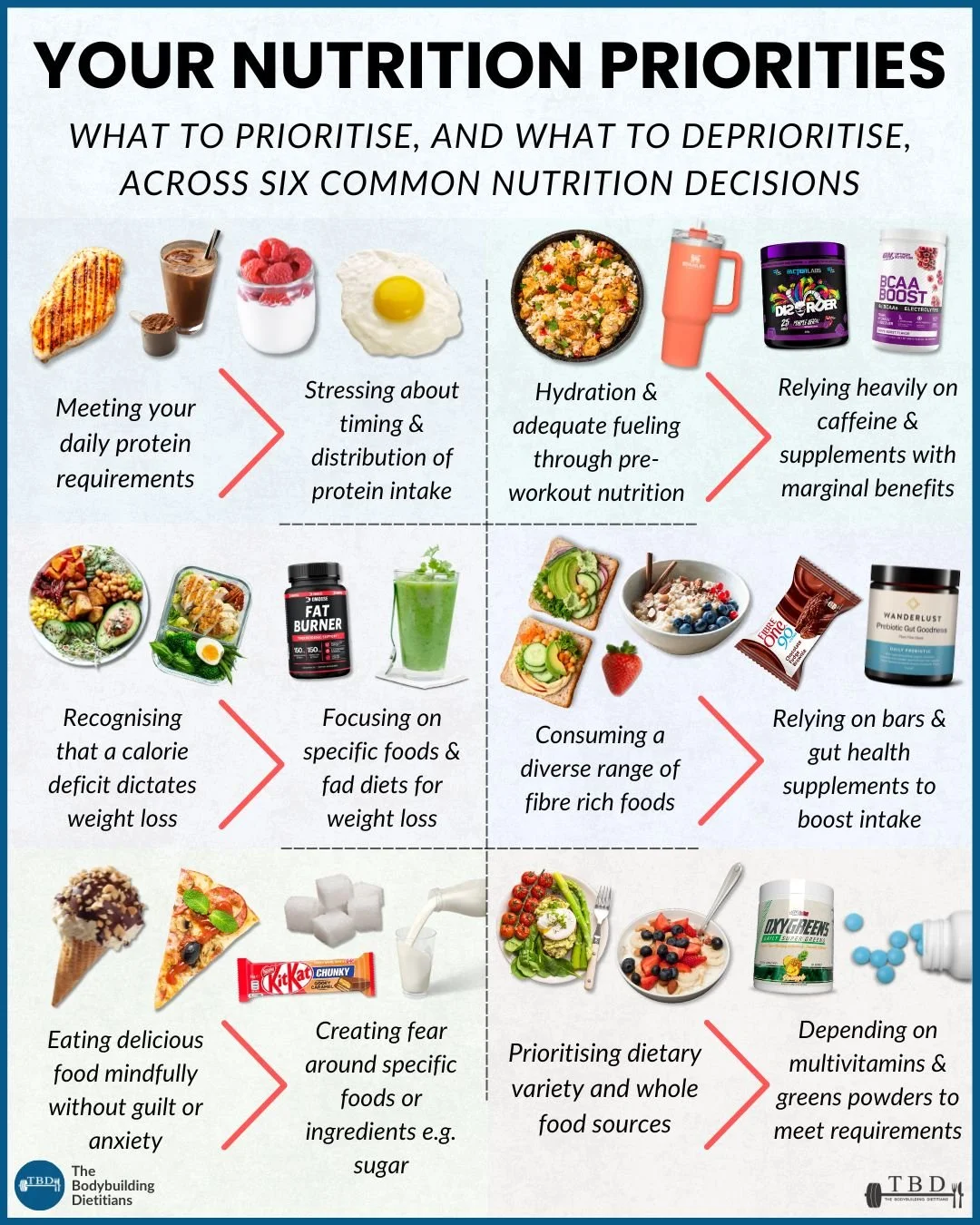
Six common nutrition decisions with the higher-priority variable identified for each. The secondary variables are not irrelevant, but they produce meaningful benefit only once the primary variables are consistently in place.
The nutrition space generates an enormous volume of advice about specifics. The optimal protein timing window. The most effective pre-workout stack. Which foods to avoid for fat loss. The best gut health supplement. Whether sugar is uniquely harmful. Which micronutrient is most likely to be missing from a modern diet. Most of this advice is not wrong, but much of it is premature for the person receiving it, because the higher-order variables it depends on are not yet consistently in place.
Priority order matters considerably more when time, attention, and resources are limited, which describes most people's relationship with their nutrition. The goal of this framework is not to dismiss the value of optimising finer details. It is to clarify which variables produce the greatest return when addressed first, and which become genuinely worth addressing once those foundations are established.
The six pairings below each represent a common nutrition decision where effort is frequently directed at the lower-return variable before the higher-return one is consistently managed. The ordering reflects the current evidence on what drives outcomes most reliably, not a claim that the secondary variable is without value.
Should You Prioritise Total Protein or Protein Timing?
Total daily protein intake is the dominant variable for muscle protein synthesis, lean mass preservation, and satiety. Protein distribution across meals does show some benefit in the research, particularly at higher training volumes where the anabolic signal from protein can be meaningfully influenced by how intake is spread across the day, but distribution becomes relevant only after total intake is consistently adequate.
The research on protein timing indicates that consuming protein in reasonably sized doses across multiple meals, rather than loading it into one or two large servings, supports muscle protein synthesis more effectively at equivalent total intakes. This is a real effect and worth attending to once daily intake is managed. The issue is sequencing: many people who worry about the timing of their protein shake have not established whether they are actually meeting their daily target in the first place.
Muscle protein synthesis is the biological process through which dietary protein stimulates the repair and construction of skeletal muscle fibres. It is maximally stimulated by adequate leucine availability at each meal alongside sufficient total daily protein to meet both synthetic and breakdown demands. A daily protein target of 1.6 to 2.4 grams per kilogram of bodyweight, distributed across three to five meals in serves of around 30 to 50 grams, covers both the quantity and distribution requirements simultaneously. Getting total intake right first, then considering distribution, is the productive order.
For anyone who has not yet established a consistent daily protein target, the time and cognitive effort spent on protein timing is premature. For someone who has, attending to distribution, particularly around training, is a worthwhile next step.
Should You Prioritise Pre-Workout Nutrition or Supplements?
Adequate hydration and appropriate pre-workout fuelling, primarily through carbohydrate, directly support training performance by ensuring glycogen availability and physiological readiness for the session ahead. These are the variables most reliably associated with better training output in the research.
Supplementation strategies built primarily around stimulants and compounds with marginal or context-dependent benefits address a much smaller portion of the performance equation. Caffeine specifically is worth separating from this category: it has a well-established and meaningful performance benefit, and the evidence supports its use as a pre-workout ergogenic aid. The issue is not caffeine, but the broader pattern of reaching for supplement stacks while neglecting the foundational preparation that determines the session's ceiling.
A person who trains fasted, inadequately hydrated, and reliant on stimulants to create arousal will perform worse and recover more slowly than one who arrives adequately fuelled, well-hydrated, and in a physiological state that carbohydrate availability and sleep have prepared. Supplements that work by enhancing an already well-prepared physiological environment produce a meaningfully different outcome than those used to compensate for inadequate preparation.
In practice, the pre-workout nutrition question for most training-focused individuals reduces to two considerations: how much carbohydrate is needed before the session to support glycogen availability for the training volume being performed, and whether hydration status is adequate. Both of these are address through food and fluid rather than supplement products, and both have a larger and more reliable effect on training performance than any commonly used pre-workout ingredient other than caffeine.
Should You Prioritise Energy Balance or Food Selection?
Understanding that a calorie deficit drives fat loss, and that total energy intake relative to expenditure is the mechanism by which every dietary approach produces weight loss, is the foundational variable for anyone with a fat loss goal. Fixating on specific foods or dietary approaches before establishing that energy balance principle means applying the secondary variable without the primary one in place.
This does not mean food selection is irrelevant. Food choices influence satiety, training performance, nutrient density, adherence, and long-term health in ways that energy balance alone does not capture. But food selection that is not embedded within an appropriate energy balance produces no fat loss, regardless of how evidence-aligned the individual food choices are.
The pattern this pairing addresses is common: an individual switches from one food or dietary approach to another, motivated by the belief that the food itself is the agent of change, when the actual change, if it occurs, is produced by the calorie deficit that the new approach happens to create. Understanding the mechanism first, and then selecting foods that support adherence, satiety, and performance within that mechanism, is the productive direction.
Fat-burning supplements occupy a specific position in this pairing: they sit at the lower-priority end not just because food selection is secondary to energy balance, but because the evidence for meaningful efficacy of most products marketed as fat burners is weak or absent. The calorie deficit is the mechanism. There is no supplement that meaningfully substitutes for it.
Should You Prioritise Whole Food Fibre or Gut Health Supplements?
A diverse intake of fibre-rich whole foods is the primary and most evidence-supported strategy for gut health, microbiome diversity, satiety, glycaemic management, and the health outcomes associated with adequate fibre. Gut health supplements, including probiotic bars, prebiotic powders, and similar products, represent a secondary and considerably less robust approach to the same goals.
Gut microbiome diversity is best supported by dietary diversity, specifically the variety of plant foods consumed across the week. Research on the gut microbiome consistently identifies the number of different plant species eaten per week as one of the strongest correlates of microbiome diversity, and the fibre types provided by those different plants as the primary substrate for the beneficial bacteria that populate the gut. This is not something a supplement can replicate with comparable effectiveness because supplements provide a narrow substrate, while diverse whole food intake provides the full spectrum.
The practical implication is that resources and attention directed toward gut health supplements before establishing a consistently diverse whole food fibre intake are allocated out of priority order. A diet that includes legumes, wholegrains, a range of vegetables across different families, varied fruit, nuts, and seeds covers the microbiome substrate diversity that the research supports. A gut health supplement added on top of that foundation may provide marginal additional benefit in some cases. The same supplement added to a diet of limited plant food variety has considerably less to work with.
Should You Prioritise a Healthy Relationship With Food or Fear Around Specific Ingredients?
A dietary pattern characterised by mindful eating, food enjoyment, and the absence of guilt or anxiety around specific foods or ingredients is more sustainable, more psychologically protective, and more compatible with long-term body composition outcomes than one built around fear of particular foods.
The pattern this pairing addresses is the specific framing of certain ingredients, sugar being the most common example, as inherently harmful in a way that warrants active avoidance and anxiety. Sugar at excessive intake within a calorie surplus does contribute to fat storage and metabolic disruption. Sugar as an ingredient in a meal that sits within appropriate energy intake, contains adequate protein and fibre, and forms part of a varied dietary pattern is not a meaningful contributor to adverse outcomes. The dose and dietary context determine the relevance.
A diet that creates ongoing anxiety, guilt, or preoccupation around specific foods carries its own costs. The cognitive burden of avoiding entire ingredient categories, the social friction created by dietary restriction, and the psychological patterns that develop around food restriction are not neutral. They affect adherence, quality of life, and the relationship with eating over the long term in ways that frequently undermine the dietary goals they are intended to support.
This is not an argument against dietary awareness or choosing less processed foods where practical. It is an argument for placing those preferences within a broader dietary relationship that remains flexible, enjoyable, and free of the disordered patterns that excessive food fear tends to produce. The distinction between appropriate dietary selectivity and problematic food fear is a useful clinical concept, and for individuals who notice that their relationship with food is generating significant anxiety or avoidance, professional support from a dietitian or psychologist is worth considering.
Should You Prioritise Dietary Variety and Whole Foods or Supplementation?
Dietary variety and a predominantly whole food intake provide the micronutrient diversity, phytonutrient breadth, fibre diversity, and overall nutritional completeness that supplements are designed to replicate but cannot fully substitute. Multivitamins and greens powders represent a lower-priority approach to micronutrient adequacy than a varied whole food diet.
Multivitamins provide a subset of known essential nutrients in forms and doses that may or may not reflect what is needed by a given individual. They do not provide the full complexity of phytonutrients, fibre, polyphenols, and co-factors found in whole foods, and the research on multivitamin supplementation in otherwise healthy individuals with adequate dietary variety is mixed in terms of demonstrable benefit. They fill gaps when gaps exist, which is a useful function. They do not replace dietary variety when the variety is achievable.
Greens powders present a similar picture. They provide concentrated micronutrients and plant extracts in a convenient format, but the serving sizes typically used and the processing involved in production mean they are not nutritionally equivalent to the whole vegetables and fruit they derive from. For individuals who genuinely struggle to include adequate whole plant foods in their diet due to access, preference, or life circumstances, they may be a practical adjunct. As a primary strategy for meeting micronutrient requirements in someone who has not yet built a varied dietary pattern, they are addressing the secondary variable before the primary one.
The practical starting point is building a dietary pattern that draws regularly from a range of vegetables, fruit, wholegrains, legumes, and varied protein sources. From that foundation, supplementation fills specific, identified gaps rather than serving as a substitute for the variety that whole foods provide. Where supplementation is genuinely warranted, the evidence for specific nutrients in specific populations is considerably stronger than the evidence for broad multivitamin use. How supplement decisions are made within a broader nutritional context is something we work through individually with our coaching clients based on their diet, goals, and any identified gaps.
Practical Takeaways
Nutrition priorities follow a hierarchy. Higher-order variables, including total protein intake, energy balance, whole food fibre, and dietary variety, need to be consistently in place before optimising finer details produces meaningful additional benefit.
Total daily protein intake is the dominant variable for muscle protein synthesis and lean mass preservation. Protein timing and distribution are worth attending to once daily intake is consistently adequate.
Adequate hydration and pre-workout carbohydrate fuelling have a larger and more reliable effect on training performance than most supplement ingredients. Caffeine is an exception and has well-established performance benefits, but it does not replace appropriate preparation.
A calorie deficit drives fat loss regardless of which specific foods or dietary pattern creates it. Understanding energy balance before focusing on food selection or dietary approaches puts effort in the right place.
Diverse whole food fibre intake is more effective for gut health and microbiome diversity than gut health supplements. Reaching daily fibre targets through varied plant foods provides the substrate diversity that the research consistently supports.
A dietary relationship characterised by food enjoyment and the absence of guilt or anxiety is more sustainable than one built around fear of specific ingredients. Appropriate dietary selectivity and problematic food fear are meaningfully different.
Dietary variety and whole food sources provide micronutrient diversity and phytonutrient breadth that supplements cannot fully replicate. Supplementation fills specific identified gaps rather than substituting for dietary variety.
The secondary variables in each pairing are not irrelevant. For someone who has the primary variables consistently in place, optimising protein distribution, training nutrition, and dietary pattern is evidence-supported and worthwhile. Priority order matters most when resources and attention are limited.
Frequently Asked Questions
Does protein timing actually matter for muscle building?
Protein timing does show benefit for muscle protein synthesis, particularly at higher training volumes, but total daily intake is the dominant variable and should be addressed first. Once daily protein intake is consistently meeting a target of 1.6 to 2.4 grams per kilogram of bodyweight, distributing that intake across multiple meals with adequate leucine at each sitting produces a meaningful additional stimulus. For most people, getting total intake right while eating three to five times per day already covers the distribution benefit without specific timing optimisation.
Is food selection irrelevant if you are in a calorie deficit?
Food selection is not irrelevant within a calorie deficit, but energy balance is the primary mechanism by which fat loss occurs. Food choices within a deficit affect satiety, training performance, nutrient density, adherence, and long-term health in ways that matter considerably. The priority issue is that food selection optimised without an underlying calorie deficit in place produces no fat loss. Understanding and managing energy balance first, then selecting foods that support adherence and performance within that framework, is the productive sequence.
Are gut health supplements worth taking?
Gut health supplements may provide marginal additional benefit for individuals who already have a consistently diverse whole food diet, but they are not an effective substitute for dietary variety when that variety is achievable. The gut microbiome is most effectively supported by the fibre diversity that a wide range of plant foods provides. Supplements offer a narrower substrate than the full spectrum of plant food types. Where specific probiotic strains have evidence for particular clinical applications, supplementation may be appropriate, but broad gut health supplement use before establishing dietary diversity is a secondary priority.
Is sugar bad for you?
Sugar at excessive intakes within a calorie surplus contributes to fat storage and, when concentrated in sugary beverages, to visceral fat accumulation and metabolic disruption specifically. Sugar as an ingredient within a varied diet that is appropriate in total energy, adequate in protein and fibre, and not in consistent surplus is not a meaningful contributor to adverse outcomes for most people. The dose and dietary context determine the relevance. The evidence supports reducing added sugar from discretionary sources, particularly sugary drinks, rather than treating sugar as a universally harmful ingredient across all dietary contexts.
Should everyone take a multivitamin?
Multivitamins are most useful for individuals with identified nutrient gaps, restricted diets, or life stages with elevated specific requirements, such as pregnancy, where supplementing particular nutrients is well-evidenced. For individuals with adequate dietary variety, the evidence for multivitamin benefit is mixed. They do not provide the nutritional complexity of whole foods and are less effective as a primary strategy for micronutrient adequacy than a varied dietary pattern. Supplementing specific nutrients where deficiency or insufficiency is identified is more evidence-based than broad multivitamin use as a nutritional insurance policy.
What is the most important nutrition priority for fat loss?
For fat loss specifically, understanding and managing energy balance is the most important nutrition priority. Every dietary approach that produces fat loss does so by creating a calorie deficit, and directing effort toward food quality, food timing, or supplementation before the energy balance is understood and managed means addressing secondary variables before the primary one is in place. Once a sustainable calorie deficit is established, adequate protein intake for lean mass preservation and dietary choices that support adherence, hunger management, and training quality are the next most important priorities.
How these priorities are ordered and applied for a specific person depends on where they are starting from, what their goal is, and what their current habits look like. If you want support working through that individually, you can enquire about coaching or book a consultation to get started.