Most of what decides how a competitor looks on stage is determined before the deficit even starts. Starting body composition, underlying muscle mass, timeline, rate of loss, and the ability to keep training and recovery holding as weight comes down are the five variables that shape a prep from the inside out.
Peak conditioning in bodybuilding is determined by five interdependent factors. Starting body composition sets the ceiling on what is achievable given the available timeline, with a starting point around 10 to 15 percent above projected stage weight allowing for a controlled rate of loss without compromising muscle retention. Underlying muscle mass determines how much visible detail is available to reveal when body fat is low, making off-season training quality as important as prep execution. A calorie deficit is necessary but contest prep is not a weight loss competition: muscle retention, training performance, sleep quality, and nutritional status all need to hold as the scale moves down. Timeline needs to accommodate diet breaks, practice peaks, and margins for error. And the psychological readiness to sustain the demands of an extended prep determines whether the plan that is built can actually be executed.
Contest preparation is one of the more complex nutritional and physiological undertakings in sport. At its surface, it involves creating a sustained calorie deficit until body fat is low enough to compete. The reality is that multiple variables are in motion simultaneously, and allowing one to slip tends to compromise the others in ways that are difficult to recover from within the constraints of a fixed competition date.
The five factors covered here are the ones that most consistently determine whether a competitor reaches the stage at peak conditioning, or arrives having gone through a hard process without the result it warranted. They are not independent: starting point affects how aggressive the deficit needs to be, which affects muscle retention, which affects what the conditioning can reveal, which affects how the timeline needs to be structured from the outset.
Why Does Starting Body Composition Determine So Much of What Follows?
Starting prep at the highest point of the off-season weight creates a specific and avoidable problem: the rate of loss required to reach stage condition within the available timeline becomes too aggressive to protect muscle mass effectively. The prep becomes a race against the calendar rather than a controlled physiological process, and the decisions that get made under that pressure tend to compromise both the result and the experience.
Starting body composition is not just about how much fat needs to be lost. It determines the pace at which the entire prep can be run. A competitor who begins prep with enough body fat to allow a controlled rate of loss of approximately 0.5 to 1 percent of bodyweight per week has the flexibility to keep training performance high, incorporate diet breaks and refeeds when diet fatigue accumulates, and manage the final weeks without a forced aggressive acceleration in the deficit that the research consistently links to accelerated lean mass loss.
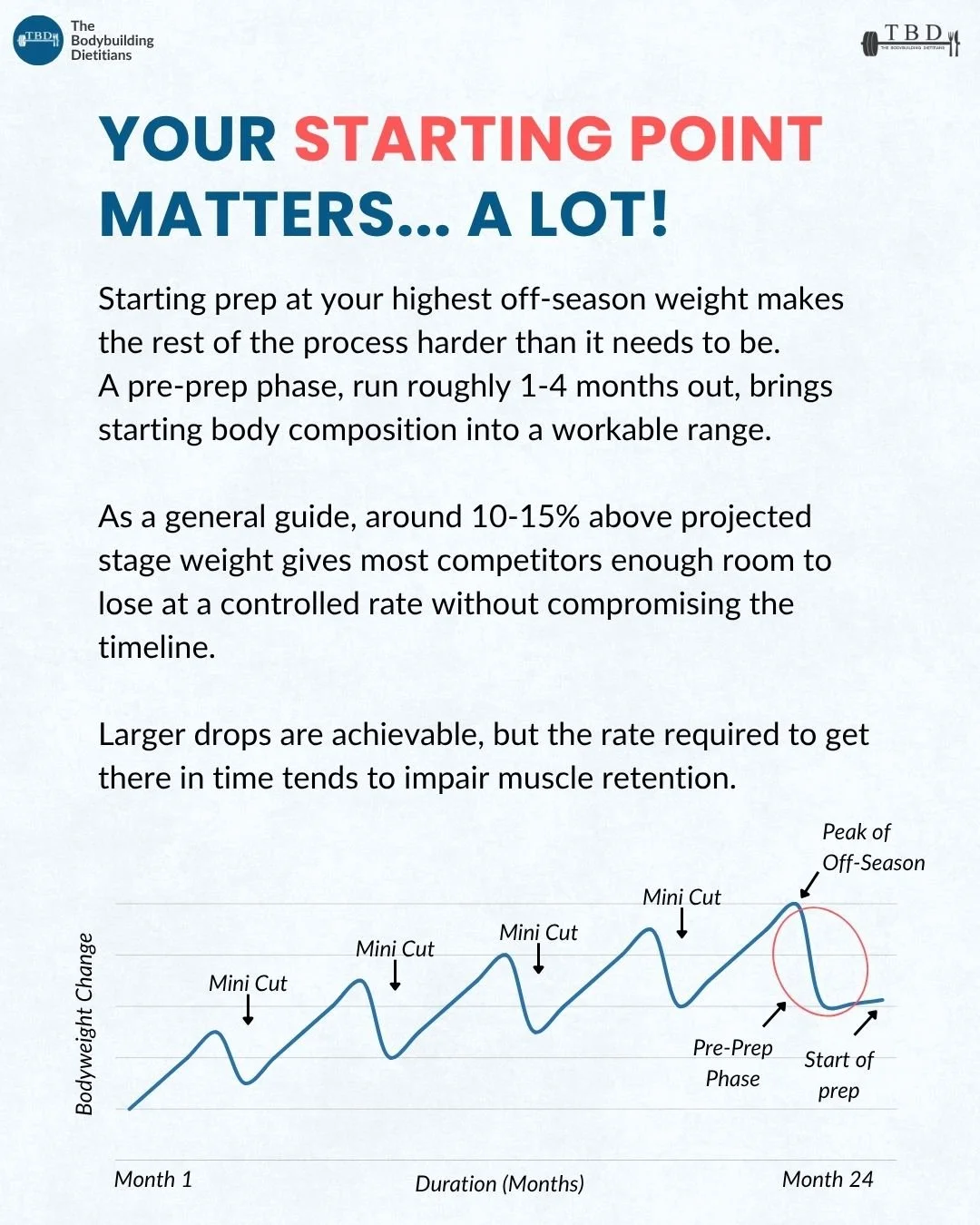
A starting point of approximately 10 to 15 percent above projected stage weight gives most competitors enough room to lose at a controlled pace without compromising the timeline. This is a general guide rather than a universal rule: individual variation in fat distribution, muscle mass, and the division being competed in all influence what constitutes an appropriate starting body composition. The number that matters is not absolute body fat percentage but the gap between starting composition and stage-ready composition relative to the time available to close it.
The pre-prep phase, typically run one to four months before the formal start of prep, addresses this problem directly. A structured period of modest calorie reduction in the months before competition season begins moves starting body composition into a more workable range without the pressure of a competition date. Periodic mini cuts across the off-season, used to manage the inevitable weight gain of building phases, are one way competitors whose sport involves recurring competition cycles manage starting point across multiple seasons. The line graph in the carousel illustrates this pattern: a bodyweight trajectory across twenty-four months that includes multiple mini cuts, a peak of off-season weight, a deliberate pre-prep phase, and a more controlled start of prep from a better position.
How Does Underlying Muscle Mass Affect Conditioning?
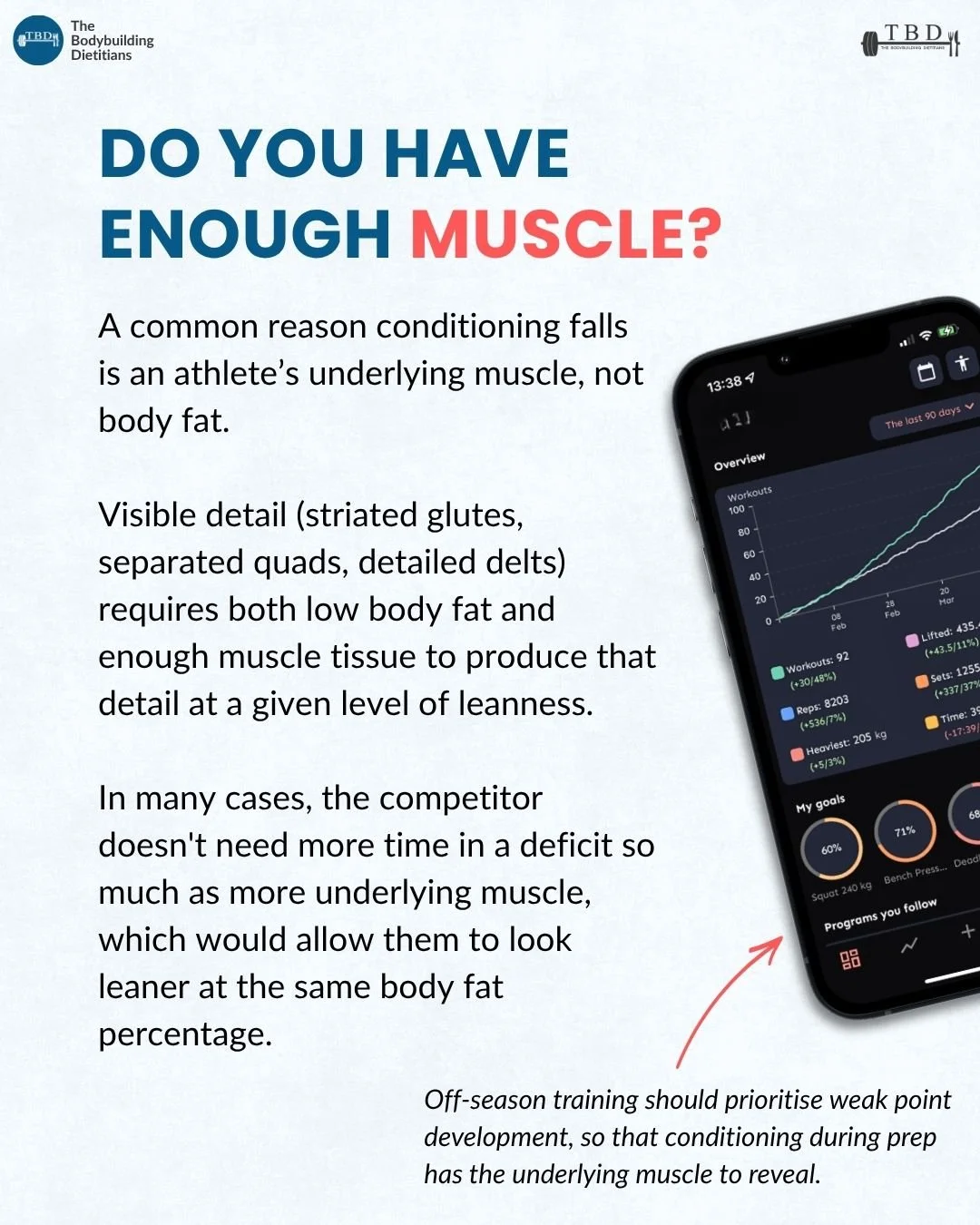
Conditioning in physique competition refers to the visible muscular detail that is revealed when body fat is sufficiently low: separation between muscle groups, surface striations, the three-dimensional fullness of well-developed musculature against a backdrop of minimal subcutaneous fat. Achieving this requires two things simultaneously: body fat low enough that the tissue beneath the skin is visible, and enough muscle tissue to produce the detail being looked for at that level of leanness.
The implication is often underappreciated in early-career competitors. Getting leaner reveals what is there. It does not add to it. A competitor who reaches stage condition with insufficient underlying muscle will present with the leanness required but without the muscular detail the division demands, because there is not enough muscle tissue to produce it. More time in a deficit would not solve the problem. More off-season muscle building would.
This is one of the most common patterns in natural physique competition: a competitor who has dieted hard, reached a genuinely low body fat, and still falls short on visible conditioning because the limiting factor was the amount of muscle they carried into prep rather than the depth of their deficit. Visible detail in areas like glutes, quads, and deltoids requires both metabolic leanness and a sufficient volume of trained muscle tissue in those areas to produce the separation and density the judges are assessing.
The practical implication for any competitor planning a prep is that off-season training should be structured around developing the specific muscle groups that represent weak points relative to division standards, so that the conditioning process has the underlying tissue to reveal. Building a prep plan without honestly assessing whether the current muscle mass is sufficient for the target division is one of the more avoidable reasons competitors fall short of the conditioning they are capable of. How progressive overload is structured across an improvement season to address weak points is something we work through with our bodybuilding coaching clients as a foundational part of long-term athlete development.
Why Is Contest Prep Not Simply a Weight Loss Competition?
A calorie deficit is the mechanism through which body fat is lost, and it is a necessary condition of every prep. But weight loss measured on the scale is only one of the variables that determine how a competitor looks on stage, and treating it as the primary goal at the expense of the others tends to produce a result that reflects that misalignment.
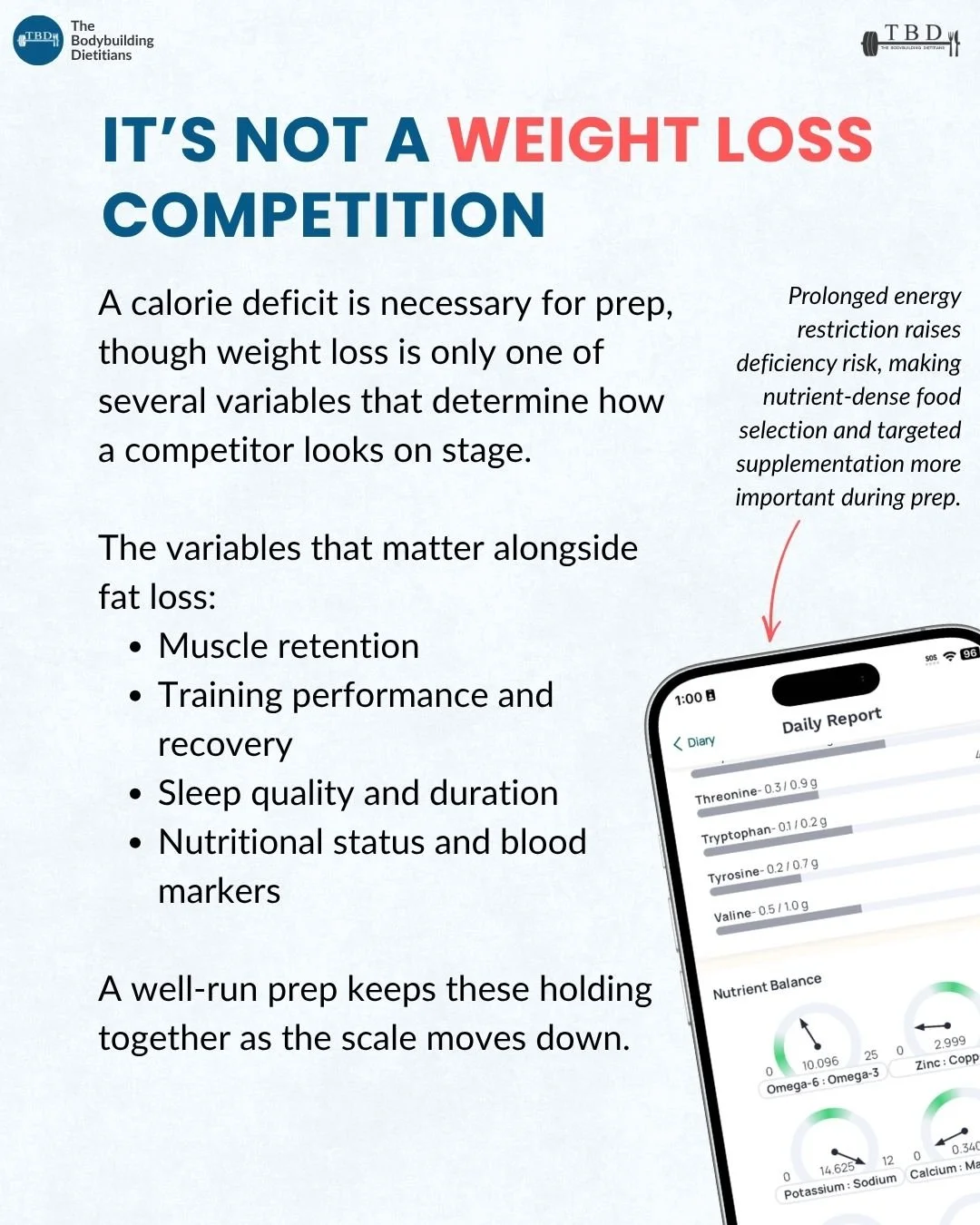
The variables that matter alongside fat loss are muscle retention, training performance and recovery, sleep quality and duration, and nutritional status. In a well-managed prep, all of these are held as close to their optimal state as the calorie deficit allows as weight comes down. When they deteriorate significantly, the scale is moving but the stage outcome is being compromised.
Muscle retention is the most critical of these. The goal of contest prep is to arrive at stage condition with as much lean mass as possible, which is what produces the fullness and detail that distinguished conditioning from simply being very light. Muscle is lost in a calorie deficit to a degree, and the factors that minimise that loss, including adequate protein intake, controlled rate of weight loss, maintained training stimulus, and avoiding extreme energy restriction, are central to prep nutrition rather than secondary considerations.
Training performance is both a goal and a monitoring tool. Maintaining performance across a prep supports the training stimulus that preserves muscle mass, and a sustained decline in performance that is not attributable to a specific temporary cause is one of the more reliable early indicators that the deficit has become too aggressive or that nutritional status is deteriorating.
Prolonged energy restriction during prep raises the risk of micronutrient insufficiency in a way that off-season eating does not. Food volume decreases, food variety may narrow as the diet becomes more structured, and the caloric space available for nutrient-dense foods contracts. This makes nutrient-dense food selection and targeted supplementation more important during prep than during a standard fat loss phase, and it is one reason that monitoring nutritional status through blood markers across a longer prep provides useful information that scale weight and physical appearance cannot.
Sleep quality and duration affect recovery, mood, hunger hormones, and performance in ways that compound across weeks of competition preparation. The relationship between sleep and body composition, particularly the role of cortisol, ghrelin, and leptin in a sleep-deprived state, means that protecting sleep quality during prep is not a passive background variable but an active component of the plan.
How Does Timeline Shape the Quality of a Prep?
A realistic prep timeline that accounts for the full picture of what needs to happen is one of the variables most consistently underestimated by competitors planning their first season or returning after time away. The number of weeks between the start of prep and competition day is not simply a calculation of weekly weight loss rate multiplied by kilograms to lose. It needs to accommodate the variables that make a prep productive rather than just short.
The rate of loss that best preserves lean mass and training performance during energy restriction in resistance-trained athletes is consistently around 0.5 to 1 percent of bodyweight per week, with slower rates producing better lean mass outcomes during the final stages when fat stores are lower and the margin between fat and muscle as fuel sources narrows. A timeline that requires consistently exceeding this rate to reach stage condition in time is a timeline that forces a trade-off between stage readiness and muscle retention, and that trade-off rarely resolves in the competitor's favour.
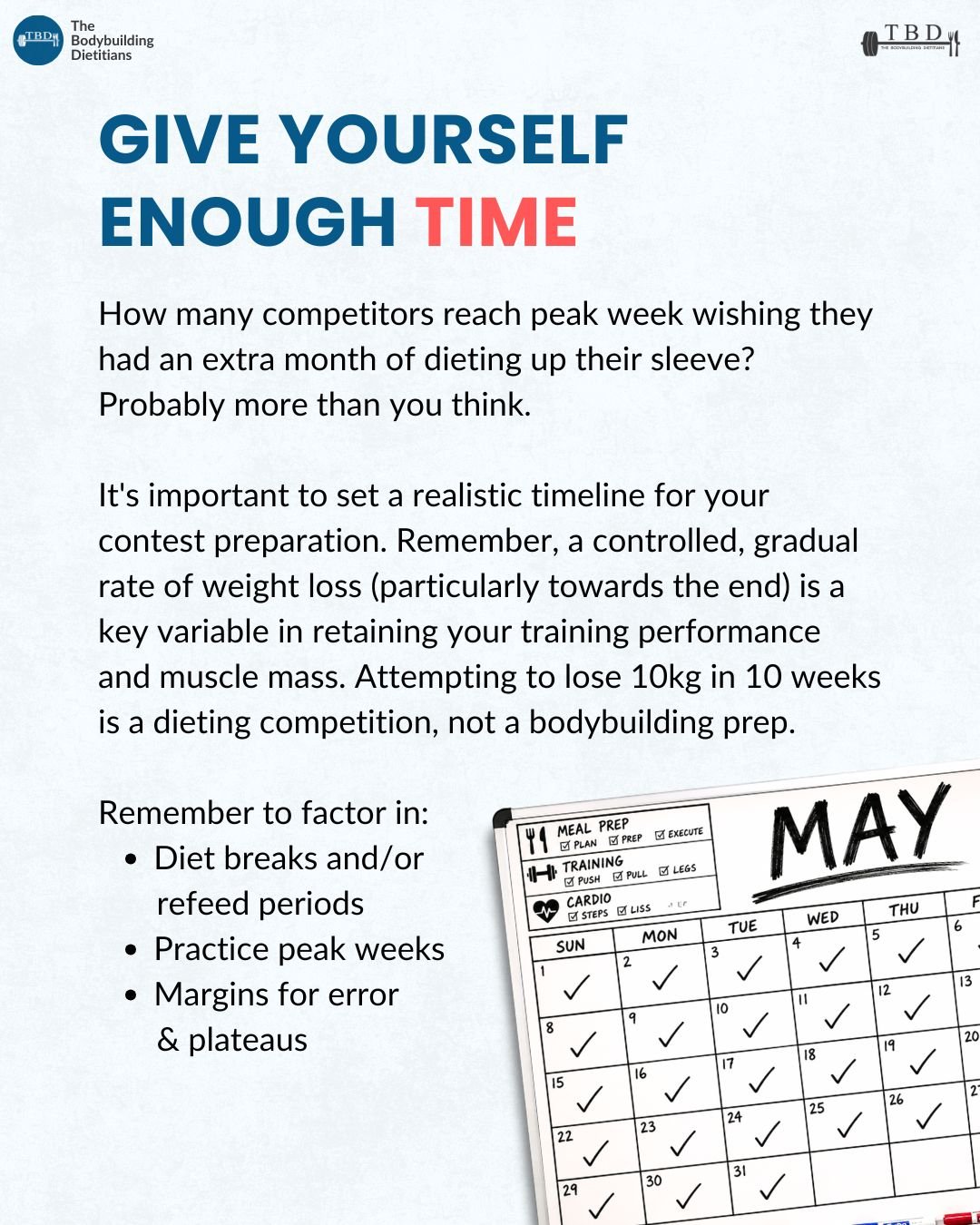
Beyond the rate of loss, a well-planned timeline incorporates diet breaks of approximately one to two weeks at maintenance calories to manage diet fatigue accumulation and partially restore the hormonal environment that sustained restriction disrupts. It includes refeed periods around training. It allows time for a practice peak week before the competition season begins, which is the only way to calibrate the peaking protocol to the individual rather than applying a generic approach on the highest-stakes day of the season. And it builds in margins for plateaus and the periods of slower progress that occur in virtually every extended prep.
Attempting to lose ten kilograms in ten weeks is not a bodybuilding prep. It is a dieting competition that happens to end on a stage. The rate required to achieve that kind of weight loss in a trained athlete at low body fat will not spare muscle, and the outcome on stage reflects it. The time investment required to prepare properly is significant, and understanding that before committing to a competition date is part of making a decision to compete that reflects the full picture of what the process involves.
How Does Psychological Readiness Shape a Prep?
Contest preparation requires sustained commitment to a demanding process across weeks and months during which the physiological environment is actively working against the continuation of that commitment. For many competitors, it represents one of the most physically and mentally challenging endeavours they have undertaken. The psychological readiness to navigate that experience is not a soft variable that sits separate from the practical considerations. It is a functional determinant of whether the plan that has been built gets executed.
The specific challenge of late prep is that motivation based on how the process feels tends to decline precisely when adherence is most critical. Diet fatigue accumulates, hunger is elevated, mood and stress tolerance are reduced, and the daily demands of tracking, training, meeting step targets, and managing social situations around food all require cognitive and emotional resources that are being drawn down by the deficit itself. Relying on feeling motivated to carry the prep through this period is not a reliable strategy.
What tends to carry experienced competitors through the difficult final stretch of a prep is a clearly articulated personal reason for competing that goes beyond how they feel on a given day. The specific content of that reason matters less than whether it is genuinely meaningful to the individual. It needs to be substantial enough to sustain the decision to continue when the experience is uncomfortable, because there will be days during a serious prep when continuing is a deliberate choice made against significant friction.
Competing is a choice. That framing is not dismissive of how hard a prep is. It is a reminder that the discomfort is not being imposed externally but accepted voluntarily in service of a goal the competitor has decided matters to them. Competitors who understand this tend to navigate the difficult periods more effectively than those who frame the difficulty as something happening to them, and the framing has practical consequences for adherence and outcome.
This psychological dimension of prep is not separate from the nutritional and training management. How well a competitor sleeps, how consistently they adhere to their intake targets, how they respond to a week of slower weight loss, and whether they maintain training intensity when they are tired and hungry are all influenced by their psychological relationship with the process. Preparation that addresses the practical variables without considering the psychological context is incomplete.
Practical Takeaways
Starting body composition is one of the most consequential decisions in contest prep. Beginning prep approximately 10 to 15 percent above projected stage weight allows a controlled rate of loss without forcing a pace that compromises muscle retention.
A pre-prep phase of one to four months before the formal start of prep moves starting body composition into a workable range. Periodic mini cuts across the off-season manage the gap between building phases and prep starts.
Conditioning reveals what is already there. Insufficient underlying muscle means that no amount of dieting produces the visible detail a division requires. Off-season training should prioritise weak point development relative to division standards.
Contest prep is not a weight loss competition. Muscle retention, training performance and recovery, sleep quality, and nutritional status all need to hold as the scale moves down. When recovery falls apart, the result is usually muscle loss and a compromised stage outcome.
A realistic timeline accounts for diet breaks, refeed periods, a practice peak week, and margins for plateaus and error. A rate of loss of approximately 0.5 to 1 percent of bodyweight per week better preserves lean mass than faster approaches, particularly in the final stages of prep.
Prolonged energy restriction raises micronutrient deficiency risk. Nutrient-dense food selection and targeted supplementation become more important during prep than during standard fat loss phases.
Psychological readiness to sustain the demands of an extended prep determines whether the plan gets executed. A clearly articulated personal reason for competing that goes beyond daily motivation is a functional part of prep preparation.
Frequently Asked Questions
How long should a contest prep be for natural bodybuilding?
Prep length depends on starting body composition, the target body fat for the division, and how much weight needs to be lost at a rate that preserves muscle. As a general guide, most natural competitors benefit from a prep of 16 to 24 weeks, with longer preps appropriate for competitors starting further from stage condition. Factoring in diet breaks, refeed periods, a practice peak week, and margins for plateaus means the usable dieting time within a 20-week prep is often closer to 14 to 16 effective weeks. Starting prep too close to the competition date forces a rate of loss that compromises muscle retention and stage outcome.
What body fat percentage should a competitor start prep at?
Starting prep at approximately 10 to 15 percent above projected stage weight is a practical guide for most competitors. This allows for a controlled rate of loss of 0.5 to 1 percent of bodyweight per week without requiring the aggressive restriction that forces the timeline. The appropriate starting composition varies by division, sex, and individual fat distribution patterns. A pre-prep phase run one to four months before the formal start of prep is often what closes the gap between off-season peak weight and an appropriate starting point.
How do you maintain muscle mass during contest prep?
The primary strategies for preserving lean mass during a calorie deficit are adequate protein intake at the higher end of the evidence-based range, around 2.0 to 2.4 grams per kilogram of bodyweight; a controlled rate of weight loss that avoids the aggressive restriction that accelerates muscle loss; maintaining the training stimulus through the prep rather than significantly reducing volume or intensity; managing sleep quality; and monitoring training performance as an early indicator that the deficit has become too aggressive.
What is a practice peak week and why does it matter?
A practice peak week is a structured rehearsal of the water, sodium, carbohydrate, and timing manipulations that are used in the week leading up to competition to optimise stage appearance. Running a practice peak several weeks before the competition season allows the competitor to observe how their body responds to the protocol without the performance being on a competition stage, and to adjust the approach based on what they actually see rather than what the theory predicts. Individual responses to peaking protocols vary considerably, and trial-and-error before the competition is the only reliable way to calibrate the approach.
How important is nutrition quality during prep compared to just hitting macros?
Macronutrient targets drive the primary outcomes of prep: protein intake preserves lean mass, carbohydrate intake supports training performance, and total energy determines the deficit. Food quality becomes increasingly important as prep extends because prolonged restriction raises micronutrient deficiency risk and food volume decreases, making every food choice a more consequential contributor to nutritional completeness. Nutrient-dense whole foods that meet macro targets cover both requirements simultaneously better than calorie-matched processed alternatives, and targeted supplementation for identified gaps adds a layer of protection that becomes more relevant the deeper into prep the competitor goes.
Is competing in bodybuilding bad for your health?
The health implications of contest preparation depend considerably on how it is structured, how long the prep is, how deep the deficit and body fat reduction go, and the support structures around the athlete. A moderately aggressive prep run over an appropriate timeline, with adequate protein, nutrient-dense food selection, attention to blood markers, and professional guidance, carries a different risk profile from an extremely prolonged, highly aggressive prep with inadequate nutritional support.
When to start prep, how aggressive the deficit should be, and how to keep training and recovery holding as weight comes down are all decisions that depend on the individual. Working through that calibration with the structure and feedback a serious prep requires is a central part of our bodybuilding coaching. You can enquire about working with our team or book a consultation to discuss your next prep.