Peak week can be structured in several ways, and the right one depends on the athlete rather than a single correct protocol. A look at five carbohydrate loading approaches, what each suits, and the factors beyond carbs that shape how you present on stage.
The best peak week strategy is one of the most frequently debated topics in physique sport, and those debates often miss the forest for the trees. What works best is highly individual, shaped by the athlete, their circumstances and what they are trying to present on stage. A protocol that produces a career-best showing for one competitor can flatten another, which is why the search for a single correct approach tends to lead nowhere useful.
Planning a peak week means weighing a long list of individual factors: conditioning, muscularity, division, current fullness, digestive tolerance and previous responses to carbohydrate loading, alongside how the athlete has responded through prep, how much time there is to make adjustments, and the physique being presented. This article covers five ways carbohydrate and energy intake can be structured across the final week, what each one suits, and the considerations beyond carbohydrate that influence how someone looks on the day. For the errors that most often compromise a peak, our guide to common peak week mistakes covers what to avoid alongside the structures here.
Why Is There No Single Best Peak Week?
There is no single best peak week because the response to carbohydrate loading and the surrounding manipulations varies considerably between individuals, so the approach has to be matched to the athlete rather than copied from a protocol. The factors that shape the right approach are specific to the person standing on stage.
Conditioning and muscularity influence how much carbohydrate a physique can take before fullness tips into spillover. Division sets the look being judged, which changes the target. Digestive tolerance determines how much food can be processed comfortably in a compressed window. Most importantly, previous responses to carbohydrate loading give the clearest signal of all, since an athlete who has peaked before carries data that no general protocol can provide. How someone has responded throughout prep, and how much time remains to make adjustments, further narrow the sensible options. The practical result is that peak week is a decision made from individual information, and the structures below are starting frameworks to be fitted to the athlete rather than prescriptions to be applied uniformly.
What Is Peak Week Trying to Achieve?
Peak week aims to present the physique at its fullest and most conditioned on show day, primarily by restoring and slightly supercompensating muscle glycogen after the depletion of a long prep. The carbohydrate structure is the main lever for this, which is why it receives so much attention.
Glycogen is the stored form of carbohydrate found in muscle and liver tissue, and in muscle it contributes directly to the visual fullness and volume seen on stage. Each gram of glycogen is stored alongside roughly three grams of water, so loading carbohydrate into depleted muscle draws water into the muscle itself, which is part of what produces a full, rounded look. The goal across the week is to arrive on stage with muscles that are full rather than flat or spilled over, and the different loading structures are different timings for reaching that point. Hydration supports this process rather than working against it, which is one reason the aggressive water restriction discussed later tends to undermine the look it is meant to improve.
How Can Carbohydrate Loading Be Structured Across Peak Week?
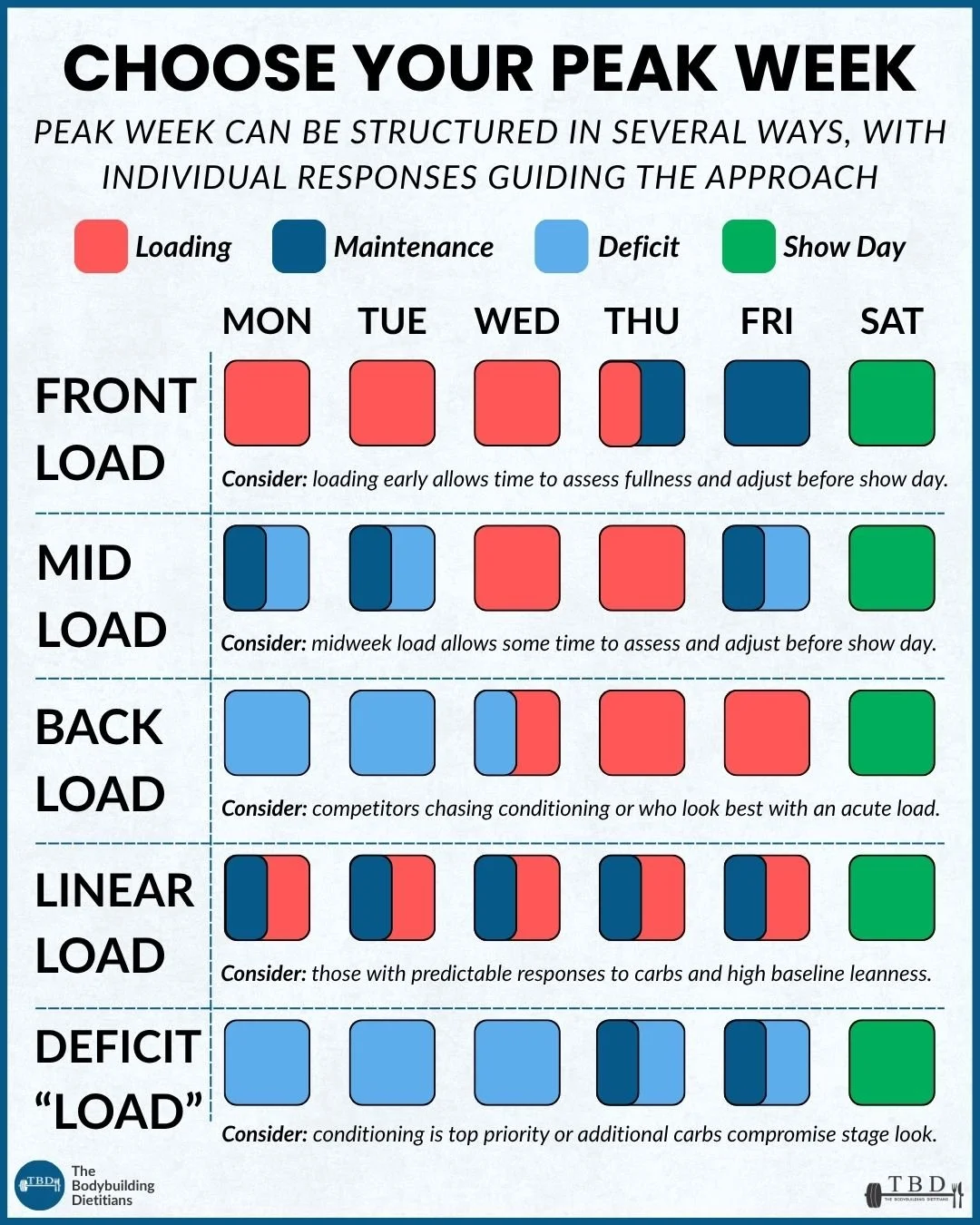
Carbohydrate loading can be structured in several ways across the final week, each placing the load at a different point and each suiting a different athlete and situation. The split days in each structure represent opportunities to adjust intake based on how the athlete is responding, rather than fixed instructions.
A front load concentrates carbohydrate in the early part of the week, easing back towards show day. Loading early allows time to assess fullness and make adjustments before the stage, which suits athletes who want the longest possible runway to correct an over or under-full response.
A mid load places the bulk of the carbohydrate around midweek. This keeps some of the benefit of an earlier load while still leaving a window to assess and adjust before show day, sitting between the front and back approaches in how much time it allows for correction.
A back load concentrates carbohydrate in the final days before the show. This suits competitors who are still chasing conditioning late into the week, or who present best with an acute load close to stage time, accepting less time to adjust in exchange for a sharper, later fill.
A linear load distributes carbohydrate steadily across each day of the week rather than concentrating it. This tends to suit athletes with predictable, well-understood responses to carbohydrate and high baseline leanness, where a consistent daily intake holds the look without the swings of a concentrated load.
A deficit-led approach keeps most of the week in a modest deficit with minimal loading. This is reserved for situations where conditioning is the top priority or where additional carbohydrate compromises the stage look, prioritising a tight, conditioned appearance over maximal fullness.
Not sure which of these is yours?
Five structures on a page is useful context, and it is also exactly where most competitors get stuck, because the right one depends on information about your physique that a graphic cannot see. Reading your conditioning, your carbohydrate response and how you have moved through prep, then choosing and adjusting the approach from there, is what our competition coaching is built around, so the decision is made from your data rather than a template.
Why Do the Split Days Matter?
The split days in each structure matter because they are the built-in points for adjusting intake based on what the athlete is showing, which is where peaking becomes responsive rather than fixed. A peak week plan is a starting hypothesis, and the split days are where it meets reality.
How a physique responds to a given load is only partly predictable in advance, so observing fullness, conditioning and how the athlete feels across the week provides information that the initial plan cannot. A competitor filling out faster than expected can have intake pulled back on an adjustment day, while one looking flat can have it pushed up. This responsiveness is why running the chosen approach as a practice peak week before the competition is so valuable, since it reveals how an individual responds and allows the real peak to be built on observation rather than theory. The ability to read those responses and adjust at the right moments is a large part of what separates a well-executed peak from a protocol followed blindly.
What Matters Beyond Carbohydrate?
A great deal beyond carbohydrate manipulation influences how an athlete presents on show day, and focusing on carbohydrate alone leaves much of the outcome unmanaged. The surrounding variables often make the difference between a good peak and a flat one.
Training and cardio decisions across the week affect depletion and fullness. Fibre intake and digestion influence how the gut looks and feels, since a bloated or uncomfortable midsection undermines even a well-loaded physique. Hydration supports glycogen storage and muscle fullness rather than detracting from it. Consistency in sodium intake helps keep fluid balance stable and predictable through the week. Sleep and stress influence everything from water retention to how the athlete carries themselves on stage. Even the finer details of tanning, shaving and stage timing deserve attention, because the physique is being judged under specific lighting at a specific moment, and small presentation factors can change how the same conditioning reads. None of these replace the carbohydrate structure, and all of them shape the final result alongside it.
Why Is Aggressive Water and Electrolyte Manipulation a Risk?
Aggressive water restriction and electrolyte manipulation introduce genuine health risks and make an already complex process considerably less predictable, which is why evidence-based peaking moves away from them. The potential downside extends well beyond a suboptimal stage look.
Severe fluid restriction and electrolyte manipulation can disturb the body's fluid and electrolyte balance in ways that carry real medical consequences, and the stage presentation they aim for is often worse rather than better, because restricting water works against the glycogen storage and muscle fullness that produce a full physique.
Severe voluntary dehydration before physique competitions has been associated with impaired cardiovascular function, reduced cognitive performance and, in extreme cases, serious medical events. Evidence-based peak week approaches emphasise maintaining adequate hydration to support glycogen storage and muscle fullness, using carbohydrate and sodium adjustments to manage fluid balance rather than water restriction. Source: Chappell and Simper, 2018, Journal of the International Society of Sports Nutrition.
The more reliable path is to arrive at stage-lean conditioning through a well-structured prep and to maintain adequate hydration through peak week, letting the conditioning show rather than attempting to manufacture it through dehydration. The practical message for peak week is to keep hydration and electrolytes stable and to treat aggressive manipulation as a source of risk rather than an edge.
Why Is Peak Week Described as an Art?
Peak week is often described as an art because sound physiology only takes you so far, and applying it well depends on experience, careful observation and an understanding of how a specific individual responds. The science sets the principles, and the execution is where the skill lies.
Understanding the underlying physiology of glycogen loading, fluid balance and presentation is the necessary foundation. Translating that understanding into the right decisions for one athlete, in one week, with the information available, is a different task that improves with experience and attention. Knowing what to adjust, when to adjust it, and when to leave things alone can make a meaningful difference to the final presentation, and the last of those is often the hardest, since the instinct to keep tinkering late in the week causes as many flat peaks as it fixes. The combination of solid physiological knowledge and the judgement to apply it individually is what a well-executed peak reflects, which is why the same five structures produce very different results depending on who is steering them.
Practical Takeaways
There is no single best peak week. The right structure depends on the athlete's conditioning, muscularity, division, digestive tolerance and previous responses to carbohydrate loading.
Peak week aims to present a full, conditioned physique, mainly by restoring and slightly supercompensating muscle glycogen, which stores water alongside it and contributes to muscle fullness.
Five common structures place the carbohydrate load at different points: front, mid, back, linear across the week, and a deficit-led approach, each suiting a different athlete and situation.
The split days in each structure are opportunities to adjust intake based on how the athlete is responding, which is why a practice peak week before the show is so valuable.
Much beyond carbohydrate shapes the result: training and cardio, fibre and digestion, hydration, sodium consistency, sleep, stress, and details like tanning and stage timing.
Aggressive water restriction and electrolyte manipulation carry real health risks and tend to worsen the look. Maintaining hydration and keeping electrolytes stable is the safer and more reliable approach.
Frequently Asked Questions
What is the best peak week carb loading strategy?
There is no single best strategy, because the response to carbohydrate loading is highly individual. The right approach depends on the athlete's conditioning, division, digestive tolerance and how they have responded to loading before. The five common structures (front, mid, back, linear and deficit-led) are starting frameworks to be matched to the individual rather than a protocol that suits everyone.
What is the difference between a front load and a back load?
A front load concentrates carbohydrate early in peak week, which leaves the most time to assess fullness and adjust before show day. A back load concentrates it in the final days, which suits competitors still chasing conditioning late or who present best with an acute load close to stage, in exchange for less time to correct. The choice depends on how predictably the athlete responds and how much adjustment room they want.
How does carbohydrate loading make muscles look fuller?
Loading carbohydrate restores and slightly supercompensates muscle glycogen after the depletion of a prep, and glycogen is stored in muscle alongside roughly three grams of water per gram. This draws water into the muscle itself, contributing to a full, rounded appearance on stage. Adequate hydration supports this process, which is one reason water restriction tends to work against muscle fullness.
Should you restrict water during peak week?
Current evidence does not support aggressive water restriction. Severe fluid restriction has been associated with impaired cardiovascular and cognitive function and, in extreme cases, serious medical events, and it tends to undermine the glycogen storage and muscle fullness that produce a good stage look. Evidence-based peaking maintains adequate hydration and manages fluid balance through carbohydrate and sodium adjustments instead.
What matters in peak week besides carbs?
Training and cardio, fibre intake and digestion, hydration, consistent sodium intake, sleep and stress all influence how an athlete presents on stage. Presentation details such as tanning, shaving and stage timing also matter, since the physique is judged under specific conditions at a specific moment. These factors work alongside the carbohydrate structure rather than replacing it.
Why is peak week called an art?
Peak week is called an art because understanding the physiology is only the starting point, and applying it well requires experience, careful observation and an understanding of how a specific individual responds. Individual responses to loading and the surrounding manipulations vary considerably, so knowing what to adjust, when, and when to leave things alone is a skill that develops with practice rather than a formula.
If you want individual nutrition and training support through competition prep and peak week, our team can build and adjust your approach around how your physique responds. Enquire about bodybuilding coaching or book a free discovery call to get started.