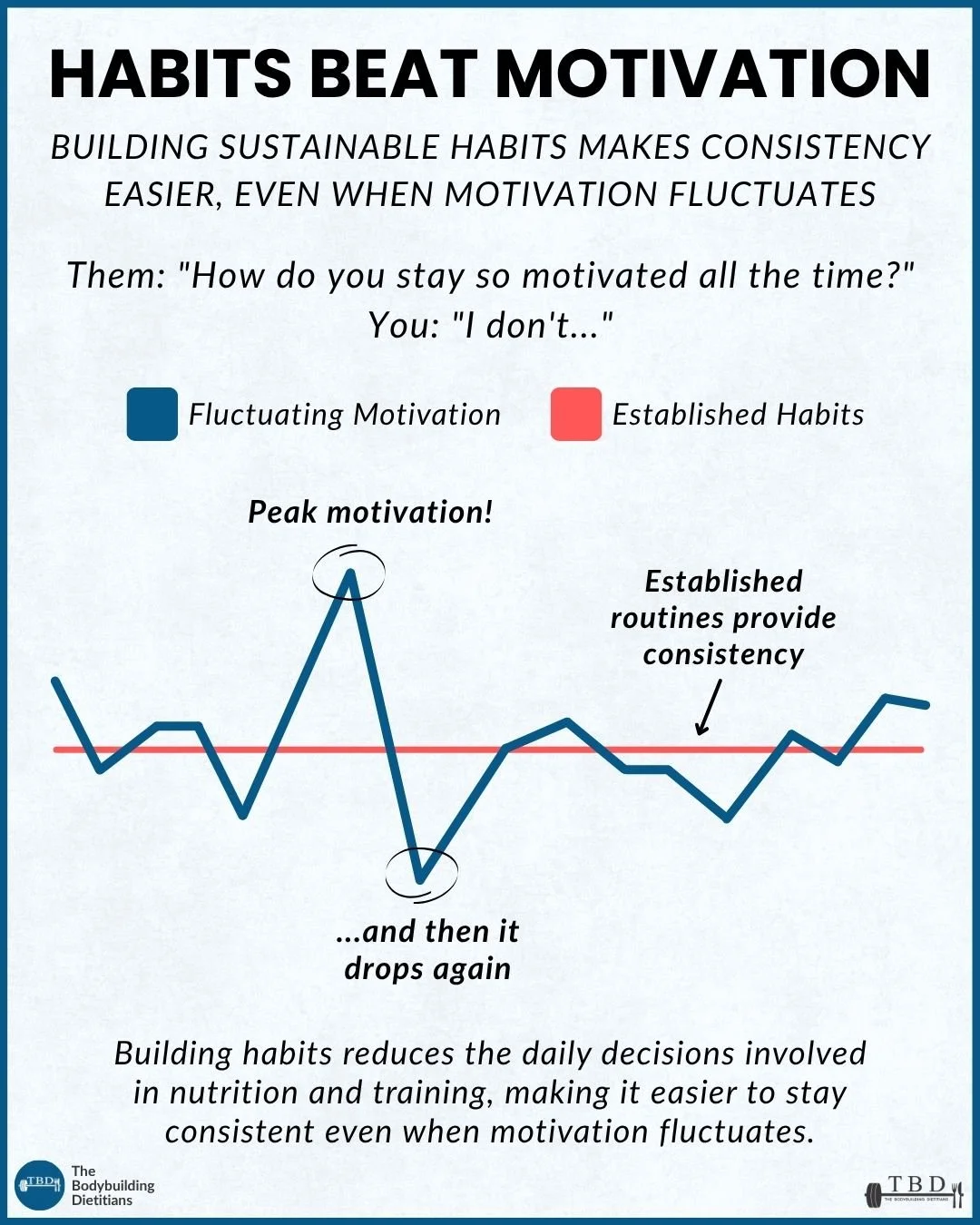
Motivation rises and falls with sleep, stress and everything else life throws at you. Building habits around your nutrition and training is what makes consistency hold through those fluctuations, and this is how that process works.
Consistency becomes much easier when it stops depending on motivation, because motivation naturally fluctuates with sleep, stress, work and everything else happening in life. Habits are the alternative, and they form through repeatedly performing an action in a relatively consistent context, so that familiar cues become associated with the behaviour and it gradually requires less conscious effort. Once a behaviour is habitual, it continues running during the low-motivation periods that would otherwise derail progress, because it no longer relies on how you feel on a given day. Building habits also reduces the number of daily decisions involved in nutrition and training, which lowers the mental effort consistency demands. The practical goal is to make the behaviours realistic, easy to start and repeatable enough to become automatic, with your environment, your existing habits and the effort each behaviour requires all influencing how well it sticks.
A common question put to people who train and eat consistently is some version of how they stay so motivated. The honest answer from most of them is that they do not, at least not in the way the question assumes. Their consistency does not come from a steady supply of motivation, because no one has that. It comes from habits that keep the important behaviours running whether motivation is high, low or absent on a given day.
Motivation naturally fluctuates with sleep, stress, work commitments and everything else happening in life, which makes it an unreliable foundation for anything you want to sustain over months and years. Habits offer a steadier alternative, and understanding how they form and why they work is what lets you build consistency that does not collapse the moment motivation dips. This article covers why motivation falls short, how habits develop, and how to build ones that hold.
Why Isn't Motivation Enough for Consistency?
Motivation is unreliable for consistency because it fluctuates constantly with factors largely outside your control, so building a routine on top of it means the routine inherits that instability. The graph of motivation over time is a jagged line of peaks and troughs, and anything that depends on it rises and falls the same way.
Sleep, stress, work demands, mood and the general state of life all move motivation up and down from one day to the next. On a high day, training and hitting nutrition targets feel easy. On a low day, the same tasks feel like a negotiation you are likely to lose. Relying on motivation means your consistency is only as reliable as your worst days, and everyone has plenty of those. The problem is not a personal shortage of willpower, since motivation behaves this way for everyone, including the people who appear most disciplined. The useful response is to build a system that keeps working when motivation is low, rather than one that assumes it will always be high.
How Do Habits Form?
Habits form through repeatedly performing an action in a relatively consistent context, until the context itself begins to trigger the behaviour with little conscious effort. This is a well-studied behavioural process rather than a matter of discipline or personality.
A habit is a behaviour that has become largely automatic through repetition, triggered by a familiar cue rather than a conscious decision each time. When you perform the same action in the same setting often enough, the brain begins to associate the surrounding cues, such as the time of day, the location or the preceding activity, with the behaviour that usually follows. Over time that association strengthens, and the behaviour starts to initiate on its own when the cue appears, requiring less deliberation and less effort to get going. This is why a long-established gym-goer does not debate whether to train on a normal weekday. The cue of the usual time and routine carries them into the session before motivation enters the conversation.
Research tracking people forming new habits found that a behaviour became automatic after a median of around 66 days of repetition, with a wide individual range from roughly 18 to 254 days depending on the person and the behaviour. Missing an occasional day did not meaningfully disrupt the process. Source: Lally et al., 2010, European Journal of Social Psychology.
The practical message from that research is twofold. Habits take longer to form than the popular three-week figure suggests, so patience is warranted, and an occasional missed day does not undo the progress, so a single slip is not a reason to abandon the effort. Consistency over weeks, rather than perfection over days, is what moves a behaviour towards automatic.
How Do Habits Make Consistency Easier Than Motivation?
Habits make consistency easier because once a behaviour is automatic it continues running during the low periods that would otherwise stop it, and it draws on far less mental effort to do so. Where motivation is the jagged line that spikes and crashes, an established habit is the steady line that holds through both.
The clearest benefit is what happens on the bad days. A behaviour that depends on motivation disappears when motivation does, whereas a habit keeps operating because it no longer asks how you feel before it runs. The person with an established training routine still trains on a flat, tired, uninspired day, not through heroic willpower but because the routine carries them there by default. A second benefit is the reduction in decisions. Building habits reduces the daily decisions involved in nutrition and training, and every decision removed is a small amount of mental effort and willpower saved. When meals, training times and food choices are largely decided in advance by routine, there is less to deliberate over and less opportunity for a low-motivation moment to talk you out of the plan. Consistency stops being a daily battle and becomes something closer to the path of least resistance.
Keep starting strong and falling off?
The pattern of starting with high motivation and losing consistency when it fades is one of the most common reasons progress stalls, and it is rarely a willpower problem. Identifying which habits to build first, how to fit them to your life, and when to adjust is the kind of thing our coaching works through with you, so consistency stops depending on how motivated you feel that week.
What Makes a Habit Stick?
A habit sticks when the behaviour is realistic, easy to initiate and repeatable enough to survive being done over and over until it becomes part of your routine. Habits that are too ambitious, too effortful or too dependent on ideal conditions tend to fall apart before they become automatic.
Several factors influence how successfully a behaviour becomes established. Your environment plays a large role, since cues and convenience in your surroundings either prompt the behaviour or stand in its way. Your existing habits matter too, because attaching a new behaviour to one you already perform reliably gives it a ready-made cue. The effort required to start the behaviour is often the deciding factor, since a behaviour that is easy to begin gets repeated, while one that requires significant setup each time tends to be skipped on the days that matter most. The practical implication is to lower the friction on the behaviours you want to keep and set a realistic bar for them, rather than relying on an ambitious plan that only works when conditions are perfect. A smaller habit performed consistently becomes automatic, while a larger one performed sporadically never does.
What Does Building These Habits Look Like in Practice?
Building habits in practice means attaching specific nutrition and training behaviours to consistent cues and making them easy to carry out, so they repeat until they run on their own. The behaviours themselves are ordinary, and their power comes from the consistency rather than the complexity.
This might involve preparing your meals at the same time each evening, so the cue of that time slot reliably triggers the behaviour. It might mean scheduling training around existing commitments rather than hoping to fit it in, so sessions have a fixed place in the week rather than competing for one each day. It often means making certain food choices more convenient and accessible, such as keeping easy high-protein options on hand, so the lower-effort choice is also the one that supports your goals. Each of these works by reducing the effort and decision-making involved, and by tying the behaviour to a cue that shows up reliably. The aim across all of them is the same, make the behaviours realistic, easy to initiate and repeatable enough that they gradually stop requiring motivation and become what you do by default.
Knowing which behaviours to prioritise, how to integrate them into a specific lifestyle, and when to adjust expectations is also a large part of what effective coaching provides. The right starting habits differ from person to person, and matching them to someone's circumstances is what makes the difference between a plan that looks good on paper and one that gets followed. Supporting that process is central to how we coach for long-term adherence rather than short-term results.
Practical Takeaways
Motivation fluctuates with sleep, stress and life, so building consistency on top of it means the routine inherits that instability. Everyone has low-motivation days, including the people who look most disciplined.
Habits form by repeating an action in a consistent context until familiar cues trigger the behaviour automatically, which takes a median of around 66 days with a wide individual range.
An occasional missed day does not undo habit progress, so consistency over weeks matters more than perfection over days.
Once automatic, a habit keeps running during low-motivation periods and reduces the daily decisions involved in nutrition and training, lowering the mental effort consistency requires.
Habits stick when the behaviour is realistic, easy to start and repeatable. Lower the friction, attach it to an existing routine, and set a bar you can hit on a bad day.
In practice this looks like preparing meals at a set time, scheduling training around fixed commitments, and making supportive food choices the convenient ones.
Frequently Asked Questions
Why are habits better than motivation for consistency?
Motivation fluctuates with sleep, stress, work and mood, so anything that depends on it rises and falls the same way. Habits run on familiar cues rather than how you feel, which means they keep operating during the low periods that would otherwise stop you. They also reduce the daily decisions involved in nutrition and training, lowering the mental effort consistency demands.
How long does it take to build a habit?
Research tracking real habit formation found a median of around 66 days for a behaviour to become automatic, with a wide range from roughly 18 to 254 days depending on the person and the behaviour. This is considerably longer than the popular three-week figure. The practical implication is to expect the process to take a couple of months and to judge progress over weeks rather than days.
Does missing a day ruin a habit?
No. The research on habit formation found that an occasional missed day did not meaningfully disrupt the process of a behaviour becoming automatic. A single slip is not a reason to abandon the effort, since consistency over time is what builds the habit, not an unbroken streak. Returning to the behaviour the next day is what matters.
How do you make a habit easier to stick to?
Make the behaviour realistic, easy to start and repeatable, then lower the effort required to begin it. Attaching a new behaviour to an existing routine gives it a reliable cue, and arranging your environment so the supportive choice is the convenient one removes friction. A smaller habit performed consistently becomes automatic, while an ambitious one performed sporadically rarely does.
What are examples of good nutrition and training habits?
Preparing meals at the same time each evening, scheduling training around fixed existing commitments, and keeping convenient high-protein options accessible are all practical examples. Each works by attaching the behaviour to a consistent cue and reducing the effort involved in doing it. The specific habits matter less than making them repeatable enough to become automatic.
Is a lack of motivation a willpower problem?
No. Motivation fluctuates for everyone, including the most consistent people, so struggling to rely on it is not a personal failing. The more useful response is to build habits that keep the important behaviours running when motivation is low, rather than trying to summon more willpower. Consistency comes from the system, not from feeling motivated more often.
If you want personalised nutrition and training support that fits your goals, lifestyle and circumstances, our team can help you build the habits that keep you consistent when motivation fluctuates. Enquire about coaching or book a free discovery call to get started.