Repeated attempts at fat loss can leave you stuck losing the same weight over and over. Why maintenance is harder than the diet itself, and how planning for it from the start breaks the cycle.
Losing fat can be easier than keeping it off, which is a frustrating thing to discover after the work a diet takes. Having spent weeks or months managing intake, training and hunger to reach a target, watching the weight gradually return and realising you are planning another cut to reach a point you have already been is a demoralising place to land. The effort of the first cut is fresh in memory, and now much of it is lined up to be repeated.
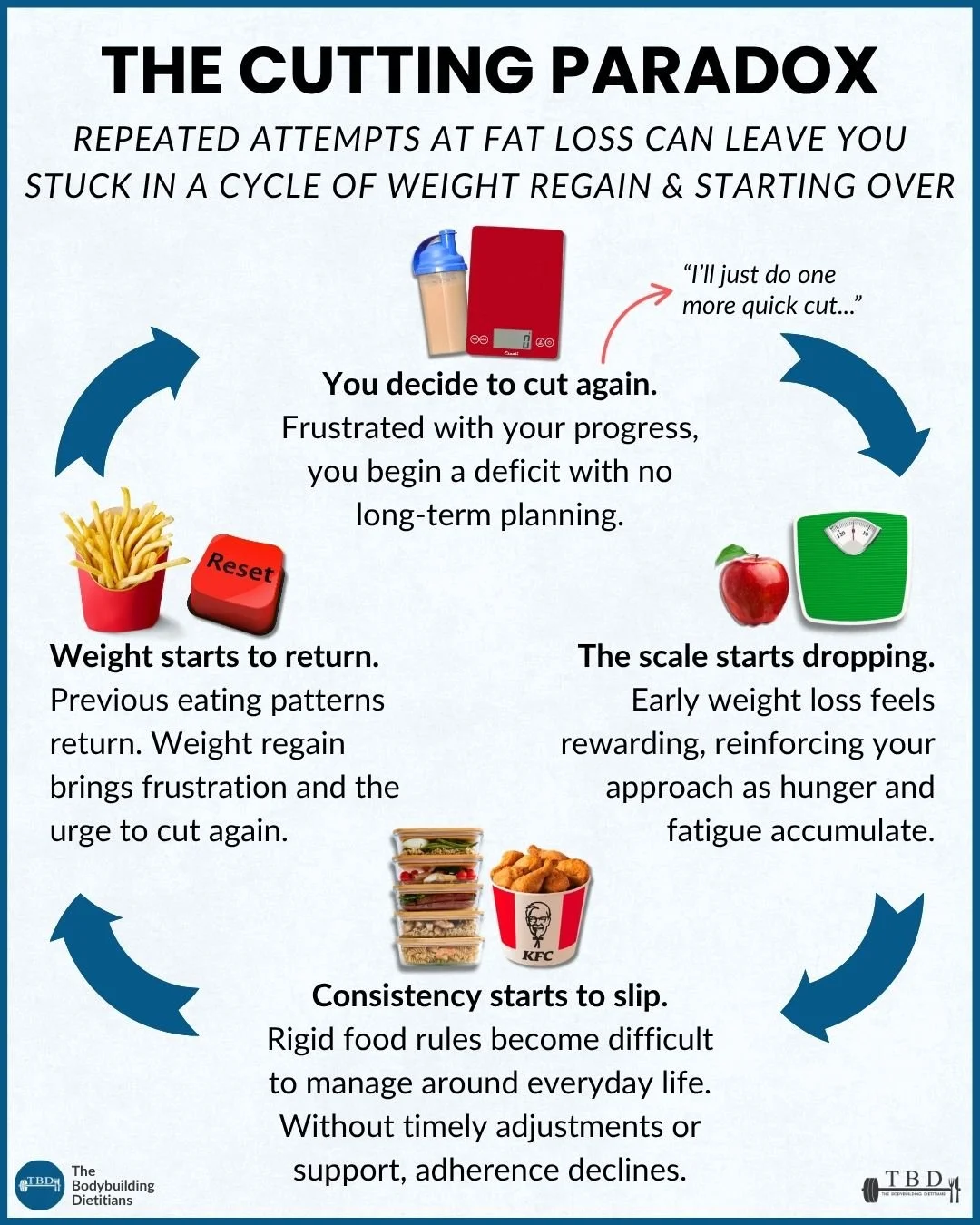
This pattern is common enough to have a shape. A cut begins, the scale drops, consistency slips, the weight returns, and the cycle starts again, often with the thought that it will just be one more quick cut. Understanding why keeping fat off is harder than losing it, and why the maintenance phase so often gets skipped, is what makes it possible to break the loop rather than keep repeating it. This article covers how the cycle works and how planning for maintenance from the start changes the outcome.
Why Is Keeping Fat Off Harder Than Losing It?
Keeping fat off is harder than losing it because the body actively works against maintaining a lower weight, while a diet has the momentum of visible progress behind it. The physiological changes that follow weight loss make maintenance an ongoing task rather than a finish line.
As you become lighter, your energy requirements decrease, since a smaller body costs less to move and maintain. The intake that produced weight loss eventually becomes the intake that maintains the new weight, and without adjusting for that, old habits return the body towards where it started. Appetite also tends to increase after weight loss, and these changes can persist for a long time rather than resolving the moment the diet ends.
Research following people after weight loss has found that the hormonal changes which increase appetite can persist for up to a year or more after the weight is lost, rather than returning to pre-diet levels once a target is reached. Source: Sumithran et al., 2011, New England Journal of Medicine.
The practical consequence is that maintenance is a phase with its own demands rather than the absence of dieting. Reaching a goal weight shifts the challenge rather than ending it, and treating the diet as the whole job leaves the harder part unmanaged. This is the gap the cutting cycle exploits.
What Is the Cutting Cycle?
The cutting cycle is the repeating loop of dieting, regaining and dieting again that many people find themselves in, and it tends to run through the same four stages each time. Recognising the shape of it is the first step to stepping out of it.
It usually begins with a decision to cut again, often from a place of frustration with where progress has gone, and typically with little long-term planning beyond starting the deficit. The scale then starts dropping, and the early weight loss feels rewarding, which reinforces the approach even as hunger and fatigue begin to accumulate underneath the progress. Consistency starts to slip as rigid food rules become difficult to manage around work, training and social life, and without timely adjustments or support, adherence declines. Weight then starts to return as previous eating patterns come back and activity changes, and the frustration of regaining feeds the urge to cut again, which closes the loop and starts it over. Each lap through the cycle covers ground that was already covered, which is what makes it feel like running to stand still.
About to start another "quick cut"?
If you are planning another diet to re-lose weight you have already lost, the problem is rarely the cut itself. It is usually that the last one had no maintenance plan attached, so the weight had nowhere to go but back. Building the diet and the maintenance phase together, with adjustments and support along the way, is what our coaching is designed around, so the next cut is the last one you need for that weight.
Why Does a Cut Get Harder the Longer It Runs?
A cut gets harder as it continues because the physiological and practical demands of a deficit accumulate while the body adapts to the lower intake. The first few weeks are rarely a reliable guide to how the rest of the phase will feel.
Early on, a cut can feel relatively straightforward. Weight drops at its fastest, progress is visible, and that progress reinforces the approach. Over time the picture changes. Energy requirements decrease as you become lighter, which means the same intake produces a smaller deficit and slower loss. Appetite tends to increase as the diet continues, driven by the shifting hormonal environment that follows fat loss. The practical effort of maintaining a deficit around work, training and social commitments compounds, and what felt manageable in week two can feel considerably harder by week ten. This is a normal and predictable feature of dieting rather than a failure of willpower, and the way it is managed, through appropriate adjustments and realistic expectations, largely determines whether the phase holds together. The signals that a diet needs adjusting, and when to pause or stop, are covered in our guide to recognising and managing diet fatigue.
Why Does the Weight Come Back After a Diet Ends?
Weight returns after a diet most often because the end of the diet arrives with little preparation for maintenance, so there is no plan to hold the new weight in place. The deficit ends, but nothing deliberate replaces it.
For many people, reaching the goal is treated as the end of the process rather than a transition into a new phase. Previous eating patterns return, often gradually and without much awareness, activity levels drift back down, and the combination slowly moves intake above the lower maintenance requirement that the new, lighter body now has. The weight regain that follows brings frustration, and that frustration becomes the trigger for the next cut. The underlying issue is not a lack of discipline but a missing phase: the maintenance period that should follow a diet was never planned, so the body returned to its previous state by default. Without a deliberate approach to holding a new weight, regaining it is the path of least resistance.
How Do You Break the Cycle by Planning Maintenance From the Start?
You break the cutting cycle by treating maintenance as part of the plan from the beginning of a diet, rather than an afterthought once the goal is reached. When the diet is designed with its endpoint in mind, the transition to maintenance becomes a planned step instead of a vacuum that old habits fill.
Planning for maintenance from the start shapes the diet itself. It means choosing an appropriate deficit and rate of loss that can be sustained and transitioned out of, rather than the fastest cut available. It means making adjustments as hunger and fatigue accumulate, so the phase stays manageable and does not end in a collapse of adherence. It means developing flexibility around food during the diet, so the rigid rules that become hard to maintain are not the only tool available. And it means establishing in advance how nutrition, activity and progress will be managed once the deficit ends, so there is a defined maintenance phase to move into rather than an open-ended return to old patterns.
This is where structured support makes a clear difference. When we coach someone through fat loss, the maintenance phase is considered from the outset: the deficit and rate of loss are chosen with it in mind, adjustments are made as the diet progresses, food flexibility is built along the way, and the plan for maintaining the result is established before the diet ends. Treating fat loss and maintenance as one connected process, rather than two separate events, is what turns a cut into a lasting change instead of another lap of the cycle.
Practical Takeaways
Losing fat is often easier than keeping it off, because energy needs fall as you become lighter and appetite tends to increase and persist after weight loss.
The cutting cycle runs in four stages: deciding to cut again with little planning, early rewarding weight loss, slipping consistency as fatigue accumulates, and weight regain that triggers the next cut.
A cut gets harder the longer it runs, since the deficit shrinks as you get lighter, appetite rises, and the practical demands compound. This is normal physiology, not a willpower failure.
Weight returns mostly because the diet ends with no maintenance plan, so old eating patterns and lower activity drift intake back above the new, lower maintenance level.
Breaking the cycle means planning maintenance from the start: an appropriate deficit and rate of loss, adjustments as fatigue builds, flexibility around food, and a defined plan for after the deficit.
Treat fat loss and maintenance as one connected process rather than two separate events.
Frequently Asked Questions
Why is it so hard to keep weight off after dieting?
Keeping weight off is hard because the body adapts to a lower weight in ways that favour regaining it. Energy requirements decrease as you become lighter, so the intake that caused weight loss becomes roughly the intake that maintains it, and appetite tends to increase after weight loss and can stay elevated for months. Without a deliberate maintenance plan, old eating patterns and reduced activity gradually move intake back above the new, lower requirement.
What is the cutting cycle or cutting paradox?
The cutting cycle is the repeating loop of dieting, regaining and dieting again. It typically runs through four stages: starting a cut with little long-term planning, enjoying early rewarding weight loss, slipping in consistency as hunger and fatigue accumulate, and regaining weight once the diet ends, which triggers the next cut. The paradox is that each lap re-loses weight already lost, so effort is repeated without lasting progress.
Why does losing weight get harder the longer I diet?
As you lose weight, your energy requirements fall because a lighter body costs less to maintain, so the same intake produces a smaller deficit over time. Appetite also tends to rise as the diet continues, and the practical effort of sustaining a deficit around daily life accumulates. This predictable increase in difficulty is a normal feature of dieting, and managing it with adjustments and realistic expectations is what keeps a phase sustainable.
How do I stop regaining weight after a diet?
Plan the maintenance phase before the diet ends rather than treating the goal weight as the finish line. This means moving into a defined maintenance intake that matches your new, lower energy requirement, keeping some of the structure and activity that produced the result, and maintaining the food flexibility built during the diet. Treating maintenance as its own phase, rather than a return to old habits, is what holds the result in place.
Is yo-yo dieting bad for you?
Repeated cycles of loss and regain can gradually make each subsequent phase harder, as adaptive and appetite-related changes tend to leave the metabolic and hormonal environment slightly less favourable over time. Beyond the physiology, the cycle is discouraging and inefficient, since it repeats effort without durable progress. Breaking the pattern by planning maintenance into each phase is more productive than continuing to cut and regain.
Should I plan for maintenance before I start a cut?
Yes. Planning for maintenance from the start shapes better decisions during the diet, including choosing a sustainable deficit and rate of loss, building food flexibility, and knowing how nutrition and activity will be managed afterwards. A diet designed with its endpoint in mind transitions into a maintenance phase, whereas one with no plan for after tends to end in a gradual return to old patterns.
If you want personalised nutrition and training support across both fat loss and the maintenance phase that follows, our team can help you build a plan that holds your result rather than restarting the cycle. Enquire about coaching or book a free discovery call to get started.