Comp Prep Timeline Mistakes
Planning ahead remains one of the most underappreciated skills in bodybuilding.
Despite how advanced the sport has become, many competitors still treat contest preparation as a straight line between two points: current bodyweight and stage weight. When progress is judged primarily by the scale, the prep becomes less about preserving the qualities that define a competitive physique and more about simply losing weight.
That mindset is what turns bodybuilding into a dieting contest.
Fat loss is not the goal in isolation. The goal is to arrive on stage lean while maintaining muscle mass, training performance, recovery capacity, hormonal function, and the ability to present a full, responsive look. When those variables are sacrificed, conditioning may be achieved, but the physique often lacks resilience.
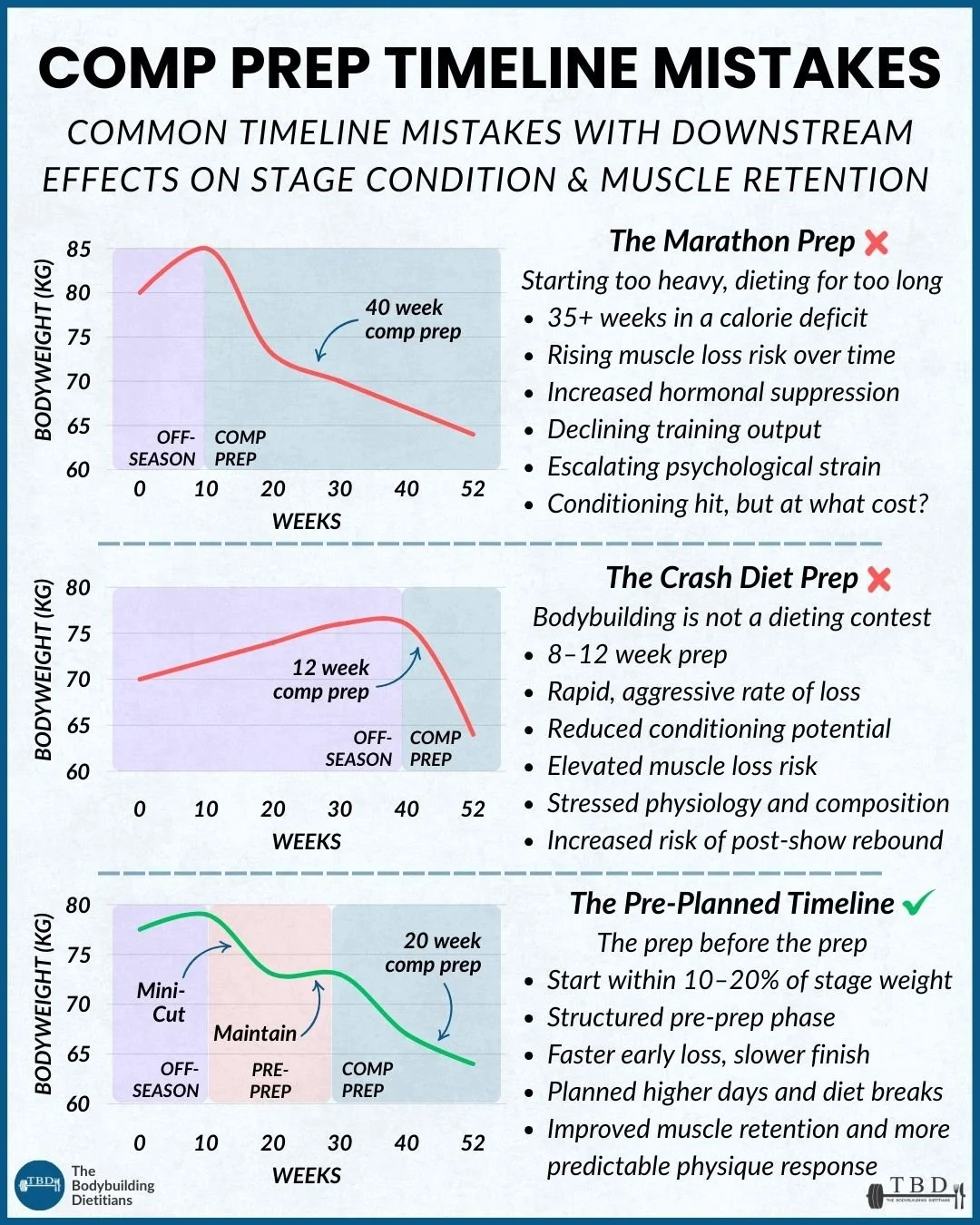
The timelines shown above illustrate three common approaches to contest prep, two of which frequently lead athletes into unnecessary physiological stress.
The Marathon Prep: When Starting Too Heavy Becomes the Problem
Long preps that extend well beyond 30 to 35 weeks typically begin from a bodyweight that is simply too far removed from stage condition.
While slower rates of loss can seem conservative, the issue here is cumulative exposure to a calorie deficit. Months of sustained energy restriction increase total fatigue load, suppress key hormonal signals, and gradually erode training output. Over time, muscle retention becomes harder, recovery slows, and psychological strain escalates.
Condition is often achieved eventually, but at a cost. Athletes may arrive leaner, yet flatter, weaker, and less responsive. In these scenarios, the prep technically works, but it rarely represents the best version of the athlete.
The Crash Diet Prep: Speed Without Stability
At the opposite end of the spectrum is the aggressive short prep.
Eight to twelve week timelines demand rapid rates of fat loss that place substantial stress on the system. While scale weight can drop quickly, the body has limited time to adapt. Muscle loss risk rises, training quality declines, and the ability to fine-tune conditioning becomes constrained.
Crash dieting often leaves competitors looking depleted rather than polished, and it significantly increases the risk of post-show rebound. Conditioning may be reached, but it is fragile.
The Pre-Planned Timeline: Where Pre-Prep Makes the Difference
The most reliable outcomes tend to come from preparation that begins well before prep officially starts.
By entering contest prep within roughly 10 to 20 percent of stage weight, athletes retain flexibility. Early fat loss can occur at a faster rate when physiology is more resilient, followed by a slower, more controlled finish as conditioning deepens.
A structured pre-prep phase allows for strategic use of higher intake days, diet breaks, and performance preservation. Training quality stays higher for longer, muscle retention improves, and peak week becomes a process of refinement rather than damage control.
This approach does not remove discomfort. It simply places it where it is most productive.
Conditioning Is Not the Only Metric That Matters
All three timelines shown can technically lead to a lean physique. What differs is the biological cost of getting there.
Success in bodybuilding is not defined by who can tolerate the most stress. It is defined by who can present the highest quality physique on the day. Planning ahead shifts the focus from surviving prep to optimising it.
Pre-prep is not about making things easy. It is about making the process more predictable, sustainable, and aligned with the demands of the sport.
Want guidance on structuring your pre-prep or contest timeline? Our coaching focuses on planning phases before they become limiting, so prep is driven by physiology rather than panic.