The Complete Guide to Carbohydrates: Optimising Intake for Health and Performance
If training performance matters to you, carbohydrate intake deserves deliberate planning.
Carbohydrates remain one of the most debated macronutrients in modern nutrition discourse, yet in performance settings their role is relatively clear. They are the primary fuel source for moderate to high intensity training, and they meaningfully influence session quality, recovery and training sustainability across the week.
The question is rarely whether carbohydrates are useful. The more productive question is how much, what type, and when.
This guide approaches the discussion through three practical layers: total intake, quality, and distribution.
1. Carbohydrate Intake: Matching Fuel to Output
Carbohydrate requirements should reflect training demands and total energy expenditure. Higher volume, higher intensity, or more glycolytically demanding training typically benefits from greater carbohydrate availability. Lower training loads or lower overall calorie intake may not require the same level of support.
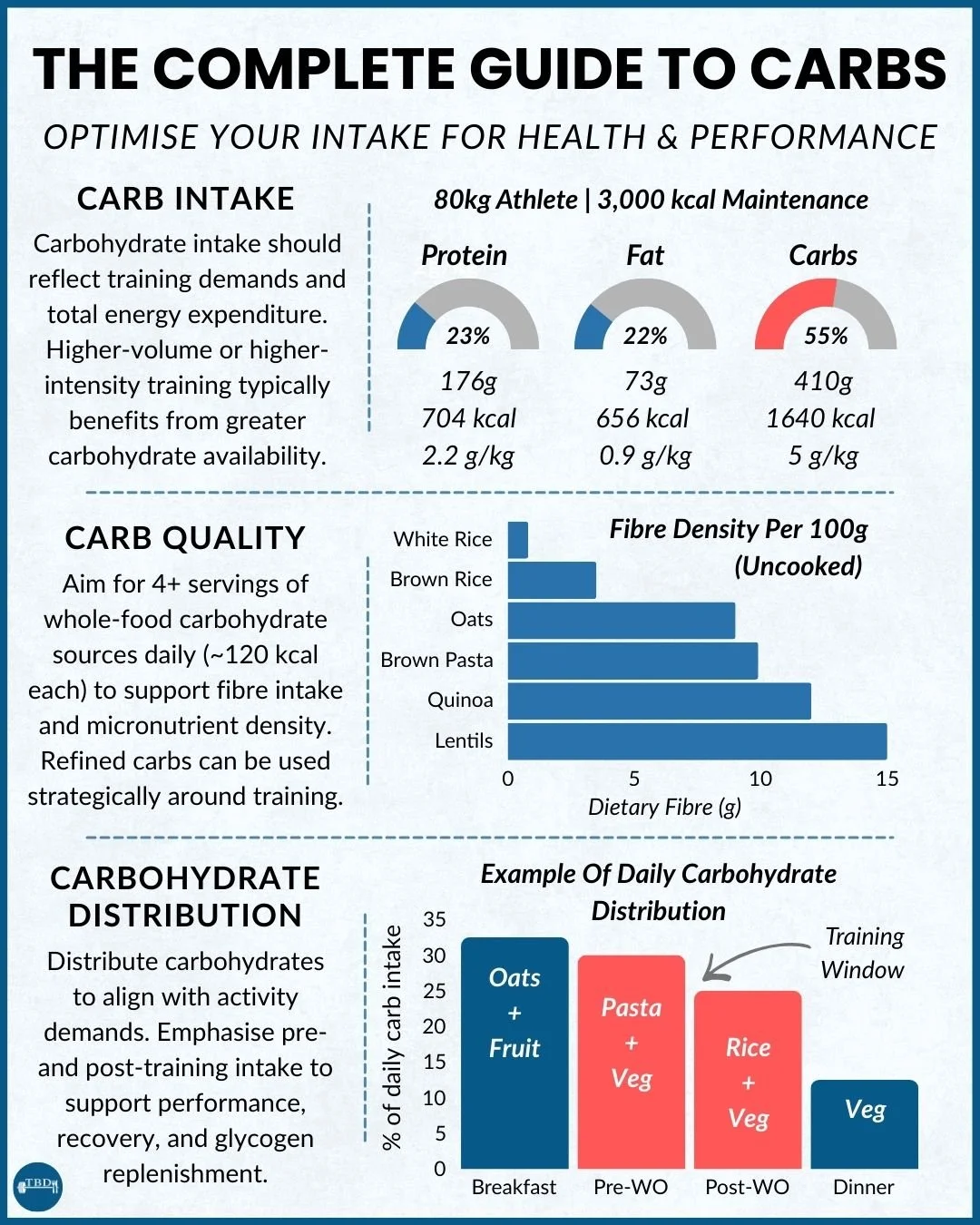
In the example shown in the infographic, an 80 kilogram athlete consuming 3,000 kilocalories per day is taking in approximately 5 grams of carbohydrate per kilogram of bodyweight. For an athlete training with substantial weekly volume, this level can meaningfully support glycogen availability, session output and recovery.
The specific number is illustrative rather than prescriptive. Carbohydrate needs exist on a spectrum. An individual performing multiple high-volume resistance sessions or incorporating conditioning work will generally require more carbohydrate than someone training three moderate sessions per week.
In practice, performance is often the clearest indicator. When carbohydrates are appropriately aligned with output, training tends to feel repeatable and recoverable. When intake is mismatched to demand, session quality and perceived energy frequently reflect that gap.
2. Carbohydrate Quality: Fibre and Micronutrient Density
Carbohydrates contribute substantially to fibre intake and overall micronutrient density. Whole food sources such as oats, quinoa, lentils, brown rice and wholemeal pasta provide a higher fibre density and broader nutritional return compared to more refined options.
The fibre comparison in the graphic illustrates how these differences accumulate. Over the course of a week, consistent inclusion of higher fibre carbohydrate sources meaningfully contributes to gut health, satiety regulation and micronutrient adequacy.
Lower fibre carbohydrates such as white rice or certain refined cereals are not inherently problematic. They are often easier to digest and can be strategically placed around training sessions where rapid gastric emptying and lower gastrointestinal discomfort are advantageous.
The goal is not to eliminate refined carbohydrates. The goal is to ensure that the majority of intake supports both performance and nutritional sufficiency.
A balanced approach often involves anchoring the day in higher fibre sources, while using lower fibre options in proximity to demanding sessions.
3. Carbohydrate Distribution: Refining Performance
Total daily carbohydrate intake carries the greatest influence over glycogen stores and recovery across time. However, distribution can refine how that fuel is utilised.
Aligning a greater proportion of carbohydrates in the pre and post training window can support performance and glycogen replenishment. Pre-training intake provides accessible substrate for the upcoming session. Post-training intake supports recovery and prepares the athlete for subsequent work.
The remainder of daily carbohydrate intake can be distributed according to appetite, schedule and personal preference. For some individuals, a higher carbohydrate breakfast improves training later in the day. For others, consolidating intake around evening sessions makes more sense.
The principle is alignment rather than rigidity.
Carbohydrates and Body Composition
Carbohydrates are sometimes viewed primarily through the lens of body fat. In reality, their influence on body composition is mediated by total energy balance and training output.
When carbohydrate intake supports high quality training, it indirectly supports lean mass retention and progression. Inadequate carbohydrate availability can compromise performance, which in turn may influence long term muscle accrual or preservation.
During fat loss phases, carbohydrate intake is often reduced to create a deficit. Even in those contexts, aligning intake with key training sessions can preserve session quality and mitigate some of the fatigue associated with dieting.
The broader framework remains consistent: match fuel availability to the work being performed.
A Practical Framework
When planning carbohydrate intake, consider:
Your weekly training volume and intensity
Your total energy intake
Your need for fibre and micronutrient density
Your digestive comfort around sessions
Your broader body composition goal
Higher output generally justifies higher carbohydrate availability. Lower output typically requires less.
This relationship is dynamic. As training phases shift, intake can shift accordingly.
The Bigger Picture
Carbohydrates are neither universally required in extreme amounts nor inherently problematic. Their utility depends on context.
When intake is aligned with training demands and overall energy expenditure, carbohydrates become a performance tool rather than a point of confusion.
Developing this level of alignment often requires more than a fixed macro split. It requires understanding your output, recovery capacity and long term objectives.
If you would like support structuring your carbohydrate intake to align with your training phase and body composition goals, our team can help you build a plan that reflects both performance and sustainability.