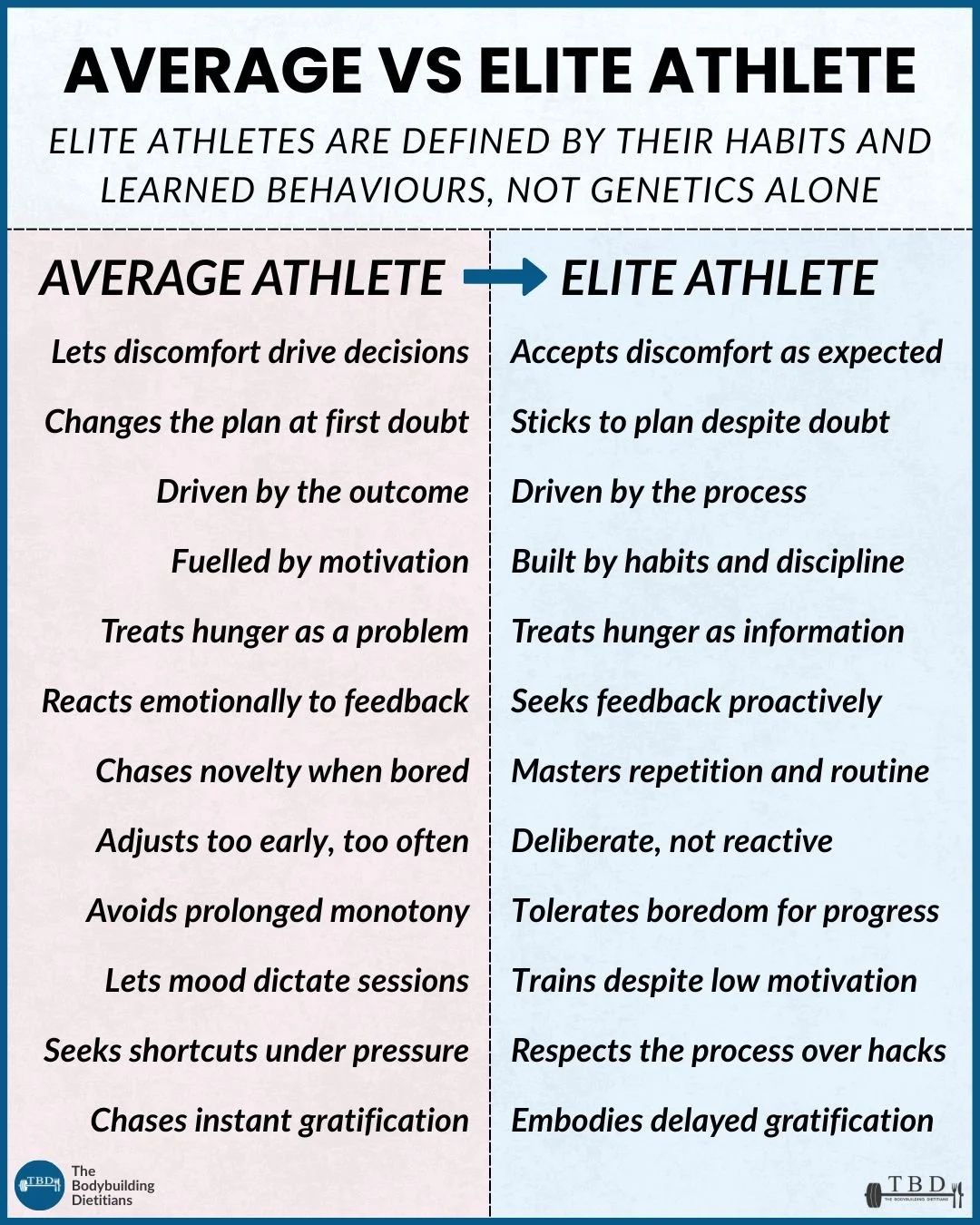
Average vs Elite Athletes: Why Behaviour Matters More Than Talent Over Time
Elite athletes are rarely defined by genetics alone.
Genetic potential sets the ceiling, but once athletes reach a certain level, it stops being the primary differentiator. At that point, most competitors are already talented enough. What separates those who continue to progress from those who plateau or burn out is behaviour.
Bodybuilding, like many individual sports, exposes athletes to prolonged periods of discomfort, ambiguity, and delayed reward. Hunger without immediate payoff, fatigue that accumulates over weeks, training blocks where visual progress stalls despite consistent execution. These experiences are not signs that something is broken. They are an expected part of the process.
The difference lies in how those signals are interpreted.
How Average Athletes Respond to Discomfort
Less developed athletes tend to treat internal sensations as directives.
Discomfort becomes a reason to adjust prematurely. Doubt becomes evidence that the plan is wrong. Motivation is used as a proxy for readiness, and hunger is framed as a problem to eliminate rather than a predictable physiological response.
In practice, this often looks like frequent program changes, inconsistent nutrition adherence, and reactive decision-making. Short-term relief is prioritised over long-term outcomes. While this approach can feel productive, especially when it creates a sense of control, it often erodes consistency and increases decision fatigue over time.
The athlete becomes trapped in a cycle of constantly “fixing” things that were never actually broken.
How Elite Athletes Interpret the Same Signals
More developed athletes experience the same sensations, but they assign them a different meaning.
Hunger, fatigue, boredom, and doubt are treated as information rather than emergencies. These signals are expected, particularly when the athlete is pushing adaptation through training volume, energy manipulation, or prolonged structure.
Rather than reacting emotionally, elite athletes lean more heavily into systems when confidence drops. Plans are judged by trends, data, and outcomes, not by how enjoyable or motivating a session felt on a given day. Adjustments are deliberate and informed, not reflexive.
This does not mean ignoring feedback or pushing through genuine red flags. It means understanding which forms of discomfort are adaptive and which are not.
Discipline Is Built, Not Inherited
This mindset is rarely innate.
Very few athletes are born with a high tolerance for monotony, delayed gratification, or uncertainty. These traits are developed gradually through repetition, exposure, mistakes, and reflection. Training cycles, contest preps, missed expectations, and setbacks all contribute to shaping decision-making over time.
What ultimately compounds is not just physical adaptation, but behavioural consistency. How often an athlete trains when motivation is low. How reliably nutrition is adhered to when hunger rises. How feedback is received when progress slows.
Elite performance is less about reaching a peak and more about sustaining quality execution over years.
Sustaining Progress Is the Real Separator
At higher levels, success is rarely defined by who can tolerate the most suffering in the short term. It is defined by who can make stable, rational decisions under pressure, maintain structure when confidence wavers, and continue showing up long after novelty has faded.
In that sense, elite athletes are not just better performers. They are better decision-makers.
Our coaching focuses on building sustainable systems for training, nutrition, and decision-making over the long term. Learn more below.