Your Off-Season Timeline: Why Most Contest Preps Are Compromised Before They Begin
Many contest preps are compromised before they even start.
Not because the final 16 to 24 weeks were poorly designed, but because the preceding one to three years lacked structure. When the off-season becomes reactive, the cost usually shows up later through longer diets, unnecessary lean tissue loss, excessive fatigue and rushed decision-making.
Meaningful physique change occurs in the off-season. Prep reveals it.
Understanding how to structure that improvement season is one of the most overlooked aspects of natural bodybuilding.
The Off-Season Is an Improvement Season
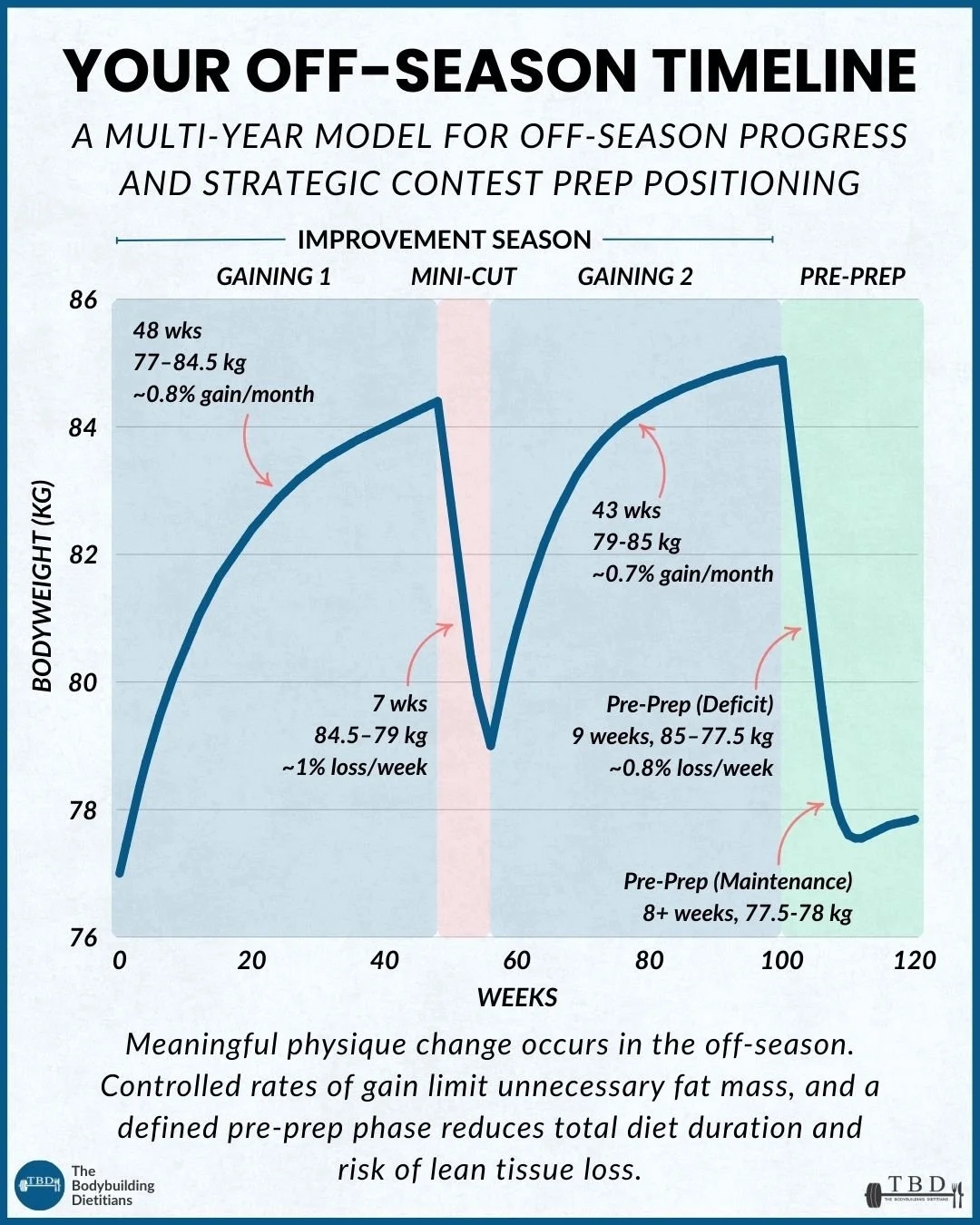
The model shown here spans roughly 120 weeks. It is not rigid or prescriptive, but it illustrates a principle that consistently holds true in practice.
Most of the timeline is spent building.
Across the improvement season, the majority of weeks sit in a controlled surplus. Rates of gain fall in the range of approximately 0.6 to 1 percent of bodyweight per month. For natural athletes, this is generally sufficient to support performance progression and muscle accrual without unnecessary fat accumulation.
Early in a gaining phase, bodyweight often climbs slightly faster. Over time, the rate tends to taper. At higher bodyweights, performance may stabilise while recovery improves and training quality peaks. A large surplus is rarely required, particularly as athletes become more advanced and marginal muscle gain slows.
What matters most is control.
Unstructured surpluses frequently lead to body fat peaks that require extended dieting to correct. Structured surpluses, by contrast, keep the athlete within a manageable range and preserve flexibility.
The Role of the Mini-Cut
In this 120-week example, only one mini-cut is used across the improvement season.
That is deliberate.
Short, purposeful deficits can be useful to recalibrate body composition, improve insulin sensitivity, and restore appetite regulation. When executed for 4 to 8 weeks at moderate weekly rates of loss, they provide relief without creating prolonged diet fatigue.
In practice, the mini-cut acts as a reset rather than a panic response.
Where athletes struggle is not in the concept of mini-cuts, but in the frequency. Repeated short deficits that interrupt gaining momentum can erode training performance and dilute the overall improvement phase.
Used sparingly and strategically, a mini-cut supports long-term progress. Used reactively, it becomes a cycle.
Minimising Time in a Deficit
Across the entire 120-week span, total time spent dieting is relatively low.
That is not accidental.
Progress is easier to sustain when most of your time is spent fuelled rather than restricted. Recovery is more robust. Performance is more stable. Psychological stress is lower.
When athletes oscillate between aggressive gaining and prolonged dieting, overall output suffers. The body spends too much time compensating and too little time progressing.
A well-structured off-season minimises the cumulative cost of dieting.
The Pre-Prep Phase Is Where Maturity Shows
The pre-prep phase is arguably the most critical transition in the entire timeline.
Positioning an athlete roughly 10 to 15 percent above projected stage weight before formal prep begins dramatically alters the trajectory of the contest diet.
When this positioning is accurate:
Total prep length can be reduced
Weekly rates of loss can remain conservative
Lean tissue retention improves
Fatigue is better managed
Training performance declines less abruptly
In coaching practice, this phase often determines whether a prep feels controlled or chaotic.
Athletes who enter prep significantly above a calculated position typically require longer, more aggressive deficits. That increases cumulative diet stress and raises the likelihood of unnecessary tissue loss.
A defined pre-prep phase creates margin.
Controlled Gain vs Excessive Peak
One of the most common misconceptions in natural bodybuilding is that significant off-season body fat gain is a necessary cost of muscle accrual.
In practice, excessive peaks often reflect imprecision rather than necessity.
Controlled rates of gain allow the athlete to push performance while keeping body composition within a recoverable range. This makes future dieting shorter and more predictable.
The goal is not to stay perpetually lean. The goal is to avoid unnecessary extremes.
Over a multi-year timeline, the athlete who controls their peaks often accumulates more muscle with fewer setbacks.
The Numbers Are Illustrative, the Principle Is Consistent
The exact weeks, bodyweights and rates shown in this model are illustrative. Different athletes will require different timelines based on training age, division, genetics and lifestyle constraints.
The consistent principles remain:
Control the rate of gain
Avoid unnecessary body fat peaks
Use mini-cuts strategically, not emotionally
Minimise cumulative time dieting
Enter prep from a calculated position
When these are applied consistently, contest prep becomes an expression of progress rather than a recovery effort.
The Bigger Picture
Physique development is not built in 16 weeks.
It is built across years of structured surplus, disciplined training, measured resets and deliberate transitions.
The off-season is not a holding period between preps. It is the phase that determines what is possible on stage.
Developing this level of structure rarely happens by accident. If you want support designing an improvement season that sets up your next prep with precision rather than guesswork, our team is here to guide you.