Weight Fluctuates, Take the Average
If your weight fluctuates daily, that is normal.
In the fitness space, it is common to step on the scale each morning. Used correctly, this can be a valuable practice. Used reactively, it can distort perception and drive unnecessary adjustments.
Before allowing a single reading to shape expectations, it helps to understand what the scale is actually capturing.
Scale weight reflects far more than body fat.
What the Scale Is Really Measuring
Your body is in constant flux. Even in the absence of true tissue change, several variables shift throughout the week.
Fluid balance alone can account for meaningful day-to-day variability. Glycogen storage fluctuates depending on carbohydrate intake and training demands. Gastrointestinal content changes with food volume and fibre intake. Inflammation from training can temporarily increase fluid retention. Hormonal variations influence water balance. Sleep quality and stress physiology alter sodium handling and hydration status.
Even weigh-in timing plays a role.
A reading taken an hour earlier than usual, before bowel movements or fluid loss, can look meaningfully different from the following day’s number under different conditions.
None of these changes reflect fat gain or muscle loss.
How Daily Readings Can Mislead
Consider a typical week:
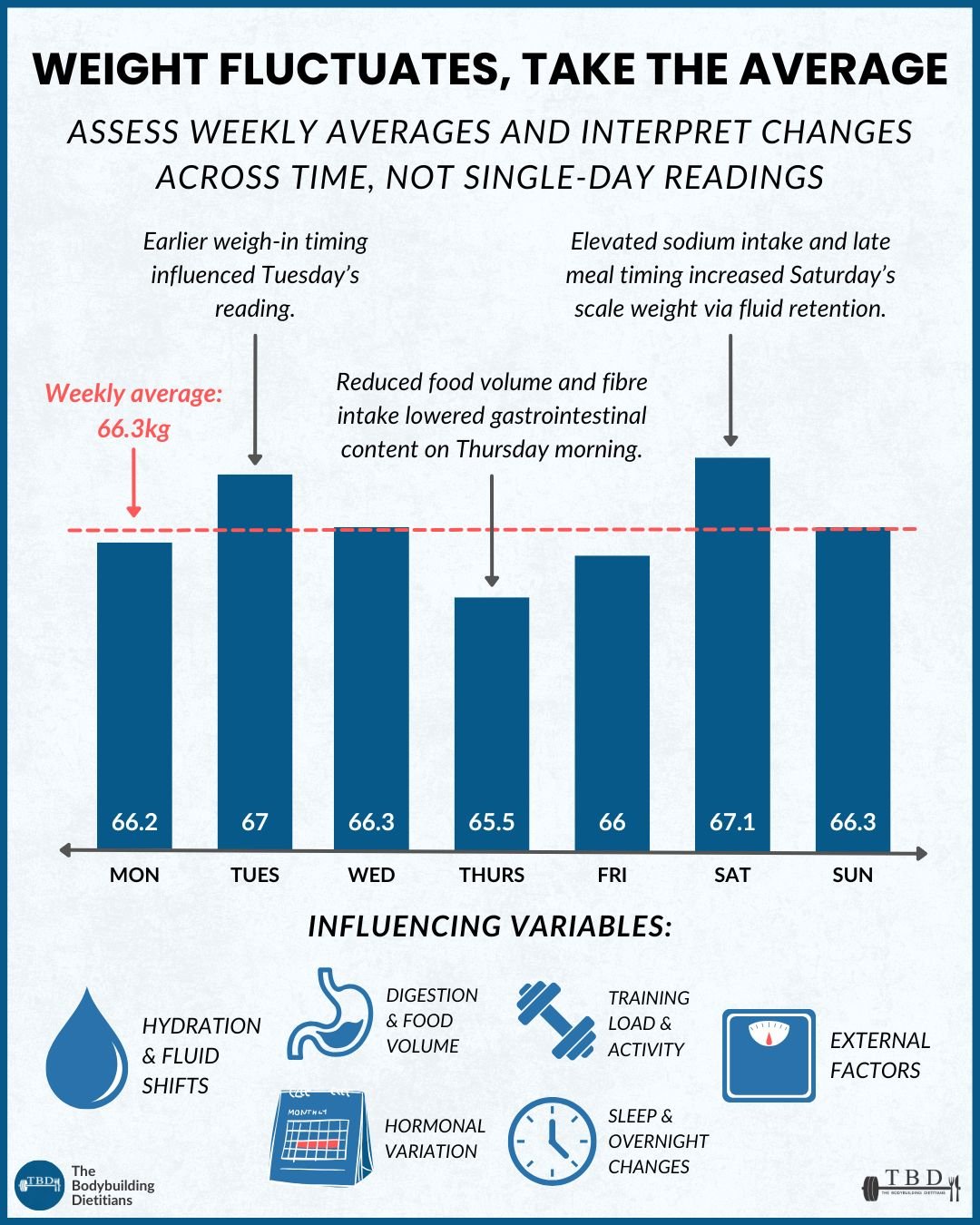
Tuesday’s weigh-in may appear higher because it was taken slightly earlier than usual.
Thursday’s reading may drop following a lower food-volume day that reduces gastrointestinal content.
Saturday’s spike may reflect higher sodium intake and glycogen restoration from a larger Friday meal.
Viewed in isolation, these numbers can look dramatic. When averaged across the week, the pattern often becomes far more stable.
In the example shown, daily readings range from 65.5 kg to 67.1 kg. The weekly average sits at 66.3 kg. That mean value provides a far more accurate representation of underlying tissue change than any single morning measurement.
Body composition changes gradually. The scale moves daily.
Why Weekly Averages Matter
Fat loss and muscle gain occur slowly. Even at an optimal rate, true tissue change is modest relative to the scale shifts caused by hydration or digestion.
When individuals react to single weigh-ins, they often make premature adjustments. Calories are cut unnecessarily. Cardio is increased. Confidence wavers despite progress being on track.
Weekly averages smooth out transient noise and allow for more rational interpretation. Comparing one weekly average to the next provides a clearer indication of direction.
This approach reduces emotional reactivity and improves decision-making.
How to Reduce Unnecessary Variability
While some fluctuation is inevitable, consistency reduces excess noise.
Weigh under consistent conditions, ideally at the same time each morning, fasted, using the same scale.
Keep fibre and food volume relatively stable across the week, as large shifts alter gastrointestinal content.
Maintain consistent sodium and hydration patterns to limit fluid-driven fluctuations.
Be mindful of late meals and heavy training sessions, both of which can transiently elevate weight.
Prioritise sleep, as disruptions in stress physiology influence water balance.
These practices do not eliminate variability entirely, but they narrow the range.
The Scale as One Data Point
Scale weight is a useful tool, though it is not a complete measure of progress.
Interpreting it alongside progress photos, strength trends, girth measurements, skinfolds and broader health markers provides a more accurate picture of body composition change.
An athlete maintaining strength and visual fullness while the weekly average trends downward is likely progressing well, even if certain days appear elevated.
Similarly, someone in a gaining phase may see rapid short-term increases driven by glycogen and fluid rather than true tissue gain.
Context transforms interpretation.
The Long-Term Perspective
The scale rewards patience and consistency rather than reaction.
Tracking daily weigh-ins, calculating weekly averages and interpreting multi-week trends encourages a more stable and objective mindset. Over months, this method provides clarity. Over days, it prevents unnecessary stress.
When progress is assessed across time rather than through isolated data points, adjustments become strategic rather than emotional.
If you would like guidance interpreting your scale data and aligning it with training performance and body composition goals, our team can help you build a structured monitoring approach that reflects real progress rather than day-to-day fluctuation.