Protein vs Calorie Density: Which Foods Actually Deliver the Most Protein for the Calories?
You still hear statements like “peanut butter is a great source of protein” repeated regularly in the nutrition space. ThIs statement lacks context. When protein is examined relative to calorie density, the picture becomes clearer.
Every food that contains protein sits somewhere on a spectrum between protein-dense and energy-dense. Understanding where a food falls on that spectrum allows you to align your choices with your goal, rather than relying on generalised descriptions.
When calorie intake is abundant, this distinction may not matter greatly. When calories are constrained, it becomes central.
Looking at Protein Through an Energy Lens
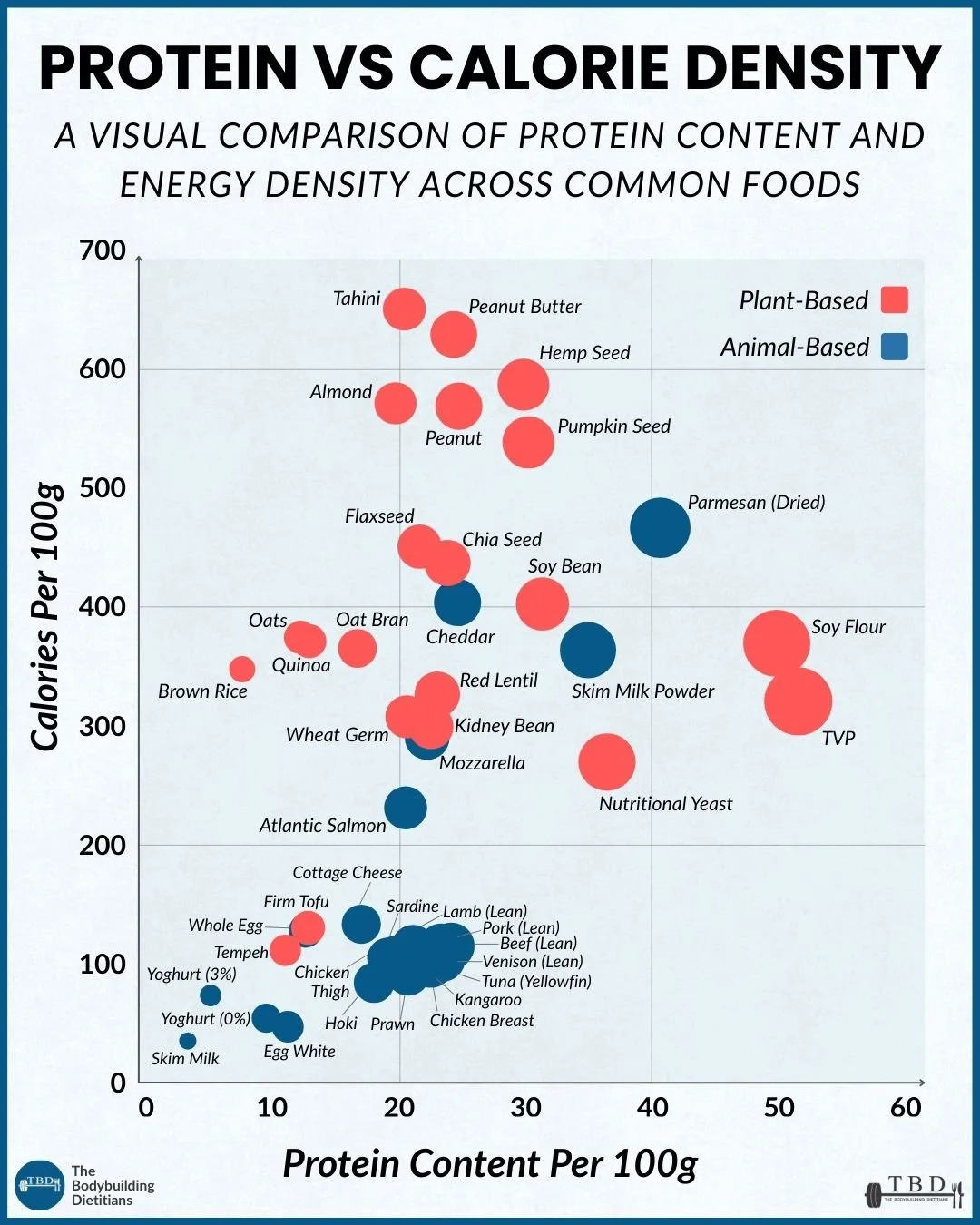
The visual comparison of protein content per 100 grams plotted against calories per 100 grams highlights a simple principle: the most efficient protein sources cluster in the lower calorie, higher protein region of the graph.
These include foods such as:
Chicken breast
White fish
Lean red meat
Prawns
Egg whites
Low-fat yoghurt
Skim milk
These options deliver a relatively large amount of protein for comparatively modest calorie cost. In practical terms, they allow someone to increase protein intake without dramatically increasing total energy intake.
This is particularly useful during fat loss phases, where preserving lean mass while managing calories is a priority.
Energy-Dense Protein Sources
Nuts, seeds and nut butters sit much higher on the calorie axis.
Peanut butter, tahini, almonds, chia seeds and hemp seeds all contain protein. They also contain substantial amounts of fat, which increases their calorie density. As a result, the protein delivered per calorie is relatively modest.
This does not reduce their value. These foods provide essential fatty acids, micronutrients and flavour diversity. The key consideration is purpose. If the objective is to drive protein intake upward within a fixed calorie budget, relying heavily on these foods can make that task more difficult.
In practice, they often work better as complements rather than primary protein anchors.
The Middle Ground: Legumes, Grains and Dairy
Whole legumes and grains typically sit in a moderate region of the graph. Lentils, kidney beans, oats and quinoa provide protein alongside fibre and micronutrients at a moderate calorie density.
They are not as protein-efficient as lean animal sources, but they contribute meaningfully, particularly when total intake is balanced across meals.
Dairy products show a range. Skim milk powder and lower-fat cheeses move closer to the higher-protein region, while full-fat cheeses sit higher on the calorie axis. The variation within a single food category illustrates why nuance matters.
Refined Plant Proteins
More refined plant-based products such as soy flour and textured vegetable protein (TVP) shift further toward the higher-protein, more efficient end of the spectrum. Removing much of the fat and carbohydrate content increases protein concentration relative to energy.
For individuals following predominantly plant-based diets, these foods can help bridge the gap between total protein targets and calorie limits.
However, protein quantity is not the only variable to consider.
Protein Quality and Bioavailability
Protein content on paper does not always reflect biological impact.
Animal-based proteins generally offer higher digestibility and a more complete essential amino acid profile, particularly in leucine content. This can influence muscle protein synthesis, especially when total protein intake is lower.
Plant-based proteins can absolutely support muscle gain and retention, though they may require slightly higher total intake or thoughtful combination of sources to optimise amino acid coverage.
Context matters. Total daily protein intake, distribution across meals, and training stimulus all influence outcomes.
Matching Food Choice to Objective
When the goal is fat loss, preserving muscle while controlling calories often requires a focus on protein efficiency. Leaner protein sources allow for higher protein targets without exceeding energy budgets.
When the goal shifts toward gaining, maintaining or diversifying intake, energy-dense protein sources may become more practical.
The key is understanding trade-offs rather than categorising foods as inherently good or bad.
If someone is struggling to hit protein targets without overshooting calories, the issue may not be total food quantity but protein selection. Small shifts in food choice can meaningfully change protein-to-calorie ratios.
The Bigger Picture
Protein intake plays a central role in muscle retention, recovery and satiety. Calorie density determines how easily that protein fits within an overall energy framework.
When protein and calorie density are viewed together, food selection becomes more strategic. Instead of asking whether a food “contains protein,” a more useful question becomes how efficiently it contributes toward your daily target.
This level of clarity simplifies decision-making, particularly during structured dieting phases.
If you would like support structuring your nutrition around protein targets that align with your body composition goals, our team can help you design an approach that balances efficiency, performance and long-term sustainability.