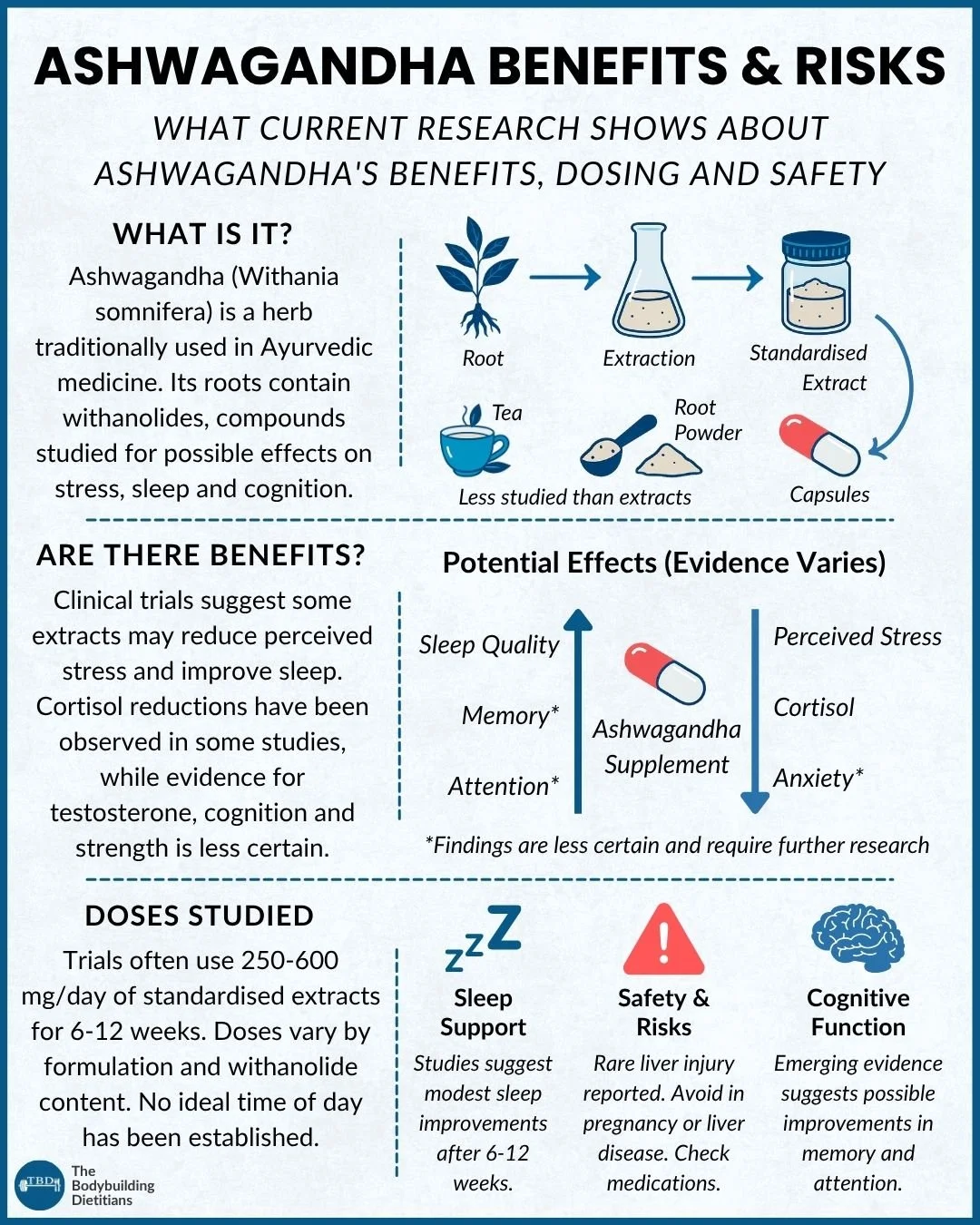
Ashwagandha may help reduce perceived stress and improve sleep, with emerging research suggesting possible benefits for cognition, testosterone and strength. However, the size and reliability of these effects vary, and evidence for increased muscle growth remains limited. Side effects, potential medication interactions and rare reports of liver injury are important considerations.
You've probably seen ashwagandha recommended for better sleep, lower cortisol or improved recovery. Some supplements even promote it as a way to increase testosterone and build muscle.
Those claims draw on real research, although they vary considerably in how well they are supported. The type of extract, the people studied and whether the result makes a meaningful difference to everyday life all affect how useful the findings are. It's worth understanding the safety evidence too, particularly if you're considering taking it regularly.
What Is Ashwagandha and How Does It Work?
Ashwagandha (Withania somnifera) is a herb traditionally used in Ayurvedic medicine. It contains compounds called withanolides, which are thought to contribute to some of its biological effects.
It's often described as an adaptogen, a term for substances proposed to influence the body's response to stress. One possible mechanism involves the hypothalamic-pituitary-adrenal (HPA) axis, which helps coordinate hormonal responses to stress, including cortisol release. Other proposed mechanisms are still being investigated, and the precise effects in humans remain uncertain.
Products include teas, root powders and concentrated extracts. Much of the clinical research involves standardised extracts with specified concentrations of withanolides, so its findings cannot be assumed to apply to every ashwagandha product.
Does Ashwagandha Reduce Stress and Cortisol?
Ashwagandha may reduce perceived stress and cortisol, particularly in adults experiencing elevated stress, although reviews have reached different conclusions about the subjective benefits.
Arumugam et al. (2024), in Effects of Ashwagandha (Withania Somnifera) on Stress and Anxiety: A Systematic Review and Meta-Analysis, pooled nine randomised controlled trials involving 558 participants. They found improvements in perceived stress and anxiety scores, alongside lower cortisol concentrations compared with placebo.
However, Albalawi (2025), in Dual Impact of Ashwagandha: Significant Cortisol Reduction but No Effects on Perceived Stress - A Systematic Review and Meta-Analysis, found a reduction in cortisol without a statistically significant improvement in perceived stress. The reviews differed in their included studies and analyses, which helps explain why the conclusions are not identical.
This distinction matters because cortisol serves essential functions in blood glucose regulation, energy availability and normal stress responses. Its concentration also fluctuates throughout the day and rises with exercise. A lower reading does not automatically mean better recovery or improved body composition.
For someone with persistent psychological stress and disrupted sleep, an improvement in how they feel and function would be valuable. For someone hoping to suppress cortisol to accelerate muscle growth or fat loss, there is insufficient evidence to support that expectation.
Can Ashwagandha Improve Sleep?
Ashwagandha may modestly improve sleep, with more promising results in people experiencing insomnia.
Cheah et al. (2021), in Effect of Ashwagandha (Withania somnifera) Extract on Sleep: A Systematic Review and Meta-Analysis, analysed five trials involving 400 participants. They reported an improvement in overall sleep outcomes, with larger effects in people with insomnia, studies lasting at least eight weeks and trials using at least 600 mg per day.
Some trials also found improvements in sleep duration and time taken to fall asleep, although the evidence is limited by relatively small studies and differences between extracts.
The likely value depends on what's contributing to poor sleep. Someone struggling to switch off during a stressful period may benefit if supplementation helps reduce stress-related arousal. Someone sleeping six hours because their schedule leaves only six hours in bed would benefit more directly from creating additional sleep opportunity.
We would first consider sleep timing, caffeine, alcohol, stress and the sleep environment. Our guide to improving sleep quality covers those factors in more detail.
Does Ashwagandha Improve Memory and Attention?
Emerging evidence suggests possible improvements in memory, attention and processing speed, although the practical importance of these changes is still uncertain.
Zhu et al. (2026), in Effects of Withania somnifera (L.) Dunal (Ashwagandha) on Cognitive and Physical Function in Adults: A Systematic Review and Meta-Analysis, analysed 20 studies involving 1,249 participants. They reported favourable effects across several cognitive outcomes, with varying certainty of evidence.
The participants, tests and formulations differed across studies, and some outcomes were supported by relatively little data. It is also unclear how much improvements in sleep or perceived stress might contribute to changes in cognitive performance.
For someone experiencing brain fog or poor concentration, sleep, nutrition, psychological stress and relevant medical factors still deserve consideration before introducing a supplement.
Does Ashwagandha Increase Testosterone, Strength or Muscle Growth?
Some studies report modest increases in testosterone and strength, but evidence that ashwagandha meaningfully improves muscle hypertrophy is much weaker.
Fornalik et al. (2026), in Hormonal Modulation with Withania somnifera: Systematic Review and Meta-Analysis of Randomized-controlled Trials, pooled 23 trials involving 1,706 participants. Among men, supplementation was associated with an average testosterone increase of approximately 57 ng/dL compared with placebo.
That is an interesting hormonal finding. Its practical significance depends on baseline testosterone, the individual's health and whether the change produces a meaningful outcome. A modest increase within the normal physiological range cannot be taken as proof of additional muscle growth.
Lee and Heo (2026), in Adjunctive Ashwagandha (Withania somnifera) Supplementation and Resistance-Training Adaptations in Healthy Adults: A Systematic Review and Random-Effects Meta-Analysis of Muscular Strength, Chest Circumference, and Body Composition, examined four eligible trials, with three contributing to the pooled analysis. Some strength results were favourable, but they were sensitive to the statistical methods used and the authors rated the evidence as low to very low certainty.
There is also limited reliable evidence directly measuring muscle hypertrophy. Consider two lifters following similar programmes. One is under considerable stress, sleeping poorly and struggling to recover. The other is sleeping well and progressing consistently. Improving sleep or stress may be useful for the first person, but we cannot assume that taking ashwagandha leads to additional muscle growth in either case.
For most lifters, progressive training, sufficient energy and protein, and adequate sleep remain the more established priorities. Our evidence-based supplement guide provides further context for comparing supplements.
Unsure which supplements are worth taking?
With so many supplements promising improvements in sleep, recovery and performance, it can be difficult to determine which ones are genuinely worthwhile for your circumstances.
Our dietitians assess your supplement use alongside your nutrition, training and recovery to help you make more informed decisions based on your goals. You can enquire about coaching here.
What Dose of Ashwagandha Has Been Studied?
Trials investigating stress and sleep commonly use around 250–600 mg per day of standardised extracts for six to twelve weeks. These are studied ranges rather than a universal recommendation.
For example, Chandrasekhar et al. (2012), in A Prospective, Randomized Double-Blind, Placebo-Controlled Study of Safety and Efficacy of a High-Concentration Full-Spectrum Extract of Ashwagandha Root in Reducing Stress and Anxiety in Adults, investigated 600 mg daily for 60 days in adults experiencing chronic stress.
KSM-66 is one standardised root extract used in clinical research, commonly containing approximately 5% withanolides. Other formulations vary in extraction method, plant parts and concentration. Two capsules containing the same milligram amount of ashwagandha may therefore contain different amounts of active compounds.
A standardised formulation helps make its composition more consistent, but it does not establish that all extracts have interchangeable benefits or that a particular brand is free from safety risks. Evidence is also insufficient to identify an ideal time of day for supplementation.
What Are the Side Effects and Safety Risks?
The more commonly reported effects include gastrointestinal discomfort, nausea, diarrhoea and drowsiness. Rare liver injury and possible thyroid or medication-related effects warrant greater caution.
Some users describe feeling emotionally flat, less motivated or detached while taking ashwagandha. These accounts are largely anecdotal. Research has not established how frequently this occurs or whether ashwagandha causes it, although an unwanted change in mood or daily functioning is worth discussing with a healthcare professional.
Can Ashwagandha Cause Liver Injury?
Very rare cases of liver injury have been associated with ashwagandha-containing products, including serious cases overseas.
In its July 2026 safety update, the Australian Therapeutic Goods Administration (TGA), Withania somnifera (Ashwagandha) and Very Rare Risk of Liver Injury, reported further suspected cases in Australia and described international reports of liver failure, including cases involving pre-existing liver disease.
This needs to be considered alongside short-term trial findings. Coope et al. (2026), in Back to the Roots: Safety and Tolerability of Standardised Ashwagandha (Withania somnifera) Root Extract in Healthy Adults - A Systematic Review of Biomarkers and Adverse Events, reviewed 23 studies involving 2,317 participants. Standardised root extracts were generally well tolerated, with no serious adverse events attributed to supplementation in the included trials.
However, the studies largely involved healthy adults and lasted no longer than 180 days. Trials of this size and duration may miss very rare or delayed adverse reactions. The review also included authors with disclosed supplement-industry relationships, an additional consideration when interpreting reassurance about safety.
The TGA advises people with current or previous liver problems to avoid ashwagandha. Anyone experiencing yellowing of the skin or eyes, dark urine, unusual fatigue, nausea, vomiting or abdominal pain should stop using the product and seek prompt medical advice.
Who Else Should Be Cautious?
Ashwagandha should be avoided during pregnancy and breastfeeding because of safety concerns and inadequate evidence. People with thyroid conditions should also seek medical advice, as ashwagandha may affect thyroid hormone concentrations. Potential interactions are relevant for some sedatives, thyroid medicines, immunosuppressants and medicines affecting blood pressure or glucose.
Long-term safety remains poorly understood. An Australian AUST L or AUST R number provides a way to identify products subject to local regulatory oversight, although it does not guarantee that a supplement is effective or risk-free.
Is Ashwagandha Worth Taking?
Ashwagandha may be worth discussing with a healthcare professional if persistent stress or sleep difficulties are the main concern and the potential benefits outweigh the risks in your circumstances.
The case is less compelling if your main goal is to increase testosterone or accelerate muscle growth. The changes observed in some trials have yet to demonstrate consistent, meaningful improvements in physique outcomes.
It also helps to identify what is contributing to the issue. Poor sleep during a dieting phase, for example, might be influenced by reduced energy intake, high training demands, caffeine use or psychological stress. Those factors may offer more direct opportunities for improvement.
When we review someone's supplements, we look at the intended outcome, the quality of the evidence, the formulation and whether the intervention makes sense alongside their nutrition, training and health. That is usually a more useful basis for deciding what to take than a list of possible benefits on a product label.
Practical Takeaways
The most promising evidence concerns perceived stress and modest improvements in sleep, although results across reviews are not entirely consistent.
Cortisol reductions have been observed, but lower cortisol does not necessarily mean better recovery, fat loss or muscle growth.
Cognitive, testosterone and strength findings are interesting but less certain, particularly for meaningful improvements in hypertrophy.
Many studies use 250–600 mg daily for six to twelve weeks. The extract and its withanolide content matter when interpreting the dose.
Gastrointestinal effects and drowsiness can occur. Rare liver injury, possible medication interactions and unknown long-term safety warrant caution.
Frequently Asked Questions
How long does ashwagandha take to work?
Stress and sleep trials often assess outcomes after six to eight weeks. Individual responses vary, and evidence for a predictable immediate benefit is limited.
Should I take ashwagandha in the morning or at night?
Research has not established an ideal time. Most trials assess regular daily intake rather than directly comparing morning and evening supplementation.
Can ashwagandha make you feel emotionally flat?
Some people report reduced motivation or emotional responsiveness. These accounts remain largely anecdotal, with insufficient research to determine how common they are or whether supplementation causes them.
Does KSM-66 work better than other ashwagandha extracts?
KSM-66 has been used in several clinical trials, which helps identify what was actually studied. Comparative evidence is insufficient to conclude that it is universally more effective or safer than other extracts.
Can you take ashwagandha long term?
Evidence for continuous use over years is limited. Most trials are relatively short, and rare liver injury reports make individual risk assessment important.
If you'd like guidance on which supplements are worth considering alongside your nutrition, training and health, our weekly coaching provides an opportunity to review your approach and establish practical next steps.