Balance in bodybuilding rarely looks like a 50/50 split, and it doesn't need to. The habits that support a high standard in the sport naturally shift the ratio well away from the middle, but that shifted ratio can still leave meaningful room for social flexibility, occasional indulgences, and the rest of life outside the gym.
Balance in a bodybuilding lifestyle rarely looks like an even 50/50 split of habits and choices, and it doesn't need to. Reaching a high standard in the sport requires consistency most of the time, which naturally shifts the ratio well away from the middle. A more useful framing than 50/50 is 90/10: for every ten decisions made around the goal, roughly nine support the goal and one leaves room for social flexibility, occasional indulgence, or rest. Practically, this looks like training five times a week with room for one flexible session every ten, eating four to five structured meals a day with room for two or three flexible meals across the week, hitting daily step targets while accepting occasional low-activity days, and attending social events without necessarily drinking at all of them. Where any individual sits on this ratio depends on their competitive level, phase of the year (offseason versus contest prep), and personal preferences. Bodybuilders aren't unbalanced by having a shifted ratio; they've built a version of balance that fits the demands of the sport.
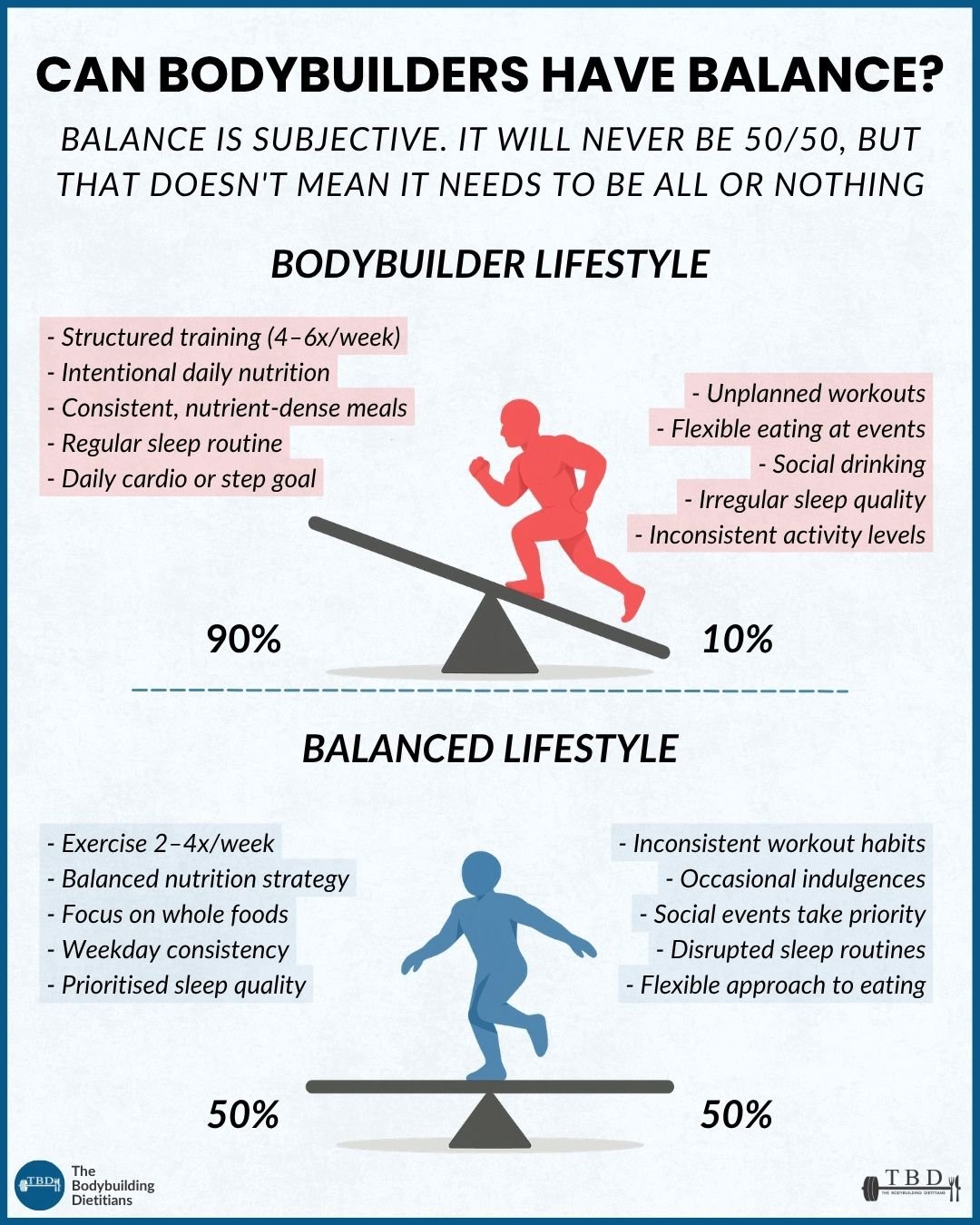
The word "balance" implies something close to 50/50: an even distribution of habits and choices between what supports a goal and what doesn't. When friends, family, or partners ask whether taking bodybuilding seriously means giving up "having a balanced life," the implicit reference point is usually that even split. Measured against it, the bodybuilding lifestyle looks unbalanced almost by definition.
The framing itself is where the tension usually comes from rather than any real conflict with the sport. Reaching a high standard in any discipline requires consistency most of the time, which naturally shifts the ratio well away from a 50/50 midpoint. This is true for elite musicians, competitive athletes in any sport, high-performing professionals in any demanding career, and anyone else pursuing meaningful outcomes that require sustained effort. Bodybuilders aren't unbalanced by having a shifted ratio; they've built a version of balance that fits the demands of the sport.
The more useful framing for the bodybuilding lifestyle is 90/10 rather than 50/50. That ratio still leaves meaningful room for the rest of life, and it accurately reflects what taking the sport seriously actually requires. This article walks through what 90/10 looks like in practice, why the specific ratio isn't universal, and how it shifts across seasons and goals.
What Does 90/10 Actually Look Like in a Bodybuilding Lifestyle?
A 90/10 ratio sounds extreme when stated as a bare number. Nine out of every ten choices tilted toward the goal, one out of ten left for flexibility. In the abstract, this reads as restrictive. In the specifics of what those choices actually involve, it's genuinely workable and leaves substantial room for a life outside the gym.
Training. A structured training week of five sessions leaves room for one flexible session every ten. That might be a rest day taken when tired rather than scheduled, a session skipped for an event that matters, or a lighter session replaced by a walk with family. Over a month, this works out to two or three sessions where the training bends around life rather than the other way around, without meaningfully affecting long-term progress.
Nutrition. Eating four to five structured meals per day across the week means roughly 30 planned meals over a week. Leaving room for two or three flexible meals (say, a dinner out on a Friday night and a lunch with a family visit on Sunday) still keeps intake on-plan for well over 90 percent of the week. The flexibility isn't a break from the diet; it's a deliberate inclusion of social eating within a structure that expects it.
Daily activity. Hitting a daily step target most days still allows for a lower-activity day when needed. Weeks where every day hits the target aren't necessary for consistent progress; three to five out of seven usually suffice for the training and body composition context. Building in the flexibility explicitly means the low-activity day happens deliberately rather than accidentally.
Sleep. A regular sleep routine most nights still allows for occasional later nights around events. Sleep quality across the week matters more than any individual night, and building in one to two later nights per week (or per fortnight, during heavier training blocks) doesn't meaningfully compromise recovery.
Social events. Attending ten social events might mean drinking at one of them, or eating off-plan at two of them, or arriving late to three of them because training ran long. Attendance is the variable that matters most for maintaining relationships; the specific choices at the event have more flexibility than the "either I'm all in or I skip" framing suggests.
For every ten decisions made around the goal, roughly nine support it and one leaves room to breathe. The 90/10 framing preserves the consistency that drives progress in the sport while explicitly building in the flexibility that sustains the lifestyle over years rather than months.
Why Does the 90/10 Ratio Feel Sustainable When 50/50 Might Not Support the Goal?
The specific ratio matters for two reasons that pull in opposite directions and land at 90/10 as a useful compromise.
The ratio needs to be high enough that the goal is actually attainable. Progress in bodybuilding compounds slowly through years of consistent training, nutrition, and recovery. The differences between lifters who reach a high standard and lifters who plateau are rarely about extraordinary genetics or unusual protocols; they're about sustained consistency across long timeframes. A 50/50 split would leave too many decisions pulling against the goal to produce the compounding progress the sport requires. Lifters aiming at a high standard need the ratio well above the middle.
The ratio also needs to leave room for the rest of life to happen. A 100/0 ratio (zero flexibility, every decision optimised) would be unsustainable psychologically and would isolate the lifter from social, family, and personal contexts that matter beyond the sport. It would also produce the kind of orthorexic pattern where flexibility disappears entirely and the sport becomes the whole identity. This is neither necessary nor desirable, and the small percentage of lifters who operate at 100/0 tend to burn out, injure, or drop out of the sport within a few years.
The 90/10 framing sits in the useful middle. It's high enough to support meaningful progress across years of training, and low enough that the lifter still has a life outside the gym. The specific choices about where the 10 percent gets spent are individual, but the framing itself is a useful reference point for lifters trying to work out whether their current ratio is producing the outcomes they want.
How Does the Ratio Shift Across Seasons and Goals?
The 90/10 framing is a general reference rather than a fixed target. Where any individual sits on the ratio depends on their competitive level, the phase of the year, and what they actually want from the sport.
Improvement seasons and off-seasons tend to sit lower on the ratio than prep. A lifter deep into an off-season might operate at 80/20 or even 70/30, with more flexibility around meals, more social engagement, and more variability in training intensity. This is a deliberate choice that supports both muscle gain (which usually requires calorie surplus, which is more sustainable with some flexibility) and long-term adherence (which requires the sport to fit into the rest of life rather than dominating it entirely).
Contest prep shifts the ratio meaningfully upward, often to 95/5 or higher in the final weeks. The deficit gets deeper, the training gets more structured, the sleep and stress management become more critical, and the flexibility that fits in an off-season no longer fits in prep. This is temporary rather than permanent, and it's one of the reasons prep is bounded (12 to 20 weeks rather than indefinite). The elevated ratio is sustainable for a period, and the return to a lower ratio post-show is part of what makes prep viable.
Recreational lifters who are not competing might operate at 70/30 or 80/20 comfortably, and that ratio can produce excellent progress across years without the intensity of a competitive lifestyle. The 90/10 framing above is calibrated to lifters aiming at a high competitive standard. Lifters aiming at general fitness, recreational strength, or moderate physique goals don't need the same ratio, and forcing a higher ratio than the goal requires tends to produce burnout without producing better results.
Personal preferences and life stage matter too. A lifter in their early 20s with fewer external commitments can sustain a higher ratio more comfortably than a lifter in their 30s or 40s with family, career, and other responsibilities pulling in additional directions. Neither is doing the sport wrong; they're operating at ratios that fit their specific context. Recognising this and adjusting the ratio to match the actual life situation is one of the more important skills that develops with experience in the sport.
For a broader look at how the bodybuilding lifestyle fits into a multi-phasic career of improvement seasons and preps, our article on bodybuilding phases covers the structural framework.
Are Bodybuilders Actually Unbalanced?
The perception that bodybuilders are inherently unbalanced usually comes from measuring the lifestyle against the wrong reference point. Balance measured as 50/50 is a specific interpretation of the word, and it's not the only one available.
An alternative interpretation is that balance means the lifestyle is sustainable, produces the outcomes the lifter wants, and doesn't compromise the other important parts of their life beyond a threshold they're willing to accept. Measured against that reference point, bodybuilders operating at 90/10 are genuinely balanced. The habits support the goal, the goal is meaningful to the individual, and the ratio still leaves room for family, friends, career, and the rest of life.
The unbalanced version of the sport does exist, and it usually appears at the 100/0 end rather than the 90/10 middle. Lifters who eliminate all flexibility, isolate themselves from social contexts that used to matter, sacrifice sleep and health for training volume, or let the sport become their entire identity are pursuing something that most experienced coaches would flag as concerning. This is a genuine failure mode, and it's worth naming so the 90/10 framing isn't misread as "more is always better."
Similarly, the version of the sport that fails to produce results usually appears at the 50/50 end. Lifters who intend to take the sport seriously but only occasionally follow through on training, nutrition, and recovery tend not to reach the standards they want. The 50/50 ratio isn't inherently wrong (it's a fine ratio for a lifter who wants general fitness rather than a competitive physique), but it produces different outcomes than the 90/10 ratio and lifters should be honest about which set of outcomes they actually want.
For lifters wondering whether their current ratio is producing the outcomes they want, or whether it's sustainable across the next few years of their life and training, the more useful question than "am I balanced" is "am I operating at a ratio that fits my actual goals, my actual life context, and my actual willingness to sustain this pattern over time." Working through those questions honestly tends to produce a clearer answer than trying to fit the lifestyle into an external definition of balance.
Working Out Where Your Line Sits
The 90/10 framing is a reference rather than a prescription. Where any individual sits depends on their goals, their competitive level, their life context, and their personal preferences. Some lifters thrive at 95/5 during improvement seasons; others need 80/20 to feel sustainable. Some can hold 90/10 across years; others cycle between higher and lower ratios across the year depending on training phase and life demands.
Working out where the line sits for a specific person, and adjusting it as goals and seasons change, is one of the areas where structured coaching tends to produce meaningful differences. The specific balance between structure and flexibility, between the sport and the rest of life, between the current phase and the longer arc of a bodybuilding career, is genuinely individual. Our team works with clients on identifying the ratio that fits their current context and adjusting it as their situation changes.
Practical Takeaways
Balance in bodybuilding rarely looks like a 50/50 split, and it doesn't need to. The habits that support a high standard in the sport naturally shift the ratio well away from the middle.
A 90/10 framing (nine out of ten choices supporting the goal, one leaving room for flexibility) is a useful reference for lifters aiming at a competitive standard. This ratio is high enough to support meaningful progress and low enough to leave room for the rest of life.
In practice, 90/10 might look like five training sessions per week with room for one flexible session every ten, four to five structured meals per day with two to three flexible meals across the week, and attending social events without necessarily drinking or eating off-plan at all of them.
The ratio shifts across seasons and goals. Improvement seasons and off-seasons often sit lower (80/20 or 70/30), while contest prep shifts upward (95/5 or higher). The elevated prep ratio is sustainable temporarily because it is bounded rather than indefinite.
Recreational lifters aiming at general fitness or moderate physique goals don't need the same ratio as competitors. Forcing a higher ratio than the goal requires tends to produce burnout without producing better results.
Bodybuilders operating at 90/10 aren't unbalanced by any useful definition of the word. The genuinely unbalanced failure modes are at 100/0 (no flexibility, sport becomes the whole identity) and at 50/50 (insufficient consistency for the goals stated).
Frequently Asked Questions
Can bodybuilders have a balanced life?
Yes, but the balance rarely looks like a 50/50 split of habits and choices. The habits that support a high standard in the sport (structured training, consistent nutrition, regular sleep, daily activity) naturally shift the ratio well away from the middle. A 90/10 framing (nine out of ten choices supporting the goal, one leaving room for flexibility) accurately reflects what taking the sport seriously requires while still leaving genuine room for the rest of life. Bodybuilders operating at 90/10 aren't unbalanced by any useful definition of the word.
What does 90/10 balance actually look like in practice?
Practically, 90/10 might look like training five times a week with room for one flexible session every ten, eating four to five structured meals a day with room for two or three flexible meals across the week, hitting daily step targets most days while accepting occasional low-activity days, and attending social events without necessarily drinking or eating off-plan at all of them. For every ten decisions made around the goal, roughly nine support it and one leaves room for social flexibility, occasional indulgence, or rest.
Do I need to be 90/10 to take bodybuilding seriously?
Not necessarily. The 90/10 framing is a reference point for lifters aiming at a high competitive standard. Recreational lifters aiming at general fitness or moderate physique goals can operate at 70/30 or 80/20 comfortably and still produce excellent long-term progress. Forcing a higher ratio than the goal actually requires tends to produce burnout without producing better results.
How does the ratio change during contest prep?
Contest prep typically shifts the ratio upward from the off-season baseline, often to 95/5 or higher in the final weeks. The deficit gets deeper, the training gets more structured, the sleep and stress management become more critical, and the flexibility that fits in an off-season no longer fits in prep. This is sustainable because prep is bounded (12 to 20 weeks rather than indefinite), and the return to a lower ratio post-show is part of what makes the elevated prep ratio viable.
What does the ratio look like in an improvement season?
Improvement seasons and off-seasons tend to sit lower on the ratio than prep, often 80/20 or even 70/30. More flexibility around meals, more social engagement, and more variability in training intensity is deliberate rather than accidental. This ratio supports both muscle gain (which usually requires calorie surplus, more sustainable with some flexibility) and long-term adherence (which requires the sport to fit into the rest of life rather than dominating it entirely).
When is the ratio actually a problem?
Two ratios tend to signal problems: 100/0 and 50/50. The 100/0 end (zero flexibility, sport becomes the whole identity) tends to produce psychological burnout, isolation from social contexts, and drop-out from the sport within a few years. The 50/50 end tends to fail at producing the outcomes the lifter says they want, because the consistency isn't high enough to support meaningful long-term progress. The useful middle is somewhere between 70/30 and 95/5 depending on goals, phase, and life context.
If you want help identifying the ratio that fits your current goals, your current phase, and the rest of your life context, our team can build a plan matched to your specific situation and adjust it as your goals and seasons change. You can enquire about coaching or book a consultation with our team.