How differences in hunger, energy expenditure and recovery influence the experience of fat loss, and what to consider when adjusting your approach.
Fat loss can feel harder for some people because individuals differ in their energy requirements, appetite responses, activity patterns and tolerance of a calorie deficit. Even when two people lose fat at similar rates, one may experience greater hunger, fatigue or disruption to training and daily life. Assessing these responses alongside bodyweight trends helps determine whether a diet is appropriately structured.
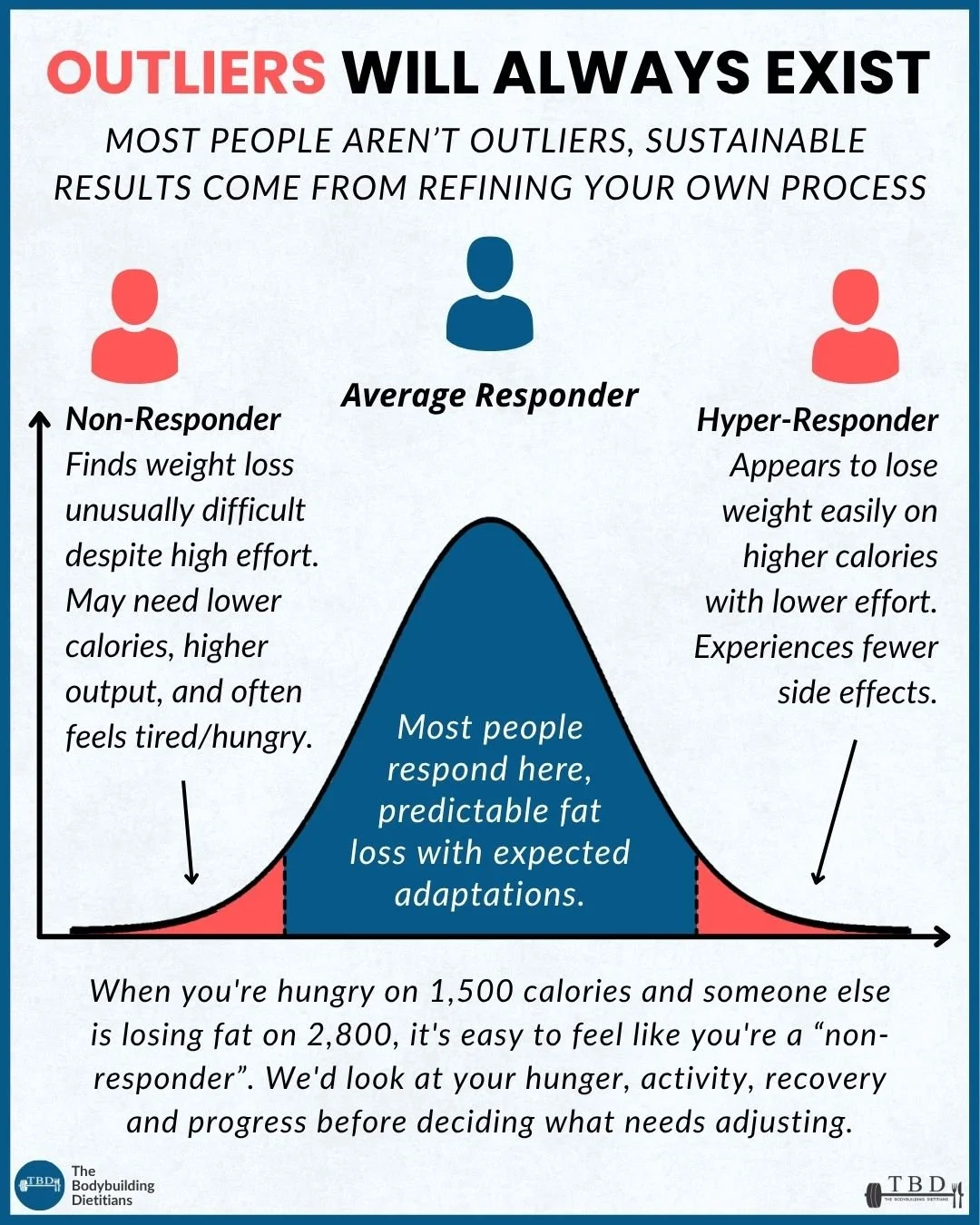
You've been dieting consistently, your calories are relatively low, and you're feeling increasingly hungry and tired. Meanwhile, someone else appears to be losing fat on considerably more food, with fewer complaints about the process.
It's understandable to wonder whether your metabolism is unusually slow or whether you're simply someone who struggles more with fat loss.
The comparison is difficult to make because there are several variables you can't see. People differ in their energy requirements, activity levels, body composition and responses to sustained calorie restriction. Their experience of hunger and fatigue can also vary, even when they're making similar progress.
Understanding these differences helps explain why the same fat-loss approach can be manageable for one person and unnecessarily demanding for another.
Why Can Some People Lose Fat on More Calories Than Others?
People can lose fat on different calorie intakes because their total daily energy expenditure varies according to body size, body composition, physical activity and other individual factors.
A larger individual with more lean mass and a physically demanding occupation may have substantially higher energy requirements than someone smaller who spends most of their day sitting.
Consider two hypothetical examples.
One person's maintenance intake is approximately 2,000 calories, and they're losing fat while consuming 1,600. Another maintains their weight around 3,400 calories and loses fat while consuming 2,900.
Despite eating 1,300 more calories, the second person is still in an energy deficit. Their higher intake tells us relatively little about how restrictive their diet feels or how successfully they're managing it.
Even people with similar body sizes can have different requirements because of their movement, training and individual physiology.
We've covered these differences in more detail in our article on why individual calorie requirements vary.
However, there is another important consideration. Two people can lose fat at similar rates and still have very different experiences of dieting.
Why Does the Same Calorie Deficit Feel Harder for Some People?
The difficulty of maintaining a calorie deficit depends on several factors beyond the amount of energy being restricted, including appetite, recovery, current body composition and lifestyle demands.
Someone may tolerate a moderate deficit with relatively little disruption to their daily routine. Another person might experience persistent hunger, reduced concentration and worsening training performance while losing bodyweight at a comparable rate.
Some of these differences reflect physiology, while others relate to the circumstances in which someone is dieting.
For example, a person working regular hours with predictable meal times may find it easier to organise their nutrition than someone managing shift work, poor sleep and considerable family or occupational demands.
Both could be equally committed to their goals, although one has a more demanding environment in which to maintain the same behaviours.
It's also worth considering how lean someone already is. As body fat decreases, particularly towards the levels achieved during bodybuilding competition preparation, hunger and the physiological demands of continued fat loss can become increasingly pronounced.
The appropriate rate of loss and level of dietary restriction may therefore differ considerably between individuals.
Why Do Hunger Responses Differ During Fat Loss?
Hunger generally increases during sustained energy restriction, although individuals can differ in how strongly they experience and respond to it.
Appetite regulation involves several interacting systems, including hormonal signals, energy availability, sleep, food environment and psychological factors.
Sumithran et al. (2011), in Long-Term Persistence of Hormonal Adaptations to Weight Loss, investigated hormonal and appetite changes following a structured weight-loss intervention.
The researchers enrolled 50 adults in a ten-week programme involving substantial energy restriction. Following weight loss, participants experienced changes in several appetite-regulating hormones, alongside increased subjective hunger.
Some of these changes remained evident one year after the initial intervention.
These findings demonstrate that the body's response to weight loss can create physiological pressure to increase food intake. However, the study examined group-level changes and does not establish how strongly every individual will experience hunger.
In practice, two people consuming similarly sized meals may experience different levels of fullness and different amounts of food preoccupation throughout the day.
This can influence how manageable their diet feels, particularly when the deficit needs to be maintained over several months.
It also explains why dietary strategies should account for someone's hunger response. A meal structure that works well for one person may need adjusting for another, even if both are consuming the same total calories.
How Does Daily Movement Affect Your Response to Dieting?
Daily movement can influence both energy expenditure and how a person responds to changes in food intake.
Non-exercise activity thermogenesis, or NEAT, refers to the energy expended through movement outside structured exercise. This includes walking, standing, household tasks and other incidental activity.
Levine et al. (1999), in Role of Nonexercise Activity Thermogenesis in Resistance to Fat Gain in Humans, investigated how individuals responded to a period of deliberate overfeeding.
The researchers found considerable variation in changes to NEAT, which helped explain differences in fat storage between participants.
Although this study examined overfeeding rather than dieting, it demonstrates how differently individuals can regulate their movement-related energy expenditure when energy availability changes.
Research also suggests that compensatory responses to exercise vary considerably.
King et al. (2008), in Individual Variability Following 12 Weeks of Supervised Exercise: Identification and Characterization of Compensation for Exercise-Induced Weight Loss, investigated 35 adults completing a supervised exercise intervention.
Despite following the same exercise programme, participants experienced substantially different changes in bodyweight.
Those who lost less weight than predicted tended to show greater increases in energy intake and hunger, whereas others experienced little change in appetite.
This is relevant because changes in energy expenditure do not always translate into the expected changes in bodyweight. People can respond through changes in eating behaviour and activity.
During a fat-loss phase, someone may also move less as fatigue accumulates, even if their scheduled exercise remains unchanged.
Keeping an eye on daily steps and general activity can therefore provide useful context when assessing progress.
Does Dieting History or Body Composition Matter?
Your starting body composition, previous dieting experience and current level of energy availability can influence how demanding a fat-loss phase becomes.
Someone with relatively high body fat may have greater flexibility in the rate at which they can lose fat while maintaining training and recovery.
For someone who is already lean, particularly an experienced physique athlete, a slower rate of loss may be more appropriate for preserving muscle and managing the physiological demands of dieting.
Previous dieting experience can also influence how someone approaches a deficit.
An experienced lifter may have established useful meal routines and learned which strategies help them manage hunger. Someone dieting for the first time may still be developing those skills.
However, experience doesn't remove the physiological demands of energy restriction.
A competitor who has completed several successful preparations may understand the process extremely well and still experience substantial hunger, fatigue and food preoccupation towards the end of a diet.
Sleep, stress, training demands and available recovery also influence how manageable the process feels.
These factors help explain why a calorie target that was appropriate during one phase may be less suitable when someone's circumstances change.
How Can You Tell Whether Your Diet Is Harder Than It Needs to Be?
The most useful approach is to assess your rate of fat loss alongside hunger, energy, training performance, recovery and dietary adherence over several weeks.
Bodyweight trends tell us whether progress is occurring, although they provide limited information about the physiological and psychological cost of achieving it.
For example, someone losing approximately 0.5% of their bodyweight per week might be progressing at a perfectly reasonable rate.
If they're also persistently exhausted, struggling to train and thinking about food throughout the day, we'd want to understand what is contributing to those experiences.
Several questions are worth considering.
Are you losing bodyweight at the intended rate? Is hunger manageable across most days? Are you maintaining a reasonable level of training performance? Is your daily activity remaining relatively consistent? Are you sleeping adequately and finding your nutrition practical to follow?
These responses should be interpreted together.
A single difficult training session or unusually hungry afternoon may have little significance. Persistent changes across several areas provide a stronger reason to review the approach.
The purpose of this assessment is to identify which variables may need attention before making adjustments.
Is your fat-loss plan becoming difficult to maintain?
If you're making progress but struggling with persistent hunger, fatigue or declining training performance, it may be worth reviewing how your diet is structured.
Our dietitians assess your progress alongside your nutrition, activity, training and recovery to help establish an approach suited to your goals and circumstances.
Should You Reduce Calories When Fat Loss Feels Difficult?
Reducing calories may be appropriate when progress has genuinely stalled, but the decision should account for your current intake, activity, adherence and how well you're tolerating the diet.
If bodyweight is trending down at an appropriate rate, further restriction may offer little benefit while increasing hunger and fatigue.
If progress has slowed, we'd first look at whether the trend is consistent across several weeks, whether food intake reflects the intended targets and whether activity has changed.
There may be opportunities to adjust meal composition, calorie distribution, daily movement or recovery before reducing energy intake.
In other circumstances, a modest calorie reduction may be the most straightforward option.
And sometimes the appropriate decision is to maintain or increase intake, particularly when the deficit has become unnecessarily aggressive or recovery is being compromised.
The important consideration is what the available information suggests, rather than how your intake compares with someone else's.
Are There Really Fat-Loss Non-Responders and Hyper-Responders?
People can differ considerably in their response to a fat-loss intervention, although the terms non-responder and hyper-responder are not established clinical categories for ordinary calorie-restricted dieting.
Some people experience faster changes in scale weight, greater appetite compensation or larger reductions in activity than others.
However, apparent differences in fat-loss response can also reflect differences in body size, energy expenditure, actual energy intake and temporary changes in fluid balance.
The bell curve in our accompanying infographic illustrates the general concept of individual variation. It shouldn't be interpreted as a measured distribution showing how many people fall into distinct responder categories.
A sustained energy deficit will generally produce a reduction in body energy stores, although the rate of change and the experience of achieving it vary between individuals.
For someone struggling to make progress, applying a non-responder label is unlikely to help identify what needs adjusting.
A more useful approach is to examine the factors influencing their current results and whether the intended rate of fat loss is appropriate.
What Should You Focus on During Your Own Fat-Loss Phase?
Your own progress and response to dieting provide a more useful basis for decision-making than comparing your calories, hunger or rate of loss with another person.
Someone else may have higher energy expenditure, a different body composition or a different tolerance for the demands of dieting.
Their experience offers limited information about the adjustments that would be most appropriate for you.
When we coach someone through fat loss, we consider how their bodyweight, hunger, energy, training performance and activity are changing over time. We also consider whether the current approach is practical enough to maintain for the intended duration of the phase.
Sometimes that means adjusting calories or movement. Other times, it involves changing the rate of loss, meal structure or training demands.
The aim is to make meaningful progress while managing the demands of the process as well as possible.
There is little benefit in making a fat-loss phase more difficult than it needs to be.
Practical Takeaways
Compare calorie intake relative to individual requirements. Someone losing fat on 2,800 calories may have substantially higher energy expenditure than someone dieting on 1,500. Absolute calorie intake provides little information about the size of their deficit or how manageable it feels.
Expect individual differences in hunger and appetite. Energy restriction can increase hunger and food preoccupation, although the response varies. Assess whether your meal structure and intended rate of loss are appropriate for how you're experiencing the diet.
Monitor activity alongside dietary intake. Changes in non-exercise activity thermogenesis can influence energy expenditure during dieting. Tracking daily steps and general movement may help identify changes that are otherwise easy to overlook.
Assess the cost of fat loss alongside your results. Bodyweight trends, training performance, recovery, hunger and adherence provide a more complete picture of whether your calorie deficit is appropriate.
Adjust your approach according to your response. Persistent fatigue or excessive hunger may warrant changes to calorie intake, food selection, activity or the intended rate of loss. A lower calorie target is not automatically the best solution.
Frequently Asked Questions
Why is losing weight harder for some people than others?
Fat loss can feel harder because individuals differ in their calorie requirements, appetite responses, body composition, physical activity and lifestyle circumstances. Two people may achieve similar rates of loss while experiencing very different levels of hunger and fatigue. These differences can influence which dietary approach is most manageable for each person.
Why am I hungry on 1,500 calories when someone else eats 2,800?
Your calorie intake needs to be considered relative to your total daily energy expenditure. Someone eating 2,800 calories may have a much higher maintenance requirement because of their body size, occupation or activity levels. Hunger is also influenced by the size of the deficit, food composition, sleep and individual appetite responses, so the number of calories alone cannot explain the difference.
Do some people naturally lose fat faster?
People can lose fat at different rates because their energy expenditure, effective calorie deficit, starting body composition and physiological responses differ. Some also experience greater changes in appetite or movement during dieting. Faster scale weight loss does not always mean faster fat loss, particularly when changes in water, glycogen and digestive contents contribute to the result.
Can two people have the same calorie deficit but different hunger levels?
Yes. Even when the estimated energy deficit is similar, appetite can differ because of individual physiology, current body composition, sleep, stress, meal composition and previous dieting experience. A similar rate of fat loss therefore does not guarantee that two people will experience the same degree of hunger or dietary difficulty.
Does metabolic adaptation mean I'm a poor responder to fat loss?
Metabolic adaptation refers to changes in energy expenditure that occur during weight loss, including reductions beyond those expected from changes in body size. It can influence the deficit achieved at a given calorie intake, although its magnitude varies. Experiencing these changes does not establish that someone is a fat-loss non-responder or that their metabolism is permanently damaged.
How do I know if my calorie deficit is too aggressive?
Persistent fatigue, difficult-to-manage hunger, declining training performance, poor recovery and unusually rapid weight loss can indicate that a deficit is more aggressive than necessary. These signs should be assessed together with bodyweight trends, dietary adherence, activity and individual circumstances. If several problems persist, reviewing the deficit with a qualified professional may help identify appropriate adjustments.
If you're unsure whether your current calorie intake, training and activity are appropriately matched to your goals, our coaching provides an opportunity to review your progress and establish practical next steps.