Estimate your daily calories, protein, carbohydrates and fats using a free calculator designed around your training, activity and body composition goals.
Our free calorie and macro calculator estimates your daily calories, protein, carbohydrates and fats based on your activity, training and body composition goals. It provides a practical starting point for fat loss, muscle gain, maintenance or body recomposition, which you can refine as you assess your progress.
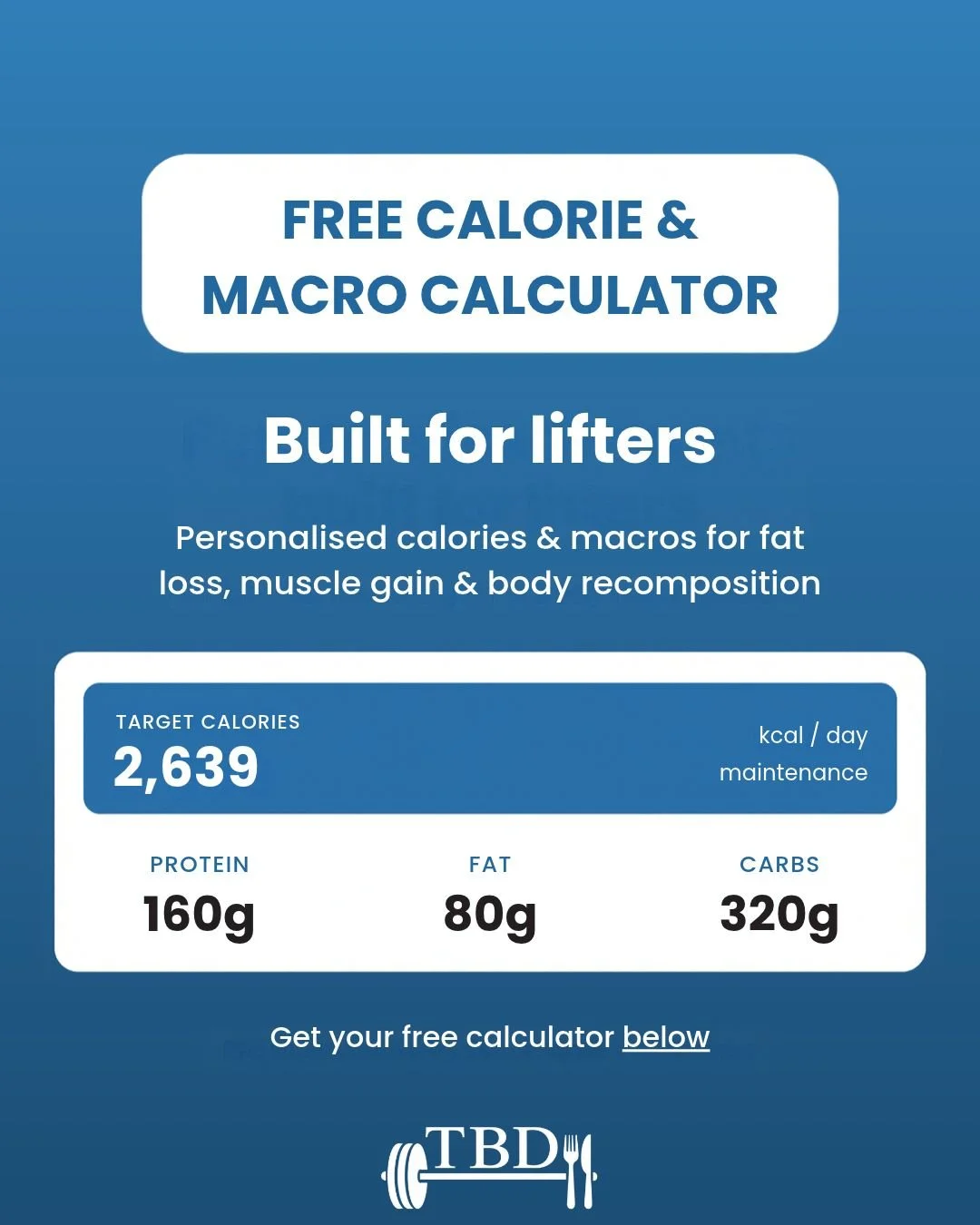
You might have a good idea of how much protein you need, but still be unsure how many calories you should be eating to lose fat, build muscle or maintain your current physique.
And if you've tried a few calorie calculators before, you've probably noticed they can produce surprisingly different recommendations.
We've developed a free calorie and macro calculator specifically for people who lift weights. It considers your training, daily activity, experience level and goal to provide starting targets you can use to structure your nutrition.
How Does Our Calorie and Macro Calculator Work?
Our calculator uses information about your body, training, activity and goal to estimate how much energy and each macronutrient you may need.
Your total daily energy expenditure (TDEE) is the amount of energy your body uses across a typical day. It includes your resting metabolic requirements, the energy used to digest food, structured exercise and everyday movement.
Estimating this provides a starting point for determining your calorie needs.
Equations used to estimate energy expenditure have been studied extensively. For example, Mifflin et al. (1990), in A New Predictive Equation for Resting Energy Expenditure in Healthy Individuals, developed a method for estimating resting energy expenditure using characteristics such as bodyweight, height, age and sex.
However, these equations cannot account perfectly for every individual difference, particularly the variation in daily activity and energy expenditure.
This is something we regularly consider when reviewing someone's nutrition.
Two people might be the same height and bodyweight, but have very different calorie requirements because one has a physically active occupation and trains five times per week, while the other spends most of their day sitting.
A useful calorie estimate needs to consider more than bodyweight alone.
What Calorie Targets Should You Use for Fat Loss, Muscle Gain or Recomp?
Your calorie target should reflect what you're trying to achieve, your current body composition and how your body responds to changes in energy intake.
The calculator allows you to work towards four common goals.
Fat Loss
To lose body fat, you'll generally need to consume fewer calories than you expend over time.
For resistance-trained individuals, the size of the deficit should also consider muscle retention, training performance, hunger and recovery.
A relatively lean, experienced lifter may benefit from losing bodyweight more slowly than someone starting a fat-loss phase with considerably more body fat.
Muscle Gain
Building muscle is supported by progressive resistance training, sufficient protein and adequate energy availability.
A modest calorie surplus can be appropriate, particularly for someone who is already well trained and looking to increase bodyweight gradually.
However, gaining faster doesn't necessarily mean building muscle faster. We'd also consider training experience, body composition and recent progress before deciding how much additional energy is useful.
Body Recomposition
Body recomposition involves gaining muscle while reducing body fat.
For some individuals, particularly those newer to resistance training or returning after time away, this may be achievable around maintenance calories or with a modest deficit.
The most appropriate approach depends on training experience, current body composition and the relative priority of muscle gain versus fat loss.
Maintenance
Maintenance calories are the approximate amount of energy needed to maintain your current bodyweight over time.
This can be useful when transitioning out of a dieting phase, focusing on training performance or establishing a more consistent nutrition routine.
How Are Protein, Carbohydrate and Fat Targets Calculated?
Once an energy target has been established, your protein, carbohydrate and fat intake can be organised around your training and body composition goals.
Protein is particularly relevant for supporting muscle growth and retention.
Morton et al. (2018), in A Systematic Review, Meta-Analysis and Meta-Regression of the Effect of Protein Supplementation on Resistance Training-Induced Gains in Muscle Mass and Strength in Healthy Adults, found diminishing additional benefits for fat-free mass gains beyond approximately 1.6 g/kg/day on average.
For many lifters, an intake around 1.6–2.2 g/kg/day provides a useful starting range, although higher intakes may be appropriate in some circumstances, particularly during energy restriction.
Dietary fat supports normal physiological function, including the absorption of fat-soluble vitamins and the provision of essential fatty acids.
Carbohydrates provide an important fuel source for resistance training, particularly as training volume and intensity increase.
The balance between these macronutrients can vary considerably.
For example, when we're working with someone training frequently while dieting, we'd generally want to preserve enough carbohydrate to support their sessions while meeting their protein and fat requirements.
Ready to Calculate Your Calories and Macros?
Our free calculator provides starting targets based on your training, activity and goal, giving you a practical foundation for planning your nutrition.
How Accurate Is a Calorie and Macro Calculator?
Calorie calculators provide estimates, and the most useful way to assess those estimates is to compare them with your actual progress over time.
Even well-established energy expenditure equations have limitations when applied to individuals.
Your daily movement, training demands, recent dieting history and changes in bodyweight can influence how much energy you require.
For this reason, we generally recommend treating calculated targets as an initial estimate and reviewing the response over the following two to three weeks.
If your goal is fat loss, we'd look at your average bodyweight trend alongside hunger, energy, training performance and dietary consistency.
If you're trying to gain muscle, we'd also consider whether bodyweight is increasing at an appropriate rate and whether your training is progressing.
Someone could receive an estimated maintenance intake of 2,600 calories and find that their bodyweight gradually decreases at that level. In that situation, their actual maintenance requirements may be higher than the initial estimate.
We would adjust the recommendation based on the information collected, rather than assuming the original number must be correct.
This is also how we approach nutrition during our one-on-one weekly coaching. Starting targets provide structure, while ongoing assessment helps determine when adjustments are worthwhile.
Practical Takeaways
Use a calorie and macro calculator to establish initial targets for fat loss, muscle gain, maintenance or body recomposition, then assess how your body responds.
Consider your training and daily activity when estimating calorie requirements. People with similar bodyweights can have substantially different energy expenditure.
Prioritise sufficient protein to support muscle growth and retention, with dietary fat and carbohydrate organised around your overall requirements and training.
Review bodyweight trends, training performance, hunger and recovery over several weeks before making adjustments to your calorie or macro targets.
Frequently Asked Questions
How do I calculate my calories and macros for fat loss?
Start by estimating your maintenance calories, then establish a calorie deficit appropriate for your body composition, training and desired rate of fat loss. Protein intake should be sufficient to support muscle retention, with fat and carbohydrates allocated around your remaining energy needs. Our free calculator provides starting targets for each of these.
How many calories should I eat to build muscle?
Your calorie requirements depend on your body size, activity, training and current energy expenditure. Many lifters benefit from maintaining a modest calorie surplus during a muscle-building phase, although the appropriate amount varies with training experience and body composition. Monitoring bodyweight and training progress helps refine the starting target.
How much protein do I need for muscle growth?
Approximately 1.6–2.2 g of protein per kilogram of bodyweight per day is a practical range for many resistance-trained adults. Individual requirements may differ during energy restriction or when dietary protein quality is limited. Total intake, adequate energy and progressive training all contribute to muscle growth.
Are calorie and macro calculators accurate?
Calorie and macro calculators provide estimates based on the information entered and the methods used to calculate energy requirements. Actual needs vary, so your initial targets should be evaluated using bodyweight trends, training performance, recovery and dietary consistency. Adjustments may be appropriate as your circumstances and goals change.
Can I use the calculator for body recomposition?
Yes. The calculator includes body recomposition as a goal, providing starting calorie and macronutrient targets. The most suitable approach depends on your training experience, current body composition and ability to support progressive resistance training while managing energy intake.
Get Your Free Calorie & Macro Calculator
Whether you're starting a fat-loss phase, planning to build muscle or looking to maintain your physique, our calculator can help you establish a practical starting point.