Understanding the building blocks of protein, how they're digested and when the differences between protein sources matter.
Amino acids are the building blocks of proteins. When joined by peptide bonds, they form shorter chains called peptides and longer chains that can fold into functional proteins. During digestion, these structures are broken down into smaller peptides and amino acids, which the body absorbs and uses for muscle growth, tissue repair and other essential functions.
You probably know roughly how much protein you're aiming to consume each day. You might even have a preferred protein powder, a few meals you regularly eat and a fairly good idea of which foods are high in protein.
But have you ever wondered what those grams of protein are made up of, or why 30 g of protein from whey isn't necessarily equivalent to 30 g from collagen or chickpeas?
There's some interesting biochemistry behind that, and understanding a little of it helps explain why different protein sources can produce different physiological responses.
We tend to spend more time discussing how much protein someone needs than the individual amino acids making up that protein. For most people, that's appropriate. However, there are circumstances where those differences become relevant to the recommendations we make.
What Are Amino Acids?
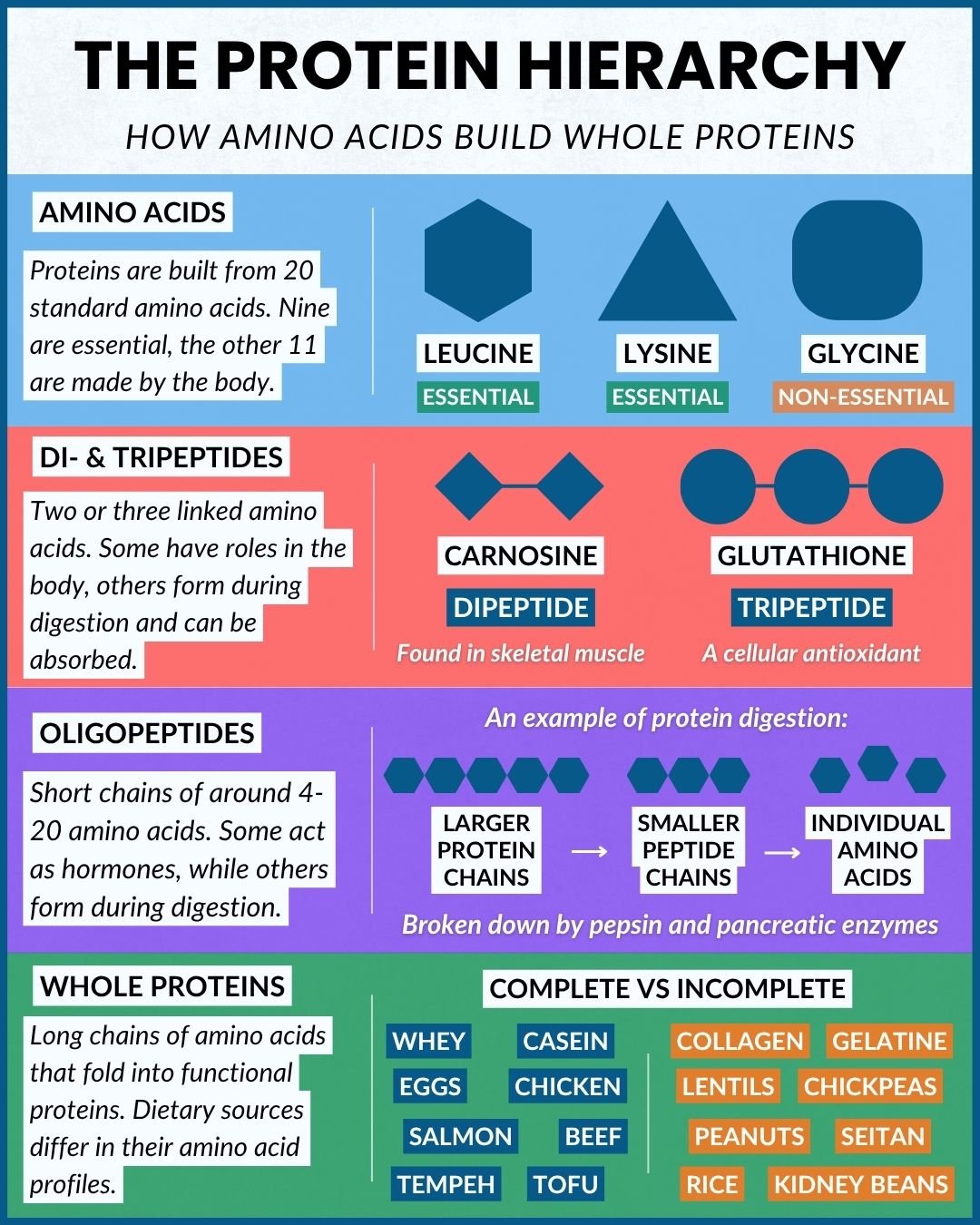
Amino acids are the individual building blocks used to construct proteins. The body uses 20 standard amino acids to produce the many proteins involved in muscle contraction, tissue repair, immune function and other physiological processes.
Of these, nine are classified as essential amino acids because the body cannot produce them in sufficient amounts to meet its requirements. They must therefore come from the diet.
The remaining 11 are generally classified as non-essential, although some can become conditionally essential during periods of illness or increased physiological demand.
Individual amino acids also have functions beyond forming proteins.
Leucine, for example, plays an important role in stimulating muscle protein synthesis, while glycine contributes to collagen and creatine synthesis.
This helps explain why the amino acid composition of a protein source can matter, even when the total protein content is identical.
What Is the Difference Between Peptides and Proteins?
Peptides are chains of amino acids connected by peptide bonds. As these chains become longer and form more complex structures, they can function as whole proteins.
The distinction is commonly described according to chain length, although there is no universally agreed number of amino acids separating a peptide from a protein.
Dipeptides and tripeptides
Dipeptides contain two linked amino acid units, while tripeptides contain three.
Some have specific functions within the body.
Carnosine, for example, is a dipeptide formed from beta-alanine and histidine. It's found in skeletal muscle, where it contributes to buffering the accumulation of hydrogen ions during high-intensity exercise.
Glutathione is a tripeptide composed of glutamate, cysteine and glycine. It plays an important role in cellular antioxidant defence.
These compounds illustrate how relatively small peptide structures can have important physiological functions.
Oligopeptides and whole proteins
Oligopeptides are relatively short chains containing several amino acids. Longer chains are generally referred to as polypeptides, and one or more polypeptide chains can fold into functional proteins.
The sequence and arrangement of amino acids influence how a protein folds and ultimately what it does.
For example, collagen has a structural role in connective tissues, while actin and myosin are involved in muscular contraction.
Both are proteins, although their amino acid sequences and three-dimensional structures allow them to perform very different functions.
How Does the Body Digest and Absorb Protein?
Dietary proteins are broken down into smaller peptides and amino acids during digestion, allowing their components to be absorbed and used throughout the body.
Digestion begins in the stomach, where hydrochloric acid helps unfold proteins and the enzyme pepsin begins breaking their peptide bonds.
Once food reaches the small intestine, pancreatic enzymes such as trypsin and chymotrypsin continue breaking larger protein chains into smaller fragments.
The intestinal lining then absorbs free amino acids, dipeptides and tripeptides through specialised transport systems.
Most of the smaller peptides are subsequently broken down into individual amino acids within intestinal cells before entering the bloodstream.
These absorbed amino acids can then be used to synthesise muscle proteins, enzymes, hormones and other compounds.
This also explains an important distinction we regularly discuss in nutrition. The amount of protein your body can digest and absorb from a meal is different from the amount that maximally stimulates muscle protein synthesis over a particular period.
Our article on how much protein you can absorb in one meal explores that in more detail.
Why Do Different Protein Sources Have Different Amino Acid Profiles?
Different foods contain proteins with different amino acid compositions, which influences how effectively they can provide the essential amino acids required by the body.
You'll often see proteins classified as complete or incomplete.
Complete proteins provide all nine essential amino acids in proportions that meet human requirements. Many animal proteins, including whey, eggs, dairy, meat and fish, fall into this category.
Some plant proteins, including soy, also provide favourable essential amino acid profiles.
Foods commonly described as incomplete proteins may still contain all nine essential amino acids, although one or more may be present in relatively lower proportions.
For example, legumes tend to be lower in methionine, while grains are often lower in lysine.
Eating a variety of protein sources across the day helps provide a more balanced overall amino acid intake. There's generally no need to deliberately combine complementary plant proteins within the same meal.
Collagen is a notable exception because it contains no tryptophan, one of the nine essential amino acids.
Despite being a protein, its amino acid composition makes it a poor primary protein source for supporting muscle growth.
When Does Protein Quality Actually Matter for Muscle Growth?
Protein quality becomes more relevant when total protein intake is relatively low, food choices are restricted or someone relies heavily on a narrow selection of protein sources.
Amino acid composition and digestibility both influence protein quality, although the practical importance of these differences depends on the broader diet.
Van der Heijden et al. (2024), in Plant Protein Blend Ingestion Stimulates Postexercise Myofibrillar Protein Synthesis Rates Equivalently to Whey in Resistance-Trained Adults, compared 32 g of whey with an equal amount of a blended plant protein.
Despite differences in circulating essential amino acid availability, both produced similar muscle protein synthesis responses over the four-hour measurement period.
The study involved ten participants and measured an acute response, so it cannot establish identical long-term muscle growth outcomes.
Mendes et al. (2026), in Effects of Plant- vs Animal-Based Proteins on Muscle Protein Synthesis: A Systematic Review With Meta-Analysis, also found relatively small and uncertain differences between plant and animal proteins, with some evidence favouring animal proteins in older adults.
What does this mean when we're assessing someone's nutrition?
Imagine someone consuming 180 g of protein daily from a variety of animal and plant sources. Assuming that intake is appropriate for their requirements, we'd generally be less concerned about the precise amino acid profile of every individual meal.
Now consider someone consuming 90 g of protein from a relatively narrow selection of plant-based foods.
Depending on their bodyweight and goals, we'd want to look more closely at whether their total intake is sufficient and whether they're consuming enough digestible essential amino acids.
The same biochemical principles apply to both people, although the recommendations could look quite different.
Our protein quality guide explores these differences in more detail.
Unsure whether your protein sources are meeting your needs?
Meeting a daily protein target is a useful starting point, although your dietary pattern, food choices and training goals can influence whether any adjustments are worthwhile.
Our dietitians can help you assess your current intake and establish a practical approach that suits your requirements and food preferences.
How Much Should You Worry About Individual Amino Acids?
For most people consuming sufficient protein from a varied diet, there's little reason to calculate the essential amino acid content of every meal.
Morton et al. (2018), in A Systematic Review, Meta-Analysis and Meta-Regression of the Effect of Protein Supplementation on Resistance Training-Induced Gains in Muscle Mass and Strength in Healthy Adults, identified approximately 1.6 g/kg/day as the average point beyond which additional protein was associated with diminishing benefits for fat-free mass gains.
For many resistance-trained adults, approximately 1.6–2.2 g/kg/day is a useful starting range, although requirements can change according to training, body composition, energy availability and individual circumstances.
Once total protein intake is adequate, the additional value of optimising small differences in amino acid composition may be relatively limited.
We'd be more interested in whether someone is consistently meeting their requirements, how practical their food choices are and whether there are any meaningful gaps in their intake.
If those areas are already well managed, there may be very little reason to change an otherwise effective diet simply because another protein source has a higher protein quality score.
Understanding the biochemistry helps explain how proteins work. Knowing when to apply that information is what makes it useful.
Practical Takeaways
The body uses 20 standard amino acids to construct proteins, including nine essential amino acids that must be obtained through the diet.
Dipeptides, tripeptides and longer peptide chains are formed when amino acids link together. Some, including carnosine and glutathione, have important physiological functions.
Dietary protein is digested into smaller peptides and amino acids, which are absorbed through the small intestine and used for protein synthesis and other metabolic processes.
Protein quality depends partly on essential amino acid composition and digestibility. Differences between sources become more relevant when total intake is low or dietary variety is limited.
For most resistance-trained adults consuming sufficient protein from varied sources, meeting daily requirements is generally more important than optimising the amino acid profile of every individual meal.
Frequently Asked Questions
What's the difference between amino acids, peptides and proteins?
Amino acids are individual building blocks of proteins. Peptides consist of amino acids joined by peptide bonds, while proteins generally contain longer chains folded into functional structures. Their amino acid sequence and structure determine how they function within the body.
Can your body absorb peptides, or do they need to become amino acids?
The small intestine can absorb free amino acids as well as dipeptides and tripeptides. Most absorbed dipeptides and tripeptides are then broken down into individual amino acids within intestinal cells. These amino acids become available for muscle protein synthesis and other physiological functions.
Are complete proteins better for muscle growth?
Complete proteins provide all nine essential amino acids in proportions that meet human requirements, making them useful for supporting muscle protein synthesis. However, total daily protein intake, dietary variety and resistance training are also important. Well-planned diets containing plant-based proteins can support muscle growth.
Do incomplete proteins count towards your daily protein target?
Yes. Protein from legumes, grains, nuts and other plant foods contributes to your total daily protein intake. Many of these foods contain all nine essential amino acids, although their proportions and digestibility vary. Consuming a variety of sources can help meet overall requirements.
Is collagen as effective as whey protein for building muscle?
Collagen has a less favourable essential amino acid profile than whey, including an absence of tryptophan and relatively little leucine. Whey is therefore better suited to supplying the essential amino acids needed to support muscle protein synthesis. Collagen can contribute to total protein intake, although it shouldn't be relied upon as a primary muscle-building protein source.
Want help reviewing your protein intake?
If you're unsure whether your current protein intake and food choices are appropriate for your training and body composition goals, our coaching can help you review your nutrition and identify any worthwhile adjustments.