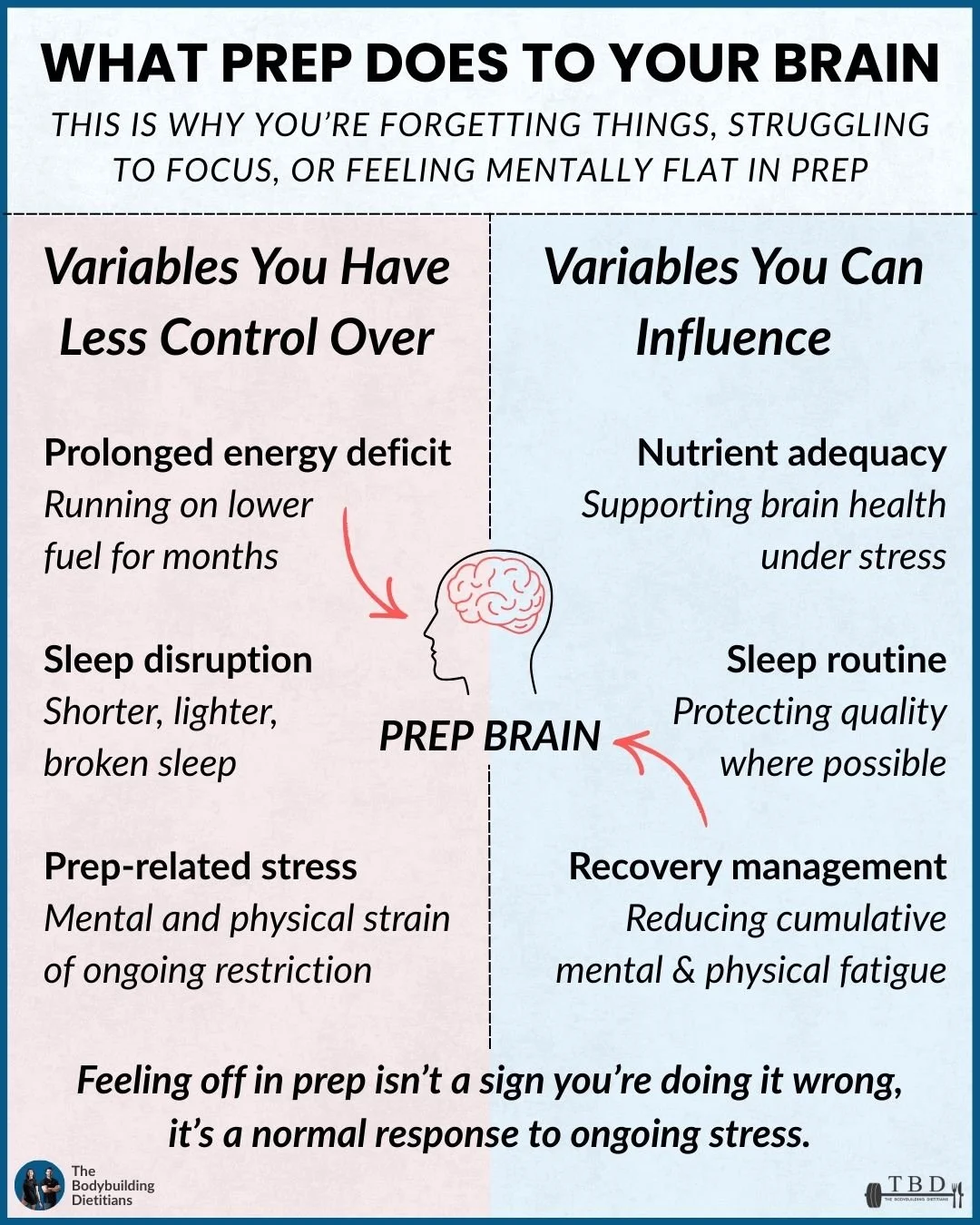
What Contest Prep Does to Your Brain
Most athletes go into contest prep expecting it to be physically demanding. They anticipate hunger, fatigue, and the general grind that comes with pushing body fat to uncomfortable levels. What often catches them off guard is how noticeably prep can affect their thinking.
Midway through a prep, it’s common to hear athletes describe moments of forgetfulness, difficulty concentrating, or a general sense of mental flatness that wasn’t present earlier on. Tasks that once felt automatic suddenly require more effort. Focus drifts more easily. Motivation becomes harder to access, not just in training, but in everyday life.
These experiences are often brushed off as “prep brain,” usually with a bit of humour, but they reflect a very real cognitive response to sustained physiological and psychological stress.
Prep Brain Isn’t Unique, It’s Just Amplified
Outside of bodybuilding, the same symptoms are typically grouped under the umbrella of brain fog. Poor sleep, prolonged stress, illness, and under-fuelling are all well-known contributors. Contest prep simply brings many of these factors together simultaneously and maintains them over an extended period.
A prolonged energy deficit reduces available fuel not just for training, but for the brain. Carbohydrate intake is often lower, training demands remain high, and recovery resources become increasingly limited. Sleep quality frequently declines as body fat drops, while the mental load of constant structure, monitoring, and decision-making quietly accumulates in the background.
In our coaching experience, this combination almost inevitably produces some degree of cognitive strain. Even athletes who have prepped multiple times and know what to expect often underestimate how early these effects can show up, or how persistent they can become as the weeks progress.
What You Have Less Control Over
Some cognitive fatigue during prep is simply part of the cost of getting lean. Running on reduced energy availability for months at a time places a real constraint on brain function. Sleep tends to become shorter and lighter. The ongoing psychological pressure of restriction, deadlines, and outcome focus adds another layer of stress that cannot be completely removed.
These responses are not signs of weakness, nor are they indications that an athlete lacks resilience or discipline. They are predictable physiological adaptations to prolonged stress, and they occur even when prep is well planned.
Problems arise when athletes interpret these signals incorrectly, either assuming something is fundamentally wrong with their approach or attempting to push through by tightening the screws further.
Where You Can Influence the Outcome
While prep brain cannot be eliminated entirely, its severity is far more modifiable than many athletes realise. In practice, cognitive resilience during prep tends to reflect how well the fundamentals are protected rather than the presence of any single intervention.
Nutrient adequacy plays a larger role than is often acknowledged. A calorie deficit does not have to translate into micronutrient deprivation, but without careful planning it frequently does. Diets that become overly repetitive, low in fruit and vegetables, or excessively restrictive in food choice can quietly undermine cognitive function over time.
Sleep, while often compromised during prep, remains one of the most powerful levers available. Athletes who treat sleep routines as non-negotiable, protecting consistency and quality where possible, tend to retain better focus and emotional stability deeper into a diet phase.
Starting position also matters. Athletes who enter prep with less weight to lose and more realistic timelines consistently experience a lower cognitive cost than those attempting to force rapid changes. The urgency required by aggressive timelines amplifies both physical and mental fatigue.
Extremes accelerate everything, including burnout. Large deficits paired with very high outputs may move fat loss along quickly, but they also tend to accelerate mental exhaustion, irritability, and decision fatigue. What looks efficient on paper often proves costly in practice.
As carbohydrate intake decreases, distribution becomes increasingly relevant. Strategically placing carbohydrate-rich meals around training and cognitively demanding parts of the day can support both performance and mental clarity, even when overall intake is modest.
Learning to Read the Signal Properly
Feeling mentally flat during prep does not mean an athlete is failing the process. More often, it is simply feedback that the system is operating under sustained load.
Across multiple prep seasons, we see that athletes who progress and remain in the sport long term are not those who feel nothing, but those who learn how to interpret what they are feeling without panic or overcorrection. They recognise cognitive fatigue as part of the process, respond by tightening up recovery and structure, and avoid turning a normal response into a self-judgement.
Understanding how prep affects the brain, and learning how to manage that reality, is part of competitive maturity. It is not a detour from progress, but one of the skills that allows athletes to pursue leanness without unnecessarily sacrificing their wellbeing or longevity in the sport.
Managing the mental demands of contest prep rarely comes down to toughness alone. It is shaped by planning, recovery, realistic timelines, and ongoing feedback that considers the whole athlete, not just the rate of fat loss.
If you’re looking for guidance that accounts for both the physical and cognitive realities of prep, our team works with physique athletes to navigate the process with structure, context, and long-term perspective.