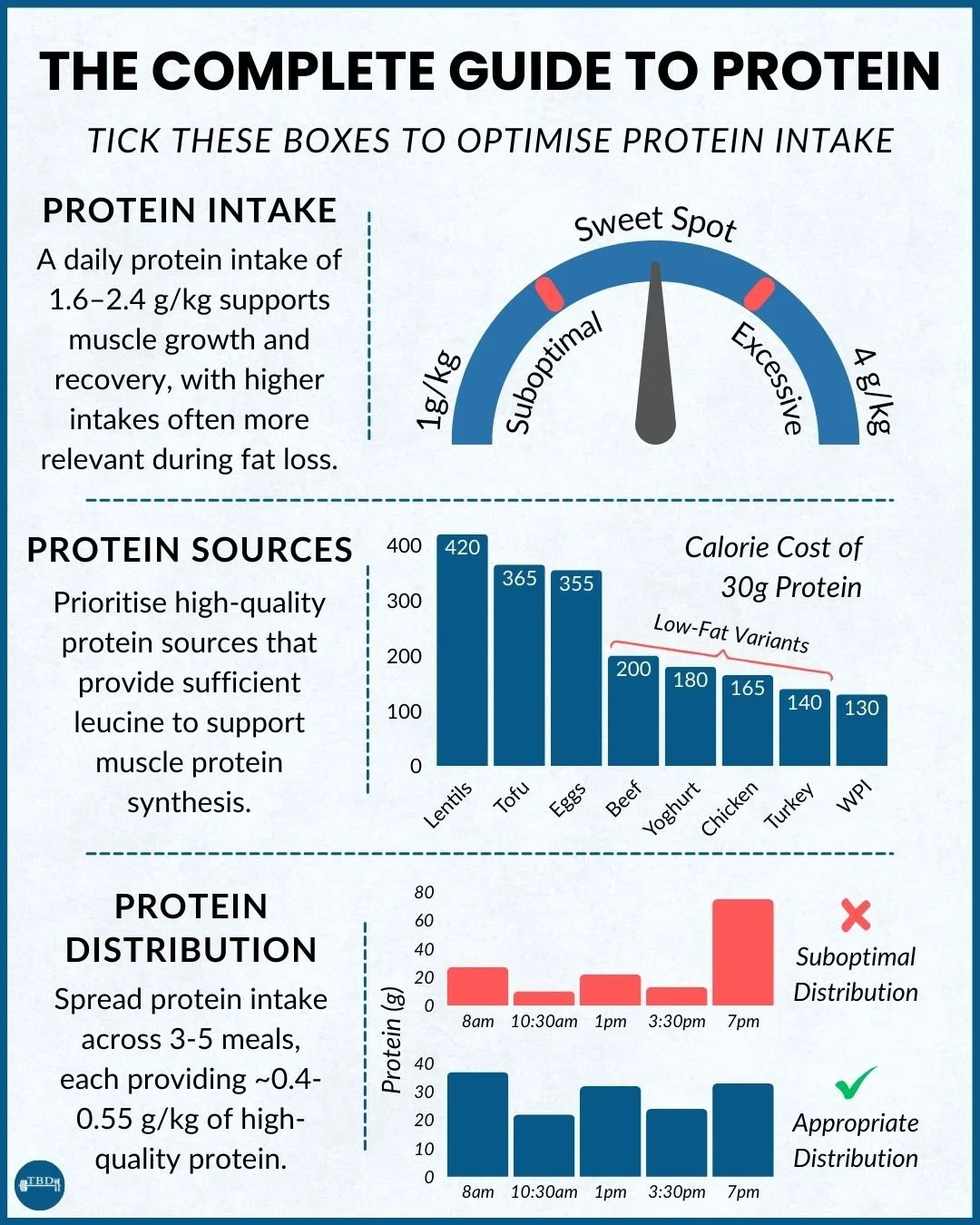
The Complete Guide to Protein Intake
How Much You Need, Which Sources Matter, and How to Structure It Properly
Protein is one of the most discussed nutrients in sport and physique development. Yet despite the attention it receives, the practical details are often misunderstood or oversimplified.
Most conversations stop at “eat more protein”.
Very few address:
How much is actually optimal
Which sources meaningfully support muscle protein synthesis
How intake should be distributed across the day
When these three components are aligned, protein becomes far more effective and easier to sustain long term.
This guide breaks it down into three foundational principles.
1️⃣ Total Daily Protein Intake
For most resistance-trained individuals, a daily intake of 1.6–2.4 g/kg bodyweight supports muscle growth, recovery, and lean mass retention.
Where This Range Comes From
~1.6 g/kg appears sufficient for maximising muscle protein synthesis in energy balance
Intakes toward the higher end (2.2–2.4 g/kg) become more relevant during:
Fat loss phases
High training volumes
Calorie deficits
Situations where lean mass retention is critical
Higher intakes are not inherently “better”, but they can provide a margin of safety when recovery capacity is compromised.
More Is Not Always More Effective
Going well beyond 2.4 g/kg does not appear to further increase muscle gain under normal conditions. Protein above requirements is simply oxidised or contributes to total energy intake.
For most people, the sweet spot is about adequacy, not excess.
2️⃣ Protein Source Quality
Not all protein sources stimulate muscle protein synthesis equally.
Two key considerations:
Leucine content
Digestibility and amino acid profile
Leucine plays a central role in triggering muscle protein synthesis. Most meals require roughly 2–3 g of leucine to maximise the anabolic response.
Animal-Based Proteins
Whey protein isolate
Lean poultry
Eggs
Low-fat dairy
These are typically:
Highly digestible
Rich in leucine
Efficient in calorie-to-protein ratio
Plant-Based Proteins
Lentils
Chickpeas
Tofu
Soy products
Quinoa
These can absolutely work, but often require:
Slightly larger servings
Strategic food combining
Attention to total intake
The goal is not to label foods as “good” or “bad”, but to understand the trade-offs.
For example:
Lentils provide fibre and micronutrients but at a higher calorie cost per gram of protein
Whey isolate delivers protein very efficiently with minimal additional energy
Context determines the better choice.
3️⃣ Protein Distribution Across the Day
Total intake matters most, but distribution still plays a meaningful role.
Rather than consuming most protein in one large evening meal, spreading intake across 3–5 meals supports:
Repeated stimulation of muscle protein synthesis
Better satiety control
More consistent energy
Improved adherence
Practical Target
For most individuals:
~0.4–0.55 g/kg per meal
Typically 30–40 g per meal for average-sized adults
This ensures each meal meaningfully stimulates muscle protein synthesis.
Why Skewed Intake Is Suboptimal
A common pattern looks like:
Low-protein breakfast
Minimal protein snacks
Very large protein intake at dinner
While total protein may still be adequate, muscle protein synthesis is not optimally stimulated throughout the day.
Distribution is about efficiency, not perfection.
Putting It Together
Optimising protein intake is not complicated, but it is deliberate.
You want to:
Hit an appropriate total daily intake
Choose predominantly high-quality, leucine-rich sources
Distribute intake evenly across the day
When these three boxes are ticked, protein becomes a tool rather than a guess.
And importantly, once structured correctly, it becomes easier to maintain long term without overthinking.
Common Mistakes We See
Chasing extreme protein intakes unnecessarily
Relying on low-density protein sources during fat loss
Ignoring distribution entirely
Treating supplements as mandatory rather than convenient
The fundamentals remain the same whether someone is in:
Off-season muscle gain
Contest prep
General fat loss
Performance-focused phases
The structure just shifts slightly depending on context.
If you’re unsure whether your protein intake is structured appropriately for your current phase, that uncertainty tends to show up in stalled progress, inconsistent recovery, or unnecessary hunger.
If you would like your intake assessed and structured with intent, you can enquire about working with our team below.