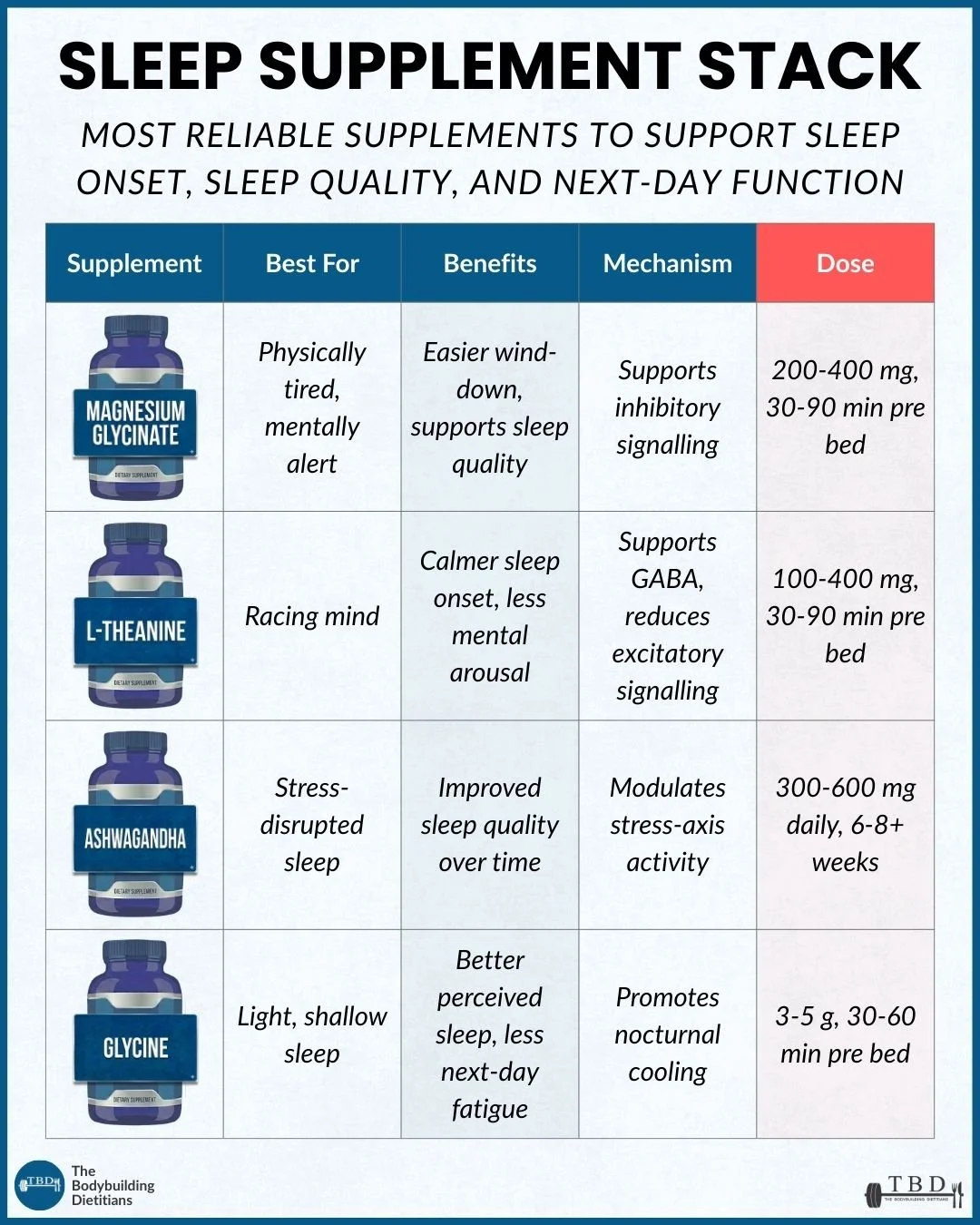
Sleep Supplements: When the Fundamentals Are in Place, but Sleep Still Isn’t
Sleep quality is not built on supplements.
In practice, most meaningful improvements in sleep come from boring fundamentals done consistently. Light exposure, caffeine timing, regular routines, sleep opportunity, and predictable schedules will always have a larger impact than anything that comes in capsule or powder form.
In our coaching experience, however, many athletes and high-performing individuals run into situations where those fundamentals are largely in place and sleep still suffers. Contest prep, prolonged energy deficits, high training volumes, psychological stress, travel, shift work, or young children can all compromise sleep despite doing most things “right”.
This is where supplements can play a supporting role, not as fixes, but as targeted tools aimed at specific barriers to sleep.
Who This Applies To (and Who It Doesn’t)
This article is most relevant for athletes who:
Have reasonably consistent sleep routines
Are mindful of caffeine and light exposure
Still struggle with sleep onset, sleep depth, or next-day fatigue
Are under high physiological or psychological load
It is not written for people looking to replace sleep hygiene with supplements, or for those expecting sedative-like effects. None of the options discussed here work that way.
Why Context Matters With Sleep Supplements
One of the most common mistakes we see is treating sleep supplements as interchangeable.
In practice, sleep disruption tends to fall into a few broad patterns. The nervous system is too activated. The mind will not shut off. Stress load has accumulated over time. Sleep feels shallow and non-restorative despite adequate time in bed.
Different supplements interact with different parts of that system. Using the wrong tool for the wrong problem often leads to the conclusion that “supplements don’t work”, when the real issue is poor matching of mechanism to symptom.
Magnesium: When You’re Tired but Still Wired
Magnesium tends to be most useful when physical fatigue is present, but the nervous system struggles to downshift.
In practice, this shows up as feeling exhausted at night, yet restless once in bed. Magnesium plays a role in inhibitory neurotransmission and neuromuscular relaxation, which may help facilitate a smoother wind-down rather than force sleep.
The effect is subtle. It is not a knockout. For some athletes, however, that small reduction in nervous system tone is enough to improve sleep quality over time.
L-Theanine: When the Mind Won’t Slow Down
L-theanine is better suited to mental arousal rather than physical fatigue.
We see this most often in athletes who are physically tired but cognitively alert, replaying training sessions, work stress, or upcoming plans once the lights go out. L-theanine appears to promote a calmer mental state by supporting GABAergic activity and reducing excitatory signalling.
For individuals whose primary barrier to sleep is a racing mind, it can make the transition into sleep feel less abrupt and less effortful.
Ashwagandha: When Stress Is the Driver
Ashwagandha is not an acute sleep aid in the traditional sense.
Its usefulness tends to emerge over weeks rather than nights, particularly in people whose sleep disruption is closely tied to sustained stress and elevated physiological load. In coaching settings, this often applies during long dieting phases, high work stress, or periods of poor recovery capacity.
Rather than targeting sleep directly, ashwagandha appears to modulate stress-axis activity, which may indirectly improve sleep quality over time.
Glycine: When Sleep Feels Light or Unrefreshing
Glycine is often underestimated because it does not act as a sedative.
Its primary interest lies in its role in thermoregulation and sleep depth. Human studies suggest that bedtime glycine can promote a small, brain-mediated drop in core body temperature, a normal physiological process associated with sleep onset and depth.
In practice, we see glycine help most in athletes who fall asleep without much difficulty but wake feeling under-recovered, foggy, or fatigued the next day. Again, the effects are modest, but in the right context they can be meaningful.
What These Supplements Can and Cannot Do
None of these supplements override poor sleep habits.
The evidence supporting them ranges from modest to moderate, and individual response varies considerably. In research settings, effect sizes are small. That does not mean they are useless. It means expectations need to be realistic.
When sleep hygiene is poor, supplements are noise. When sleep hygiene is solid and sleep is still compromised, they can act as small levers that improve consistency and next-day function.
The Bigger Picture
Sleep rarely improves because of one intervention.
It improves when the overall system becomes more supportive of recovery. Supplements, when used appropriately, are part of that system, not the foundation of it.
Learning when to introduce them, how to match them to the underlying problem, and when to remove them again is where most people go wrong.
Sleep issues are rarely isolated.
They usually sit downstream of training load, energy intake, stress, and recovery capacity. Addressing them properly often requires adjusting the whole picture, not just adding another supplement.
If you want support structuring training, nutrition, and recovery in a way that improves sleep and performance long-term, working with an experienced dietitian can accelerate that process.