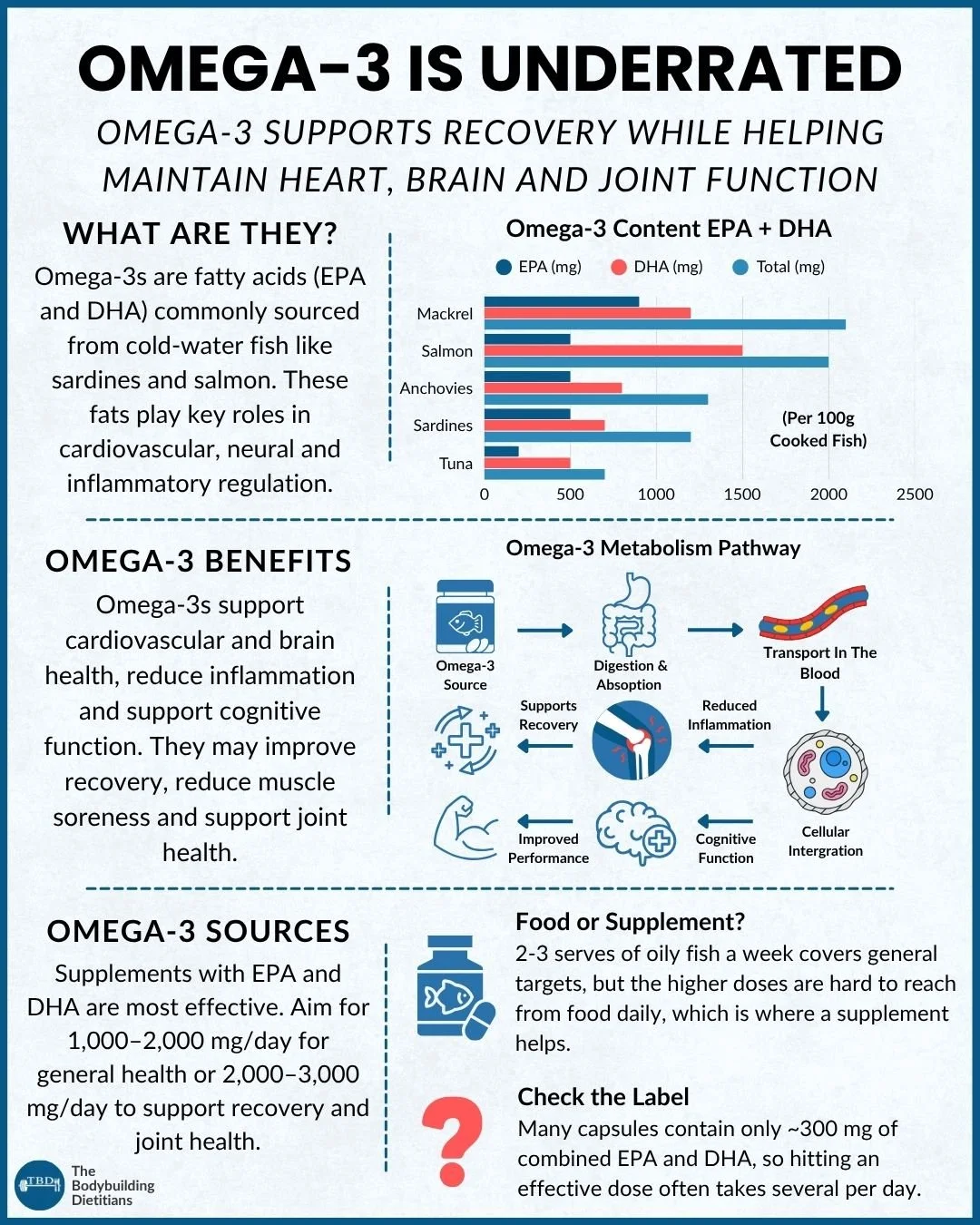
Oily fish such as mackerel, salmon, and sardines are the richest whole-food sources of the EPA and DHA that carry most of omega-3's benefit.
Fish oil and omega-3 are often treated as the same thing, which is where most of the confusion around dosing and supplement labels begins. This guide explains the difference between ALA, EPA, and DHA, how much omega-3 is worth aiming for, and why the combined EPA + DHA figure on a label matters far more than the total amount of fish oil.
Omega-3 is a family of fatty acids, and the two that carry most of the benefit for cardiovascular, brain, and joint health are EPA and DHA, found in oily fish and marine or algae supplements. Fish oil and omega-3 are not interchangeable terms: the useful number on a supplement label is the combined EPA + DHA content, not the total amount of fish oil, because the total can substantially overstate how much long-chain omega-3 you are actually getting. For most people, two to three serves of oily fish such as salmon, mackerel, or sardines each week is a strong starting point, with supplementation becoming practical when fish intake is low or a higher dose is appropriate. General targets sit around 1,000 to 2,000 mg of combined EPA and DHA per day, with 2,000 to 3,000 mg per day sometimes used to support recovery and joint health. Many capsules contain only around 300 mg of combined EPA and DHA, so reaching an effective dose often takes several per day. The cardiovascular evidence is meaningful but should be read carefully: higher long-chain omega-3 intake is consistently associated with lower cardiovascular mortality, while the effect on all-cause mortality is smaller and less certain. Emerging evidence around exercise recovery exists but is less consistent and depends on dose, population, and the outcome measured.
Fish oil and omega-3 are not quite the same thing, and the distinction turns out to matter a great deal when you are choosing a supplement or reading a label. Omega-3 is a family of fatty acids, and the members of that family are not interchangeable. Getting clear on which one does what removes most of the confusion that surrounds this supplement.
Omega-3 fatty acids are a family of essential fats that support cardiovascular, neural, and inflammatory regulation, with EPA and DHA being the two long-chain forms that carry most of the practical benefit.
This article walks through the difference between ALA, EPA, and DHA, how much omega-3 is worth aiming for from food and supplements, how to read the number that actually matters on a fish oil label, and what the cardiovascular and recovery evidence does and does not support. For how omega-3 fits alongside the small number of supplements with solid evidence behind them, our creatine and evidence-based supplement guides provide useful context.
What Is the Difference Between ALA, EPA, and DHA?
The three omega-3s worth knowing are ALA, EPA, and DHA, and they differ in where they come from and how directly the body can use them. EPA and DHA carry the benefits most people are after, while ALA serves largely as a precursor.
ALA, or alpha-linolenic acid, is the essential omega-3 obtained from plant foods such as flax, chia, and walnuts. The body can convert ALA into EPA and DHA, but that conversion is limited, which is why it is inefficient to rely on plant sources alone for long-chain omega-3. EPA (eicosapentaenoic acid) and DHA (docosahexaenoic acid) are the long-chain forms found directly in oily fish and in marine or algae supplements. They are the forms involved in cardiovascular, neural, and inflammatory regulation, and they are what the useful research is almost always measuring.
The practical consequence is that oily fish and marine or algae supplements are valuable precisely because they supply EPA and DHA directly, sidestepping the limited conversion from ALA. For someone eating little fish, this is the gap a supplement is there to fill.
How Much Omega-3 Do You Need?
For most people, a couple of serves of oily fish each week is a very good starting point, with supplementation layered in when fish intake is low or a higher dose is warranted. General daily targets for combined EPA and DHA sit around 1,000 to 2,000 mg, with higher intakes sometimes used for specific goals.
Two to three serves of oily fish a week covers general targets comfortably for a lot of people. Salmon, mackerel, sardines, and anchovies are among the richest sources, and rotating them through the week is a simple way to reach a solid baseline without thinking about supplements at all. Whole-food sources also bring protein and other nutrients alongside the omega-3, which is why fish is the sensible first port of call.
Supplementation becomes particularly practical in two situations: when fish intake is consistently low, or when a higher EPA and DHA intake is appropriate for a specific goal. General health targets tend to sit in the 1,000 to 2,000 mg per day range for combined EPA and DHA, while intakes around 2,000 to 3,000 mg per day are sometimes used to support recovery and joint health. Higher doses are hard to reach from food alone on a daily basis, which is the situation where a supplement genuinely adds something rather than duplicating what the diet already provides.
Why Does the EPA + DHA Number on a Label Matter More Than Total Fish Oil?
The number worth reading on a fish oil label is the combined EPA + DHA content, not the headline "fish oil" figure. The total amount of fish oil can substantially overstate how much long-chain omega-3 you are actually getting.
The specific problem is that a capsule advertised as 1,000 mg of fish oil may contain only a fraction of that as EPA and DHA. Many capsules provide only around 300 mg of combined EPA and DHA per serve, which means reaching an effective dose often takes several capsules per day rather than the one the front of the bottle implies. A product's "1,000 mg fish oil" claim and its actual EPA + DHA content can be very different numbers.
Reading the label properly is therefore the difference between an effective dose and an expensive placebo. Turning the bottle over and adding up the EPA and DHA per serve, then working out how many serves reach your target, is the single most useful habit when choosing an omega-3 supplement. This is also where cheaper products often reveal themselves, since a low EPA + DHA concentration means you need more capsules to reach the same dose, which changes the true cost per effective serve.
Not Sure Whether Your Supplements Are Actually Doing Anything?
Supplements are easy to accumulate and hard to audit, and omega-3 is one where the label rarely tells the whole story. When we work with clients, we look at what each supplement is genuinely adding against the diet as a whole, rather than assuming more products means better coverage.
What Does the Evidence Actually Show?
The cardiovascular evidence for omega-3 is meaningful but needs context, because the effect is clearer for cardiovascular mortality than for all-cause mortality. Reading the research carefully matters here, since the topic attracts both overstatement and dismissal.
Higher long-chain omega-3 intake is consistently associated with lower cardiovascular risk in large observational datasets. It is worth separating that observational signal from the causal question, since the two are often blurred in supplement marketing.
A meta-analysis of 11 prospective studies including 371,965 people found that higher long-chain omega-3 intake was associated with lower all-cause mortality, with each additional 0.3 g per day associated with a 6 percent lower risk. This is observational evidence, so it indicates association rather than proof of causation. Source: Zhang et al., 2016, Journal of Epidemiology and Community Health.
When the question moves to controlled trials, the picture is more measured. Supplementation shows a clearer effect on cardiovascular death than on overall mortality, which is an important distinction for anyone deciding how much weight to place on omega-3 as a longevity intervention rather than a cardiovascular one.
A meta-analysis of 55 randomised controlled trials found a significant reduction in cardiovascular death with omega-3 supplementation, while the effect on all-cause mortality was small and not statistically significant. Source: An et al., 2020, Nutrients.
There is also emerging interest in omega-3 for exercise recovery, including reduced muscle soreness and support for joint health. Those findings are less consistent than the cardiovascular data and depend heavily on dose, the population studied, and the specific outcome measured, so they are best treated as promising rather than settled. For a lifter, the cardiovascular and general-health case is the firmer reason to pay attention to omega-3 intake, with any recovery benefit a possible bonus rather than the main event.
How Should You Approach Omega-3 in Practice?
The practical approach is to start with food, supplement the gap, and read the EPA + DHA number rather than the fish oil headline. Omega-3 is one of the more worthwhile supplements to get right, precisely because the labels make it so easy to get wrong.
When we assess omega-3 intake with clients, we look at three things: how much oily fish is already in the diet, the actual EPA and DHA dose being consumed from any supplement, and whether supplementation is adding something useful rather than duplicating what food already covers. That last question is the one most people skip, and it is where a supplement either earns its place or quietly becomes wasted spend.
Practical Takeaways
Fish oil and omega-3 are not the same thing. The number that matters on a label is combined EPA + DHA, not total fish oil, which can overstate what you are getting.
EPA and DHA are the long-chain forms that carry the benefit. ALA from plants converts to them only in limited amounts, so oily fish or marine and algae supplements are the direct sources.
Two to three serves of oily fish a week (salmon, mackerel, sardines, anchovies) is a strong baseline for most people.
General targets sit around 1,000 to 2,000 mg combined EPA and DHA per day, with 2,000 to 3,000 mg sometimes used for recovery and joint health.
Many capsules contain only around 300 mg of combined EPA and DHA, so reaching an effective dose can take several per day. Check the per-serve figure.
The cardiovascular evidence is meaningful, with a clearer effect on cardiovascular death than on all-cause mortality. Recovery evidence is promising but less consistent.
Frequently Asked Questions
Is fish oil the same as omega-3?
Not exactly. Omega-3 is a family of fatty acids, and fish oil is one source of the long-chain forms EPA and DHA. The key point is that a fish oil supplement's total oil content is not the same as its EPA and DHA content, and the combined EPA + DHA figure is the number worth reading.
How much EPA and DHA should I take per day?
General health targets tend to sit around 1,000 to 2,000 mg of combined EPA and DHA per day. Intakes around 2,000 to 3,000 mg per day are sometimes used to support recovery and joint health. Because many capsules provide only around 300 mg per serve, reaching these targets often takes several capsules daily.
Can I get enough omega-3 from food alone?
For general targets, yes. Two to three serves of oily fish such as salmon, mackerel, or sardines each week is a strong baseline for most people. Supplementation becomes practical when fish intake is low or when a higher EPA and DHA dose is appropriate, since higher intakes are hard to reach from food every day.
Are plant sources of omega-3 enough?
Plant foods such as flax, chia, and walnuts provide ALA, which the body converts to EPA and DHA only in limited amounts. This makes it inefficient to rely on plant sources alone for long-chain omega-3. Marine or algae supplements are a useful direct source of EPA and DHA for those who do not eat fish.
Does omega-3 actually help with recovery?
There is emerging evidence that omega-3 may support recovery, reduce muscle soreness, and support joint health. These findings are less consistent than the cardiovascular data and depend on dose, population, and the outcome measured. It is reasonable to view any recovery benefit as a possible bonus rather than the primary reason to supplement.
What should I look for on a fish oil label?
Look at the combined EPA + DHA per serve, not the total fish oil figure on the front. Work out how many serves it takes to reach your target dose, since a low concentration means more capsules and a higher true cost per effective serve. This single habit separates an effective product from an ineffective one.
Getting omega-3 right is mostly a matter of reading labels properly and knowing when a supplement adds something your diet does not. If you would like help auditing your supplements and building a diet that covers the basics first, our coaching can take the guesswork out of it, or you can book a consultation to talk through your current setup.