How to estimate energy availability, understand the research behind common thresholds and recognise when your nutrition may be insufficient for your training.
Energy availability measures dietary energy remaining after exercise expenditure, expressed relative to fat-free mass. Persistently low energy availability can affect hormonal function, bone health, recovery and performance, although calculated values are imprecise and there is no universal diagnostic threshold. Assessing possible underfuelling requires consideration of nutrition, training demands, symptoms and medical history.
Underfuelling doesn't always look like eating very little.
You might be eating 2,400 calories, training five days per week and consistently meeting your protein target, yet still feel unusually tired or struggle to recover between sessions.
If someone came to us in this situation, we'd want to understand quite a bit more before deciding whether their calorie intake was appropriate.
How much exercise are they completing? Are they losing bodyweight? Has their training volume recently increased? How long have they been experiencing fatigue, and have they noticed other changes in their health or performance?
Energy availability gives us one way to investigate these questions. However, estimating it accurately is challenging, and the result needs to be interpreted alongside the broader picture.
What Is Energy Availability?
Energy availability (EA) is the amount of dietary energy remaining after exercise expenditure, relative to someone's fat-free mass.
It describes how much energy is available to support the body's physiological functions after accounting for the demands of exercise.
Low energy availability (LEA) occurs when energy intake is insufficient relative to exercise demands, potentially compromising the energy available for normal physiological function.
This can occur during intentional fat loss, although it can also develop when someone increases their training without making appropriate changes to their nutrition.
For example, a lifter might increase their weekly training volume, add several cardio sessions and maintain a high daily step count while continuing to eat the same amount.
Their energy requirements may have increased substantially, even though their food intake hasn't changed.
The duration and severity of insufficient energy availability, alongside individual physiological differences, influence whether this becomes a concern for health and performance.
How Do You Calculate Energy Availability?
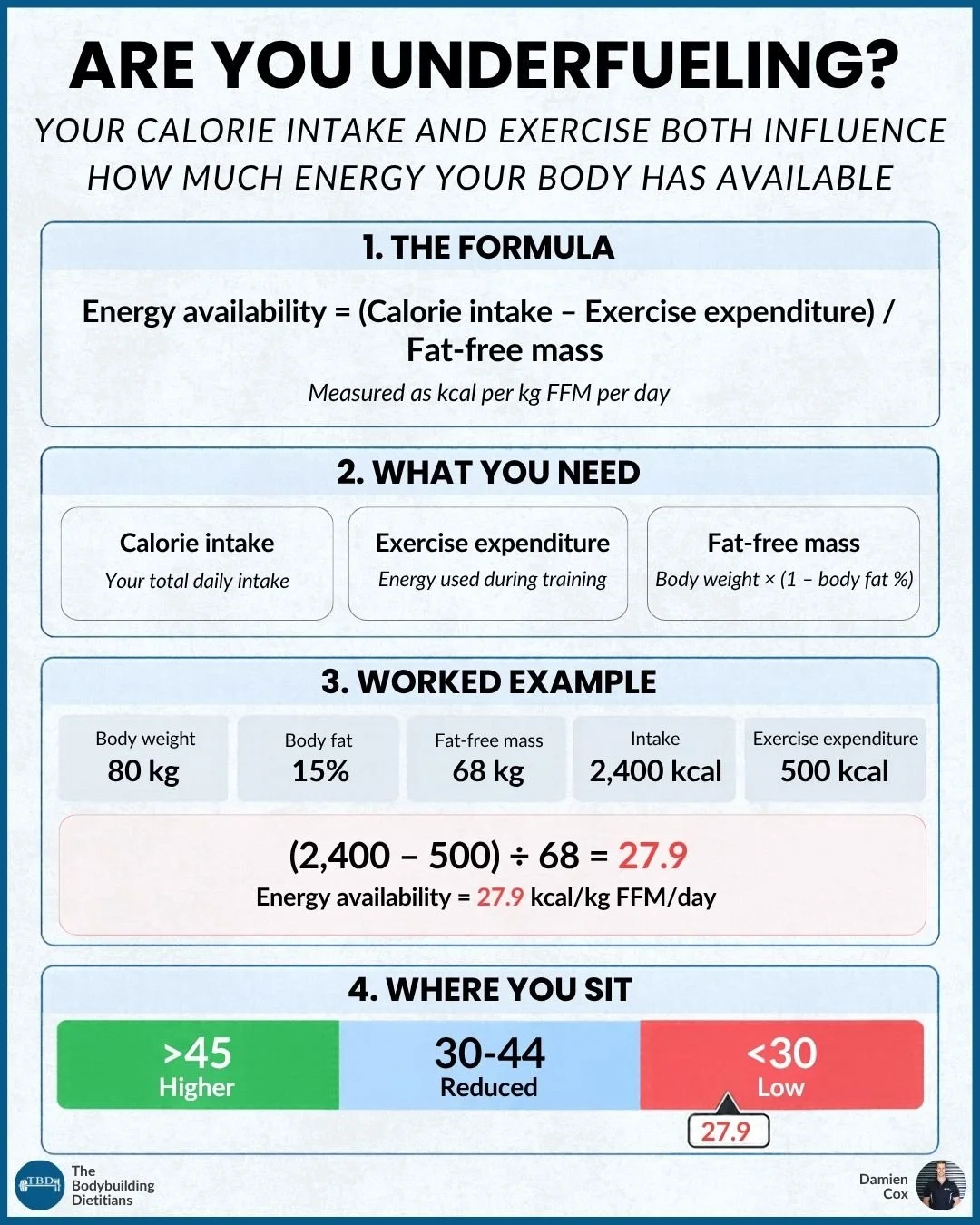
Energy availability is calculated by subtracting exercise energy expenditure from calorie intake, then dividing the result by fat-free mass in kilograms.
Energy availability = (Calorie intake − Exercise expenditure) ÷ Fat-free mass
The result is expressed as kcal/kg FFM/day.
Consider the example in our infographic.
Someone weighs 80 kg, has an estimated body fat percentage of 15% and consumes 2,400 calories per day.
Their estimated fat-free mass is 68 kg.
If their exercise expenditure is approximately 500 calories, their calculated energy availability would be:
(2,400 − 500) ÷ 68 = 27.9 kcal/kg FFM/day
Historically, this result would have fallen below a commonly referenced threshold of 30, potentially raising concerns about low energy availability.
However, we'd be cautious about drawing conclusions from the number alone.
Why Is Energy Availability Difficult to Measure Accurately?
All three components of the calculation can introduce error.
Food tracking may underestimate or overestimate actual intake, while wearable devices and exercise equipment can produce inaccurate estimates of energy expenditure.
For this calculation, exercise expenditure should also reflect the additional energy cost of exercise above resting expenditure, which may differ from the figure displayed on a fitness watch.
Estimating fat-free mass introduces further uncertainty, particularly when body composition measurements are based on less reliable methods.
Ackerman et al. (2023), in Methodology for Studying Relative Energy Deficiency in Sport (REDs): A Narrative Review by a Subgroup of the International Olympic Committee (IOC) Consensus on REDs, highlighted these methodological limitations.
The authors advised against relying on retrospective energy availability calculations to determine REDs risk or establish a diagnosis.
When we review someone's fuelling, an estimated EA value may provide useful context. However, we'd place considerable importance on their symptoms, training history, dietary intake and progress over time.
What Do the 30 and 45 Energy Availability Thresholds Mean?
The commonly referenced values of 30 and 45 kcal/kg FFM/day come largely from controlled research involving women. They provide historical research reference points rather than universal clinical thresholds.
Loucks and Thuma (2003), in Luteinizing Hormone Pulsatility Is Disrupted at a Threshold of Energy Availability in Regularly Menstruating Women, investigated the hormonal responses of 29 young women exposed to different levels of energy availability.
The researchers found that luteinising hormone pulsatility, which contributes to reproductive hormone regulation, was disrupted below approximately 30 kcal/kg FFM/day under the conditions studied.
These findings contributed to the widespread use of 30 as a threshold for low energy availability, with 45 frequently used as a reference for adequate availability.
However, different physiological systems may respond at different levels, and these thresholds cannot be applied consistently across all individuals.
The 2023 International Olympic Committee consensus statement on Relative Energy Deficiency in Sport, led by Mountjoy et al., emphasised that responses to low energy availability exist on a continuum.
There is also less research establishing appropriate thresholds for male athletes.
What Would We Make of an Energy Availability of 27.9?
Consider two hypothetical lifters with the same estimated energy availability of 27.9.
One is maintaining their training performance, recovering well and experiencing no obvious health concerns. The other reports persistent fatigue, declining performance, reduced libido and a history of substantial dietary restriction.
The calculated value is identical, but the second presentation gives us considerably more reason to investigate possible problematic underfuelling.
We'd also recognise that an absence of obvious symptoms doesn't necessarily exclude a problem, particularly if insufficient fuelling has persisted for an extended period.
This is why we'd avoid recommending changes based entirely on whether someone falls above or below a particular number.
What Are the Signs That You Might Be Underfuelling?
Persistent fatigue, declining exercise performance, poor recovery, menstrual irregularities, reduced libido and recurrent illness or injury can be associated with low energy availability.
Some of these changes may initially be subtle.
A lifter might notice that their usual training sessions feel harder, they're struggling to recover between workouts or their general energy has declined despite maintaining a similar routine.
Others may experience changes in reproductive function, recurrent bone stress injuries or more substantial health concerns.
However, these symptoms can also have other explanations.
Persistent fatigue could relate to inadequate sleep, iron deficiency, thyroid dysfunction, excessive training demands or another medical condition.
For this reason, we'd want to understand when the symptoms developed and whether they coincide with changes in dietary intake, training volume, bodyweight or lifestyle.
If someone has experienced declining performance after a substantial increase in exercise, we'd investigate that differently from someone whose symptoms began during an extended period of aggressive dieting.
Both situations deserve attention, although the appropriate recommendations may differ.
Is Low Energy Availability the Same as REDs?
Low energy availability is an underlying cause of Relative Energy Deficiency in Sport (REDs) when exposure becomes sufficiently problematic to impair physiological or psychological functioning.
REDs can affect athletes of different sexes and across multiple sports, including bodybuilding and resistance training.
Potential consequences include changes in reproductive hormones, bone health, metabolism, immune function and exercise performance.
However, experiencing a period of reduced energy availability doesn't automatically mean someone has REDs.
Mountjoy et al. (2023), in the 2023 International Olympic Committee's (IOC) Consensus Statement on Relative Energy Deficiency in Sport (REDs), introduced an updated clinical assessment framework known as the REDs CAT2.
This framework considers multiple health and performance indicators when assessing the likelihood and severity of REDs.
A diagnosis requires an appropriate medical assessment, including consideration of other potential causes of the symptoms.
How Would a Sports Dietitian Assess Possible Underfuelling?
We'd start by reviewing the person's current nutrition, training demands, bodyweight history, symptoms and how these have changed over time.
For someone eating 2,400 calories and training five days per week, we'd first want to understand whether that intake is producing weight maintenance, weight loss or weight gain.
We'd also review their resistance training, cardio, daily movement and recent changes in activity.
From there, we'd look at their meal structure, carbohydrate availability, recovery and whether their current nutrition is practical to maintain.
If the person is losing bodyweight relatively quickly, experiencing persistent hunger and struggling with recovery, there may be a reasonable case for increasing energy intake or adjusting the intended rate of loss.
However, if they're maintaining their bodyweight and experiencing ongoing fatigue, we'd want to investigate other contributing factors before assuming that increasing calories will resolve the issue.
We'd also pay attention to symptoms that may warrant further medical investigation.
Changes in menstrual function, reduced libido, recurrent injuries or persistent unexplained fatigue could justify referral to a GP or sports medicine physician.
Relevant bloodwork may provide useful information, particularly when investigating possible nutritional deficiencies or hormonal concerns. However, normal blood results don't necessarily exclude problematic low energy availability, and no single blood marker can establish REDs.
Espinar et al. (2026), in Rethinking Energy Availability from Conceptual Models to Applied Practice: A Narrative Review, similarly emphasised the value of integrating nutritional, physiological and clinical information rather than relying on a calculated energy availability threshold.
The most appropriate recommendation depends on what the assessment identifies. That might involve changing energy intake, adjusting training expenditure, reviewing carbohydrate availability or pursuing further medical investigation.
Unsure whether you're eating enough to support your training?
If you're experiencing persistent fatigue, poor recovery or changes in performance, understanding whether your nutrition is contributing can be difficult.
Our dietitians can review your intake, training demands, progress and relevant health information to help identify what may need adjusting and whether further investigation is appropriate.
Can You Experience Low Energy Availability While Building Muscle?
Yes. Low energy availability can occur during a muscle-building phase if energy intake isn't sufficient relative to exercise demands.
For example, someone might increase their training volume and daily activity while making only a small increase to their calorie intake.
Even though their goal is muscle gain, the energy available to support physiological functions may be lower than expected.
We'd consider their bodyweight trend, training performance, recovery and nutritional intake before deciding whether additional calories or changes to training are appropriate.
During fat loss, some reduction in energy availability may be expected. The severity and duration of the deficit, along with the individual's response, determine how concerning that becomes.
Energy availability can be a useful part of that assessment, although it provides only one piece of information.
The broader objective is to ensure your nutrition supports the training you're undertaking, the progress you're trying to achieve and your long-term health.
Practical Takeaways
Energy availability considers calorie intake relative to exercise expenditure and fat-free mass. Someone can consume a seemingly reasonable amount of food while still having insufficient energy available for their training demands.
The calculation is an estimate. Food tracking, exercise expenditure and body composition measurements all introduce uncertainty, making calculated values difficult to interpret in isolation.
The traditional thresholds of 30 and 45 kcal/kg FFM/day aren't universal diagnostic cut-offs. They come largely from research in women and shouldn't be directly applied to every athlete.
Persistent symptoms deserve attention. Fatigue, declining performance, menstrual changes, reduced libido and recurrent illness or injury may warrant further investigation, particularly alongside dietary restriction or increased exercise.
Fuelling decisions should reflect the individual. Dietary intake, bodyweight trends, training demands, recovery and relevant medical findings help determine whether changes to nutrition or exercise are appropriate.
Frequently Asked Questions
How do you calculate energy availability?
Subtract your daily exercise energy expenditure from your calorie intake, then divide the result by your fat-free mass in kilograms. The calculation produces a value in kcal/kg FFM/day. Because each input is subject to measurement error, the result should be interpreted as an estimate rather than a definitive measure of fuelling adequacy.
What is considered low energy availability?
Values below approximately 30 kcal/kg FFM/day have historically been associated with low energy availability in research involving women. However, more recent consensus guidance recognises substantial individual variation, and there is no universally applicable diagnostic threshold. Symptoms, training demands and clinical information are important when assessing possible underfuelling.
Can you have low energy availability without losing weight?
Yes. Someone can experience insufficient energy availability while maintaining a relatively stable bodyweight. Changes in energy expenditure and other physiological adaptations can influence weight trends, so stable bodyweight doesn't necessarily establish that fuelling is adequate. Health, recovery and performance indicators also deserve consideration.
What are the symptoms of underfuelling in athletes?
Potential symptoms include persistent fatigue, poor recovery, declining exercise performance, menstrual irregularities, reduced libido and recurrent illness or injury. These changes can have several possible causes, so identifying when they developed and how they relate to nutrition and training is important. Persistent or concerning symptoms warrant professional assessment.
Is low energy availability the same as REDs?
Low energy availability describes insufficient energy remaining after exercise relative to the body's requirements. REDs is a broader syndrome involving impaired physiological or psychological functioning associated with problematic low energy availability. A diagnosis requires a medical assessment that considers multiple indicators and excludes other possible causes.
How do you improve low energy availability?
Management may involve increasing energy intake, reducing exercise expenditure or adjusting both, depending on the individual's circumstances. Carbohydrate availability, training demands and the duration of dietary restriction may also warrant attention. Where REDs is suspected, management should involve appropriately qualified healthcare professionals.
Would you like help reviewing your fuelling?
If you're concerned that your nutrition may be affecting your training, recovery or health, our coaching provides an opportunity to review your current approach and identify appropriate next steps.