How to set realistic expectations for fat loss and muscle growth, assess your progress and recognise when a change is worthwhile.
A training or nutrition plan needs enough time to produce measurable progress, but the appropriate timeframe depends on the goal and the individual. Fat-loss trends may become apparent over several weeks, while meaningful changes in muscularity usually require months of progressive training. Reviewing adherence, recovery and objective progress helps determine whether to continue the current approach or make an adjustment.
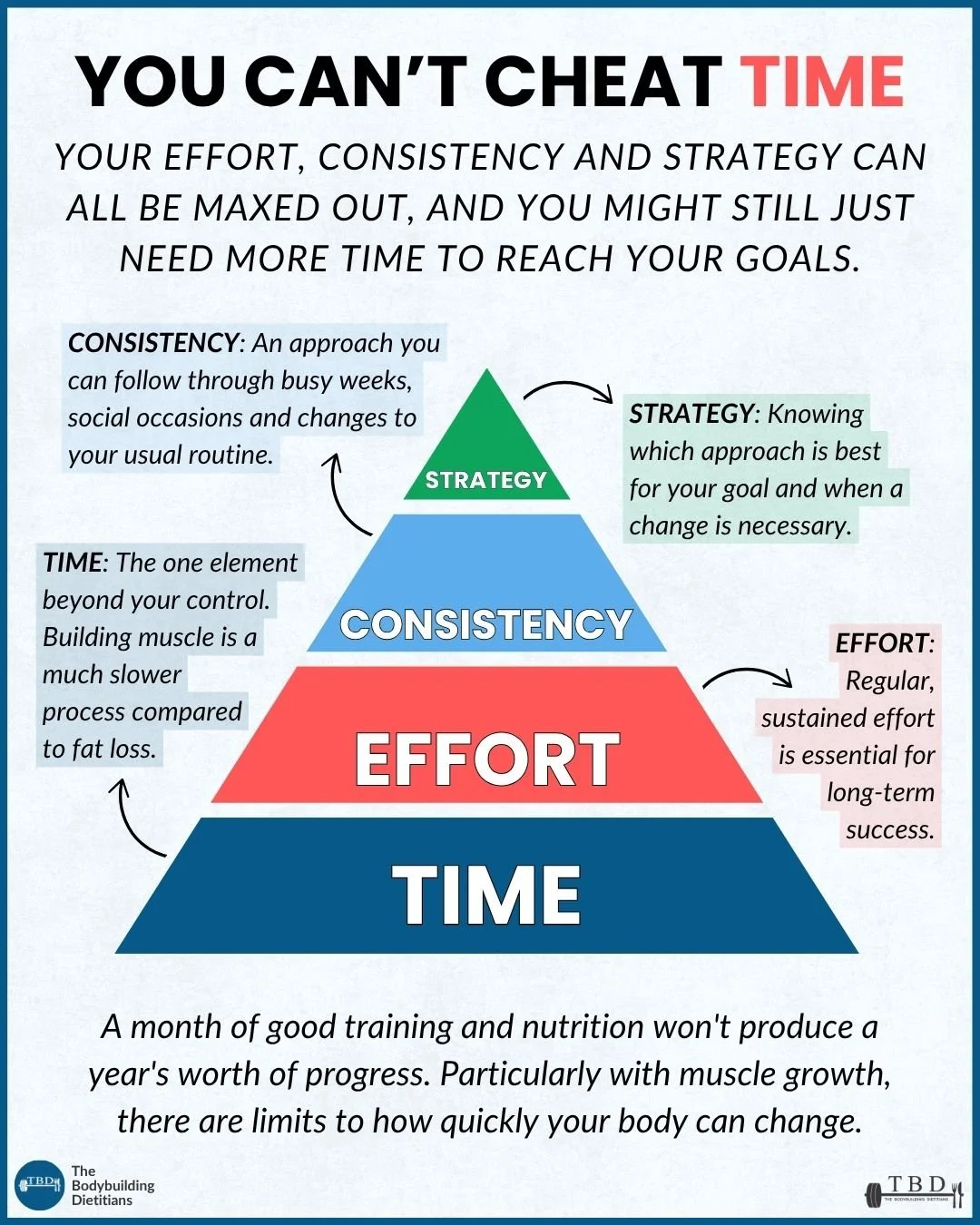
You've been training consistently, meeting your nutrition targets and doing most of the things you set out to do. A few weeks have passed, but you're starting to wonder whether you've made enough progress.
Maybe your physique hasn't changed as much as you'd hoped, or your bodyweight is moving more slowly than expected. You start considering whether you need fewer calories, more training volume or a completely different approach.
We regularly work with people who've tried several strategies, often making changes whenever results feel slower than anticipated. Sometimes those changes are appropriate. In other situations, the original approach simply hasn't been followed long enough to establish what it's capable of achieving.
One of the more valuable parts of coaching is helping someone understand which situation they're in.
Why Does Muscle Growth Take Longer Than Fat Loss?
Building muscle is generally a slower process than losing body fat because new muscle tissue accumulates gradually in response to repeated training and adequate recovery.
Resistance training creates the stimulus for muscle growth, while nutrition helps provide the energy and amino acids needed to support adaptation.
Currier et al. (2026), in American College of Sports Medicine Position Stand: Resistance Training Prescription for Muscle Function, Hypertrophy, and Physical Performance in Healthy Adults, reviewed evidence from 137 systematic reviews. They confirmed that progressive resistance training improves strength and muscle size, although the magnitude of adaptation varies with the training performed.
We also need to distinguish between improvements in strength and measurable increases in muscle size.
Someone beginning resistance training may improve their lifts relatively quickly as their technique, coordination and familiarity with the exercises develop. Those changes can occur before substantial muscle growth becomes apparent.
Damas et al. (2016), in Early Resistance Training-Induced Increases in Muscle Cross-Sectional Area Are Concomitant With Edema-Induced Muscle Swelling, also demonstrated that early increases in measured muscle size can partly reflect exercise-induced swelling.
For experienced lifters, changes may be slower again. Someone who has trained productively for eight years should generally expect a different rate of muscle gain from someone who has only recently started.
This is why we'd be cautious about judging the success of a muscle-building phase based on a few weeks of progress photos or bodyweight measurements.
How Long Should You Follow Your Plan Before Changing It?
For many people, two to four weeks of consistent nutrition data can help establish whether bodyweight is moving in the intended direction. Assessing muscle-building progress generally requires a longer timeframe.
These are practical review windows rather than fixed biological deadlines.
For someone dieting, we'd usually look at their average bodyweight across multiple weeks, alongside adherence, activity, hunger and training performance.
A single week with no change on the scale may reflect fluctuations in fluid balance, gastrointestinal contents or other factors. A more consistent pattern across several weeks provides a stronger basis for deciding whether calorie intake needs adjusting.
Muscle gain is different.
We might review training performance every week and evaluate the quality of an exercise programme over a training block, but changes in muscularity are generally better assessed across months.
Iraki et al. (2019), in Nutrition Recommendations for Bodybuilders in the Off-Season: A Narrative Review, recommended adjusting energy intake according to training experience, rate of weight gain and changes in body composition. The authors also highlighted the importance of a more conservative gaining approach for advanced bodybuilders.
The practical implication is that we need different expectations and review periods for different outcomes.
A plan can be producing useful progress before there is a dramatic visual change.
How Do You Know Whether Your Plan Is Working?
We look for evidence that the intended outcome is developing, while also considering how manageable the process has been.
If someone is trying to lose fat, we'd examine their bodyweight trend, relevant measurements and how consistently they've maintained their intended intake.
For someone trying to build muscle, we'd be interested in training progression, bodyweight changes, recovery and periodic assessments of body composition.
Consider someone four weeks into a fat-loss phase.
Their average bodyweight is decreasing gradually, they're training consistently and their hunger is manageable. Even if they expected faster visual changes, there may be very little reason to adjust their calories.
Now consider someone completing a muscle-building phase.
Their bodyweight has increased modestly over six weeks, their training is progressing and they're recovering well. They might not look noticeably more muscular yet, but we'd generally be encouraged by those indicators.
In both situations, we'd want to continue monitoring progress rather than assuming the absence of dramatic changes means the plan isn't working.
This is also why we encourage people to look at their goals across different timeframes.
Improving meal consistency, adjusting sleep habits or managing digestion may provide useful feedback relatively quickly. Changes in body composition can require considerably more time, particularly for experienced lifters.
When Is Consistency More Important Than Making Changes?
Consistency becomes especially valuable when someone is following an appropriate plan but hasn't accumulated enough reliable information to assess its effectiveness.
An approach needs to work through busy weeks, social occasions, work commitments and changes in routine.
If someone repeatedly switches their diet or training whenever circumstances become inconvenient, they may never establish whether a particular approach was suitable.
For example, someone might change their training programme every four weeks because they feel they're progressing slowly. Each change introduces new exercises, movements and progression expectations, making comparisons more difficult.
We'd first want to understand how consistently they've followed their programme, whether their training performance is improving and whether they're recovering adequately.
The same principle applies to nutrition.
If someone's calorie intake varies considerably from what they've planned, we'd want to address that before assuming their calculated energy requirements are incorrect.
Consistency gives us better information about what is working and what needs adjusting. That doesn't require perfect adherence, but we do need a reasonably clear picture of what's happening.
When Should You Adjust Your Training or Nutrition?
Adjustments are worthwhile when the available information suggests the current approach is no longer producing the intended response, or when its demands have become unnecessarily difficult to manage.
Consider someone whose bodyweight has remained relatively stable for several weeks during a fat-loss phase.
We'd first review their actual intake, daily activity, recent weight fluctuations and how long the apparent plateau has persisted.
If adherence is consistent and the evidence suggests their energy deficit has become too small, a modest change to calorie intake or activity may be appropriate.
For someone whose training performance has stalled, we'd look at their training volume, exercise execution, recovery and nutritional intake before recommending a new programme.
There are also circumstances where we'd make changes despite measurable progress.
Someone might be losing fat at the intended rate but experiencing persistent fatigue, declining performance and difficulty managing hunger. We'd want to consider whether the rate of loss or current demands are appropriate.
In these situations, giving the plan more time may mean continuing an approach that's becoming counterproductive.
Our framework for identifying training and nutrition plateaus explains how we distinguish between different reasons progress may slow.
Making progress but unsure whether you should change anything?
It can be difficult to know whether you're progressing at an appropriate rate, particularly when you're already putting considerable effort into your nutrition and training.
Your dietitian will review your goals, adherence, progress and recovery to help determine which adjustments are worthwhile and when your current approach deserves more time.
How Can You Set More Realistic Body Composition Goals?
We encourage people to set goals across different timeframes, so progress can be assessed without relying entirely on changes in their physique.
Shorter-term goals might include improving meal consistency, meeting nutritional requirements, developing better sleep habits or establishing a training routine.
Over several weeks, we'd look for evidence that those behaviours are supporting the intended outcome.
Longer-term goals could involve achieving a particular level of body fat, completing a productive muscle-building phase or making substantial changes to muscularity.
Someone relatively new to resistance training might achieve noticeable changes within their first few months. An experienced bodybuilder may need an entire improvement season to develop the muscle needed to meaningfully change their physique.
These differences should influence the timeline we establish before beginning.
We'd also consider how much flexibility someone needs in their approach and whether the intended goal can be pursued alongside their broader responsibilities.
A realistic plan gives someone enough time to achieve their goal while allowing us to review and refine the process along the way.
What Happens When Time Is the Main Limiting Factor?
When someone's training, nutrition and recovery are well managed, additional time may be the main requirement for further progress.
That's often a good position to be in.
It means we can continue monitoring their response, maintain productive habits and make changes when the evidence supports them.
Of course, even a well-designed approach benefits from periodic review. Training demands, nutritional requirements and personal circumstances can change.
As coaches, part of our role is identifying when those changes warrant an adjustment and when someone can feel confident continuing what they're already doing.
There will always be limits to how quickly the body can change. Understanding those limits helps us develop realistic expectations and avoid making the process more demanding than it needs to be.
Practical Takeaways
Set realistic timeframes for your body composition goals. Fat-loss trends may become apparent within several weeks, while meaningful muscle growth generally requires months of progressive training. Your experience, starting point and intended outcome influence the timeline.
Assess progress using multiple measures. Bodyweight averages, training performance, measurements, progress photos and recovery can help establish whether a training or nutrition plan is working.
Allow enough consistency to evaluate your approach. Frequent changes to calories or training make it harder to identify which variables are influencing your results. Review whether your plan has been followed consistently before adjusting it.
Make changes when the evidence supports them. Persistent plateaus, inadequate recovery or an unsustainable level of dietary restriction may warrant adjustments, even if the original plan was appropriate.
Use goals across different timeframes. Daily nutrition and training behaviours provide opportunities for progress while longer-term changes in body composition develop.
Frequently Asked Questions
How long should you follow a training plan before changing it?
A well-structured resistance-training programme should generally be followed long enough to assess progression across multiple sessions and weeks. A training block of approximately four to eight weeks can provide useful information about performance and recovery, although it may take considerably longer to assess changes in muscle size. Adjustments may be needed earlier when training is inappropriate, recovery is inadequate or symptoms suggest a problem.
How long does it take to see results from muscle building?
Strength improvements can become apparent within the first few weeks of resistance training, particularly among beginners. Measurable muscle growth develops over weeks and months, with the rate generally slowing as training experience increases. Visible changes also depend on starting body composition, the muscle groups involved and how progress is assessed.
How long should you wait before adjusting calories for fat loss?
Two to four weeks of reasonably consistent intake and bodyweight data often provide a useful starting point for assessing a calorie deficit. The appropriate review period depends on the intended rate of loss, fluctuations in bodyweight and dietary adherence. If progress is occurring at an appropriate rate, maintaining the current intake may be more useful than reducing calories further.
How do you know if you need patience or a different plan?
Start by assessing whether you've followed the plan consistently and whether objective indicators are moving towards your goal. Improving training performance, appropriate bodyweight trends and manageable recovery may support continuing your current approach. Persistent lack of progress, poor recovery or an approach that is difficult to sustain warrants a more detailed review.
Can you make progress without seeing changes in the mirror?
Yes. Improvements in strength, exercise technique, training capacity and nutrition consistency can occur before visible physique changes become apparent. Progress photos, body measurements and performance records can provide additional information. The importance of each measure depends on whether your goal is muscle gain, fat loss, maintenance or body recomposition.
Would you like help reviewing your progress?
If you're uncertain whether your training and nutrition are producing the results you should expect, our coaching provides an opportunity to review your current approach and identify appropriate next steps.