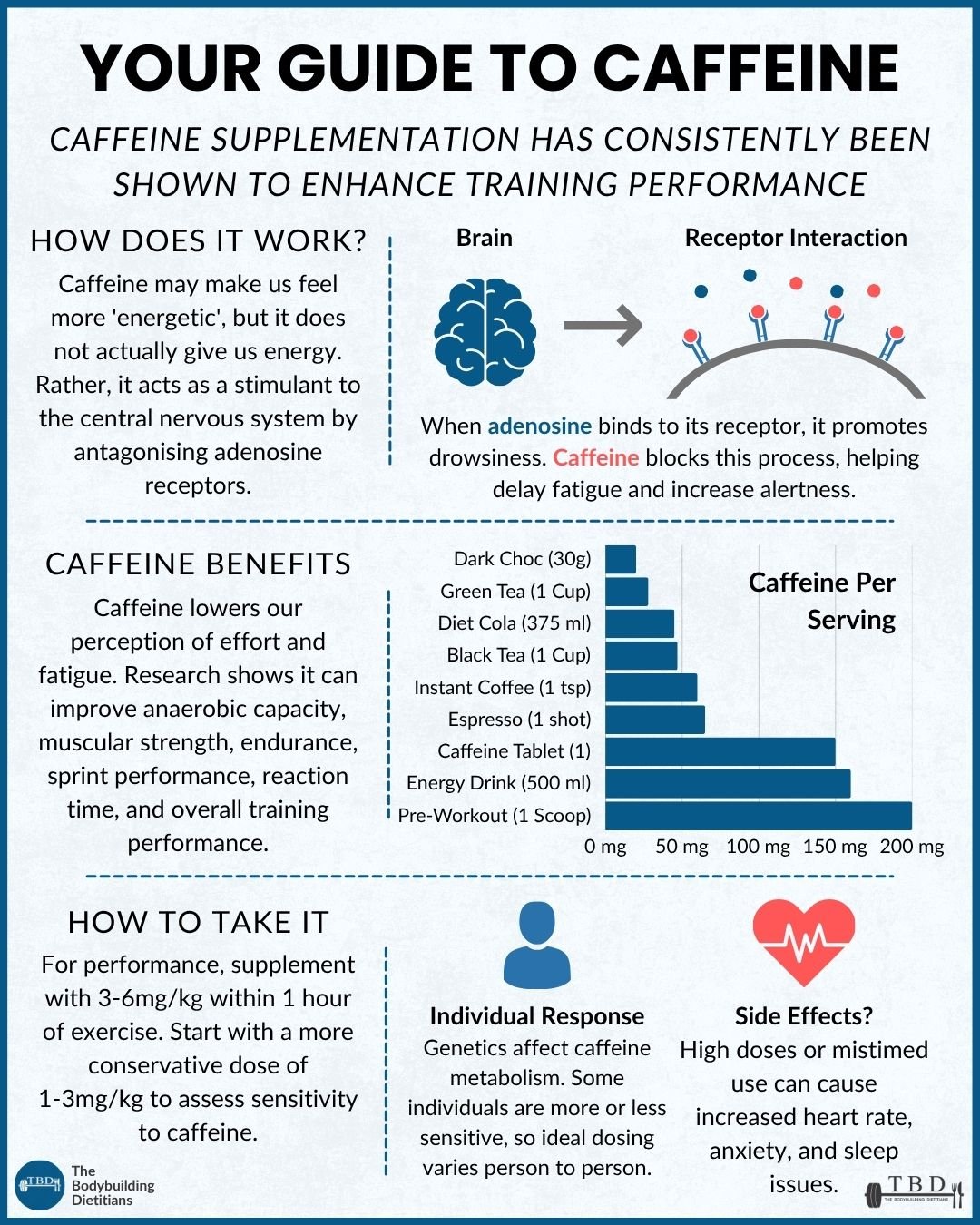
Caffeine at a glance: the adenosine antagonism mechanism, the training performance benefits from reduced perceived effort, standard dosing at 3 to 6 milligrams per kilogram of bodyweight, and the individual response and side effect variables that shape ideal use.
Caffeine has one of the strongest evidence bases of any performance supplement, with consistent effects on training performance, muscular endurance, sprint performance, and cognitive function. This guide covers what caffeine actually does, how to dose it correctly for performance, how to time it around training and sleep, the individual response variables that shape ideal use, and the coaching-level distinction between using caffeine to enhance well-supported training versus relying on it to make an under-recovered athlete feel ready to train.
Caffeine is one of the most researched performance supplements available and produces consistent effects on training performance through central nervous system stimulation rather than by providing energy directly. It works by antagonising adenosine receptors in the brain, which reduces perceived effort and fatigue and improves alertness, allowing higher-quality training in a given session. The dose most consistently supported for performance benefits is 3 to 6 milligrams per kilogram of bodyweight, taken approximately 30 to 60 minutes before training. Lower doses (1 to 3 mg/kg) can still be effective and are a sensible starting point for lifters assessing individual sensitivity. The primary practical consideration for consistent caffeine use is sleep, because caffeine has a half-life of approximately five hours in most adults and even mid-afternoon doses can meaningfully disrupt sleep quality. Individual response varies substantially due to genetic differences in caffeine metabolism (specifically variations in the CYP1A2 enzyme), which means some lifters tolerate high doses well while others experience jitters and impaired performance at effective performance doses. The most important coaching distinction is between using caffeine to enhance an already well-supported training session and relying on it to repeatedly make an under-recovered athlete feel ready to train, because improved output in a session does not necessarily mean the underlying recovery variables are actually in a good position.
Caffeine has one of the deepest evidence bases of any supplement in sports nutrition. The International Society of Sports Nutrition position stand describes it as an ergogenic aid with consistent, meaningful effects on training performance across a broad range of athletes and training modalities. What has changed over the past decade is not the strength of the evidence but the depth of understanding around individual response, sleep interaction, and the specific contexts where caffeine adds meaningful value versus the contexts where it masks underlying problems.
This article walks through what caffeine actually does at the physiological level, the specific performance benefits documented in the literature, how to dose and time it for training, how to manage the sleep and tolerance considerations that shape sustainable use, and the coaching-level distinction between caffeine as a genuine performance enhancement and caffeine as a substitute for adequate recovery. The intent is to provide the depth that shorter caffeine content typically glosses over, particularly around the variables that determine whether long-term caffeine use is supporting progress or gradually compromising it.
What Is Caffeine and How Does It Work?
Caffeine is a naturally occurring stimulant that acts on the central nervous system, primarily through antagonism of adenosine receptors in the brain. Understanding this mechanism matters because it clarifies what caffeine actually does, which is meaningfully different from the common perception that it "gives you energy."
Adenosine is a neuromodulator that gradually accumulates in the brain across the waking day, binding to specific adenosine receptors and producing the perception of fatigue, drowsiness, and reduced alertness. This accumulation is one of the primary drivers of the sleep pressure that builds across the day and eventually produces the desire for sleep at night.
Caffeine's molecular structure is similar enough to adenosine that it can bind to the same receptors without activating them. This produces two related effects. It blocks the adenosine currently in circulation from binding to its receptors, which reduces the perception of fatigue and increases alertness. And it delays the accumulation of adenosine-driven fatigue signals as the day progresses, which extends the period of high alertness beyond what would occur without caffeine.
The practical implication is that caffeine does not provide additional energy or fuel for the body. It changes how existing energy and fatigue signals are perceived and processed by the central nervous system. A lifter on caffeine feels less fatigued during a training session, perceives effort as lower, and can sustain training quality longer than they could without caffeine. But the underlying energy stores, recovery status, and physical capacity of the body are not directly enhanced by the caffeine itself.
This distinction matters because it clarifies both what caffeine can and cannot do. Caffeine can meaningfully improve training output when the underlying capacity to train is already there but perceived effort is limiting execution. Caffeine cannot compensate for genuinely inadequate energy availability, sleep deficiency, or recovery gaps. It can make an under-recovered athlete feel ready to train, but the training that follows still produces the fatigue and adaptation consequences of training from an under-recovered state.
Caffeine is a stimulant that antagonises adenosine receptors in the brain, reducing perceived fatigue and increasing alertness without providing additional energy directly.
What Are the Performance and Cognitive Benefits?
The physical performance benefits of caffeine are the most established application, with consistent effects documented across a broad range of training modalities and athlete populations.
Muscular endurance and repeated efforts show the strongest and most consistent benefits from caffeine supplementation. Time-to-exhaustion during resistance training, ability to sustain rep quality across working sets, and performance in repeated sprint or interval work all improve meaningfully with caffeine intake in the 3 to 6 milligrams per kilogram range.
Strength and power output show smaller but real improvements. Maximum strength benefits from caffeine are typically in the 3 to 8 percent range compared to placebo, which is meaningful for competitive athletes and worth noting for physique-focused lifters even though it's smaller than the endurance effects.
Sprint and jump performance show consistent improvements, with typical effect sizes ranging from 2 to 4 percent improvement in peak power output and sprint times.
Cognitive performance metrics including reaction time, attention, working memory, and vigilance all show improvements with caffeine supplementation. For lifters training after a full workday or in a fatigued state, this cognitive component can be as valuable as the direct physical performance effects. The subjective experience of feeling more alert and focused before training is a real physiological effect, and it contributes to the willingness to push through harder sets that ultimately drives training adaptation.
The International Society of Sports Nutrition position stand on caffeine consolidates decades of research into practical recommendations. Caffeine supplementation was found to acutely enhance various aspects of exercise performance, with small to moderate benefits for muscular endurance, movement velocity, muscular strength, sprinting, jumping, and throwing performance, and moderate to large benefits for aerobic endurance. Dosing between 3 and 6 milligrams per kilogram of bodyweight consumed approximately 60 minutes pre-exercise was identified as the most consistently effective range. Source: Guest et al., 2021, Journal of the International Society of Sports Nutrition, 18(1):1.
The effects diminish with habitual high intake as tolerance develops. Lifters consuming large amounts of caffeine throughout the day tend to derive less acute benefit from a pre-training dose than lifters using caffeine more strategically, which is one of the reasons the ISSN position stand recommends starting from the lowest effective dose and adjusting based on individual response rather than defaulting to the highest tolerated dose.
How Should You Dose Caffeine?
The practical dosing framework for caffeine is well-supported by the research, with modest room for individual adjustment.
Standard performance dose: 3 to 6 milligrams per kilogram of bodyweight, taken 30 to 60 minutes before training. For an 80 kilogram lifter, this translates to 240 to 480 milligrams of caffeine per training session. This is the range where the ergogenic effects are most consistently observed across the research literature.
Starting dose for caffeine-naive lifters or those assessing sensitivity: 1 to 3 milligrams per kilogram. Beginning at the lower end of the range and adjusting upward based on individual response is a sensible protocol, particularly for lifters with limited caffeine exposure or those who have experienced jitters or elevated heart rate at higher doses.
Upper practical limit: approximately 6 milligrams per kilogram in a single dose. Doses above 9 milligrams per kilogram have not been shown to produce additional performance benefits and increase the likelihood of side effects including anxiety, elevated heart rate, gastrointestinal discomfort, and sleep disruption.
Starting with the lowest effective dose is worthwhile for two reasons. First, individual sensitivity to caffeine varies substantially due to genetic differences in caffeine metabolism. Second, lower doses preserve responsiveness by limiting tolerance development, which extends the useful lifespan of caffeine as a performance tool.
Some lifters experience jitters or elevated heart rate at doses that produce meaningful performance benefits. Combining caffeine with L-theanine at a 1:2 caffeine-to-theanine ratio can smooth the response while preserving the performance benefits. L-theanine is an amino acid found in tea that produces a mild calming effect and has been shown to attenuate some of the acute cardiovascular and anxiety effects of caffeine without reducing the ergogenic properties.
How Should You Time Caffeine Around Training?
Timing depends primarily on the source of caffeine, because different delivery formats have meaningfully different absorption profiles.
Coffee and pre-workout powders are absorbed relatively quickly, with peak plasma caffeine concentrations reached approximately 30 to 60 minutes after consumption. For a lifter consuming coffee or pre-workout, dosing 45 to 60 minutes before the working sets of training aligns peak concentrations with the moment they matter most.
Caffeine tablets and capsules are absorbed more slowly, with peaks closer to 60 to 90 minutes post-consumption. Lifters using capsules should dose earlier than coffee users to align peak concentrations with training.
Caffeine chewing gum and buccal formulations are absorbed particularly quickly, with peaks within 10 to 15 minutes. This is useful for lifters who need to time caffeine intake precisely (immediately pre-training rather than an hour before) or who forgot to dose earlier.
Energy drinks and diet colas typically peak at 30 to 45 minutes, similar to coffee but slightly slower due to the carbonation and other ingredients affecting absorption.
The specific caffeine content of common sources varies widely, and the source infographic provides useful approximate values. Dark chocolate (30 grams) delivers approximately 20 milligrams. A cup of green tea provides approximately 30 milligrams. A 375 millilitre diet cola provides approximately 50 milligrams. A cup of black tea provides approximately 55 milligrams. A teaspoon of instant coffee provides approximately 70 milligrams. A single espresso shot provides approximately 75 milligrams. A caffeine tablet typically provides 100 to 200 milligrams depending on the product. A 500 millilitre energy drink provides approximately 160 milligrams. A single scoop of pre-workout typically provides 150 to 300 milligrams depending on the specific product.
For lifters weighing more than about 80 kilograms who need 240 to 480 milligrams of caffeine for the standard 3 to 6 mg/kg dose, this typically means three to five espresso shots, two to three cups of drip coffee, or one to two servings of most pre-workout products. The specific combination depends on preference, timing considerations, and other ingredients in the source.
How Does Caffeine Interact With Sleep?
The most important practical consideration for consistent caffeine use is the interaction between caffeine intake and sleep quality. Training performance gains from caffeine do not survive chronic sleep disruption, and habitual high caffeine intake is one of the more common contributors to fragmented sleep in the physique-focused population.
Caffeine has a half-life of approximately five hours in most adults, meaning a dose consumed at midday still has half of its caffeine present in circulation by early evening. A 300 milligram dose at 1 pm leaves approximately 150 milligrams still in the system at 6 pm and roughly 75 milligrams at 11 pm. This residual caffeine is enough to increase sleep onset latency, reduce deep sleep, and reduce overall sleep quality even in habitual users who report subjectively feeling like caffeine "does not affect their sleep."
The half-life varies substantially between individuals due to genetic differences in the CYP1A2 enzyme responsible for caffeine metabolism. Fast metabolisers can clear caffeine in as little as 2 to 3 hours, while slow metabolisers may take 8 to 10 hours to clear the same dose. This means the practical impact of late-day caffeine varies enormously between individuals, and lifters who are slow metabolisers pay a substantially larger sleep cost for the same caffeine intake than fast metabolisers.
Practical strategies for balancing caffeine and sleep include stopping caffeine intake by early afternoon (approximately 8 hours before intended sleep time), keeping the pre-training dose as the primary daily source rather than adding caffeine across the rest of the day, and periodically reducing caffeine intake for 1 to 2 weeks to reset tolerance and restore sleep quality. For lifters whose sleep is meaningfully disrupted, reducing total daily caffeine to a single pre-training dose (or eliminating caffeine on non-training days) often produces improvements in sleep within 1 to 2 weeks.
The most common pattern in coaching that combines caffeine with progressive sleep degradation involves a lifter who has gradually escalated their daily caffeine intake to sustain training intensity across increasingly demanding training weeks or a fat loss phase, while their sleep quality has progressively declined. The two are not independent: the deteriorating sleep is being partly driven by the escalating caffeine, and the escalating caffeine is being partly driven by the deteriorating sleep. This loop can persist for months or years before it becomes obvious, and it is one of the more subtle ways that caffeine can shift from a performance tool to a factor limiting long-term progress.
For a more detailed look at how sleep specifically affects body composition and training outcomes, our article on sleep and body composition covers the mechanisms and practical strategies.
How Does Individual Response to Caffeine Vary?
Individual response to caffeine varies substantially, and understanding your own response is one of the more useful refinements available in caffeine use.
Genetic variation in CYP1A2 metabolism is the primary driver of individual differences. Fast metabolisers (approximately 40 to 45 percent of the population) clear caffeine more quickly, which means the acute effects are shorter-lasting but they can typically tolerate late-day doses without meaningful sleep disruption. Slow metabolisers (approximately 55 to 60 percent of the population) clear caffeine more slowly, which extends both the acute effects and the sleep-disruption window. Testing companies can identify CYP1A2 variants, but observational assessment (noting how late in the day you can consume caffeine without sleep impact, and how strongly you feel a specific dose) usually provides enough practical information without formal testing.
Adenosine receptor sensitivity also varies genetically. Some individuals experience strong subjective effects from small caffeine doses, while others require larger doses to feel meaningful effects. This variation is independent of metabolic speed and can produce combinations like a slow metaboliser with low receptor sensitivity (who tolerates high doses well but experiences long sleep-disruption windows) or a fast metaboliser with high receptor sensitivity (who feels strong effects but clears caffeine before sleep is affected).
Habituation and tolerance develop with sustained daily use. Lifters who consume 300 to 500 milligrams daily for weeks develop tolerance that reduces the acute performance benefit of any specific pre-training dose. Periodic tolerance breaks (1 to 2 weeks of substantially reduced or eliminated caffeine intake) can restore responsiveness, though at the cost of the daily alertness benefits during the break period.
Anxiety response varies substantially and is worth attending to. Lifters with anxiety-prone tendencies often experience amplified anxiety, elevated heart rate, and reduced training focus at doses that other lifters tolerate well. For these lifters, the ceiling on useful caffeine dosing is often lower than the standard 6 mg/kg upper limit, and the L-theanine combination discussed earlier can be particularly useful.
Age and sex produce smaller effects than the genetic variables above, but women may experience slightly different responses across menstrual cycle phases due to hormonal effects on caffeine metabolism, and older adults may be more sensitive to sleep-disruption effects due to changes in sleep architecture with age.
The practical implication is that ideal caffeine dosing is genuinely individual rather than being a fixed formula applied to bodyweight. Starting at the lower end of the recommended range, observing subjective response and sleep effects across weeks of use, and adjusting based on the observed pattern tends to produce a more useful long-term protocol than immediately dosing at the theoretical performance-optimal level.
Is Your Caffeine Use Actually Supporting Your Training?
If you have been steadily increasing caffeine intake to sustain training intensity while noticing that your sleep quality, mood, or recovery has been drifting in the wrong direction, the two are almost certainly connected. This is one of the more common patterns we see with lifters coming to us for structured guidance, particularly during demanding training blocks or fat loss phases where the temptation to lean harder on caffeine is highest. Our team helps lifters structure supplement timing, training load, and recovery in a way that fits their individual physiology and life demands, rather than working from a generic protocol that assumes universal caffeine tolerance.
What Are the Common Side Effects and Concerns?
Several concerns and side effects associated with caffeine use warrant explicit discussion.
Anxiety and jitters. The most common acute side effect is anxiety, particularly at higher doses or in caffeine-sensitive individuals. This typically manifests as elevated heart rate, feelings of restlessness, and reduced training focus rather than the alertness the dose was intended to produce. The response is often dose-dependent and reduces at lower doses or with L-theanine combination.
Elevated heart rate and blood pressure. Caffeine acutely elevates heart rate and blood pressure through central nervous system stimulation. The effects are typically small at standard doses in healthy individuals but can be more pronounced in caffeine-sensitive individuals or at higher doses. For lifters with existing cardiovascular concerns, discussing caffeine use with a healthcare provider is worthwhile.
Gastrointestinal effects. Caffeine can produce gastrointestinal discomfort in some individuals, including nausea at high doses and increased bowel motility that can be problematic during training. Coffee specifically can be worse than isolated caffeine due to additional compounds in the beverage that affect gastric acid production and bowel motility.
Sleep disruption. As discussed above, this is the most consequential long-term concern with sustained caffeine use. Most lifters underestimate how meaningfully afternoon caffeine affects sleep quality.
Tolerance development. Not strictly a side effect but a real limitation on sustained high-dose use. Tolerance reduces the acute benefit of any specific dose and can produce a dependency cycle where escalating doses are required to achieve the initial effect.
Withdrawal. Caffeine users who abruptly stop can experience withdrawal symptoms including headaches, fatigue, mood decline, and difficulty concentrating for several days. This is not a serious health concern but is worth noting for lifters planning tolerance breaks. Tapering caffeine intake over several days rather than stopping abruptly minimises withdrawal effects.
Interactions with medications. Caffeine can interact with several medications including some antibiotics, birth control (which slows caffeine metabolism), and certain heart medications. Lifters on any regular medication should confirm the interaction profile with a pharmacist.
For serious dose considerations, doses above approximately 400 milligrams per day are the threshold that most safety guidelines cite as the upper limit of daily caffeine intake in healthy adults. Doses above 1,000 milligrams in a single day can produce meaningful acute cardiovascular symptoms in some individuals, and doses in the multi-gram range can be fatal.
Are You Using Caffeine to Enhance Training or Compensate for Under-Recovery?
The most important coaching-level distinction in caffeine use is between using it to enhance an already well-supported training session and relying on it to repeatedly make an under-recovered athlete feel ready to train. Both feel similar in the moment, but they produce very different long-term outcomes.
Enhancement use occurs when a lifter is genuinely well-recovered (adequate sleep, appropriate energy intake, reasonable stress levels) and caffeine is added to a session where the physical capacity to train hard already exists. The caffeine reduces perceived effort and improves execution, producing training that is meaningfully more productive than the same session without caffeine. This is the ideal use case and the one that produces the strongest long-term performance benefits.
Compensation use occurs when a lifter is genuinely under-recovered (short sleep, inadequate calories, elevated stress, accumulated training fatigue) and caffeine is used to override the fatigue signals that would otherwise indicate the need for reduced training or additional recovery. The caffeine makes the athlete feel ready to train, and the training that follows can look similar to normal training. But the training is being performed from a compromised recovery state, and the adaptation response is meaningfully worse than the same training performed from a well-recovered state.
Over months and years, sustained compensation use produces several problems. Training progress stalls or reverses because the sessions aren't producing the adaptation the volume and intensity would suggest. Injury risk increases as fatigued neuromuscular systems execute movements that require intact motor control. Sleep quality progressively degrades as caffeine intake escalates to override worsening recovery. And the psychological experience of training shifts from a source of energy to a source of accumulating debt.
The specific signs that caffeine use has drifted toward compensation include: needing progressively larger doses to feel meaningful effects, using caffeine on days when training doesn't happen just to feel functional, experiencing meaningful mood decline on the occasional day without caffeine, and finding that sleep quality has progressively worsened over months while caffeine intake has climbed.
The correction depends on which of the underlying recovery variables is compromised. Chronic sleep restriction requires extending sleep before reducing caffeine can produce results. Chronic under-eating requires increasing calorie intake. Chronic accumulated training fatigue requires a deload week or reduced training volume for several weeks. Reducing caffeine intake before addressing the underlying variable typically produces withdrawal symptoms and the return of the fatigue that the caffeine was masking, which can lead to reverting to the original caffeine intake without addressing the root cause.
Where Does Caffeine Sit Within a Broader Supplement Approach?
Caffeine is one of two supplements (alongside creatine) with the strongest evidence base for improving training performance, and it earns its place as a foundational inclusion in a supplement stack for most lifters interested in training performance.
The complementary role of caffeine and creatine is worth noting. Creatine works through phosphocreatine saturation across weeks of consistent daily use and supports the physical capacity for repeated high-intensity efforts. Caffeine works acutely on the day of training to reduce perceived effort and improve alertness. The two supplements work through completely different mechanisms and are not competitive: taking both produces additive benefits, with creatine supporting the underlying physical capacity and caffeine supporting the acute execution of any specific session.
Beyond creatine and caffeine, other supplements can be justified in specific contexts. Whey protein for convenient protein contribution when daily targets are difficult to hit from food alone. Vitamin D for lifters with documented deficiency. Omega-3s for lifters who don't consume oily fish regularly. Beta-alanine for lifters focused on repeated high-intensity efforts lasting 60 seconds or more. But the evidence base for these secondary supplements is narrower and the practical effects are smaller than for creatine and caffeine used correctly.
Practical Takeaways
Caffeine is one of the most researched performance supplements available, with consistent effects on training performance through central nervous system stimulation rather than by providing energy directly. It works by antagonising adenosine receptors in the brain, which reduces perceived effort and fatigue.
The dose most consistently supported for performance benefits is 3 to 6 milligrams per kilogram of bodyweight, taken 30 to 60 minutes before training. Lower doses (1 to 3 mg/kg) can still be effective and are a sensible starting point for lifters assessing individual sensitivity.
Caffeine has a half-life of approximately five hours in most adults, meaning even mid-afternoon doses can meaningfully disrupt sleep quality. Stopping caffeine intake by early afternoon (approximately 8 hours before intended sleep time) is the practical target for most lifters concerned about sleep.
Individual response varies substantially due to genetic differences in caffeine metabolism (CYP1A2 variants) and adenosine receptor sensitivity. Fast metabolisers can tolerate late-day caffeine without sleep impact, while slow metabolisers pay a substantially larger sleep cost for the same intake.
Tolerance develops with sustained daily use, which reduces the acute performance benefit of any specific dose. Periodic tolerance breaks (1 to 2 weeks of substantially reduced or eliminated caffeine) can restore responsiveness. Starting at the lower end of the recommended range preserves responsiveness over time.
The most important distinction in caffeine use is between using it to enhance an already well-supported training session and relying on it to make an under-recovered athlete feel ready to train. The former produces sustained performance benefits; the latter progressively compromises recovery, sleep, and long-term training adaptation.
Frequently Asked Questions
How much caffeine should I take before training?
Three to six milligrams per kilogram of bodyweight consumed 30 to 60 minutes before training is the range where the ergogenic effects are most consistently observed. For an 80 kilogram lifter, this translates to 240 to 480 milligrams per session. Starting at the lower end of this range and adjusting based on individual response and tolerance is the most sensible approach, particularly for lifters with limited caffeine exposure.
Does caffeine actually work for lifting?
Yes. Caffeine has one of the strongest evidence bases of any performance supplement, with consistent effects on muscular endurance, movement velocity, strength, sprint performance, and cognitive metrics like reaction time and attention. The effects are documented across a broad range of training modalities and athlete populations. The specific mechanism is central nervous system stimulation through adenosine receptor antagonism, which reduces perceived effort and fatigue.
When should I stop drinking coffee before bed?
For most adults, stopping caffeine intake approximately 8 hours before intended sleep time is a reasonable target. Caffeine has a half-life of about five hours, so a dose consumed 8 hours before sleep leaves about a quarter of the caffeine still in circulation at sleep time. Slow metabolisers (approximately half the population) may need to stop earlier, while fast metabolisers can tolerate somewhat later intake. If sleep quality has been drifting downward, moving the cutoff earlier is one of the more impactful adjustments available.
Does caffeine cause anxiety?
At higher doses or in caffeine-sensitive individuals, yes. The acute effects of caffeine include elevated heart rate and central nervous system stimulation that can produce or amplify anxiety-like symptoms including restlessness, elevated heart rate, and reduced training focus. Lifters with anxiety-prone tendencies often experience these effects at doses that other lifters tolerate well. Combining caffeine with L-theanine at a 1:2 caffeine-to-theanine ratio can smooth the response while preserving the performance benefit.
Is it OK to take caffeine every day?
For most healthy adults, daily caffeine intake within safety guidelines (typically under 400 milligrams per day) is considered safe. The practical concerns with daily use are tolerance development, potential sleep disruption if the timing extends into the afternoon, and the possibility of drifting into compensation use during periods of accumulated under-recovery. Using caffeine strategically around training rather than throughout the day tends to preserve responsiveness and reduce the sleep impact.
Can caffeine mask under-recovery?
Yes, and this is one of the more important considerations in sustained caffeine use. Caffeine reduces perceived fatigue and increases alertness, which can make an under-recovered athlete feel ready to train even when the underlying recovery variables (sleep, energy intake, accumulated training fatigue) are compromised. The training that follows still produces the fatigue and adaptation consequences of training from an under-recovered state, but the subjective signal that would normally indicate the need for reduced training or additional recovery has been suppressed by the caffeine. Over months and years, this pattern can produce stalled progress, elevated injury risk, and progressive sleep degradation.
Should I take caffeine with creatine?
The two supplements work through completely different mechanisms and are not competitive. Caffeine works acutely to reduce perceived effort and improve alertness. Creatine works through muscle phosphocreatine saturation across weeks of consistent daily use. Taking both produces additive benefits, and there is no evidence-based reason to separate them. The "caffeine blunts creatine" claim originated from a single small 1996 study and has not been supported by subsequent research.
If you want help auditing your current caffeine use, matching timing and dosing to your specific training schedule and sleep patterns, and identifying whether your caffeine is genuinely enhancing training or gradually masking under-recovery, our team can build a plan matched to your specific situation. You can enquire about coaching or book a consultation with our team.