Wanting to compete and being ready to compete are not always the same thing. Contest prep exposes whatever was or wasn't established beforehand, and the competitors who move through prep smoothly are usually the ones who arrived at the start line already carrying the physical, behavioural, psychological, and relational foundations the prep will demand. This is a structured framework for assessing your own readiness before the decision to compete becomes a committed prep.
Readiness for contest prep is separate from motivation, discipline, or willingness to do the work. Prep asks a competitor to hold an energy deficit for 12 to 20 weeks or longer while preserving muscle, maintaining training quality, and managing rising hunger and reduced energy availability. Doing that well draws on foundations that need to be built before prep begins, not during it. The five dimensions of readiness worth assessing before committing to a prep are: physical readiness (adequate muscle base and enough time before the show date), behavioural readiness (established fundamentals in training, nutrition, sleep, and recovery that already resemble the prep lifestyle), psychological readiness (a personally meaningful reason for competing that holds up when tired and hungry, plus a stable enough relationship with your body that stage condition doesn't become a new baseline expectation), relational readiness (communication with partner, family, and close friends about what the process will require and how you'll show up for those relationships during it), and practical readiness (a realistic understanding of what prep actually looks like day-to-day rather than just the exciting parts). Competitors who enter prep with these foundations in place tend to move through prep meaningfully more smoothly than equally motivated competitors who skip the groundwork.

Wanting to compete and being prepared to are not always the same thing. Plenty of people enter a prep motivated, disciplined, and willing to do the work, and still find themselves struggling within weeks. This isn't a failure of effort. It's the specific way that contest prep exposes whatever was or wasn't established beforehand.
Contest prep asks a competitor to hold an energy deficit for 12 to 20 weeks or longer while preserving muscle, maintaining training quality, and protecting health and hormonal function. It asks them to do that while managing rising hunger, lower energy, and the psychological weight of dieting toward stage conditioning. None of this can be picked up in the final weeks. It draws on a base of muscle, a practised skill of dieting, established habits, and a stable relationship with food and the body that were ideally built well in advance.
This is why readiness matters so much. Someone who steps into prep with the fundamentals in place will move through it far more smoothly than someone equally committed who skipped that groundwork. Prep is not a decision to make lightly or last minute.
This article walks through the five dimensions of readiness worth assessing before committing to a prep: physical readiness, behavioural readiness, psychological readiness, relational readiness, and practical readiness. Each section covers what the dimension actually means, what signs indicate you're ready or not ready, and links to the deeper content on that specific dimension where it exists in the library. The article is designed as a decision-support framework for the pre-prep window rather than a during-prep guide.
For a related look at what contest prep actually involves once it begins, our contest prep hunger management article covers the during-prep experience. For the specific behavioural patterns that shape how prep goes, our contest prep habits article covers the behavioural side.
Why Does Readiness Matter More Than Motivation?
Motivation for competing is largely acute and situational. It surges after watching a show, seeing a physique that inspires the goal, or making the decision to compete. It sustains the early weeks of prep when energy is still high and the deficit is modest. It doesn't reliably sustain the middle and late weeks of prep when hunger has become sustained, sleep is often disrupted, and the daily execution has become deeply repetitive.
Readiness is different. Readiness reflects the accumulated foundations built across months or years before prep begins: a muscle base large enough to reveal on stage, training and nutrition habits that already resemble the prep lifestyle, established sleep routines, communication patterns that support demanding phases, a personally meaningful reason for competing that survives fatigue, and a stable relationship with food and body that provides a stable base for the additional pressure prep applies. These foundations don't need to be pulled from motivation in the moment because they've already been built. They just need to be maintained.
The distinction matters because prep will demand both, but only readiness can be built in advance. Motivation surges and fades unpredictably. Readiness is a decision that gets made across months of improvement-season work before prep begins, and it's the specific variable that separates competitors who move through prep well from those who struggle with the same level of effort.
For competitors making the decision about whether to commit to a prep, the more useful question than "am I motivated enough" is "am I ready enough." Motivation will look after itself if the readiness is in place. If the readiness isn't in place, no amount of motivation will fully compensate.
Physical Readiness: Muscle Base and Time
The first dimension of readiness is physical. Two specific questions matter most.
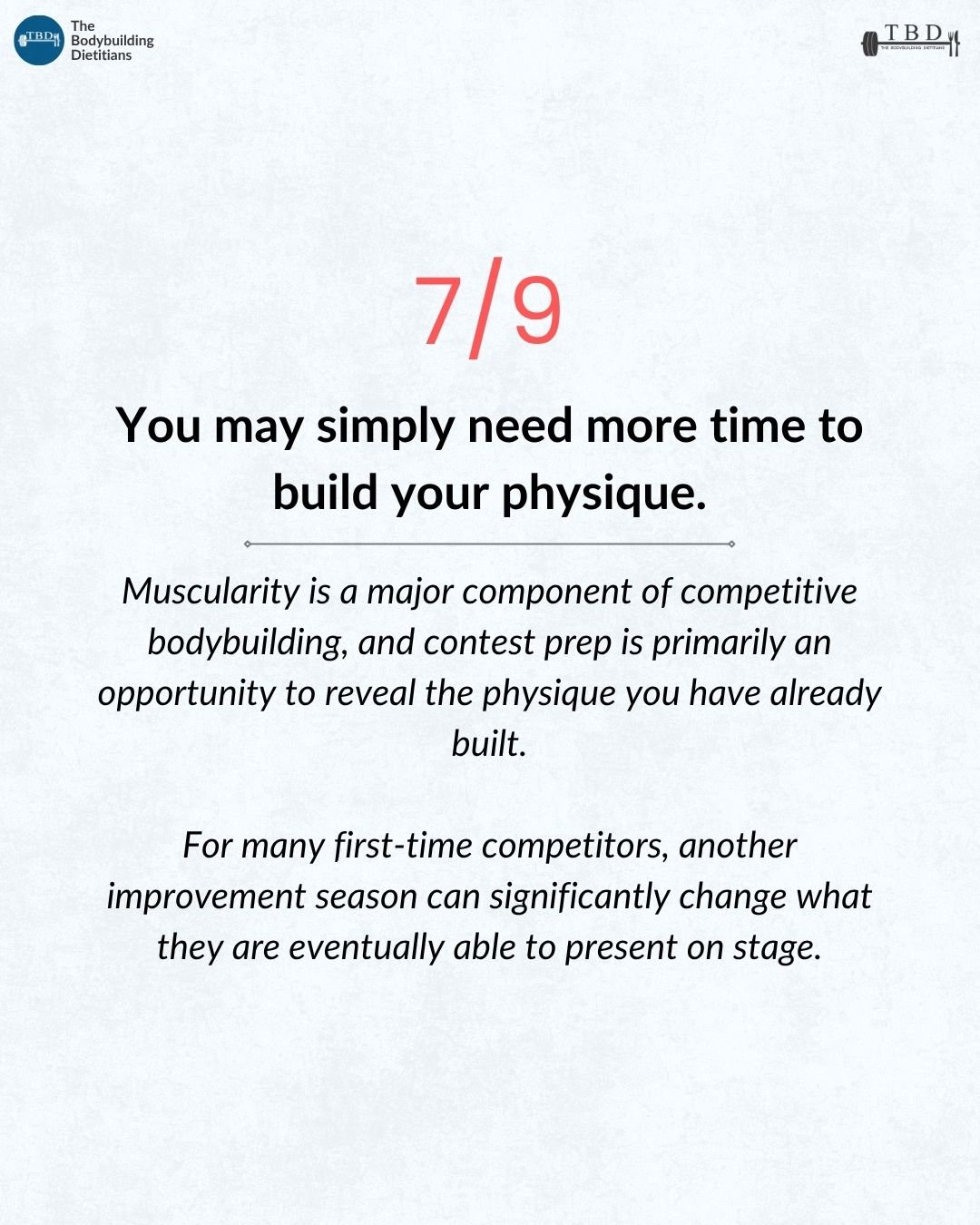
Have you built enough muscle to be competitive? Muscularity is a major component of competitive bodybuilding, and contest prep is primarily an opportunity to reveal the physique a competitor has already built. Prep doesn't build additional muscle during the prep itself. For many first-time competitors, the honest assessment is that another improvement season would significantly change what they are able to present on stage. Competing at a muscle base that's clearly below the competitive threshold in a given division produces a stage experience that reflects the physique gap regardless of how well the prep is executed.
The practical assessment is best done with a coach who can compare current condition to the standards of the division being considered. Photos taken in a lean but not stage-lean condition, at similar poses to the intended division, give a reasonable indication of how competitive the physique currently is. If the honest assessment is that another 12 to 18 months of dedicated muscle-building would meaningfully change the stage presentation, that time is almost always better spent than starting prep now.
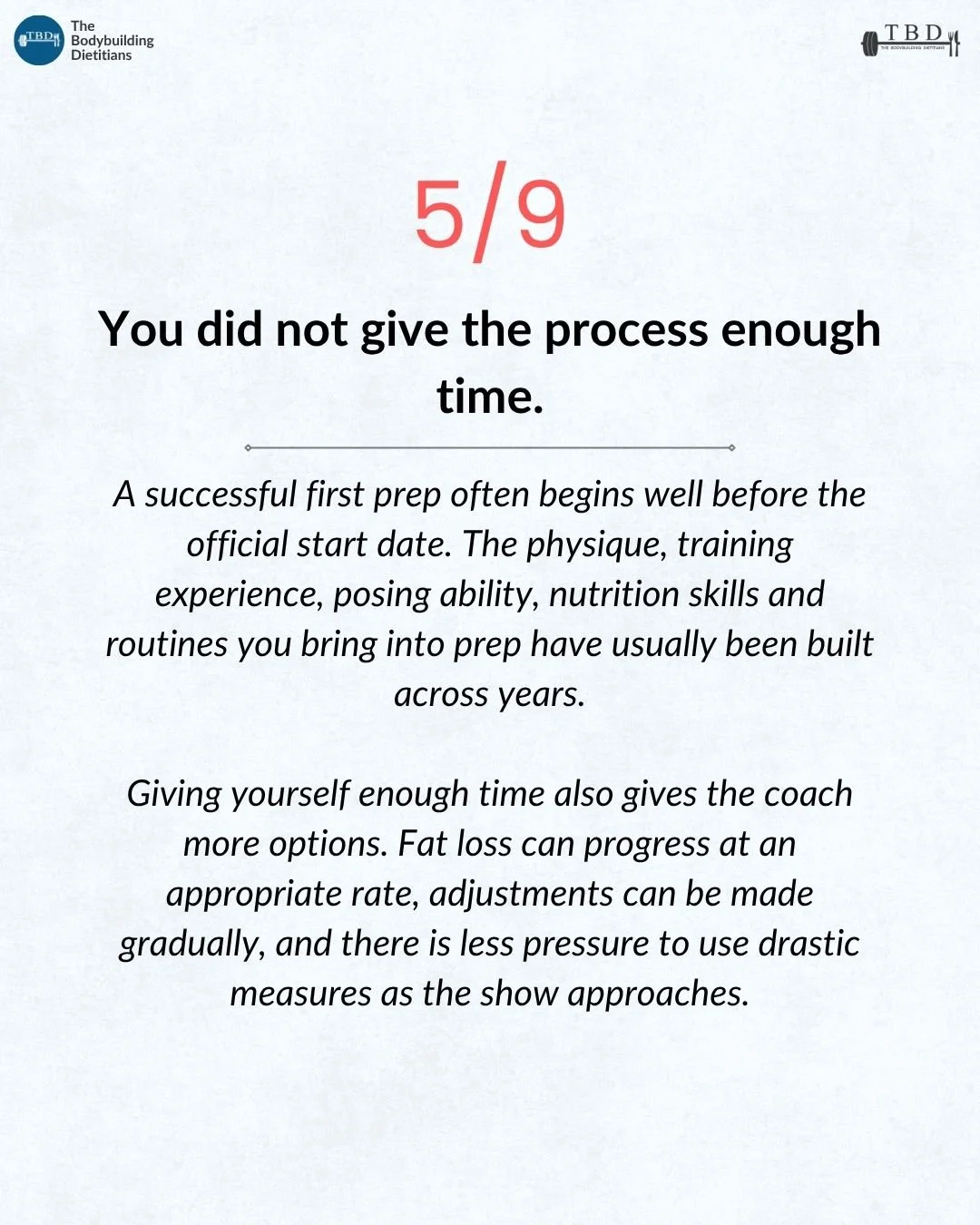
Have you given yourself enough time for the specific prep? A successful first prep often begins well before the official start date. The physique, training experience, posing ability, nutrition skills, and routines a competitor brings into prep have usually been built across years. Giving yourself enough time also gives the coach more options. Fat loss can progress at an appropriate rate, adjustments can be made gradually, and there is less pressure to use drastic measures as the show approaches.
Practical minimum timelines: for a competitor already reasonably lean (12 to 15 percent body fat for men, 22 to 25 percent for women) and with established fundamentals, 16 to 20 weeks tends to produce a manageable prep. For competitors starting less lean or with less established fundamentals, 24 to 30+ weeks is often needed to produce the same stage outcome without the harshness of an aggressive deficit in the final weeks. Compressed timelines force drastic adjustments in the final weeks that longer timelines simply don't require.
For a related look at the multi-phasic structure of a bodybuilding career and how prep fits within the longer arc of improvement seasons and competition, our article on bodybuilding phases covers the framework.
Behavioural Readiness: Established Fundamentals and Lifestyle Alignment
The second dimension of readiness is behavioural. Contest prep becomes considerably harder when every bodybuilding habit (training, sleep, nutrition) needs to be built at the same time as body fat is coming down. Prep is meaningfully easier when the fundamental behaviours already resemble the required prep behaviours before prep begins.
Are your training habits already at the level prep will require? This means consistent training four to six times per week, structured programming with progression, adequate technical execution across the compound lifts, and posing practice that has begun to develop the muscular control competitive presentation requires. A competitor whose current training is inconsistent or unstructured is being asked to develop training discipline at the same time as sustain a deficit, which is a much harder combined demand than sustaining a deficit while already having disciplined training in place.
Are your nutrition habits already at the level prep will require? This means the ability to track intake accurately when needed, consistency in meal timing and composition, adequate protein intake at every meal, and the practical skills of meal planning, food preparation, and eating according to the plan even when the food or the context isn't ideal. Competitors who haven't tracked before, or who eat inconsistently in normal life, are being asked to develop nutrition discipline while also managing the additional demands of prep.
Are your sleep and recovery habits already at the level prep will require? This means consistent sleep of 7 to 9 hours per night, sleep timing that supports morning training if that's the schedule, and stress management practices that fit around demanding weeks. Sleep restriction during prep meaningfully accelerates the negative consequences of the deficit, and building sleep habits during prep is much harder than arriving with them already in place.
The specific test is a simple one: if you removed the calorie deficit from what a prep would require, would your current lifestyle resemble the training, nutrition, and recovery patterns the prep would demand? If yes, prep is adding one variable (the deficit) to an already-established base. If no, prep is asking you to build multiple habits and hold a deficit simultaneously, which is a substantially harder task.
The correction if the fundamentals aren't in place is an improvement season focused on building those specific patterns. Six to twelve months of consistent training, nutrition, and sleep habits before starting prep tends to produce a meaningfully different prep experience than starting prep with those habits still under development.
Psychological Readiness: Your Why, Body Image, and Food Relationship
The third dimension of readiness is psychological. Three specific areas warrant honest assessment.
Is your "why" for competing personal and strong enough? Contest prep asks a lot from someone for a relatively brief moment on stage, so having a personally meaningful reason for doing it matters. For some competitors, that is the challenge of seeing what they are capable of. For others, it is the pursuit of improvement, the competition itself, or experiencing the sport at a higher level. For others still, it is the discipline and structure the process provides.
Whatever the specific reason, it should still make sense when tired, hungry, and many weeks away from show day. A "why" that depends on external validation, comparison to others, or how you happen to feel on any given day will not reliably sustain prep through its hardest weeks. A "why" that connects to something personally meaningful, that you would still stand by even if no one else was watching, tends to be the kind that holds up.
The specific test is whether the reason for competing would still be compelling to you if the show were held privately with no audience, no photos, no social media, and no external recognition. If the reason still makes sense in that framing, it is probably strong enough to sustain prep. If most of the reason depended on the external elements, the "why" may benefit from further development before committing to prep.
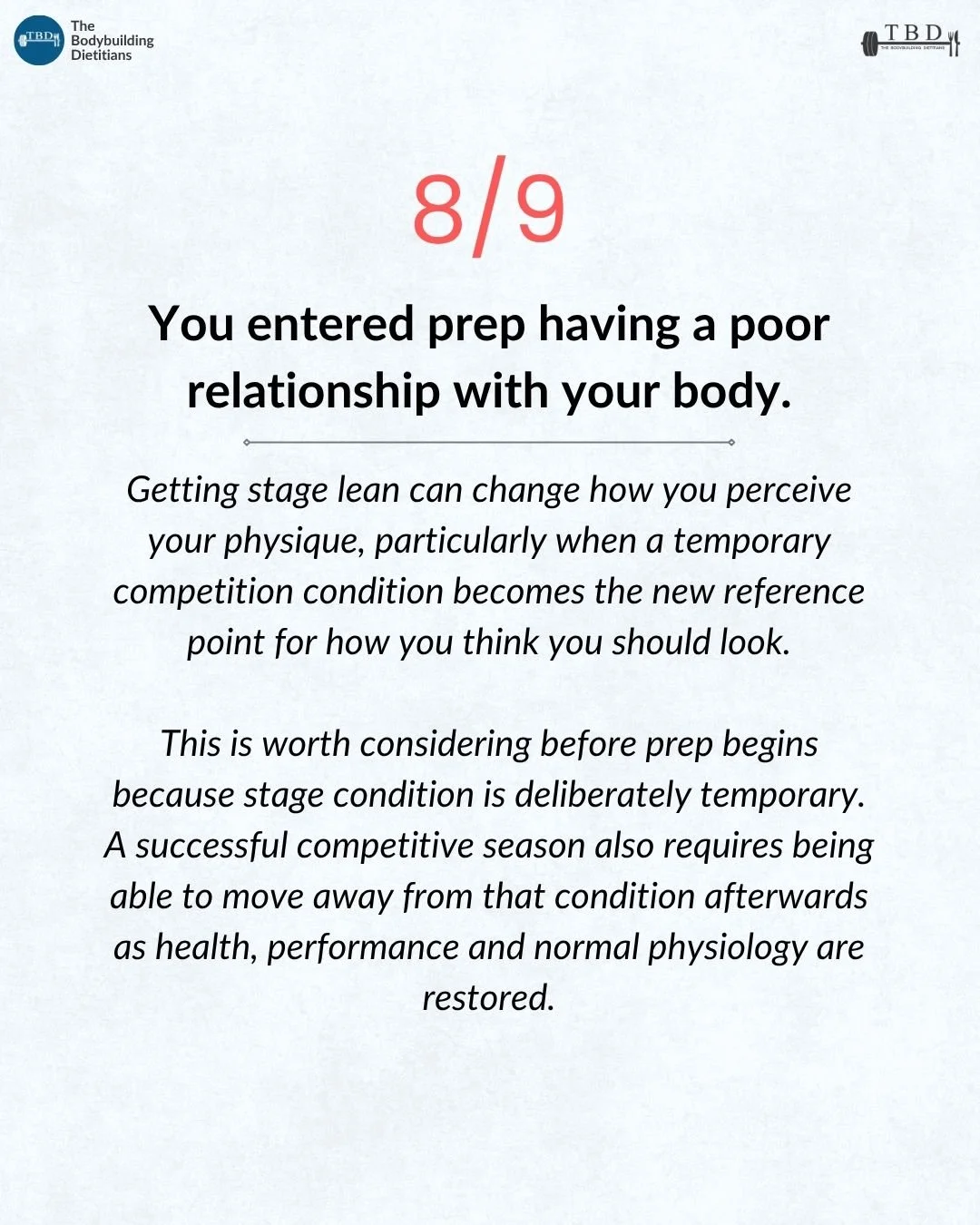
Is your relationship with your body stable enough for prep? Getting stage lean can change how a competitor perceives their physique, particularly when a temporary competition condition becomes the new reference point for how they think they should look. This is worth considering before prep begins because stage condition is deliberately temporary. A successful competitive season also requires being able to move away from that condition afterwards as health, performance, and normal physiology are restored.
Competitors with pre-existing body image concerns often find those concerns amplified rather than resolved by prep. The extreme leanness of stage condition can produce a genuine sense of accomplishment, but it can also create a new baseline expectation that becomes difficult to move away from post-show. Working through body image concerns before prep begins, ideally with a qualified mental health practitioner where the concerns are meaningful, produces substantially better long-term outcomes than trying to address them during or after prep.
Is your relationship with food stable enough for prep? Ideally, you have already learned how to manage an energy deficit, structure meals, respond to hunger, eat flexibly when appropriate, and return to normal eating patterns without every deviation feeling significant. Prep will place additional pressure on those skills as hunger and food focus increase. Developing them beforehand gives a much stronger foundation for both the diet itself and the transition out of it.
Competitors who arrive at prep with unstable food relationships (patterns of restriction and rebound, difficulty eating flexibly, food-related anxiety, or disordered eating tendencies) typically find those patterns intensified rather than managed by prep. The specific pressure of sustained restriction combined with body composition focus is challenging even for competitors with stable food relationships; it can be genuinely harmful for those without.
If any of the food-related concerns above resonate strongly with your current situation, working with a qualified mental health practitioner alongside your training and nutrition support is worthwhile before committing to prep. The professionals with expertise in disordered eating, sports psychology, and physique-focused populations can meaningfully shift outcomes for competitors navigating these patterns.
Relational Readiness: Communication and Support
The fourth dimension of readiness is relational. As fatigue increases across prep, changes in mood, availability, routine, and social flexibility can also affect the people around the competitor. Having conversations with partner, family, and close friends before the difficult stages of prep can make a meaningful difference.
The people around a competitor do not need to understand bodybuilding perfectly, but they benefit from understanding what the process may require from the competitor and how the competitor can continue showing up for those relationships throughout it. The specific conversations worth having before prep include: what will change about daily schedule and social availability, how mood and energy may shift during the harder weeks, what specific support would be helpful during that period, and what remains non-negotiable in the relationship regardless of prep demands.
The relational readiness question isn't whether the people around you approve of the goal (they don't need to). It's whether the important relationships have the communication structure to survive the specific demands prep will apply. Relationships that were already strained before prep tend to become more strained during prep, and prep is a genuinely difficult time to try to repair or rebuild them. Relationships that were solid and communicative before prep tend to remain solid through prep with appropriate ongoing communication.
For competitors with partners, the specific conversation about what prep will look like from the partner's perspective is often more valuable than any nutrition or training conversation. Partners typically bear a substantial share of the practical costs of prep (changes in shared meals, reduced social flexibility, mood shifts, reduced availability for family and household tasks), and their genuine understanding and support meaningfully affect how sustainable the prep is over the full timeline.
Practical Readiness: Understanding What Prep Actually Looks Like
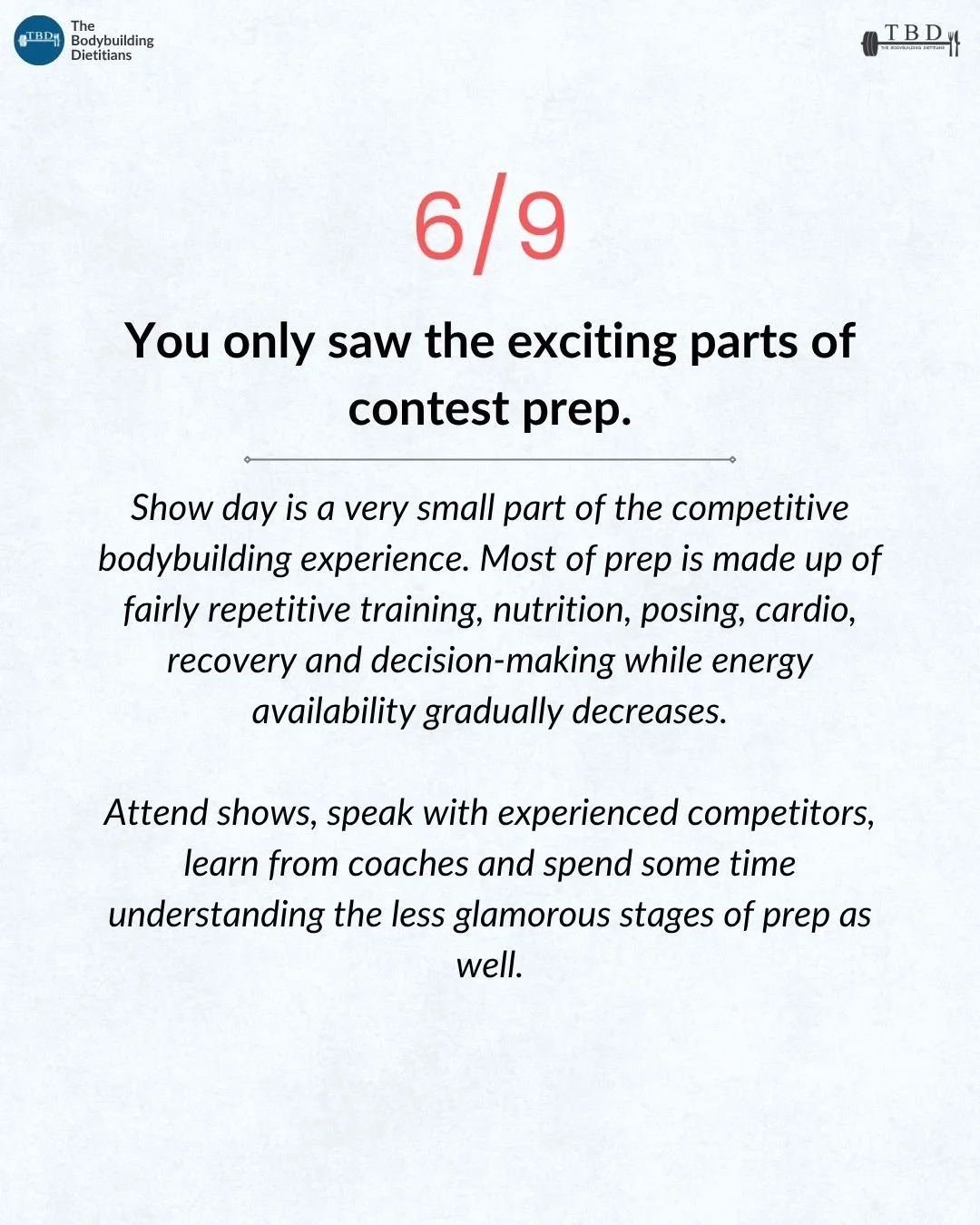
The fifth dimension of readiness is practical. Show day is a very small part of the competitive bodybuilding experience. Most of prep is made up of fairly repetitive training, nutrition, posing, cardio, recovery, and decision-making while energy availability gradually decreases.
Competitors who have only seen the exciting parts of prep (the show day photos, the peak week content, the moments of the physique looking impressive) tend to be surprised by the reality of the middle 12 to 16 weeks that make up most of the experience. The specific question worth answering before committing to prep is whether you have a realistic picture of what an average Tuesday in week 8 of prep actually looks like: a repetitive meal, a training session that feels harder than expected, cardio that has become tedious, posing practice that requires sustained effort, and the low-grade fatigue that becomes the background of the day.
The practical steps for building this realistic picture include: attending shows in person, ideally including some of the earlier lineups where the less-conditioned physiques are visible; speaking with experienced competitors about the middle weeks of prep specifically rather than the show day highlights; learning from coaches about the specific challenges and adjustments that emerge across a prep; and spending time understanding the less glamorous stages of the process before committing to it.
For competitors who complete this practical assessment and find that the realistic picture of prep doesn't fit their current life situation, life priorities, or personal preferences, the honest answer is that another year of improvement season while building the readiness for prep is often a better decision than starting prep now.
Not Sure How to Honestly Assess Your Own Readiness?
The five readiness dimensions above are difficult to assess honestly on your own. Most competitors either overestimate readiness (motivation feels convincing in the moment) or underestimate it (imposter syndrome and comparison to more established competitors can produce the opposite pattern). Working through a structured readiness assessment with a coach who has seen many first-time competitors provides a reference point that self-assessment often can't. This is exactly the kind of assessment we do with prospective competitors before their prep begins, matched to their specific division, timeline, and life context rather than assuming the same readiness bar applies to everyone.
How to Work Through the Readiness Questions Yourself
For competitors doing an initial self-assessment before working with a coach, several practical approaches make the process more useful.
Write down your honest answers to each dimension. The five readiness dimensions each contain 2 to 3 specific questions. Writing down your answers rather than thinking about them casually produces a more concrete assessment. If any of your written answers would be embarrassing to share with a coach, that's usually a signal that the specific area needs attention before prep.
Get external perspective on the physical readiness dimension. The muscle base question is the hardest to assess accurately from the inside. Photos taken in a lean condition, at similar poses to your intended division, shown to a coach or experienced competitor for honest assessment, gives you a reality check on whether the physique is currently at a competitive level for the division you're considering.
Take specific action on any dimension that isn't ready. If the fundamentals aren't in place, that's a specific improvement-season project (6 to 12 months of building consistent training, nutrition, and sleep habits before starting prep). If the "why" isn't clear, that's a specific reflection project (thinking through what would make competing personally meaningful rather than externally validated). If the food relationship isn't stable, that's a specific project involving a qualified professional. Each dimension has a clear next action if it isn't currently ready.
Give yourself a specific timeline for reassessment. Rather than deferring the decision indefinitely, set a specific reassessment point (typically 6 to 12 months out) where you'll revisit the readiness assessment against progress on the specific gaps identified. This turns "I'm not ready" from a permanent state into a plan with a timeline.
Recognise that delaying prep is often the productive decision. The competitors who make the most sustainable competitive careers are often the ones who delayed their first prep by a year or two to build a stronger foundation, not the ones who competed as soon as motivation appeared. First preps that go well produce competitors who want to continue in the sport. First preps that go poorly often produce competitors who don't compete again. The specific goal of the readiness assessment is to produce more of the former and fewer of the latter.
Practical Takeaways
Wanting to compete and being ready to compete are not always the same thing. Motivation for competing is acute and situational. Readiness reflects the accumulated foundations built across months or years before prep begins. Motivation surges and fades; readiness sustains prep through its hardest weeks.
The five dimensions of readiness worth assessing before committing to a prep are physical (adequate muscle base and enough time before the show), behavioural (established fundamentals in training, nutrition, sleep that already resemble the prep lifestyle), psychological (personally meaningful reason for competing plus stable relationship with body and food), relational (communication with partner, family, close friends about what prep will require), and practical (realistic understanding of what prep actually looks like day-to-day).
The specific behavioural test is whether removing the calorie deficit from what prep would require would leave a lifestyle that already resembles the training, nutrition, and recovery patterns prep demands. If yes, prep is adding one variable to an established base. If no, prep is asking you to build multiple habits and hold a deficit simultaneously.
The specific psychological test for the "why" is whether the reason for competing would still be compelling if the show were held privately with no audience or external recognition. A "why" that only makes sense with external validation typically won't sustain prep through its hardest weeks.
Competitors with pre-existing body image concerns or unstable food relationships typically find those patterns intensified rather than managed by prep. Working through these concerns with a qualified mental health practitioner before prep begins produces substantially better long-term outcomes than trying to address them during or after.
Delaying prep to build a stronger foundation is often the more productive decision than starting prep as soon as motivation appears. First preps that go well produce competitors who continue in the sport; first preps that go poorly often produce competitors who don't compete again.
Frequently Asked Questions
How do I know if I'm ready for my first bodybuilding show?
Readiness for a first show is separate from motivation. The five dimensions worth honestly assessing are: physical (adequate muscle base for the intended division, enough time before the show for the specific starting condition), behavioural (established training, nutrition, and sleep habits that already resemble the prep lifestyle), psychological (personally meaningful reason for competing, stable relationship with body and food), relational (communication with partner and family about what prep will require), and practical (realistic understanding of what prep looks like day-to-day rather than just show day). Competitors who arrive at prep with these foundations in place tend to move through prep meaningfully more smoothly than equally motivated competitors who skip the groundwork.
How much muscle do I need before competing?
The specific muscle base depends on the division and federation. For most physique divisions, competing at a muscle base clearly below the competitive threshold produces a stage experience that reflects the physique gap regardless of how well the prep is executed. Photos taken in a lean but not stage-lean condition, at similar poses to the intended division, and shown to a coach for honest assessment, provides a reasonable reality check. If the honest assessment is that another 12 to 18 months of dedicated muscle building would meaningfully change the stage presentation, that time is almost always better spent than starting prep now.
How long before a show should I start contest prep?
The minimum timeline depends on the starting condition and established fundamentals. For a competitor already reasonably lean (12 to 15 percent body fat for men, 22 to 25 percent for women) with established training and nutrition fundamentals, 16 to 20 weeks tends to produce a manageable prep. For competitors starting less lean or with less established fundamentals, 24 to 30+ weeks is often needed to produce the same stage outcome without harsh adjustments in the final weeks. Compressed timelines force drastic measures that longer timelines simply don't require.
What's the most important thing to have in place before contest prep?
The behavioural fundamentals (training, nutrition, sleep, and recovery habits that already resemble the prep lifestyle) are typically the most important pre-prep foundation. Prep becomes meaningfully harder when every bodybuilding habit needs to be built at the same time as body fat is coming down. Six to twelve months of consistent training, nutrition, and sleep habits before starting prep tends to produce a substantially different prep experience than starting prep with those habits still under development.
Should I wait to compete if my "why" isn't clear?
Yes. A "why" for competing that depends on how you feel on any given day, or on external validation, won't sustain prep through its hardest weeks. The specific test is whether your reason for competing would still be compelling if the show were held privately with no audience, no photos, and no social media. If the "why" still makes sense in that framing, it's probably strong enough. If most of the reason depended on external elements, spending more time developing a personally meaningful reason before committing to prep is worthwhile.
Can I do contest prep if I have body image concerns?
Prep intensifies pre-existing body image concerns rather than resolving them. Competitors with meaningful body image concerns typically benefit from working with a qualified mental health practitioner to address those concerns before committing to prep. The extreme leanness of stage condition can produce a genuine sense of accomplishment, but it can also create a new baseline expectation that becomes difficult to move away from post-show. Prep and post-show recovery are both meaningfully harder when body image concerns aren't being addressed alongside the physical process.
If you're considering competing and want a structured assessment of whether you're actually ready, matched to the specific division, timeline, and life context you're bringing to the decision, our team can work through the readiness dimensions with you before you commit to a prep. You can enquire about coaching or book a consultation with our team.