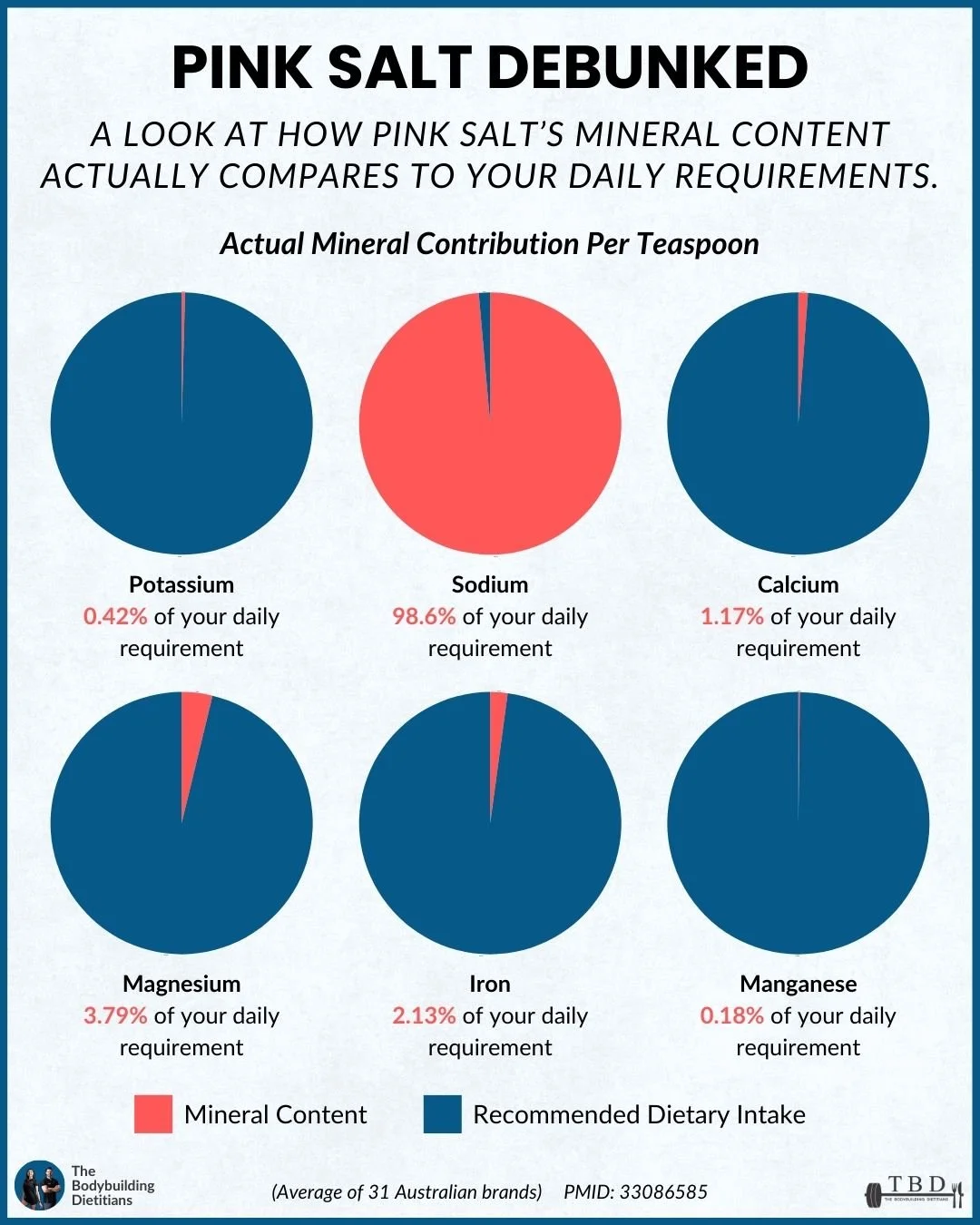
Pink salt is often marketed as a “nutrient-dense” alternative to regular table salt, rich in minerals, better for your health, and a simple nutritional upgrade. It sounds great on paper. But when we zoom in on the data, the story looks very different.
Pink salt is fantastic… at giving you salt.
When it comes to contributing meaningful amounts of essential minerals like potassium, magnesium, calcium, iron, or manganese, the reality is overwhelmingly underwhelming.
Trace Minerals ≠ Meaningful Intake
A common misunderstanding is the assumption that if a food contains a nutrient, it must therefore be a good source of that nutrient. But nutrition doesn’t work that way.
Pink salt contains trace amounts of 25+ minerals, which sounds impressive until you consider that your recommended daily salt intake is under 6 g per day.
Within that amount, the mineral contributions are tiny. The infographic summarises the findings from an analysis of 31 Australian pink salt brands (PMID: 33086585):
Potassium: 0.42% of your RDI
Magnesium: 3.79% of your RDI
Calcium: 1.17% of your RDI
Iron: 2.13% of your RDI
Manganese: 0.18% of your RDI
To meet your daily magnesium requirement from pink salt alone, you would need to consume so much sodium that you’d exceed safe upper limits many times over. In other words, you’d hit sodium toxicity long before meeting your mineral needs.
So yes, pink salt contains minerals, but no, it is not a meaningful contributor to your micronutrient intake.
The Iodine Problem
One of the biggest issues with pink salt is not what it contains, but what it doesn’t contain.
Pink salt is naturally very low in iodine and is almost never iodised. This matters because iodine is one of the few nutrients that:
Is difficult to obtain reliably from modern diets
Is essential for thyroid hormone production
Supports metabolic health, temperature regulation, and energy production
Is critical for fetal development, cognitive health, and growth
Iodised table salt is one of the most consistent and accessible iodine sources for the general population.
Switching entirely to pink salt without compensating elsewhere can increase the risk of iodine insufficiency, especially in people who do not consume dairy, seafood, or iodised bread regularly.
Can Pink Salt Still Be Used?
Absolutely.
Pink salt is perfectly fine to use for flavour, texture, preference, or enjoyment. If you like it, keep using it. Just recognise it for what it is:
✔ A seasoning
✘ Not a mineral supplement
Tiny mineral traces may add up over months or years, particularly for nutrients with very low daily needs, but the contributions for major minerals are negligible.
Practical Recommendations
1. Keep salt intake sensible (<6 g/day)
This aligns with international guidelines and supports cardiovascular, kidney, and metabolic health.
2. Use iodised salt as your household staple
You can still enjoy pink salt on meals, just ensure iodised salt is present somewhere in your weekly pattern.
3. Meet mineral needs through food, not seasoning
Magnesium from whole grains and nuts, potassium from fruits and vegetables, iron from meat and legumes, these are meaningful contributors, not decorative ones.
4. Supplement intentionally
If a deficiency or increased requirement is present, choose targeted supplementation rather than relying on salt varieties.
Final Thoughts
Pink salt isn’t harmful. It isn’t a scam. It isn’t something you need to avoid.
But it’s also not doing for you what many wellness influencers claim it does.
If you enjoy the flavour, colour, or aesthetic, go for it. Just don’t expect it to meaningfully support your mineral intake or iodine status.
Salt is a seasoning, not a multivitamin.
If you want clarity around your nutrition, minerals, supplements, or the evidence behind common health claims, we’re here to help. Our team specialises in evidence-based physique, health and performance nutrition, reach out below if you’d like personalised guidance tailored to your goals.