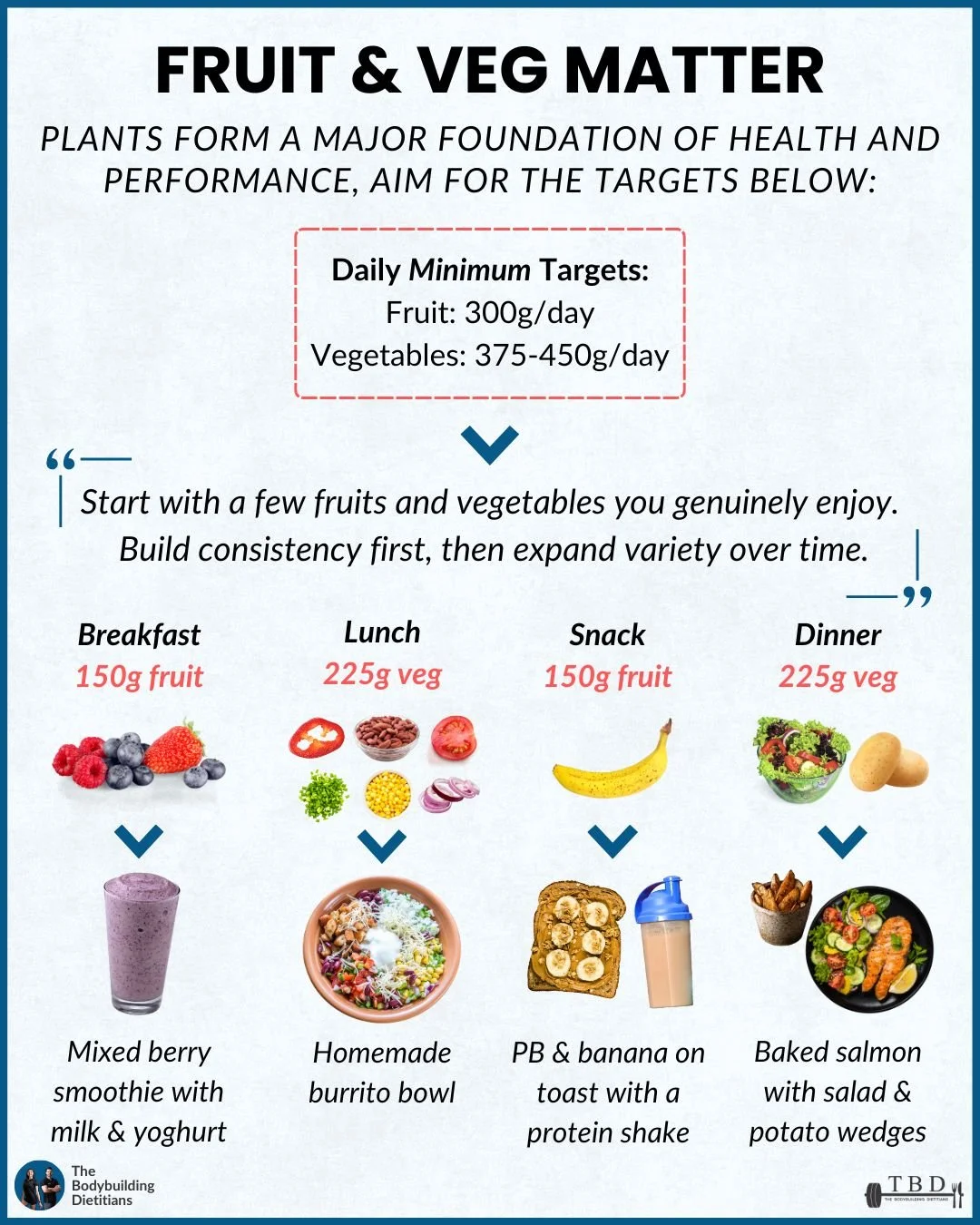
Fruit and Vegetables Aren’t Optional Extras, They’re Structural
Even among health-conscious lifters, fruit and vegetable intake is consistently underestimated.
Not because people don’t care about nutrition, but because plant foods are often treated as accessories to the diet rather than part of its structural base. Protein, calories, and macros tend to dominate attention, while fruit and vegetables are added opportunistically, if there’s room left on the plate.
From a physiological standpoint, this matters more than most athletes realise. Fruit and vegetables contribute far more than vitamins and minerals. They influence gut function through fibre and polyphenols, support immune and inflammatory regulation, affect appetite control, and help create the internal environment that allows training adaptations and recovery to actually occur. When intake is low, everything downstream tends to feel harder. Digestion is less predictable. Hunger is more volatile. Recovery feels slower. Energy is flatter.
In coaching practice, this often shows up indirectly. Athletes report feeling run down, overly food-focused, or inconsistently hungry. Training sessions feel harder to recover from. Adherence feels mentally heavier than it should. When intake is reviewed closely, fruit and vegetables are usually present, but not in amounts that meaningfully move the needle.
Scale and consistency are the real sticking points. A handful of spinach in a wrap or a garnish on a plate looks healthy, but it doesn’t provide enough fibre or plant compounds to have much physiological impact. Useful intakes tend to require deliberate portions, distributed across meals and snacks, repeated often enough that they become routine rather than effortful.
What’s important is that this doesn’t require perfection or extreme variety. In practice, starting with a small number of fruits and vegetables you genuinely enjoy, learning what realistic portions actually look like, and building meals around them tends to be far more effective than chasing novelty. Consistency beats diversity early on. Variety can expand later, once the foundation is in place.
Cost is another commonly cited barrier, but it’s rarely as limiting as it seems. Frozen vegetables, canned legumes, seasonal fruit, and simple preparation methods can make meeting intake targets far more accessible than people expect, without compromising nutritional value. For most athletes, the bigger challenge isn’t access, it’s prioritisation.
When health, performance, and longevity matter, fruit and vegetables deserve more attention than they typically receive. Not as a short-term fix or a wellness trend, but as a quiet, consistent contributor to how well everything else works. The athletes who treat plant foods as part of the structure of their diet, rather than an afterthought, tend to find that training, recovery, and appetite regulation become noticeably easier to manage over time.
Consistently hitting meaningful fruit and vegetable intake rarely happens by accident. It’s usually the result of deliberate meal structure, realistic portioning, and habits that are sustainable under training load.
If you want support building a nutrition framework that supports health, performance, and long-term consistency, our team will work closely with you to put these foundations in place in a way that actually fits real life.